
一、笔记大纲
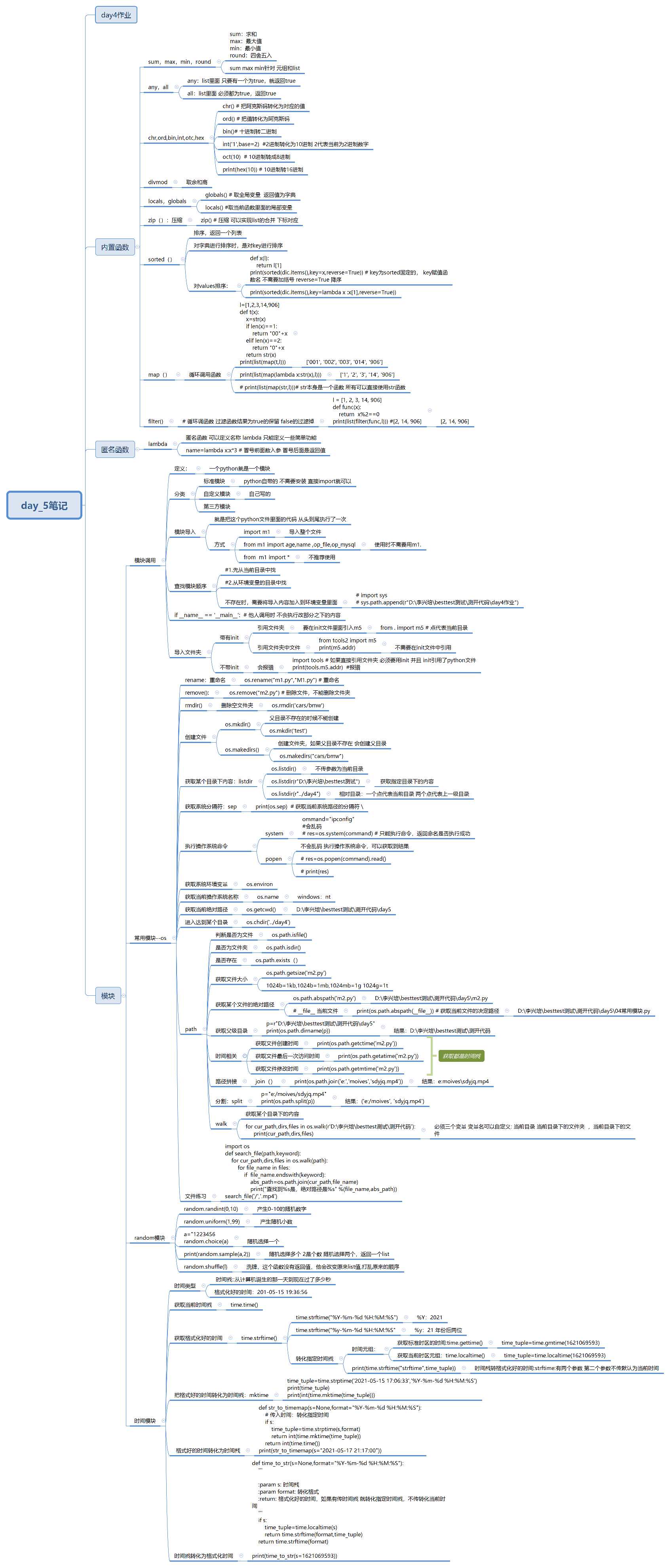
二、day4作业
2.1需求:
写一个商品管理的程序,数据在product.json 里面
1、4个功能,增、删、改、查
    1、新增
        输入 商品名称、价格、数量
        商品不存在才可以添加
        价格必须是大于0的整数/小数
        数量必须是大于0的整数
    2、查询
        如果输入的是all,那么print 所有商品的信息
        如果输入的是商品名称,打印某个商品的信息
        如果输入为的商品名称不存在,那么提示
    3、删除,输入商品名称,存在就删除
    4、修改
        输入 商品名称、价格、数量
        商品存在才可以修改
        价格必须是大于0的整数/小数
        数量必须是大于0的整数
choice = input("请输入你的选择:1、 查询商品 2新增产品 3修改商品新 4、删除商品 5、退出")
2.2代码:
import json
# 文件操作
FILE_NAME="product.json"
def op_file(file_name=FILE_NAME, content=None):
    with open(file_name,"a+",encoding="utf-8") as f:
        # 移动文件指针到最前面,原因为a+指针在文件末尾,操作时需要现将文件指针移动到开始位置
        f.seek(0)
        # 传入内容时: 为写操作
        if content:
            # 写操作需要现将原内容清空
            f.truncate()
            # 将content写入文件中
            json.dump(content,f)
        # 传入文件为空时,为读取操作
        else:
            content= f.read()
            #加强校验 防止空文件
            if content:
                return json.loads(content)
            # 文件为空时,返回一个空字典
            return {}
# 数字判断:大于0的正整数
def is_count(count):
    # 格式转化
    count=str(count)
    #是数字 并且大于0
    if count.isdigit() and int(count)>0:
        return True

# 判断价格:大于0的整数或者小数
def is_price(price):
    #格式转化
    price=str(price)
    # 判断是小数的情况
    if price.count(".")==1:
        left,right=price.split(".")
        # 小数点两边都是数字
        if left.isdigit() and right.isdigit():
            # 是小数时,判断是否为0.0的情况
            return float(price)>0
    # 判断是整数的情况,使用价格判断即可
    return is_count(price)
# 增加商品
def add():
    name=input("name:").strip()
    price=input("price:").strip()
    count=input("count:").strip()
    # 输入不能为空判断
    if not name or not price or not count:
        print("输入不能为空")
    # 价格判断
    elif not is_price(price):
        print("价格必须为大于0的数字")
    # 数量判断
    elif not is_count(count):
        print("数量必须为大于0的正整数")
    # 数量价格 检验成功后,判断商品是否存在
    else:
        # 读取到的是一个字典
        products = op_file()
        if name in products:
            print("商品已存在")
        else:
            # 将添加商品内容写入的字典中然后 在写入文件中
            products[name]={"price":float(price),"count":int(count)}
            op_file(content=products)
            print("添加成功")

# 编辑商品
def update():
    name = input("name:").strip()
    price = input("price:").strip()
    count = input("count:").strip()
    # 输入不能为空判断
    if not name or not price or not count:
        print("输入不能为空")
    # 价格判断
    elif not is_price(price):
        print("价格必须为大于0的数字")
    # 数量判断
    elif not is_count(count):
        print("数量必须为大于0的正整数")
    # 数量价格 检验成功后,判断商品是否存在
    else:
        # 读取到的是一个字典
        products = op_file()
        if name not in products:
            print("商品不存在")
        else:
            # 将编辑好的商品内容写入的字典中然后 在写入文件中
            products[name] = {"price": float(price), "count": int(count)}
            op_file(content=products)
            print("修改成功")
# 查找商品
def search():
    search_name=input("请输入要查找内容:").strip()
    if not search_name:
        print("商品名称不能为空")
    else:
        products = op_file()
        # 如果输入的是all,那么print所有商品的信息
        if search_name  =="all":
            print(products)
        elif search_name not in products:
            print("商品不存在")
        else:
            print(products[search_name])
# 删除商品
def delete():
    delete_name=input("请输入要删除商品名称:").strip()
    if not delete_name:
        print("商品名称不能为空")
    else:
        products = op_file()
        if delete_name not in products:
            print("商品不存在")
        else:
            # 删除指定商品
            products.pop(delete_name)
            # 删除后的字典重新写入
            op_file(content=products)
            print("删除成功")

# 调用函数 choice = input("请输入你的选择:1、 查询商品 2新增产品 3修改商品新 4、删除商品 5、退出")
def start():
    func_map={"1":search,"2":add,"3":update,"4":delete,"5":quit}
    while True:
        choice = input("请输入你的选择:1、查询商品 2、新增产品 3、修改商品新 4、删除商品 5、退出")
        if choice in func_map:
            func_map[choice]()
        else:
            print("操作不存在")
start()
三、内置函数
3.1sum,max,min,round:
sum,max,min:真对元组或者list
1.sum():求和
l=[1,2,3,333,434]
print(sum(l))
结果:773
2.max():求最大值
l=[1,2,3,333,434]
print(max(l))
结果:434
3.min():求最小值
l=[1,2,3,333,434]
print(min(l))
结果:1
4.round():四舍五入:
例:求平均数:
avg=sum(l)/len(l)
print(round(avg,2)) # 保留小数 2是小数格式 类型不变
3.2any,all
1.any():只要list里面有一个为true,结果就位true
print(any([False,False,False,True,[]]))
结果:True
2.all():list全部为true,结果才是true
print(all([True,True,True,True,[False]]))
结果:True
3.3阿克斯码转化
1.chr():把阿克斯码转化为对应的值
print(chr(65)) 结果:A
2.ord():把值转化为阿克斯码、
print(ord("A"))结果:65
3.阿克斯码对应表表:
https://www.cnblogs.com/biaochen/p/11307382.html
3.4十进制二进制转化
bin():十进制转化为二进制
print(bin(10)) 结果:1010 不需要看0b
int():二进制转化为十进制
print(int('1010',base=2)) #2进制转化为10进制 2代表当前为2进制数字
print(int('a',base=16)) # 16进制转10进制
oct()10进制转化为8机制
print(oct(10))
hex():10进制转化为16进制
print(hex(10))
3.5divmod():取商和余数
print(divmod(10,3)) # 取商和余的 (3, 1)
3.6局部变量,全局变量
1.locals():取当前函数的局部变量,返回值为字典
2.global():取全局变量,返回值为字典
name="abc"
def test():
    age=19
    addr="北京"
    print(locals())  #{'age': 19, 'addr': '北京'}
    print(globals())
test()
3.7zip()压缩:
1.实现list合并,对应下标
usernames=["admin","test","dev"]
passwords=['123','456',"678"]
print(list(zip(usernames,passwords)))
结果:[('admin', '123'), ('test', '456'), ('dev', '678')]
3.8排序:sorted():结果为list
1.字符串:
s='12345612'
print(sorted(s))
结果:['1', '1', '2', '2', '3', '4', '5', '6']
print("".join(sorted(s))) # 排序后转化为字符串,使用str方法 会将中括号也转 化
2.对字典按照value进行排序:
(1)排序key:、
dic={"admin":89,"test":100,"dev":77}
print(sorted(dic)) # 按照key排序
(2)对字典按照value进行排序:
dic={"admin":89,"test":100,"dev":77}
def x(l):
    return l[1]
print(sorted(dic.items(),key=x,reverse=True)) # key为sorted固定的, key赋值函数名 不需要加括号 reverse=True 降序
结果:[('test', 100), ('admin', 89), ('dev', 77)]

或者使用匿名函数:
print(sorted(dic.items(),key=lambda x :x[1],reverse=True))
(3)匿名函数:lambda:只能定义一些简单功能
name=lambda x:x*3 # 冒号前面数入参 冒号后面是返回值
print(name(5))
name=lambda x:x*3 # 冒号前面数入参 冒号后面是返回值
3.9循环调用
1.map():循环调用函数,保存到一个list里面,返回结果就是一个list
l=[1,2,3,14,906]
def t(x):
    x=str(x)
    if len(x)==1:
        return "00"+x
    elif len(x)==2:
        return "0"+x
    return str(x)
print(list(map(t,l)))
结果:['001', '002', '003', '014', '906']
或者使用匿名函数或者内置函数:
print(list(map(lambda x:str(x),l)))
print(list(map(str,l)))# str本身是一个函数 所有可以直接使用str函数
2.filter()循环调用函数,结果为true就保留,false就过滤掉
l = [1, 2, 3, 14, 906]
def func(x):
    return  x%2==0
print(list(filter(func,l))) #[2, 14, 906]
结果:[2, 14, 906]
如果使用map
print(list(map(func,l)))
结果:
[False, True, False, True, True]
四、模块
4.1模块介绍
1.定义:一个python就是一个模块
2.模块分类:
(1)标准模块:python自带的,不需要安装,可以直接引用
(2)自定义模块:自己写的python文件
(2)第三方模块:需要安装才能使用
3.模块导入:
(1)导入实质:就是将python文件中的代码从头到尾执行一遍
如果调用函数不想被执行,使用 if __name__=="__main__":
if __name__ == '__main__': # 他人调用时 不会执行改部分之下的内容
(2)查找模块的顺序:先从当前模块找,再从环境变量里面找
添加环境变量:
import sys
sys.path.append(r"D:\李兴培\besttest测试\测开代码\day4作业")  # 将day4加入到环境变量里面
import m3
print(m3.money) 结果:5000

注:m3代码为:
print(m3.money)
4.导入文件夹:实际上是执行了文件夹下的init文件
(1)导入文件夹时,需要保证文件夹下有init文件,并且在init中引用了对应的python文件
import tools2  # 执行了init
# 直接引用文件夹
print(tools2.m5.addr) # 要在init文件里面引入m5

init中:from . import m5 # 点代表当前目录
(2)直接导入文件夹中的文件
from tools2 import m5
print(m5.addr)
5.导入方式:
(1)导入整个文件:
import m1
(2)导入指定的变量
from m1 import age,name ,op_file,op_mysql# 不需要用点
(3)*号方式 不推荐使用
from m1 import *
4.2 os模块
1.rename,remove,rmdir,mkdir,makedirs
(1)os.rename()#重命名
os.rename("m1.py","M1.py") # 重命名 m1.py重命名为M1.py
(2)os.remove()# 删除文件,不能删除文件夹
os.remove("m2.py") # 删除文件,不能删除文件夹
(3)os.rmdir():删除空文件
os.rmdir('cars/bmw')
(4)创建文件
os.mkdir():父级目录不存在时不能创建
os.mkdir('test')
os.makedirs():父级目录不存在时会创建父级目录
os.makedirs("cars/bmw")
2.listdir,sep,system,popen,environ,name,getcwd,chdir
(1)os.listdir():获取某个目录下内容
print(os.listdir()) # 不传参数默认获取当前目录下文件
print(os.listdir(r"D:\李兴培\besttest测试")) # 获取指定目录下的内容:绝对路径
print(os.listdir(r"../day4")) # 一个点代表当前目录 两个点代表上一级目录
(2)os.sep():获取当前系统分隔符
print(os.sep) #\
(3)os.system():执行操作系统命令
command="ipconfig"
# 会乱吗
res=os.system(command) # 只能执行命令,返回命名是否执行成功
print(res) #0:成功 其他:失败
(4)os.popen()# 执行操作系统命令 返回结果,不会乱码
#  执行操作系统命令,可以获取到结果 所以打印不会乱码
res=os.popen(command).read()
print(res)
(5)os.environ:获取环境变量
print(os.environ) # 获取系统环境变量
(6)os.name:获取当前操作系统名称
print(os.name) # 当前从操作系统名称 nt
(7)os.getcwd():获取当前绝对路径
print(os.getcwd() )# 获取当前决对路径:D:\李兴培\besttest测试\测开代码\day5
(8)os.chdir():进入到某个目录
os.chdir('../day4') # 进入到day4目录
3.os.walk():获取某个目录下所有内容:当前目录,当前目录下的文件夹,当前目录下的文件:
4.os.path相关
(1)isfile,isdir,exists,
os.path.isfile():判断是否为文件
print(os.path.isfile('tools'))
os.path.isdir():判断是否为文件夹
print(os.path.isdir('m2.py'))
os.path.exists():判断是否存在
print(os.path.exists('a.txt'))
(2)getsize,abspath,dirname
os.path.getsize():获取文件大小,返回字节大小
print(os.path.getsize('m2.py'))
1024b=1kb,1024b=1mb,1024mb=1g 1024g=1t
os.path.abspath():获取某个文件的绝对路径
print(os.path.abspath('m2.py')) 结果:D:\李兴培\besttest测试\测开代码\day5\m2.py
# __file__ 当前文件
# print(os.path.abspath(__file__)) # 获取当前文件的决定路径
结果:D:\李兴培\besttest测试\测开代码\day5\04常用模块.py
os.path.dirname():获取父级目录
p=r"D:\李兴培\besttest测试\测开代码\day5"
print(os.path.dirname(p))
结果:D:\李兴培\besttest测试\测开代码
(3)getctime,getatime,getmtime:返回都是时间戳
os.path.getctime():获取文件创建时间
print(os.path.getctime('m2.py')) # 获取文件创建时间
结果:1621059414.377794
os.path.getatime():获取文件最后一次访问时间
print(os.path.getatime('m2.py')) #获取文件最后一次访问时间
结果:1621296817.1284304
os.path.getmtime():获取文件最后一次编辑时间
print(os.path.getmtime('m2.py'))
结果:1621296817.1284304
(4)join,split,walk
os.path.join():路径拼接
print(os.path.join('e:','moives','sdyjq.mp4')) #e:moives\sdyjq.mp4
os.path.split():路径分割
p="e:/moives/sdyjq.mp4"
print(os.path.split(p))# ('e:/moives', 'sdyjq.mp4')
5.文件练习:模糊查找文件
import os
def search_file(path,keyword):
    for cur_path,dirs,files in os.walk(path):
        for file_name in files:
            if  file_name.endswith(keyword):
                abs_path=os.path.join(cur_path,file_name)
                print("查找到%s是,绝对路径是%s" %(file_name,abs_path))
search_file('/','.mp4')
4.3random模块
1.产生随机数字
random.randint()
print(random.randint(10000,999999))
2,产生随机小数
random.uniform()
print(random.uniform(1,99))
3.随机选择一个
random.choice()
a="1223456"
print(random.choice(a))
4.随机选择多个
random.sample()
print(random.sample(a,2)) # 2代表选择个数
5.洗牌,没有返回值,会改变原来的值
random.shuffle()
l=[1,2,4,5,10,20,3]
random.shuffle(l)
print(l) #[5, 1, 10, 20, 4, 2, 3]
4.4时间模块
4.1时间格式
1.时间戳:从计算机诞生到现在过去了多少秒
2.格式化好的时间:2021-05-12 16:59:59
4.2获取时间戳
time.time()
print(int(time.time()))
4.3获取格式化时间
time.strftime("格式")
print(time.strftime("%Y-%m-%d %H:%M:%S")) #%Y 2021年份写全
print(time.strftime("%y-%m-%d %H:%M:%S")) #%y:年份后两位
4.4时间戳与格式化时间相互转化:
1、时间元组
(1)时间戳转化为时间元组
标准时区:time.gmtime(时间戳)
time_tuple=time.gmtime(1621069593)
当地时区:time.localtime(时间戳)
time_tuple=time.localtime(1621069593)
(2)格式化时间转化为时间元组
time.strptime("格式化好的时间","时间格式")
time_tuple=time.strptime('2021-05-15 17:06:33','%Y-%m-%d %H:%M:%S')
2.时间戳转化为格式化时间:time.strftime(格式,时间元组)
time_tuple=time.localtime(1621069593)
print(time.strftime("%Y-%m-%d %H:%M:%S",time_tuple))
函数写法:
# 时间戳转化为格式化好的时间
def time_to_str(timestame=None,format="%Y-%m-%d %H:%M:%S"):
    '''
       :param timestame: 时间戳
       :param format: 时间格式 %Y-%m-%d %H:%M:%S
       :return: 返回的是格式化好的时间,如果不传时间戳,那么返回当前的时间
    '''
    if timestame:
        time_tuple=time.localtime(timestame)
        return time.strftime(format,time_tuple)
    return time.strftime(format)
time_to_str(timestame=1621069593)
3.格式化好的时间转化为时间戳:tiime.mktime(时间元组)
print(int(time.mktime(time_tuple)))

函数写法:
# 格式好的时间转化为时间戳
def str_to_timestmap(s=None,format="%Y-%m-%d %H:%M:%S"):
    '''
    :param s: 格式化好的时间,比如2021-05-15 17:19:04
    :param format: 时间格式
    :return: 返回一个时间戳,如果不传是默认返回当前时间戳
    '''
    if s:
        time_tuple=time.strptime(s,format)
        return int(time.mktime(time_tuple))
    return int(time.time())

 浙公网安备 33010602011771号