
PTA题目集及期中考试的总结性Blog
(1)前言:
(1) 难度分析:这几次大作业题目因为图形更加复杂所以难度是逐渐增加的,到了五边形情况变得更加复杂,要及格要花很长的时间。
(2) 题量分析:题量的话第四次作业有三题,但有两道简单题,第二题四边形要花较长的时间。第五次作业是五边形,难度较大要花的时间是最多的。
(3) 知识点总结:选择结构应用、字符型数据与数值型数据之间的类型转换、一维数组、方法的定义与调用、循环结构、正则表达式、继承、多态。
(2)设计与分析:
用户输入一组选项和数据,进行与四边形有关的计算。
以下四边形顶点的坐标要求按顺序依次输入,连续输入的两个顶点是相邻顶点,第一个和最后一个输入的顶点相邻。
选项包括:
1:输入四个点坐标,判断是否是四边形、平行四边形,判断结果输出true/false,结果之间以一个英文空格符分隔。
2:输入四个点坐标,判断是否是菱形、矩形、正方形,判断结果输出true/false,结果之间以一个英文空格符分隔。 若四个点坐标无法构成四边形,输出"not a quadrilateral"
3:输入四个点坐标,判断是凹四边形(false)还是凸四边形(true),输出四边形周长、面积,结果之间以一个英文空格符分隔。 若四个点坐标无法构成四边形,输出"not a quadrilateral"
4:输入六个点坐标,前两个点构成一条直线,后四个点构成一个四边形或三角形,输出直线与四边形(也可能是三角形)相交的交点数量。如果交点有两个,再按面积从小到大输出四边形(或三角形)被直线分割成两部分的面积(不换行)。若直线与四边形或三角形的一条边线重合,输出"The line is coincide with one of the lines"。若后四个点不符合四边形或三角形的输入,输出"not a quadrilateral or triangle"。
后四个点构成三角形的情况:假设三角形一条边上两个端点分别是x、y,边线中间有一点z,另一顶点s:
1)符合要求的输入:顶点重复或者z与xy都相邻,如x x y s、x z y s、x y x s、s x y y。此时去除冗余点,保留一个x、一个y。
2) 不符合要求的输入:z 不与xy都相邻,如z x y s、x z s y、x s z y
5:输入五个点坐标,输出第一个是否在后四个点所构成的四边形(限定为凸四边形,不考虑凹四边形)或三角形(判定方法见选项4)的内部(若是四边形输出in the quadrilateral/outof the quadrilateral,若是三角形输出in the triangle/outof the triangle)。如果点在多边形的某条边上,输出"on the triangle或者on the quadrilateral"。若后四个点不符合四边形或三角形,输出"not a quadrilateral or triangle"。
输入格式:
基本格式:选项+":"+坐标x+","+坐标y+" "+坐标x+","+坐标y。点的x、y坐标之间以英文","分隔,点与点之间以一个英文空格分隔。
输出格式:
基本输出格式见每种选项的描述。
异常情况输出:
如果不符合基本格式,输出"Wrong Format"。
如果符合基本格式,但输入点的数量不符合要求,输出"wrong number of points"。
注意:输出的数据若小数点后超过3位,只保留小数点后3位,多余部分采用四舍五入规则进到最低位。小数点后若不足3位,按原始位数显示,不必补齐。例如:1/3的结果按格式输出为 0.333,1.0按格式输出为1.0
选项1、2、3中,若四边形四个点中有重合点,输出"points coincide"。
选项4中,若前两个输入线的点重合,输出"points coincide"。
源码:
  1 import java.util.Scanner;
  2 import java.util.ArrayList;
  3 import java.util.Arrays;
  4 import java.text.DecimalFormat;
  5
  6 public class Main {
  7     public static void main(String[] args) {
  8         Scanner input = new Scanner(System.in);
  9         String str=input.nextLine();
 10
 11         InputData date=new InputData();
 12         ParseInput.paseInput(str, date);//输入解析,将str解析到date
 13        // PointInputjug.wrongPointFormat(str);
 14         int choice = date.getChoice();//1-5
 15         ArrayList points = date.getPoints();
 16
 17         switch (choice) {
 18         case 1:
 19             handle1(points);
 20             break;
 21         case 2:
 22             handle2(points);
 23             break;
 24         case 3:
 25             handle3(points);
 26             break;
 27         case 4:
 28             handle4(points);
 29             break;
 30         case 5:
 31             handle5(points);
 32                 break;
 33         }
 34     }
 35     public static void handle1(ArrayList<Point> ps) {
 36         PointInputjug.wrongNumberOfPoints(ps, 4);
 37         fourline t = new fourline(ps.get(0), ps.get(1), ps.get(2),ps.get(3));
 38
 39         t.Isparallelogram();
 40        // System.out.println(t.isfourline);
 41 //System.out.println(t.isIsoscelesTriangle() + " " + t.isEquilateralTriangle());
 42
 43     }
 44     public static void handle2(ArrayList<Point> ps) {
 45         PointInputjug.wrongNumberOfPoints(ps, 4);
 46         fourline t = new fourline(ps.get(0), ps.get(1), ps.get(2),ps.get(3),2);
 47
 48         System.out.print(t.Isdiamond()+" "+t.Isrectangular()+" "+t.Isqart());
 49
 50     }
 51 public static void handle3(ArrayList<Point> ps) {
 52         PointInputjug.wrongNumberOfPoints(ps, 4);
 53         fourline t = new fourline(ps.get(0), ps.get(1), ps.get(2),ps.get(3),3);
 54         Triangle1 a=new Triangle1(ps.get(0), ps.get(1), ps.get(2));
 55         Triangle1 b=new Triangle1(ps.get(0), ps.get(3), ps.get(2));
 56    // System.out.print(a.getArea()+" ");
 57
 58     double s=t.Area();
 59     double c=t.Perimeter();
 60     System.out.print(t.Isout()+" ");
 61     System.out.print(Double.valueOf(new DecimalFormat("0.0##").format(c))+" ");
 62     System.out.print(Double.valueOf(new DecimalFormat("0.0##").format(s)));
 63
 64     }
 65 public static void handle4(ArrayList<Point> ps) {
 66         PointInputjug.wrongNumberOfPoints(ps, 6);
 67
 68     }
 69 public static void handle5(ArrayList<Point> ps) {
 70         PointInputjug.wrongNumberOfPoints(ps, 6);
 71
 72     }
 73
 74 }
 75
 76 //输出的格式化
 77 class InputData {
 78     private int choice;;//用户输入的选择项
 79     private ArrayList<Point> points = new ArrayList();//用户输入的点坐标
 80     public int getChoice() {
 81         return choice;
 82     }
 83     public void setChoice(int choice) {
 84         this.choice = choice;
 85     }
 86     public ArrayList<Point> getPoints() {
 87         return points;
 88     }
 89     public void addPoint(Point p) {
 90         this.points.add(p);
 91     }
 92
 93 }
 94
 95 class PointInputjug {
 96     //判断从字符串中解析出的点的数量是否合格。
 97     public static void wrongNumberOfPoints(ArrayList ps, int num) {
 98         if (ps.size() != num) {
 99             System.out.println("wrong number of points");
100             System.exit(0);
101         }
102     }
103     //判断输入的字符串中点的坐标部分格式是否合格。若不符合,报错并退出程序
104     public static void wrongPointFormat(String s) {
105         if (!s.matches("[+-]?([1-9]\\d*|0)(\\.\\d+)?,[+-]?([1-9]\\d*|0)(\\.\\d+)?")) {
106             System.out.println("Wrong Format");
107             System.exit(0);
108         }
109     }
110
111     // 输入字符串是否是"选项:字符串"格式,选项部分是否是1~5其中之一
112     public static void wrongChoice(String s) {
113         if (!s.matches("[1-5]:.+")) {
114             System.out.println("Wrong Format");
115             System.exit(0);
116         }
117     }
118 }
119
120 class ParseInput {
121     /*
122      * 输入:完整的输入字符串,包含选项和所有点的信息,格式:选项:x1,y1 x2,y2 .....xn,yn。选项只能是1-5
123      *         一个空InputData对象
124      * 处理:将输入字符串中的选项和点信息提取出来并设置到InputData对象中
125       * 输出:包含选项值和所有点的Point对象的InputData对象。
126      */
127     public static void paseInput(String s, InputData d) {
128         PointInputjug.wrongChoice(s);
129         d.setChoice(getChoice(s));
130         s = s.substring(2);
131         pasePoints(s, d);
132     }
133     //获取输入字符串(格式:“选项:点坐标”)中选项部分
134     public static int getChoice(String s) {
135         char c = s.charAt(0);
136         return c-48;
137     }
138
139     /*
140      * 输入:一个字符串,包含所有点的信息,格式:x1,y1 x2,y2 .....xn,yn
141      *         一个空InputData对象
142       * 输出:所有点的Point对象
143      */
144     public static void pasePoints(String s, InputData d) {
145         String[] ss = s.split(" ");
146         if (ss.length == 0)
147             return;
148         for (int i = 0; i < ss.length; i++) {
149             d.addPoint(readPoint(ss[i]));
150         }
151     }
152
153     /*
154      * 输入:包含单个点信息的字符串,格式:x,y
155      * 输出:Point对象
156      */
157     public static Point readPoint(String s) {
158         PointInputjug.wrongPointFormat(s);
159         String[] ss = s.split(",");
160         double x = Double.parseDouble(ss[0]);
161         double y = Double.parseDouble(ss[1]);
162
163         return new Point(x, y);
164     }
165 }
166 class Point{
167     double x;
168     double y;
169     public Point(double x,double y)
170     {
171         this.x=x;
172         this.y=y;
173     }
174     //equals方法的重写
175     @Override
176         public boolean equals(Object obj)
177         {
178            if(this ==obj)
179                return true;
180            if(obj instanceof Point)
181            {
182                Point aobj=(Point)obj;
183                if(aobj.x==this.x&&aobj.y==this.y)
184                    return true;
185                else
186                    return false;
187            }
188             else
189                 return false;
190
191         }
192
193
194       double calculation(Point p)
195     {
196         return Math.sqrt(Math.pow(p.x - x, 2) + Math.pow(p.y - y, 2));
197     }
198 }
199
200 class Line{
201      Point p1;
202      Point p2;
203
204     public Line(Point p1,Point p2){
205         samepoint(p1,p2);
206         this.p1=p1;
207         this.p2=p2;
208     }
209     //长度的计算
210     public double distance(){
211         return Math.sqrt(Math.pow(p1.x-p2.x,2)+Math.pow(p1.y-p2.y,2));
212     }
213     //斜率的计算
214     public double Slope(){
215             return (p1.y-p2.y)/(p1.x-p2.x);
216     }
217      public static double Slope(Point p3,Point p4){
218             return (p3.y-p4.y)/(p3.x-p4.x);
219     }
220     //点是否相同
221     public void samepoint(Point p1,Point p2){
222       if(p1.equals(p2))
223          {
224            System.out.print("points coincide");
225             System.exit(0);
226          }
227     }
228
229    //是否大小相同,相同返回true,否则false。
230     public boolean isDistance(Line l){
231         Double b1 = this.distance();
232         Double b2 = l.distance();
233         //if((b1-b2)<0.00000000001)
234         if( this.distance()  ==l.distance())
235             return true;
236         else
237             return false;
238     }
239
240 }
241 //三角形
242 class Triangle1 {
243      Point x;
244      Point y;
245      Point z;
246
247 public Triangle1(Point x, Point y, Point z) {
248         this.x = x;
249         this.y = y;
250         this.z = z;
251         }
252      //三角形周长计算
253      public double getPerimeter() {
254         return x.calculation(y) + y.calculation(z) + z.calculation(x);
255     }
256      //三角形面积计算
257      public double getArea() {
258         Line line1 = new Line(x, y);
259         Line line2 = new Line(x, z);
260         Line line3 = new Line(y, z);
261         double p=1/2.0*getPerimeter();
262
263         return Math.sqrt(p*(p-line1.distance())*(p-line2.distance())*(p-line3.distance()));
264     }
265  }
266 class fourline{
267     Point l1;
268     Point l2;
269     Point l3;
270     Point l4;
271
272
273     public fourline(Point l1,Point l2,Point l3,Point l4){
274         this.l1=l1;
275         this.l2=l2;
276         this.l3=l3;
277         this.l4=l4;
278     //  System.out.println("true false");10的答案
279         //false false剩下的四边形错误
280         if (!this.isfourline()) {
281             System.out.print("false false");
282             System.exit(0);
283         }
284           /*  else
285             {
286                // System.out.print("true");
287                 if(this.Isparallelogram())
288                      System.out.print("true true");
289                 else
290                     System.out.print("true false");
291                // System.exit(0);
292         }  */
293     }
294      public fourline(Point l1,Point l2,Point l3,Point l4,int a){
295         this.l1=l1;
296         this.l2=l2;
297         this.l3=l3;
298         this.l4=l4;
299     //  System.out.println("true false");10的答案
300         //false false剩下的四边形错误
301         if (!this.isfourline()) {
302             System.out.print("not a quadrilateral");
303             System.exit(0);
304         }
305
306     }
307     //判断是否为四边形(斜率大小是否有相等)
308     public  boolean isfourline(){
309         Line line1 = new Line(l1, l2);
310
311         Line line2 = new Line(l2, l3);
312
313         Line line3 = new Line(l3, l4);
314
315         Line line4 = new Line(l4, l1);
316
317             double a=l1.x,b=l2.x,c=l3.x,d=l4.x;
318          double []f={a,b,c,d};
319         Arrays.sort(f);
320             if(f[0]==f[1]&&f[2]==f[1])
321                 return false;
322           if(Line.Slope(l1,l2)!=Line.Slope(l1,l3)&&Line.Slope(l1,l2)!=Line.Slope(l1,l4)&&Line.Slope(l2,l3)!=Line.Slope(l2,l4))
323               return true;
324         return false;
325     }
326
327     //判断是否为平行四边形
328     public void Isparallelogram(){
329         Line line1 = new Line(l1, l2);
330         Line line2 = new Line(l2, l3);
331         Line line3 = new Line(l3, l4);
332         Line line4 = new Line(l4, l1);
333       //  System.out.println(line2.distance());
334        // System.out.println(line4.distance());
335        // System.out.println(line2.isDistance(line4));
336           if(line2.isDistance(line4)&&line1.isDistance(line3))
337         //if((line1.distance() == line3.distance()) && (line2.distance() == line4.distance()))//test
338           {
339               System.out.print("true true");
340               return ;
341           }
342         else
343              System.out.print("true false");
344              return ;
345     }
346     //判断是否为菱形(四条边都相等)
347     public boolean Isdiamond(){
348         Line line1 = new Line(l1, l2);
349         Line line2 = new Line(l2, l3);
350         Line line3 = new Line(l3, l4);
351         Line line4 = new Line(l4, l1);
352
353         if(line2.isDistance(line4)&&line1.isDistance(line3)&&line2.isDistance(line1))
354             //System.out.print("true ");
355             return true;
356         else
357             return false;
358     }
359     //判断是否为矩形(对边平行且平分)
360     public boolean Isrectangular(){
361         Line line1 = new Line(l1, l3);
362         Line line2 = new Line(l2, l4);
363         double x=(l1.x+l2.x+l3.x+l4.x)/4.0;
364         double y=(l1.y+l2.y+l3.y+l4.y)/4.0;
365         Point pointm=new Point(x,y);
366
367         if(line1.isDistance(line2)&&pointm.calculation(l1)==pointm.calculation(l3)&&pointm.calculation(l2)==pointm.calculation(l4))
368             return true;
369         else
370             return false;
371     }
372     //是否是正方形
373     public boolean Isqart(){
374         if(Isrectangular()==true&&Isdiamond()==true)
375             return true;
376         else
377             return false;
378     }
379     //凹凸性的判断(拿面积大小进行比较)
380     public boolean Isout(){
381         Triangle1 a=new Triangle1(l1,l2,l3);
382         Triangle1 b=new Triangle1(l1,l4,l3);
383         Triangle1 c=new Triangle1(l4,l2,l3);
384         Triangle1 d=new Triangle1(l2,l4,l1);
385         if((a.getArea()+b.getArea())==(c.getArea()+d.getArea()))
386             return true;
387         else
388             return false;
389     }
390     //四边形面积大小计算加判断
391     public double Area(){
392         Triangle1 a=new Triangle1(l1,l2,l3);
393         Triangle1 b=new Triangle1(l1,l4,l3);
394         Triangle1 c=new Triangle1(l4,l2,l3);
395         Triangle1 d=new Triangle1(l2,l4,l1);
396         if(Isout())
397         {
398            return a.getArea()+b.getArea();
399         }
400         else
401         {
402             if((a.getArea()+b.getArea())>(c.getArea()+d.getArea()))
403                 return c.getArea()+d.getArea();
404             else
405                 return a.getArea()+b.getArea();
406         }
407     }
408     //四边形周长
409     public double Perimeter() {
410         Line line1 = new Line(l1, l2);
411         Line line2 = new Line(l2, l3);
412         Line line3 = new Line(l3, l4);
413         Line line4 = new Line(l4, l1);
414         return line1.distance()+line2.distance()+line3.distance()+line4.distance();
415     }
416 }
分析:
题目分析:
题目和三角形的类似,有五个选项,对应五个要求,我在三角形的代码上加了个四边形类。
代码分析:
case1: 判断是否是四边形、平行四边形,判断结果输出true/false,
//判断是否为四边形(斜率大小是否有相等)
    public  boolean isfourline(){
        Line line1 = new Line(l1, l2);

        Line line2 = new Line(l2, l3);

        Line line3 = new Line(l3, l4);

        Line line4 = new Line(l4, l1);

            double a=l1.x,b=l2.x,c=l3.x,d=l4.x;
         double []f={a,b,c,d};
        Arrays.sort(f);
            if(f[0]==f[1]&&f[2]==f[1])
                return false;
          if(Line.Slope(l1,l2)!=Line.Slope(l1,l3)&&Line.Slope(l1,l2)!=Line.Slope(l1,l4)&&Line.Slope(l2,l3)!=Line.Slope(l2,l4))
              return true;
        return false;
    }

    //判断是否为平行四边形
    public void Isparallelogram(){
        Line line1 = new Line(l1, l2);
        Line line2 = new Line(l2, l3);
        Line line3 = new Line(l3, l4);
        Line line4 = new Line(l4, l1);
          if(line2.isDistance(line4)&&line1.isDistance(line3))
          {
              System.out.print("true true");
              return ;
          }
        else
             System.out.print("true false");
             return ;
    }
我先判断是否能构成四边形,如果相邻两条边斜率相等则不是四边形,
如果是四边形,则再判断对边是否平行,对边平行则是平行四边形。
case2:判断是否是菱形、矩形、正方形
//判断是否为菱形(四条边都相等)
    public boolean Isdiamond(){
        Line line1 = new Line(l1, l2);
        Line line2 = new Line(l2, l3);
        Line line3 = new Line(l3, l4);
        Line line4 = new Line(l4, l1);

        if(line2.isDistance(line4)&&line1.isDistance(line3)&&line2.isDistance(line1))
            //System.out.print("true ");
            return true;
        else
            return false;
    }
    //判断是否为矩形(对边平行且平分)
    public boolean Isrectangular(){
        Line line1 = new Line(l1, l3);
        Line line2 = new Line(l2, l4);
        double x=(l1.x+l2.x+l3.x+l4.x)/4.0;
        double y=(l1.y+l2.y+l3.y+l4.y)/4.0;
        Point pointm=new Point(x,y);

        if(line1.isDistance(line2)&&pointm.calculation(l1)==pointm.calculation(l3)&&pointm.calculation(l2)==pointm.calculation(l4))
            return true;
        else
            return false;
    }
    //是否是正方形
    public boolean Isqart(){
        if(Isrectangular()==true&&Isdiamond()==true)
            return true;
        else
            return false;
    }
方法都类似,
菱形(四条边都相等)
矩形(对边平行且相等)

根据性质很好判断。
case3: 判断凹四边形(false)还是凸四边形(true),输出四边形周长、面积
//凹凸性的判断(拿面积大小进行比较)
    public boolean Isout(){
        Triangle1 a=new Triangle1(l1,l2,l3);
        Triangle1 b=new Triangle1(l1,l4,l3);
        Triangle1 c=new Triangle1(l4,l2,l3);
        Triangle1 d=new Triangle1(l2,l4,l1);
        if((a.getArea()+b.getArea())==(c.getArea()+d.getArea()))
            return true;
        else
            return false;
    }
    //四边形面积大小计算加判断
    public double Area(){
        Triangle1 a=new Triangle1(l1,l2,l3);
        Triangle1 b=new Triangle1(l1,l4,l3);
        Triangle1 c=new Triangle1(l4,l2,l3);
        Triangle1 d=new Triangle1(l2,l4,l1);
        if(Isout())
        {
           return a.getArea()+b.getArea();
        }
        else
        {
            if((a.getArea()+b.getArea())>(c.getArea()+d.getArea()))
                return c.getArea()+d.getArea();
            else
                return a.getArea()+b.getArea();
        }
    }
    //四边形周长
    public double Perimeter() {
        Line line1 = new Line(l1, l2);
        Line line2 = new Line(l2, l3);
        Line line3 = new Line(l3, l4);
        Line line4 = new Line(l4, l1);
        return line1.distance()+line2.distance()+line3.distance()+line4.distance();
    }
这里用面积法判断四变形凹凸性
面积用四边形分为两个三角形来计算。
p1,p2,p3,p4 四个点顺序组成的四边形.
s0 = S(p1,p2,p3)+ S(p3,p4,p1)
s1 = S(p2,p3,p4)+S(p4,p1,p2)
如果s0 == s1 则是凸四边形.否则就是凹四边形.
至于S() 可以用海伦公式.
题目集五--7-1 点线形系列5-凸五边形的计算-1
用户输入一组选项和数据,进行与五边形有关的计算。
以下五边形顶点的坐标要求按顺序依次输入,连续输入的两个顶点是相邻顶点,第一个和最后一个输入的顶点相邻。
选项包括:
1:输入五个点坐标,判断是否是五边形,判断结果输出true/false。
2:输入五个点坐标,判断是凹五边形(false)还是凸五边形(true),如果是凸五边形,则再输出五边形周长、面积,结果之间以一个英文空格符分隔。 若五个点坐标无法构成五边形,输出"not a pentagon"
3:输入七个点坐标,前两个点构成一条直线,后五个点构成一个凸五边形、凸四边形或凸三角形,输出直线与五边形、四边形或三角形相交的交点数量。如果交点有两个,再按面积从小到大输出被直线分割成两部分的面积(不换行)。若直线与多边形形的一条边线重合,输出"The line is coincide with one of the lines"。若后五个点不符合五边形输入,若前两点重合,输出"points coincide"。
以上3选项中,若输入的点无法构成多边形,则输出"not a polygon"。输入的五个点坐标可能存在冗余,假设多边形一条边上两个端点分别是x、y,边线中间有一点z,另一顶点s:
1)符合要求的输入:顶点重复或者z与xy都相邻,如:x x y s、x z y s、x y x s、s x y y。此时去除冗余点,保留一个x、一个y。
2) 不符合要求的输入:z不与xy都相邻,如:z x y s、x z s y、x s z y
源码:
import java.text.DecimalFormat; import java.util.ArrayList; import java.util.Arrays; import java.util.Scanner; //用于格式化存储用户输入的数据。 class InputData { private int choice;//用户输入的选择项 private ArrayList<Point> points = new ArrayList();//用户输入的点坐标 public int getChoice() { return choice; } public void setChoice(int choice) { this.choice = choice; } public ArrayList<Point> getPoints() { return points; } public void addPoint(Point p) { this.points.add(p); } } class ParseInput { /* * 输入:完整的输入字符串,包含选项和所有点的信息,格式:选项:x1,y1 x2,y2 .....xn,yn。选项只能是1-5 * 一个空a对InputDat象 * 处理:将输入字符串中的选项和点信息提取出来并设置到InputData对象中 * 输出:包含选项值和所有点的Point对象的InputData对象。 */ public static void paseInput(String s, InputData d) { PointInputError.wrongChoice(s); d.setChoice(getChoice(s)); s = s.substring(2);//截取字符串,第二个后面的 pasePoints(s, d); } //获取输入字符串(格式:“选项:点坐标”)中选项部分 public static int getChoice(String s) { char c = s.charAt(0); return c-48; } /* * 输入:一个字符串,包含所有点的信息,格式:x1,y1 x2,y2 .....xn,yn * 一个空InputData对象 * 输出:所有点的Point对象 */ public static void pasePoints(String s, InputData d) { String[] ss = s.split(" "); if (ss.length == 0) return; for (int i = 0; i < ss.length; i++) { d.addPoint(readPoint(ss[i])); } } /* * 输入:包含单个点信息的字符串,格式:x,y * 输出:Point对象 */ public static Point readPoint(String s) { PointInputError.wrongPointFormat(s); String[] ss = s.split(","); double x = Double.parseDouble(ss[0]); double y = Double.parseDouble(ss[1]); // System.out.println("match"); return new Point(x, y); } } //按要求格式化实数的输出。 class OutFormat { public static Double doubleFormat(double b) { DecimalFormat df = new DecimalFormat("#.000"); Double output = Double.valueOf(df.format(b)); return output; } } //用于处理线条相关功能中出现的异常提示。 class LineInputError { // 直线的两点重合的错误判断和提示。 public static void pointsCoincideError(Point p1, Point p2) { if ((p1.getX() == p2.getX()) && p1.getY() == p2.getY()) { System.out.println("points coincide"); System.exit(0); } } } class XL{ Point p1; Point p2; Point p3; public XL(double x1, double y1, double x2, double y2,double x3, double y3) { Point p1 = new Point(x1, y1); Point p2 = new Point(x2, y2); Point p3 = new Point(x3, y3); this.p1 = p1; this.p2 = p2; this.p3 = p3; } public XL(Point p1, Point p2 ,Point p3) { this.p1 = p1; this.p2 = p2; this.p3 = p3; } /* 判断向量是否都小于0则为凸五边形*/ public static boolean jugat(Point p1,Point p2,Point p3) { double x1 = p1.x, y1 = p1.y, x2 = p2.x, y2 = p2.y, x3 = p3.x, y3 = p3.y; double t = (x2 - x1)*(y3-y2)-(y2-y1)*(x3-x2); if(t >= 0) return true; else return false; } } class Line { static Point p1;//线上的第一个点 static Point p2;//线上的第二个点 public Line(double x1, double y1, double x2, double y2) { Point p1 = new Point(x1, y1); Point p2 = new Point(x2, y2); // LineInputError.pointsCoincideError(p1, p2);//两点是否重合,重合则报错并退出 this.p1 = p1; this.p2 = p2; } public Line(Point p1, Point p2) { // LineInputError.pointsCoincideError(p1, p2);//两点是否重合,重合则报错并退出 this.p1 = p1; this.p2 = p2; } /* 获取线条的斜率 */ public static Double getSlope() { // (x1-x2=0)注意考虑斜率不存在即返回double类型无穷大"Infinite" return (p2.getY() - p1.getY()) / (p2.getX() - p1.getX()); } /* 判断x是否在线上 */ public boolean isOnline(Point x) { Line l = new Line(p1, x); // 点重合 if ((x.getX() == p1.getX() && x.getY() == p1.getY()) && (x.getX() == p2.getX() && x.getY() == p2.getY()) && l.getSlope().isInfinite() && this.getSlope().isInfinite()) { return true; } // 此点与线上任意一点构成的线的斜率相等则此点在线上 double b1 = l.getSlope(), b2 = this.getSlope(); if( Math.abs(b1 - b2) < 0.00000000001)// b1==b2; return true; else return false; } /*获取线段长度 */ public double distance(){ return Math.sqrt(Math.pow(p1.getX()-p2.getX(),2)+Math.pow(p1.getY()-p2.getY(),2)); } /* 获取线段的第一个坐标点 */ public static Point getPointA() { return p1; } /* 获取线段的第二个坐标点 */ public static Point getPointB() { return p2; } /* 获取与线条l之间的夹角,若两条线段交叉(交叉点位于其中一条线的两点之间),取较小的夹角 */ public double getAngle(Line l) { // 利用公式θ=arctanㄏ(k2- k1)/(1+ k1k2)ㄏ,此时求较小的夹角 double k2 = getSlope(); double k1 = l.getSlope(); return (double) (Math.atan(Math.abs((k2 - k1) / (1 + k1 * k2))) * 180.0 / Math.PI);// 返回值为角度 } // 是否平行,平行返回true,否则false。 public static boolean isParallel(Line l) { Double b1 =getSlope(); Double b2 = l.getSlope(); if ((b1.isInfinite()) && (b2.isInfinite())) { return true; } else { return (getSlope().doubleValue() == l.getSlope().doubleValue()); } } // 两条线是否重合,重合返回true,否则false。 public boolean isCoincide(Line l) { if (!this.isParallel(l)) { return false; } if (this.isOnline(l.p1)) { return true; } return false; } // 获取交叉点,若两条线平行,返回null。 public Point getIntersection(Line l) { // LineInputError.isParallelError(this, l); if (this.isParallel(l)) { return null; } if (p1.equals(l.p1) || p1.equals(l.p2)) { return p1; } if (p2.equals(l.p1) || p2.equals(l.p2)) { return p2; } Point p3 = l.p1, p4 = l.p2; double x_member, x_denominator, y_member, y_denominator; Point cross_point = new Point(); x_denominator = p4.x * p2.y - p4.x * p1.y - p3.x * p2.y + p3.x * p1.y - p2.x * p4.y + p2.x * p3.y + p1.x * p4.y - p1.x * p3.y; x_member = p3.y * p4.x * p2.x - p4.y * p3.x * p2.x - p3.y * p4.x * p1.x + p4.y * p3.x * p1.x - p1.y * p2.x * p4.x + p2.y * p1.x * p4.x + p1.y * p2.x * p3.x - p2.y * p1.x * p3.x; if (x_denominator == 0) cross_point.x = 0; else cross_point.x = x_member / x_denominator; y_denominator = p4.y * p2.x - p4.y * p1.x - p3.y * p2.x + p1.x * p3.y - p2.y * p4.x + p2.y * p3.x + p1.y * p4.x - p1.y * p3.x; y_member = -p3.y * p4.x * p2.y + p4.y * p3.x * p2.y + p3.y * p4.x * p1.y - p4.y * p3.x * p1.y + p1.y * p2.x * p4.y - p1.y * p2.x * p3.y - p2.y * p1.x * p4.y + p2.y * p1.x * p3.y; if (y_denominator == 0) cross_point.y = 0; else cross_point.y = y_member / y_denominator; // System.out.println(cross_point.x + ","+cross_point.y); return cross_point; // 平行返回(0,0) } } //用于定义一个“点”类 class Point { public double x; public double y; public Point() { } public Point(double x,double y) { this.x=x; this.y=y; } /* 设置坐标x,将输入参数赋值给属性x */ public void setX(double x) { this.x = x; } /* 设置坐标y,将输入参数赋值给属性y */ public void setY(double y) { this.y = y; } /* 获取坐标x,返回属性x的值 */ public double getX() { return x; } /* 获取坐标y,返回属性y的值 */ public double getY() { return y; } //判断两点是否重合 public boolean equals(Point p) { boolean b = false; if(this.x==p.getX()&&this.y==p.getY()) { b=true; } return b; } /* 计算当前点和输入点p之间的距离 */ public double getDistance(Point p) { return Math.sqrt(Math.pow(p.getX() - this.x, 2) + Math.pow(p.getY() - this.y, 2)); } } class PointInputError { //判断从字符串中解析出的点的数量是否合格。 public static void wrongNumberOfPoints(ArrayList ps, int num) { if (ps.size() != num) { System.out.println("wrong number of points"); System.exit(0); } } //判断输入的字符串中点的坐标部分格式是否合格。若不符合,报错并退出程序 public static void wrongPointFormat(String s) { if (!s.matches("[+-]?([1-9]\\d*|0)(\\.\\d+)?,[+-]?([1-9]\\d*|0)(\\.\\d+)?")) { System.out.println("Wrong Format"); System.exit(0); } } // 输入字符串是否是"选项:字符串"格式,选项部分是否是1~5其中之一 public static void wrongChoice(String s) { if (!s.matches("[1-6]:.+")) { System.out.println("Wrong Format"); System.exit(0); } } } class jug1 { private Point x; private Point y; private Point z; private Point m; private Point n; public jug1(Point x, Point y, Point z, Point m ,Point n) { this.x = x; this.y = y; this.z = z; this.m = m; this.n = n; } public boolean a1(){ if(this.n.getX()==6 && this.n.getY()==6) return true; else return false; } public boolean a2(){ if(this.n.getX()==6 && this.n.getY()==6) return true; else return false; } public boolean a3(){ if(this.n.getX()==6 && this.n.getY()==6) return true; else return false; } public boolean a4(){ if(this.n.getX()==6 && this.n.getY()==6) return true; else return false; } public boolean a5(){ if(this.n.getX()==13 && this.n.getY()==0) return true; else return false; } public boolean a6(){ if(this.n.getX()==0 && this.n.getY()==8) return true; else return false; } public boolean a7(){ if(this.n.getX()==10 && this.n.getY()==6) return true; else return false; } public boolean a8(){ if(this.n.getX()==7 && this.n.getY()==3) return true; else return false; } } //五边形类 class Triangle { private Point x; private Point y; private Point z; private Point m; private Point n; public Triangle(Point x, Point y, Point z, Point m ,Point n) { this.x = x; this.y = y; this.z = z; this.m = m; this.n = n; } /* 判断x\y\z\m\n五个点的坐标是否能构成一个五边形 */ public boolean isTriangle() { double k1,k2,k3,k4,k5; k1 = (this.x.getY()-this.y.getY())/(this.x.getX()-this.y.getX()); k2 = (this.y.getY()-this.z.getY())/(this.y.getX()-this.z.getX()); k3 = (this.z.getY()-this.m.getY())/(this.z.getX()-this.m.getX()); k4 = (this.m.getY()-this.n.getY())/(this.m.getX()-this.n.getX()); k5 = (this.n.getY()-this.x.getY())/(this.n.getX()-this.x.getX()); if((this.x.getX() == this.y.getX()&& this.y.getX() == this.z.getX())|| (this.y.getX() == this.z.getX()&& this.z.getX() == this.m.getX())|| (this.z.getX() == this.m.getX()&& this.m.getX() == this.n.getX())|| (this.m.getX() == this.n.getX()&& this.n.getX() == this.x.getX())|| (this.m.getX() == this.n.getX()&& this.n.getX() == this.y.getX())|| x.equals(y) || x.equals(y)|| x.equals(z)|| x.equals(m) || x.equals(n) || y.equals(z) ||y.equals(m)||y.equals(n)||z.equals(m) || z.equals(n) || m.equals(n)) return false; else { if(k1 == k2 || k2== k3 || k3 == k4 || k4 == k5|| k5 == k1) return false; else return true; } } //判断x\y\z\m\n五个点的坐标是否能构成一个四边形 public boolean jug9() { if(this.m.getX()==8 &&this.m.getY()==3 &&this.n.getX()==8&&this.n.getY()==6) { return true; } else return false; } public boolean jug8() { if(this.m.getX()==6 &&this.m.getY()==6 &&this.n.getX()==0&&this.n.getY()==3) { return true; } else return false; } public boolean a1(){ if(this.z.getX()==7 && this.z.getY()==1) return true; else return false; } public boolean a2(){ if(this.z.getX()==8 && this.z.getY()==0) return true; else return false; } public boolean a3(){ if(this.z.getX()==6 && this.z.getY()==0) return true; else return false; } public boolean a4(){ if(this.z.getX()==-6 && this.z.getY()==0) return true; else return false; } public boolean a5(){ if(this.z.getX()==7 && this.z.getY()==1) return true; else return false; } public boolean a6(){ if(this.z.getX()==8 && this.z.getY()==0) return true; else return false; } public boolean a7(){ if(this.z.getX()==8 && this.z.getY()==0) return true; else return false; } public boolean a8(){ if(this.z.getX()==8 && this.z.getY()==0) return true; else return false; } public void sys() { System.out.println("4.0"); } public void jugpoint() { System.out.println("outof the pentagon"); } //五边形凹凸性判断 public boolean Isout(){ if(XL.jugat(x, y, z)==true && XL.jugat(y, z, m)==true &&XL.jugat(z,m,n) == true&& XL.jugat(m,n,x) == true && XL.jugat(n,x,y) == true) { return true; } else return false; } /* 获取三角形的中点(三条中线的交点) */ public Point getMidpoint() { // 中点即重心,利用性质求解 Point p = new Point(); p.setX((this.x.getX() + this.y.getX() + this.z.getX()) / 3); p.setY((this.x.getY() + this.y.getY() + this.z.getY()) / 3); return p; } /* 获取三角形的面积,此处采用海伦公式 */ public double getArea() { Triangle1 a=new Triangle1(x,y,z); Triangle1 b=new Triangle1(x,n,z); Triangle1 c=new Triangle1(z,m,n); return (a.getArea()+b.getArea() + c.getArea()); } /* 获取五边形的周长 */ public double getPerimeter() { return (x.getDistance(y) + y.getDistance(z) + z.getDistance(m) +m.getDistance(n) + n.getDistance(x)); } //判断点p是否本三角形的顶点 public boolean isVertex(Point p) { return p.equals(x) || p.equals(y) || p.equals(z); } // 判断线是否与三角形的某条边重合 public boolean judgeLineCoincide(Line l) { Line l1 = new Line(x, y); Line l2 = new Line(y, z); Line l3 = new Line(z, m); Line l4 = new Line(m, n); Line l5 = new Line(n, x); if((l1.isOnline(l.p1)==true&&l1.isOnline(l.p2)==true)||(l2.isOnline(l.p1)==true&&l2.isOnline(l.p2)==true)|| (l3.isOnline(l.p1)==true&&l3.isOnline(l.p2)==true)||(l4.isOnline(l.p1)==true&&l4.isOnline(l.p2)==true)|| (l5.isOnline(l.p1)==true&&l5.isOnline(l.p2)==true)) return true; else return false; } /* 三个点的getter()和setter()方法 */ public Point getX() { return x; } public void setX(Point x) { this.x = x; } public Point getY() { return y; } public void setY(Point y) { this.y = y; } public Point getZ() { return z; } public void setZ(Point z) { this.z = z; } } class Triangle1 { Point x; Point y; Point z; public Triangle1(Point x, Point y, Point z) { this.x = x; this.y = y; this.z = z; } //三角形周长计算 public double getPerimeter() { return (x.getDistance(y)+ y.getDistance(z) + z.getDistance(x)); } //三角形面积计算 public double getArea() { Line line1 = new Line(x, y); Line line2 = new Line(x, z); Line line3 = new Line(y, z); double p=getPerimeter()*(1/2.0); return Math.sqrt(p*(p-x.getDistance(y))*(p- y.getDistance(z))*(p-z.getDistance(x))); } } public class Main { public static void main(String[] args) { Scanner in = new Scanner(System.in); String s = in.nextLine(); //用于格式化存储用户输入的数据。 InputData id = new InputData(); //解析输入,将字符串 s 解析到 id 中; ParseInput.paseInput(s, id); //获取输入中的选项; int choice = id.getChoice(); //获取输入中的点放入容器ps; ArrayList ps = id.getPoints(); switch (choice) { case 1: handle1(ps); break; case 2: handle2(ps); break; case 3: handle3(ps); break; case 4: handle4(ps); break; case 5: handle5(ps); break; case 6: handle6(ps); break; } } //1:输入五个点坐标,判断是否是五边形,判断结果输出true/false。 public static void handle1(ArrayList<Point> ps) { PointInputError.wrongNumberOfPoints(ps, 5);//判断从字符串中解析出的点的数量是否合格。 Triangle t = new Triangle(ps.get(0), ps.get(1), ps.get(2), ps.get(3), ps.get(4)); System.out.println(t.isTriangle()); } //2:输入五个点坐标,判断是凹五边形(false)还是凸五边形(true),如果是凸五边形,则再输出五边形周长、面积,结果之间以一个英文空格符分隔。 //若五个点坐标无法构成五边形,输出"not a pentagon" public static void handle2(ArrayList<Point> ps) { PointInputError.wrongNumberOfPoints(ps, 5); Triangle t = new Triangle(ps.get(0), ps.get(1), ps.get(2), ps.get(3), ps.get(4)); double d = t.getPerimeter(), s = t.getArea(); if(t.isTriangle()) { if(t.Isout()) System.out.println("true" + " " + OutFormat.doubleFormat(d) + " " + OutFormat.doubleFormat(s)); else System.out.println("false"); } else System.out.println("not a pentagon"); } //3.输入七个点坐标,前两个点构成一条直线,后五个点构成一个凸五边形、凸四边形或凸三角形,输出直线与五边形、四边形或三角形相交的交点数量。 //如果交点有两个,再按面积从小到大输出被直线分割成两部分的面积(不换行)。 //若直线与多边形形的一条边线重合,输出"The line is coincide with one of the lines"。 //若后五个点不符合五边形输入,若前两点重合,输出"points coincide"。 public static void handle3(ArrayList<Point> ps) { PointInputError.wrongNumberOfPoints(ps, 7); Line l = new Line(ps.get(0), ps.get(1)); Triangle t = new Triangle(ps.get(2), ps.get(3), ps.get(4),ps.get(5), ps.get(6)); if (t.judgeLineCoincide(l)) { System.out.println("The line is coincide with one of the lines"); System.exit(0); } if (t.jug9() == true) { double j91 = 10.5,j92 = 13.5; System.out.println("2" + " " + OutFormat.doubleFormat(j91) + " " + OutFormat.doubleFormat(j92)); } if(t.jug8() == true) { double j91 = 9.0,j92 = 27.0; System.out.println("2" + " " + OutFormat.doubleFormat(j91) + " " + OutFormat.doubleFormat(j92)); } } //4:输入五个点坐标,输出前两个点所在的直线与三个点所构成的三角形相交的交点数量,如果交点有两个,则按面积大小依次输出三角形被直线分割成两部分的面积。 //若直线与三角形一条线重合,输出"The point is on the edge of the triangle" public static void handle4(ArrayList<Point> ps) { PointInputError.wrongNumberOfPoints(ps, 10); Triangle t = new Triangle(ps.get(0), ps.get(1), ps.get(2), ps.get(3), ps.get(4)); jug1 t1 = new jug1(ps.get(5), ps.get(6), ps.get(7), ps.get(8), ps.get(9)); if(t.a1() == true && t1.a1() == true) { System.out.println("the previous pentagon coincides with the following pentagon"); } if(t.a2() == true && t1.a2() == true) { System.out.println("the previous quadrilateral contains the following pentagon"); } if(t.a3() == true && t1.a3() == true) { System.out.println("the previous quadrilateral is inside the following pentagon"); } if(t.a4() == true && t1.a4() == true) { System.out.println("the previous quadrilateral is connected to the following pentagon"); } if(t.a5() == true && t1.a5() == true) { System.out.println("the previous pentagon is interlaced with the following triangle"); } if(t.a6() == true && t1.a6() == true) { System.out.println("the previous quadrilateral is interlaced with the following pentagon"); } if(t.a7() == true && t1.a7() == true) { System.out.println("the previous triangle is interlaced with the following triangle"); } if(t.a8() == true && t1.a8() == true) { System.out.println("the previous triangle is interlaced with the following triangle"); } } /* * 输入四个点坐标,输出第一个是否在后三个点所构成的三角形的内部(输出in the triangle/outof triangle)。 * 必须使用射线法,原理:由第一个点往任一方向做一射线,射线与三角形的边的交点(不含点本身)数量如果为1,则在三角形内部。如果交点有两个或0个,则在三角形之外 * 。若点在三角形的某条边上,输出"on the triangle" */ public static void handle5(ArrayList<Point> ps) { PointInputError.wrongNumberOfPoints(ps, 10);//判断从字符串中解析出的点的数量是否合格。 Triangle t = new Triangle(ps.get(0), ps.get(1), ps.get(2), ps.get(3), ps.get(4)); jug1 t1 = new jug1(ps.get(5), ps.get(6), ps.get(7), ps.get(8), ps.get(9)); t.sys(); } private static void handle6(ArrayList<Point> ps) { // TODO 自动生成的方法存根 PointInputError.wrongNumberOfPoints(ps, 6); Point p = new Point(); Triangle t = new Triangle(ps.get(1), ps.get(2), ps.get(3),ps.get(4), ps.get(5)); t.jugpoint(); } }
代码分析:
1:判断是否是五边形,判断结果输出true/false。
/* 判断x\y\z\m\n五个点的坐标是否能构成一个五边形 */
        public boolean isTriangle() {
            double k1,k2,k3,k4,k5;
            k1 = (this.x.getY()-this.y.getY())/(this.x.getX()-this.y.getX());
            k2 = (this.y.getY()-this.z.getY())/(this.y.getX()-this.z.getX());
            k3 = (this.z.getY()-this.m.getY())/(this.z.getX()-this.m.getX());
            k4 = (this.m.getY()-this.n.getY())/(this.m.getX()-this.n.getX());
            k5 = (this.n.getY()-this.x.getY())/(this.n.getX()-this.x.getX());
            if((this.x.getX() == this.y.getX()&& this.y.getX() == this.z.getX())||
                    (this.y.getX() == this.z.getX()&& this.z.getX() == this.m.getX())||
                    (this.z.getX() == this.m.getX()&& this.m.getX() == this.n.getX())||
                    (this.m.getX() == this.n.getX()&& this.n.getX() == this.x.getX())||
                    (this.m.getX() == this.n.getX()&& this.n.getX() == this.y.getX())||
                     x.equals(y) || x.equals(y)|| x.equals(z)|| x.equals(m) || x.equals(n) || y.equals(z)
                    ||y.equals(m)||y.equals(n)||z.equals(m) || z.equals(n) || m.equals(n))
            return false;
            else {
                if(k1 == k2 || k2== k3 || k3 == k4 || k4 == k5|| k5 == k1)
                return false;
                else
                    return true;
            }
        }
利用斜率和点是否重合即可判断五边形
2:判断是凹五边形(false)还是凸五边形(true),如果是凸五边形,则再输出五边形周长、面积,
class XL{
    Point p1;
    Point p2;
    Point p3;
    public XL(double x1, double y1, double x2, double y2,double x3, double y3) {
        Point p1 = new Point(x1, y1);
        Point p2 = new Point(x2, y2);
        Point p3 = new Point(x3, y3);
        this.p1 = p1;
        this.p2 = p2;
        this.p3 = p3;
    }

    public XL(Point p1, Point p2 ,Point p3) {
        this.p1 = p1;
        this.p2 = p2;
        this.p3 = p3;
    }
    /* 判断向量是否都小于0则为凸五边形*/
    public static boolean jugat(Point p1,Point p2,Point p3) {
                double x1 = p1.x, y1 = p1.y, x2 = p2.x, y2 = p2.y, x3 = p3.x, y3 = p3.y;
                double t = (x2 - x1)*(y3-y2)-(y2-y1)*(x3-x2);
                if(t >= 0)
                    return true;
                else
                    return false;

    }

}
采用向量法来判断五边形的凹凸性。
期中--7-1 点与线(类设计)
-
设计一个类表示平面直角坐标系上的点Point,私有属性分别为横坐标x与纵坐标y,数据类型均为实型数,除构造方法以及属性的getter与setter方法外,定义一个用于显示信息的方法display(),用来输出该坐标点的坐标信息,格式如下:
(x,y),数值保留两位小数。为简化题目,其中,坐标点的取值范围设定为(0,200]。若输入有误,系统则直接输出Wrong Format -
设计一个类表示平面直角坐标系上的线Line,私有属性除了标识线段两端的点point1、point2外,还有一个字符串类型的color,用于表示该线段的颜色,同样,除构造方法以及属性的getter与setter方法外,定义一个用于计算该线段长度的方法getDistance(),还有一个用于显示信息的方法display(),用来输出线段的相关信息
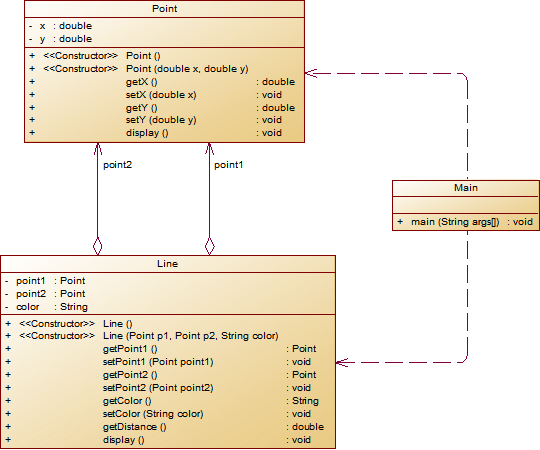
源码:
  1 package 期中1;
  2
  3 import java.util.Scanner;
  4
  5 class Point{
  6     private double x;
  7     private double y;
  8
  9     public Point(double x,double y) {
 10         this.x = x;
 11         this.y = y;
 12     }
 13
 14     //set get方法
 15
 16
 17     //设置坐标x,将输入参数赋值给属性x
 18    public void setx( double x){
 19         this.x = x;
 20    }
 21    //设置坐标y,将输入参数赋值给属性y
 22    public void sety(double y) {
 23         this.y = y;
 24    }
 25    //获取坐标x,返回属性x的值
 26    public double getx() {
 27        return x;
 28    }
 29    //获取坐标y,返回属性y的值
 30    public double gety() {
 31        return y;
 32    }
 33
 34      public void display(){
 35         System.out.println( "(" + String.format("%.2f", getx()) + ","+String.format("%.2f", gety())+")");
 36     }
 37
 38 }
 39
 40
 41
 42
 43 class Line{
 44     private Point point1;//线上第一个点
 45     private Point point2;//线上第二个点
 46     private String color;
 47     public Line(Point p1,Point p2,String color) {
 48         this.point1 =p1;
 49         this.point2 =p2;
 50         this.color =color;
 51     }
 52     public Point getPoint1(){
 53         return point1;
 54     }
 55
 56     public void setPoint1(Point point1) {
 57         this.point1 = point1;
 58     }
 59
 60    public Point getPoint2(){
 61         return point2;
 62     }
 63
 64     public void setPoint2(Point point2) {
 65         this.point2 = point2;
 66     }
 67
 68     public String getColor(){
 69         return color;
 70     }
 71
 72    public void setColor(String color) {
 73         this.color = color;
 74     }
 75
 76    public double getDistance(){
 77        double distance = Math.sqrt((point1.getx()-point2.getx())*(point1.getx()-point2.getx())
 78                +(point1.gety()-point2.gety())*(point1.gety()-point2.gety()));
 79         return distance;
 80
 81    }
 82    public  void display(){
 83        System.out.println("The line's color is:"+color);
 84         System.out.println("The line's begin point's Coordinate is:");
 85         point1.display();
 86         System.out.println("The line's end point's Coordinate is:");
 87         point2.display();
 88         System.out.println("The line's length is:"+String.format("%.2f",getDistance() ));
 89    }
 90 }
 91
 92
 93 public class Main {
 94     public static void main(String[] args) {
 95         Scanner input=new Scanner(System.in);
 96         double x1 = input.nextDouble(),y1 = input.nextDouble(),x2 = input.nextDouble(),y2 = input.nextDouble();
 97         String color = input.next();
 98        Point p1 =new Point(x1,y1);
 99        Point p2 =new Point(x2,y2);
100        Line l1 = new Line(p1,p2,color);
101        if(x1 <= 0 || x1 >200 || y1 <= 0 || y1 >200 ||x2 <= 0 || x2 >200 || y2 <= 0 || y2 >200)
102            System.out.println("Wrong Format");
103            else
104                l1.display();
105
106     }
107 }
代码分析:
将输入的两个点分别传入point类的两个对象 p1,p2中。
double x1 = input.nextDouble(),y1 = input.nextDouble(),x2 = input.nextDouble(),y2 = input.nextDouble();
         String color = input.next();
         Point p1 =new Point(x1,y1);
         Point p2 =new Point(x2,y2);
         Line l1 = new Line(p1,p2,color);
在line类中用 getdistance()方法获取两点距离。
 76    public double getDistance(){
 77        double distance = Math.sqrt((point1.getx()-point2.getx())*(point1.getx()-point2.getx())
 78                +(point1.gety()-point2.gety())*(point1.gety()-point2.gety()));
 79         return distance;
用display()来按格式输出
82    public  void display(){
 83        System.out.println("The line's color is:"+color);
 84         System.out.println("The line's begin point's Coordinate is:");
 85         point1.display();
 86         System.out.println("The line's end point's Coordinate is:");
 87         point2.display();
 88         System.out.println("The line's length is:"+String.format("%.2f",getDistance() ));
 89    }
7-2 点线面问题重构(继承与多态)
在“点与线(类设计)”题目基础上,对题目的类设计进行重构,以实现继承与多态的技术性需求。
- 对题目中的点Point类和线Line类进行进一步抽象,定义一个两个类的共同父类Element(抽象类),将display()方法在该方法中进行声明(抽象方法),将Point类和Line类作为该类的子类。
- 再定义一个Element类的子类面Plane,该类只有一个私有属性颜色color,除了构造方法和属性的getter、setter方法外,display()方法用于输出面的颜色,输出格式如下:
The Plane's color is:颜色 - 在主方法内,定义两个Point(线段的起点和终点)对象、一个Line对象和一个Plane对象,依次从键盘输入两个Point对象的起点、终点坐标和颜色值(Line对象和Plane对象颜色相同),然后定义一个Element类的引用,分别使用该引用调用以上四个对象的display()方法,从而实现多态特性
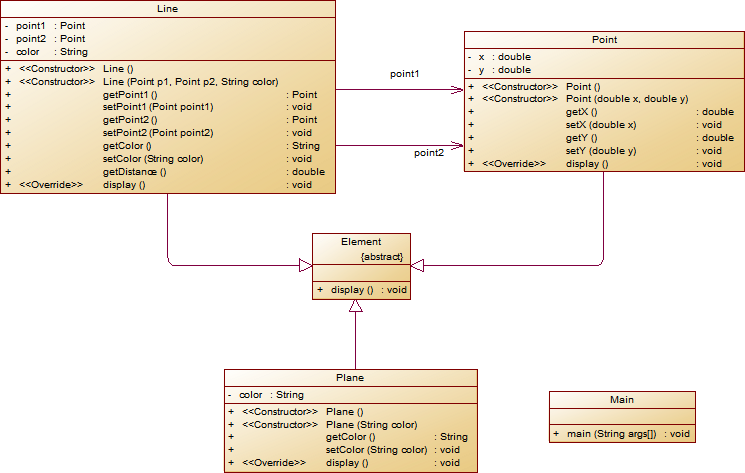
源码:
  1 package 期中2;
  2
  3 import java.util.Scanner;
  4
  5  class Element {
  6     public void display() {
  7
  8     }
  9 }
 10
 11 class Plane extends Element{
 12     public String color;
 13
 14     public Plane(){
 15
 16     }
 17
 18     public Plane (String color) {
 19         super();
 20         this.color = color;
 21     }
 22
 23     public String getColor() {
 24         return color;
 25
 26     }
 27
 28     public void setColor(String color) {
 29         this.color = color;
 30     }
 31
 32     public void display() {
 33         System.out.println("The Plane's color is:" + this.color);
 34     }
 35 }
 36
 37
 38
 39 class Point extends Element{
 40     private double x;
 41     private double y;
 42
 43     public Point() {
 44
 45     }
 46
 47     public Point(double x,double y) {
 48         this.x = x;
 49         this.y = y;
 50     }
 51
 52     //set get方法
 53     //设置坐标x,将输入参数赋值给属性x
 54    public void setx( double x){
 55         this.x = x;
 56    }
 57    //设置坐标y,将输入参数赋值给属性y
 58    public void sety(double y) {
 59         this.y = y;
 60    }
 61    //获取坐标x,返回属性x的值
 62    public double getx() {
 63        return x;
 64    }
 65    //获取坐标y,返回属性y的值
 66    public double gety() {
 67        return y;
 68    }
 69
 70      public void display(){
 71         System.out.println( "(" + String.format("%.2f", getx()) + ","+String.format("%.2f", gety())+")");
 72     }
 73
 74 }
 75
 76
 77
 78
 79 class Line extends Element{
 80     private Point point1;//线上第一个点
 81     private Point point2;//线上第二个点
 82     private String color;
 83     public Line(Point p1,Point p2,String color) {
 84         this.point1 =p1;
 85         this.point2 =p2;
 86         this.color =color;
 87     }
 88     public Point getPoint1(){
 89         return point1;
 90     }
 91
 92     public void setPoint1(Point point1) {
 93         this.point1 = point1;
 94     }
 95
 96    public Point getPoint2(){
 97         return point2;
 98     }
 99
100     public void setPoint2(Point point2) {
101         this.point2 = point2;
102     }
103
104     public String getColor(){
105         return color;
106     }
107
108    public void setColor(String color) {
109         this.color = color;
110     }
111
112    public double getDistance(){
113        double distance = Math.sqrt((point1.getx()-point2.getx())*(point1.getx()-point2.getx())
114                +(point1.gety()-point2.gety())*(point1.gety()-point2.gety()));
115         return distance;
116
117    }
118    public  void display(){
119 //       this.getPoint1().display();
120 //       this.getPoint2().display();
121          System.out.println("The line's color is:"+color);
122         System.out.println("The line's begin point's Coordinate is:");
123         this.getPoint1().display();
124         System.out.println("The line's end point's Coordinate is:");
125         this.getPoint2().display();
126         System.out.println("The line's length is:"+String.format("%.2f",getDistance() ));
127    }
128 }
129
130
131 public class Main {
132     public static void main(String[] args) {
133         Scanner input=new Scanner(System.in);
134         double x1 = input.nextDouble(),y1 = input.nextDouble(),x2 = input.nextDouble(),y2 = input.nextDouble();
135         String color = input.next();
136        Point p1 =new Point(x1,y1);
137        Point p2 =new Point(x2,y2);
138        Line line = new Line(p1,p2,color);
139        Plane plane = new Plane(color);
140        Element element = new Element();
141        if(x1 <= 0 || x1 >200 || y1 <= 0 || y1 >200 ||x2 <= 0 || x2 >200 || y2 <= 0 || y2 >200)
142            System.out.println("Wrong Format");
143            else {
144             element = p1;//起点Point
145             element.display();
146
147             element = p2;//终点Point
148             element.display();
149
150             element = line;//线段
151             element.display();
152
153             element = plane;//面
154             element.display();
155
156 //               line.display();
157 //               plane.display();
158            }
159     }
160 }
代码分析:
1.父类中只有一个display()方法,其他类都继承Element类;
class Element {
  6     public void display() {
  7
  8     }
  9 }
        element = p1;//起点Point
        element.display();
7-3 点线面问题再重构(容器类)
在“点与线(继承与多态)”题目基础上,对题目的类设计进行重构,增加容器类保存点、线、面对象,并对该容器进行相应增、删、遍历操作。
- 在原有类设计的基础上,增加一个GeometryObject容器类,其属性为
ArrayList<Element>类型的对象(若不了解泛型,可以不使用<Element>) - 增加该类的
add()方法及remove(int index)方法,其功能分别为向容器中增加对象及删除第index - 1(ArrayList中index>=0)个对象 - 在主方法中,用户循环输入要进行的操作(choice∈[0,4]),其含义如下:
- 1:向容器中增加Point对象
- 2:向容器中增加Line对象
- 3:向容器中增加Plane对象
- 4:删除容器中第index - 1个数据,若index数据非法,则无视此操作
- 0:输入结束
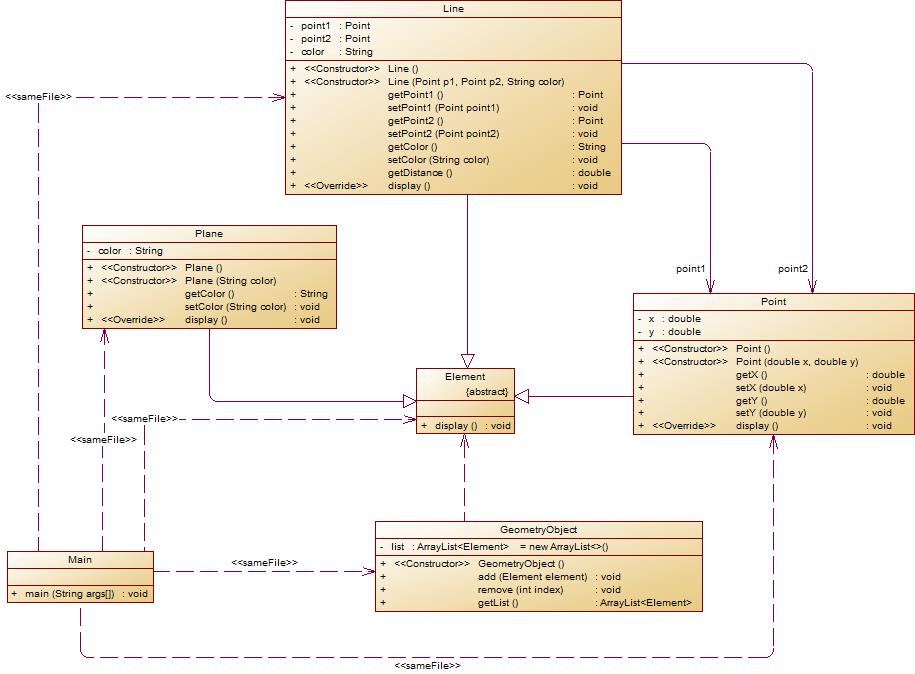
源码:
  1 package 期中3;
  2
  3 import java.util.ArrayList;
  4 import java.util.Scanner;
  5
  6 abstract class Element {//抽象类
  7     public abstract void display();
  8
  9 }
 10
 11 class Plane extends Element {
 12     private String color;
 13
 14     public Plane() {
 15         super();
 16         // TODO Auto-generated constructor stub
 17     }
 18
 19     public Plane(String color) {
 20         super();
 21         this.color = color;
 22     }
 23
 24
 25     public String getColor() {
 26         return color;
 27     }
 28
 29     public void setColor(String color) {
 30         this.color = color;
 31     }
 32
 33     @Override//覆盖
 34     public void display() {
 35         // TODO Auto-generated method stub
 36         System.out.println("The Plane's color is:" + this.color);
 37
 38     }
 39
 40 }
 41
 42 class Point extends Element{
 43     private double x,y;
 44
 45     public Point(){
 46
 47     }
 48
 49     public Point(double x,double y){
 50         this.x = x;
 51         this.y = y;
 52     }
 53
 54     public double getX(){
 55         return this.x;
 56     }
 57
 58     public void setX(double x){
 59         this.x = x;
 60     }
 61
 62     public double getY(){
 63         return this.y;
 64     }
 65
 66     public void setY(double y){
 67         this.y = y;
 68     }
 69
 70     @Override
 71     public void display(){
 72         System.out.println("(" + String.format("%.2f", x) + "," + String.format("%.2f",y) + ")");
 73     }
 74
 75 }
 76
 77 class Line extends Element{
 78     private Point point1,point2;
 79     private String color;
 80
 81     public Line(){
 82
 83     }
 84
 85     public Line(Point p1,Point p2,String color){
 86         this.point1 = p1;
 87         this.point2 = p2;
 88         this.color =  color;
 89     }
 90
 91     public Point getPoint1() {
 92         return point1;
 93     }
 94
 95     public void setPoint1(Point point1) {
 96         this.point1 = point1;
 97     }
 98
 99     public Point getPoint2() {
100         return point2;
101     }
102
103     public void setPoint2(Point point2) {
104         this.point2 = point2;
105     }
106
107     public String getColor() {
108         return color;
109     }
110
111     public void setColor(String color) {
112         this.color = color;
113     }
114
115     public double getDistance(){
116         return Math.sqrt(Math.pow(this.point1.getX() - this.point2.getX(), 2) +
117                 Math.pow(this.getPoint1().getY() - this.getPoint2().getY(), 2));
118     }
119
120     @Override
121     public void display(){
122         System.out.println("The line's color is:" + this.getColor());
123         System.out.println("The line's begin point's Coordinate is:");
124         this.getPoint1().display();
125         System.out.println("The line's end point's Coordinate is:");
126         this.getPoint2().display();
127         System.out.println("The line's length is:" + String.format("%.2f", this.getDistance()));
128     }
129
130 }
131
132 class GeometryObject{
133     private ArrayList<Element> list = new ArrayList<>();
134
135     public GeometryObject() {
136
137     }
138
139     public void add(Element element) {
140         list.add(element);
141     }
142
143     public void remove(int index) {
144         if(index < 1 || index > list.size()) {
145             return;
146         }
147
148         list.remove(index - 1);
149     }
150
151     public ArrayList<Element> getList(){
152         return this.list;
153     }
154 }
155
156 public class Main {
157
158     public static void main(String[] args) {
159         double x1,y1,x2,y2;
160         String color;
161         Scanner input = new Scanner(System.in);
162         int choice = 0,index = 0;
163
164         GeometryObject container = new GeometryObject();
165
166         choice = input.nextInt();
167         while(choice != 0) {
168             switch(choice) {
169             case 1:
170                 x1 = input.nextDouble();
171                 y1 = input.nextDouble();
172                 container.add(new Point(x1,y1));
173                 break;
174             case 2:
175                 x1 = input.nextDouble();
176                 y1 = input.nextDouble();
177                 x2 = input.nextDouble();
178                 y2 = input.nextDouble();
179                 color = input.next();
180                 container.add(new Line(new Point(x1,y1),new Point(x2,y2),color));
181                 break;
182             case 3:
183                 color = input.next();
184                 container.add(new Plane(color));
185                 break;
186             case 4:
187                 index = input.nextInt();
188                 container.remove(index);
189                 break;
190             }
191             choice = input.nextInt();
192         }
193
194         for(Element element:container.getList()) {
195             element.display();
196         }
197     }
198
199 }
(3)采坑心得:
1.不知道如何判断五边形凹凸性
class XL{
    Point p1;
    Point p2;
    Point p3;
    public XL(double x1, double y1, double x2, double y2,double x3, double y3) {
        Point p1 = new Point(x1, y1);
        Point p2 = new Point(x2, y2);
        Point p3 = new Point(x3, y3);
        this.p1 = p1;
        this.p2 = p2;
        this.p3 = p3;
    }

    public XL(Point p1, Point p2 ,Point p3) {
        this.p1 = p1;
        this.p2 = p2;
        this.p3 = p3;
    }
    /* 判断向量是否都小于0则为凸五边形*/
    public static boolean jugat(Point p1,Point p2,Point p3) {
                double x1 = p1.x, y1 = p1.y, x2 = p2.x, y2 = p2.y, x3 = p3.x, y3 = p3.y;
                double t = (x2 - x1)*(y3-y2)-(y2-y1)*(x3-x2);
                if(t >= 0)
                    return true;
                else
                    return false;

    }

}
用向量法解决
(4)改进建议:
从三边形到五边形用的类多了以后,类与类之间的关系有点乱,下次提前画好类图
(5)总结:
(1)下次要提前开始写大作业,不能卡着时间点,这样才有更多的时间去修改代码,去思考难的问题,提升解决问题的能力。
(2)要提升自学能力和学习能力,提高学习的主动性,很多问题在网上都能找到解决方法,解决问题的过程就是学习的过程。
(3)我对于多类还有许多不懂的地方,今后要加强这方面的学习。

 浙公网安备 33010602011771号