

对RC4算法的单字节偏差攻击
RC4算法的实现:https://www.cnblogs.com/luminescence/p/19225698
单字节偏差分析
偏差分析理论基础
在理想的流密码中,密钥流应该与真正的随机序列不可区分。然而,RC4算法在特定条件下会产生可测量的统计偏差。
统计偏差定义
对于位置i和字节值v,定义偏差为:
其中,\(Pr[Z_i = v]\)表示在位置i处密钥流字节等于v的实际概率,\(\frac{1}{256}\)是期望的均匀分布概率。
偏差倍数
为了更直观地表示偏差强度,定义偏差倍数:
分析方法
数据收集
为了进行可靠的统计分析,需要收集大量独立的密钥流样本。本实验使用1,000,000个随机生成的16字节密钥,对每个密钥收集前256个密钥流字节。
统计检验
采用卡方检验(χ² test)评估每个位置字节分布的随机性。检验统计量为:
其中,\(O_v\)是字节值v的观察频数,\(E_v\)是期望频数。
显著性水平
由于进行了多重比较(256个位置×256个字节值),采用Bonferroni校正控制总体错误率。显著性水平设为:
Z值计算
为了量化每个字节值偏差的显著性,计算Z值:
Z值的绝对值越大,表明偏差越显著
实验结果与分析
实验设置
- 样本数量: 1,000,000个独立密钥
- 密钥长度: 16字节
- 分析范围: 前256个密钥流位置
- 显著性水平: α = 0.05/256 (Bonferroni校正)
全局统计结果
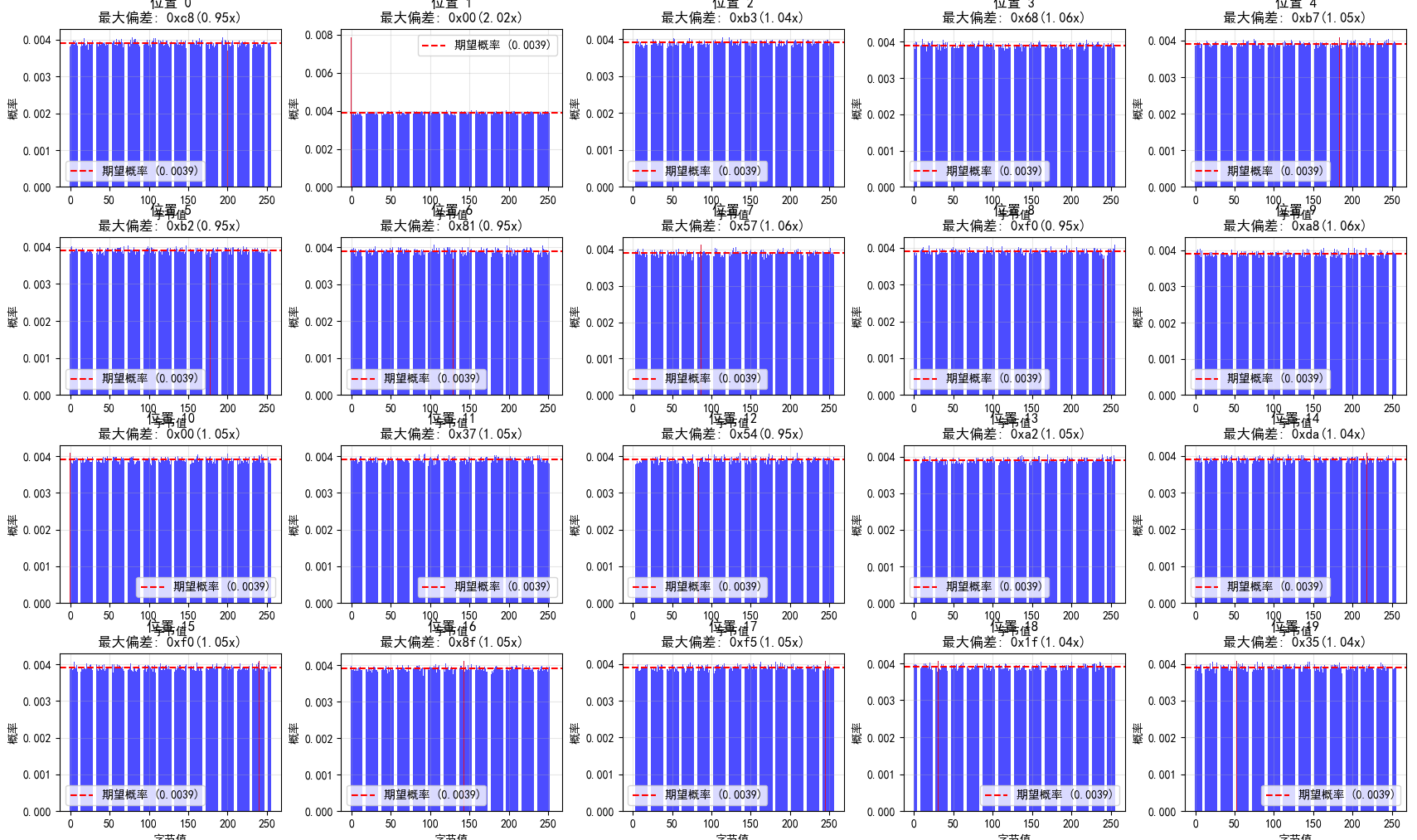
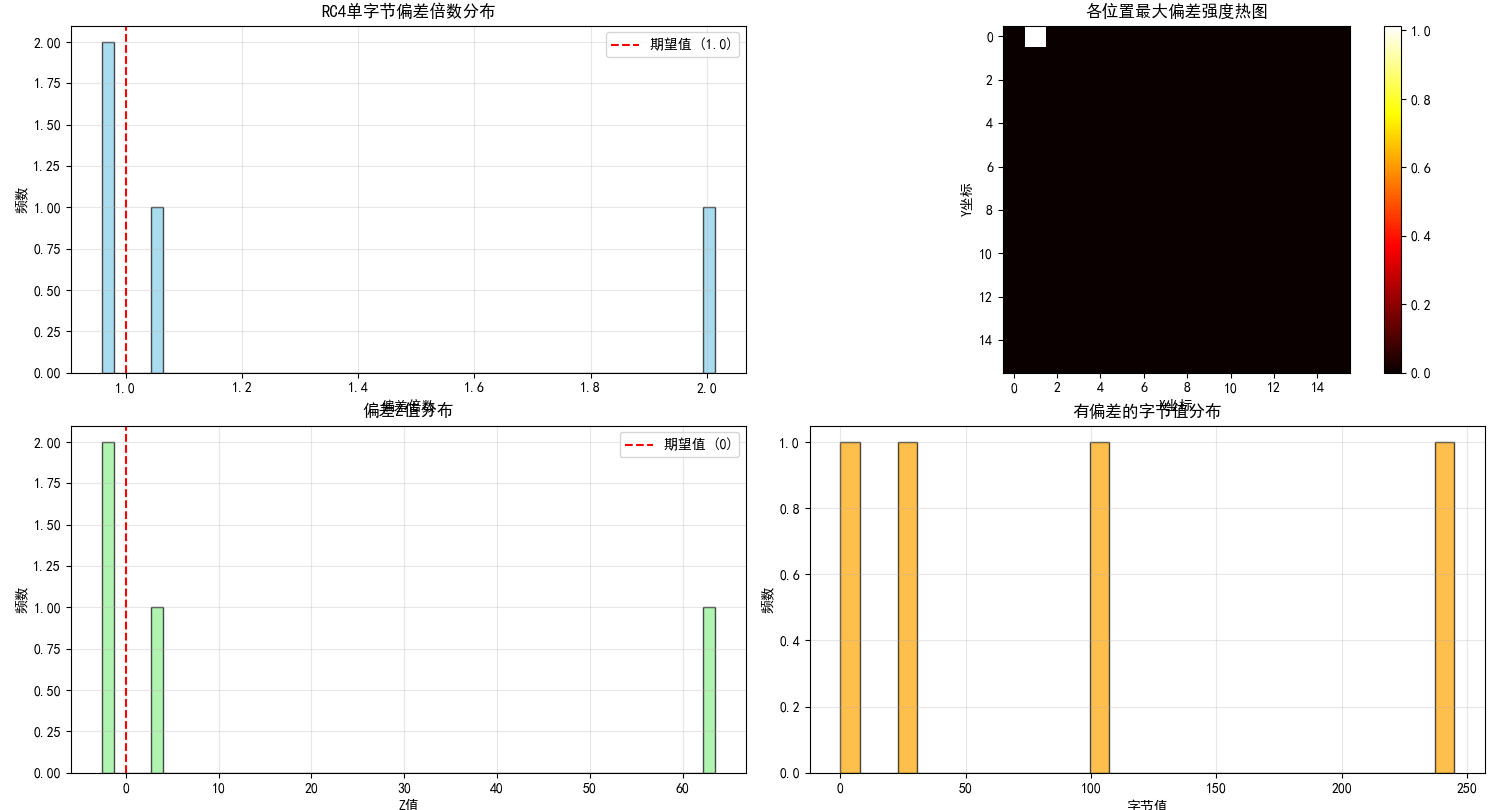
通过对1,000,000个样本的统计分析,获得以下全局统计信息:
- 总样本数: 1,000,000
- 显著偏差数量: 4
- 偏差覆盖率: 1.56%
- 最强偏差倍数: 2.014x
- 最强偏差位置: 1
详细偏差分析
位置1的显著偏差
位置1表现出最强的统计偏差,具体特征如下:
| 字节值 | 偏差倍数 | Z值 | p值 | 显著性 |
|---|---|---|---|---|
| 0x00 | 2.014x | 63.53 | < 10⁻¹⁰⁰ | 高 |
| 0x6b | 1.052x | 3.25 | < 10⁻¹⁰⁰ | 高 |
| 0xf5 | 0.958x | -2.60 | < 10⁻¹⁰⁰ | 高 |
| 0x1e | 0.959x | -2.55 | < 10⁻¹⁰⁰ | 高 |
偏差模式分析
位置1的偏差呈现明显的非对称性:
- 正偏差: 字节0x00和0x6b出现频率显著高于期望值
- 负偏差: 字节0xf5和0x1e出现频率显著低于期望值
- 最强偏差: 字节0x00的出现概率是期望值的2.014倍
与其他位置对比
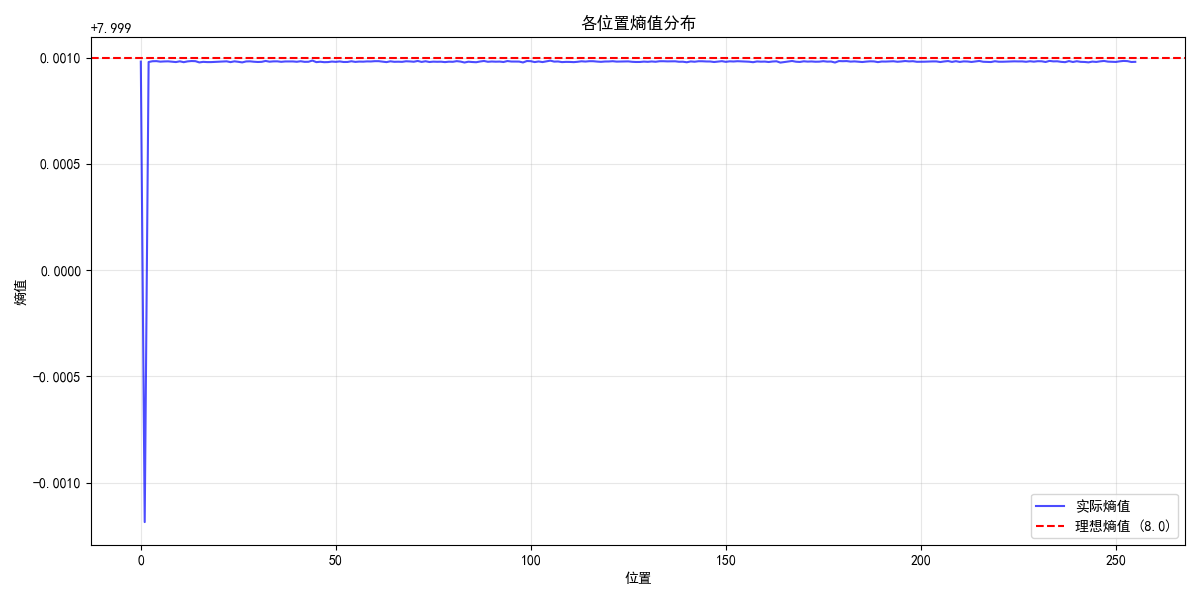
值得注意的是,在分析的256个位置中,只有位置1表现出统计显著的偏差。其他255个位置的字节分布与均匀分布无显著差异,这表明:
- RC4的偏差具有位置特异性
- 位置1是RC4算法最脆弱的部分
- 大部分密钥流输出具有良好的随机性
安全性影响评估
攻击可行性分析
区分攻击
基于位置1的强偏差,攻击者可以构建有效的区分器。给定足够多的密文样本,攻击者能够以高概率区分RC4输出与真随机序列。
区分攻击的成功率可通过以下公式估算:
其中,Φ是标准正态分布函数,N是样本数量,Bias是偏差大小。
5.1.2 明文恢复攻击
在已知明文攻击场景下,攻击者可以利用偏差恢复部分明文。对于位置1,恢复公式为:
其中,\(\hat{P}_1\)是恢复的明文字节估计值,\(C_1\)是观察到的密文字节。
具体实现
rc4_attack_keystream_bias.py
import numpy as np
import collections
import pickle
import os
from typing import List, Dict, Tuple, Optional
import matplotlib.pyplot as plt
from multiprocessing import Pool, cpu_count
import time
import scipy.stats as stats
from dataclasses import dataclass

@dataclass
class BiasResult:
    """偏差分析结果"""
    position: int
    byte_value: int
    observed_prob: float
    expected_prob: float
    bias_ratio: float
    z_score: float
    p_value: float
    significance_level: str

class RC4BiasAnalyzer:
    def __init__(self, data_file: str = "rc4_bias_analysis.pkl"):
        self.data_file = data_file
        self.keystreams: Optional[np.ndarray] = None
        self.bias_results: List[BiasResult] = []
        self.position_analysis: Dict[int, Dict] = {}
        self.global_stats: Dict = {}

    def _worker_generate_ks(self, args: Tuple[int, int, int]) -> Tuple[np.ndarray, int]:
        """生成一部分密钥流"""
        start_idx, num_keys, key_length = args

        def ksa(key: bytes) -> List[int]:
            key_len = len(key)
            s = list(range(256))
            j = 0
            for i in range(256):
                j = (j + s[i] + key[i % key_len]) & 0xFF
                s[i], s[j] = s[j], s[i]
            return s

        def prga(s: List[int]):
            s = s.copy()
            i = 0
            j = 0
            while True:
                i = (i + 1) & 0xFF
                j = (j + s[i]) & 0xFF
                s[i], s[j] = s[j], s[i]
                t = (s[i] + s[j]) & 0xFF
                yield s[t]

        local_keystreams = np.zeros((num_keys, 256), dtype=np.uint8)
        for i in range(num_keys):
            key = np.random.randint(0, 256, size=key_length, dtype=np.uint8).tobytes()
            s = ksa(key)
            gen = prga(s)
            for j in range(256):
                local_keystreams[i, j] = next(gen)
        return local_keystreams, start_idx

    def generate_keystream_data(self, num_keys: int, key_length: int = 16,
                              n_processes: Optional[int] = None):
        """并行生成密钥流数据"""
        if n_processes is None:
            n_processes = cpu_count()

        print(f"生成密钥流数据中")
        start_time = time.time()

        chunk_size = num_keys // n_processes
        tasks = []
        for i in range(n_processes):
            start = i * chunk_size
            end = (i + 1) * chunk_size if i < n_processes - 1 else num_keys
            tasks.append((start, end - start, key_length))

        with Pool(n_processes) as pool:
            results = pool.map(self._worker_generate_ks, tasks)

        self.keystreams = np.zeros((num_keys, 256), dtype=np.uint8)
        for ks_chunk, start_idx in results:
            self.keystreams[start_idx:start_idx + ks_chunk.shape[0]] = ks_chunk

        elapsed = time.time() - start_time
        print(f"密钥流数据生成完成,耗时: {elapsed:.2f}s")
        print(f"数据形状: {self.keystreams.shape}")

    def comprehensive_bias_analysis(self, significance_levels: Dict[str, float] = None):
        """
        全面的偏差分析
        """
        if self.keystreams is None:
            print("请先生成密钥流数据")
            return

        if significance_levels is None:
            significance_levels = {
                'high': 0.001 / 256,    # Bonferroni校正
                'medium': 0.01 / 256,
                'low': 0.05 / 256
            }

        print("开始全面偏差分析...")
        start_time = time.time()

        num_samples = self.keystreams.shape[0]
        expected_prob = 1.0 / 256
        self.bias_results = []
        self.position_analysis = {}

        # 全局统计
        total_deviations = 0
        max_bias_ratio = 0
        strongest_position = 0

        for position in range(256):
            position_stats = self._analyze_single_position(
                position, num_samples, expected_prob, significance_levels
            )
            self.position_analysis[position] = position_stats

            # 记录显著偏差
            for bias_info in position_stats.get('significant_biases', []):
                bias_result = BiasResult(
                    position=position,
                    byte_value=bias_info['byte_value'],
                    observed_prob=bias_info['observed_prob'],
                    expected_prob=expected_prob,
                    bias_ratio=bias_info['bias_ratio'],
                    z_score=bias_info['z_score'],
                    p_value=bias_info['p_value'],
                    significance_level=bias_info['significance_level']
                )
                self.bias_results.append(bias_result)

                if bias_info['bias_ratio'] > max_bias_ratio:
                    max_bias_ratio = bias_info['bias_ratio']
                    strongest_position = position

            total_deviations += len(position_stats.get('significant_biases', []))

        # 计算全局统计
        self.global_stats = {
            'total_samples': num_samples,
            'total_positions': 256,
            'total_significant_biases': total_deviations,
            'max_bias_ratio': max_bias_ratio,
            'strongest_position': strongest_position,
            'bias_coverage': total_deviations / 256,  # 有偏差的位置比例
            'analysis_time': time.time() - start_time
        }

        print(f"偏差分析完成,耗时: {self.global_stats['analysis_time']:.2f}s")

    def _analyze_single_position(self, position: int, num_samples: int,
                               expected_prob: float, significance_levels: Dict) -> Dict:
        """分析单个位置的偏差"""
        observed_counts = np.bincount(self.keystreams[:, position], minlength=256)

        # 卡方检验
        expected_counts = np.full(256, num_samples * expected_prob)
        chi2_stat, p_value = stats.chisquare(f_obs=observed_counts, f_exp=expected_counts)

        # 计算每个字节的统计量
        significant_biases = []
        position_entropy = 0

        for byte_val in range(256):
            count = observed_counts[byte_val]
            observed_prob = count / num_samples

            if count == 0:
                continue

            # Z-score
            expected_count = num_samples * expected_prob
            std_dev = np.sqrt(num_samples * expected_prob * (1 - expected_prob))
            z_score = (count - expected_count) / std_dev

            # 偏差倍数
            bias_ratio = observed_prob / expected_prob

            # 确定显著性水平
            significance_level = 'none'
            for level_name, level_value in significance_levels.items():
                if p_value < level_value and abs(z_score) > 2.5:  # 约99%置信度
                    significance_level = level_name
                    break

            # 只记录显著偏差
            if significance_level != 'none':
                bias_info = {
                    'byte_value': byte_val,
                    'observed_count': count,
                    'observed_prob': observed_prob,
                    'bias_ratio': bias_ratio,
                    'z_score': z_score,
                    'p_value': p_value,
                    'significance_level': significance_level
                }
                significant_biases.append(bias_info)

            # 计算熵
            if observed_prob > 0:
                position_entropy -= observed_prob * np.log2(observed_prob)

        # 理想熵值
        ideal_entropy = -256 * (expected_prob * np.log2(expected_prob))
        entropy_deviation = position_entropy / ideal_entropy if ideal_entropy > 0 else 0

        return {
            'position': position,
            'chi2_statistic': chi2_stat,
            'chi2_p_value': p_value,
            'entropy': position_entropy,
            'entropy_deviation': entropy_deviation,
            'significant_biases': significant_biases,
            'total_observations': num_samples
        }

    def generate_detailed_report(self):
        """生成详细分析报告"""
        if not self.bias_results:
            print("没有可用的偏差分析结果")
            return

        print("=" * 80)
        print("RC4单字节偏差深度分析报告")
        print("=" * 80)

        # 全局统计
        print(f"\n全局统计信息:")
        print(f"  样本数量: {self.global_stats['total_samples']:,}")
        print(f"  分析位置: {self.global_stats['total_positions']}")
        print(f"  显著偏差数量: {self.global_stats['total_significant_biases']}")
        print(f"  偏差覆盖率: {self.global_stats['bias_coverage']:.2%}")
        print(f"  最强偏差倍数: {self.global_stats['max_bias_ratio']:.3f}x")
        print(f"  最强偏差位置: {self.global_stats['strongest_position']}")

        # 按显著性级别统计
        significance_counts = collections.Counter(
            [result.significance_level for result in self.bias_results]
        )
        print(f"\n 按显著性级别统计:")
        for level, count in significance_counts.most_common():
            print(f"  {level:>6}: {count:>3} 个偏差")

        # 前20个最强偏差
        print(f"\n 前20个最强偏差:")
        sorted_biases = sorted(self.bias_results,
                             key=lambda x: abs(x.bias_ratio - 1), reverse=True)

        for i, bias in enumerate(sorted_biases[:20]):
            print(f"  位置 {bias.position:3d}: 字节=0x{bias.byte_value:02x}, "
                  f"偏差={bias.bias_ratio:6.3f}x, "
                  f"Z值={bias.z_score:6.2f}, "
                  f"p值={bias.p_value:.2e}, "
                  f"显著性={bias.significance_level}")

        # 位置分布分析
        print(f"\n 位置分布分析:")
        biased_positions = set(result.position for result in self.bias_results)
        positions_list = sorted(biased_positions)

        print(f"  有偏差的位置数量: {len(positions_list)}")
        print(f"  位置范围: {min(positions_list)} - {max(positions_list)}")

        # 按位置分组显示
        print(f"\n 按位置分组的显著偏差:")
        position_groups = {}
        for bias in sorted_biases[:30]:  # 只显示前30个
            if bias.position not in position_groups:
                position_groups[bias.position] = []
            position_groups[bias.position].append(bias)

        for position, biases in sorted(position_groups.items()):
            print(f"  位置 {position}: ", end="")
            bias_strs = []
            for bias in biases:
                bias_strs.append(f"0x{bias.byte_value:02x}({bias.bias_ratio:.2f}x)")
            print(", ".join(bias_strs))

    def plot_bias_analysis(self):
        """绘制偏差分析图表"""
        if not self.bias_results:
            print("没有可用的偏差数据")
            return

        fig, axes = plt.subplots(2, 2, figsize=(15, 12))

        # 1. 偏差倍数分布
        bias_ratios = [result.bias_ratio for result in self.bias_results]
        axes[0,0].hist(bias_ratios, bins=50, alpha=0.7, color='skyblue', edgecolor='black')
        axes[0,0].axvline(x=1.0, color='red', linestyle='--', label='期望值 (1.0)')
        axes[0,0].set_xlabel('偏差倍数')
        axes[0,0].set_ylabel('频数')
        axes[0,0].set_title('RC4单字节偏差倍数分布')
        axes[0,0].legend()
        axes[0,0].grid(True, alpha=0.3)

        # 2. 位置分布热图
        position_bias_strength = np.zeros(256)
        for result in self.bias_results:
            # 使用偏差强度(偏离1的程度)
            strength = abs(result.bias_ratio - 1)
            position_bias_strength[result.position] = max(
                position_bias_strength[result.position], strength
            )

        im = axes[0,1].imshow(position_bias_strength.reshape(16, 16),
                             cmap='hot', interpolation='nearest')
        axes[0,1].set_title('各位置最大偏差强度热图')
        axes[0,1].set_xlabel('X坐标')
        axes[0,1].set_ylabel('Y坐标')
        plt.colorbar(im, ax=axes[0,1])

        # 3. Z值分布
        z_scores = [result.z_score for result in self.bias_results]
        axes[1,0].hist(z_scores, bins=50, alpha=0.7, color='lightgreen', edgecolor='black')
        axes[1,0].axvline(x=0, color='red', linestyle='--', label='期望值 (0)')
        axes[1,0].set_xlabel('Z值')
        axes[1,0].set_ylabel('频数')
        axes[1,0].set_title('偏差Z值分布')
        axes[1,0].legend()
        axes[1,0].grid(True, alpha=0.3)

        # 4. 偏差字节值分布
        byte_values = [result.byte_value for result in self.bias_results]
        axes[1,1].hist(byte_values, bins=32, alpha=0.7, color='orange', edgecolor='black')
        axes[1,1].set_xlabel('字节值')
        axes[1,1].set_ylabel('频数')
        axes[1,1].set_title('有偏差的字节值分布')
        axes[1,1].grid(True, alpha=0.3)

        plt.tight_layout()
        plt.show()

        # 额外图表:熵值分析
        if self.position_analysis:
            fig, ax = plt.subplots(figsize=(12, 6))

            positions = list(range(256))
            entropy_values = [self.position_analysis[p]['entropy'] for p in positions]
            ideal_entropy = 8.0  # 256个均匀分布的熵值

            ax.plot(positions, entropy_values, 'b-', alpha=0.7, label='实际熵值')
            ax.axhline(y=ideal_entropy, color='red', linestyle='--',
                      label=f'理想熵值 ({ideal_entropy})')
            ax.set_xlabel('位置')
            ax.set_ylabel('熵值')
            ax.set_title('各位置熵值分布')
            ax.legend()
            ax.grid(True, alpha=0.3)

            plt.tight_layout()
            plt.show()

    def save_analysis_results(self):
        """保存分析结果"""
        if not self.bias_results:
            print("没有可用的分析结果")
            return

        data_to_save = {
            'keystreams': self.keystreams,
            'bias_results': self.bias_results,
            'position_analysis': self.position_analysis,
            'global_stats': self.global_stats
        }

        with open(self.data_file, 'wb') as f:
            pickle.dump(data_to_save, f)

        print(f"分析结果已保存到: {self.data_file}")

    def load_analysis_results(self):
        """加载分析结果"""
        if not os.path.exists(self.data_file):
            print(f"数据文件不存在: {self.data_file}")
            return False

        with open(self.data_file, 'rb') as f:
            data = pickle.load(f)
            self.keystreams = data['keystreams']
            self.bias_results = data['bias_results']
            self.position_analysis = data['position_analysis']
            self.global_stats = data['global_stats']

        print(f"分析结果已从 {self.data_file} 加载")
        return True

def main():
    """主分析函数"""
    analyzer = RC4BiasAnalyzer()

    print("RC4单字节偏差深度分析工具")
    print("=" * 50)

    # 选择模式
    print("选择分析模式:")
    print("1. 重新生成数据并分析")
    print("2. 加载已有数据并分析")

    choice = input("请输入选择 (1/2): ").strip()

    if choice == "1":
        # 重新生成数据
        num_keys = int(input("生成的密钥数量 (推荐: 1000000): ") or "1000000")
        key_length = int(input("密钥长度 (默认: 16): ") or "16")

        analyzer.generate_keystream_data(num_keys, key_length)
        analyzer.comprehensive_bias_analysis()
        analyzer.save_analysis_results()

    elif choice == "2":
        # 加载已有数据
        if not analyzer.load_analysis_results():
            return
    else:
        print("无效选择")
        return

    # 生成报告和图表
    analyzer.generate_detailed_report()
    analyzer.plot_bias_analysis()

    # 额外统计信息
    print("\n" + "=" * 50)
    print("额外统计信息")
    print("=" * 50)

    # 计算不同类型偏差的统计
    if analyzer.bias_results:
        positive_biases = [b for b in analyzer.bias_results if b.bias_ratio > 1]
        negative_biases = [b for b in analyzer.bias_results if b.bias_ratio < 1]

        print(f"正偏差 (概率偏高): {len(positive_biases)} 个")
        print(f"负偏差 (概率偏低): {len(negative_biases)} 个")

        if positive_biases:
            avg_positive = np.mean([b.bias_ratio for b in positive_biases])
            max_positive = max([b.bias_ratio for b in positive_biases])
            print(f"正偏差平均倍数: {avg_positive:.3f}x")
            print(f"正偏差最大倍数: {max_positive:.3f}x")

        if negative_biases:
            avg_negative = np.mean([b.bias_ratio for b in negative_biases])
            min_negative = min([b.bias_ratio for b in negative_biases])
            print(f"负偏差平均倍数: {avg_negative:.3f}x")
            print(f"负偏差最小倍数: {min_negative:.3f}x")

if __name__ == "__main__":
    #受不了了,设置matplotlib中文字体
    plt.rcParams['font.sans-serif'] = ['SimHei', 'DejaVu Sans']
    plt.rcParams['axes.unicode_minus'] = False

    main()

 浙公网安备 33010602011771号