
POJ 1003 -- Hangover
| Time Limit: 1000MS | Memory Limit: 10000K | |
| Total Submissions: 126127 | Accepted: 61563 |
Description
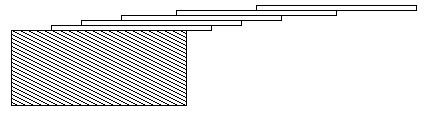
How far can you make a stack of cards overhang a table? If you have one card, you can create a maximum overhang of half a card length. (We're assuming that the cards must be perpendicular to the table.) With two cards you can make the top card overhang the bottom one by half a card length, and the bottom one overhang the table by a third of a card length, for a total maximum overhang of 1/2 + 1/3 = 5/6 card lengths. In general you can make n cards overhang by 1/2 + 1/3 + 1/4 + ... + 1/(n + 1) card lengths, where the top card overhangs the second by 1/2, the second overhangs tha third by 1/3, the third overhangs the fourth by 1/4, etc., and the bottom card overhangs the table by 1/(n + 1). This is illustrated in the figure below.
Input
Output
Sample Input
1.00
3.71
0.04
5.19
0.00
Sample Output
3 card(s)
61 card(s)
1 card(s)
273 card(s)
Source


 1 #include <iostream>
 2 #include <cmath>
 3 #include <cstring>
 4 #include <cstdio>
 5 #include <cstdlib>
 6 #include <algorithm>
 7 using namespace std;
 8 int main()
 9 {
10     double t;
11     while(scanf("%lf",&t))   //*** 输入双精度浮点数:%lf ***
12     {
13         if(t==0.00) break;
14         double ans=0;
15         for(int i=2;;i++)   //中间不写的话在循环中就一定要有退出条件
16         {
17             ans+=1.0/(double)i;
18             if(ans>=t)
19             {
20                 printf("%d card(s)\n",i-1);
21                 break;
22             }
23         }
24     }
25     //system("pause");
26     return 0;
27 }

 浙公网安备 33010602011771号