
cpp实验三 类与对象II
一、实验任务四
模拟实验任务2,不使用标准库模板类vector,自己动手设计并实现一个动态的整型数组类Vector_int,
使其支持以下要求:
支持在创建int型数组对象时,指定其大小
支持在创建int型数组对象时,指定其大小,并将数组对象中每个数据项初始化到特定的值value
支持用已经存在的int型数组对象x,来构造新的int型数组对象y(要求实现深复制)
提供方法at()能够支持诸如 x.at(i) 这样通过索引访问动态int型数组对象中第i个数据项
析构函数,释放占用的内存资源
在构造和析构函数里,增加打印输出信息。运行程序时,帮助观察资源是否正确释放。
即在测试代码中,支持形如下面的代码操作:
要求:
① 设计并实现动态整型数组类Vector_int,保存在文件vector_int.hpp中
② 编写测试代码文件task4.cpp,测试其构造函数接口、复制构造函数、at()方法等,是否都正常使用,
是否实现了深复制。
分析过后代码如下:
Vector_int.hpp如下:
 1 #include<iostream>
 2 #include<cassert>
 3 using namespace std;
 4
 5 class Vector_int
 6 {
 7 private:
 8     int n,x;//n为数组长度,x为默认初始值
 9     int *p;//数组
10 public:
11     Vector_int(int n0):n(n0),x(0)
12     {
13         p=new int[n];
14         for(int i=0;i<n0;i++)
15         p[i]=x;
16     };//构造函数
17     Vector_int(int n0,int x0):n(n0),x(x0)
18     {
19         p=new int[n];
20         for(int i=0;i<n0;i++)
21         p[i]=x;
22     };//构造函数
23     Vector_int(const Vector_int &y)//复制构造函数
24     {
25         n=y.n;
26         x=y.x;
27         p=new int[n];
28         for(int i=0;i<n;i++)
29         p[i]=y.p[i];
30     }
31
32     void print() const;//输出
33     ~Vector_int()//析构函数
34     {
35     delete[] p;
36     cout<<"destructor called"<<endl;
37     }
38
39     int &at(int index);//返回下标为index的数据引用
40
41
42 };
43
44 void Vector_int::print() const{
45     for(int i=0;i<n;i++){
46         cout<<p[i]<<"  ";
47     }
48     cout<<endl;
49
50 }
51
52 int &Vector_int::at(int index)
53 {
54     assert(index >= 0 && index < n);
55     return p[index];
56  }
task4.cpp如下:
 1 #include<iostream>
 2 #include"Vector_int.hpp"
 3 using namespace std;
 4 int main()
 5 {
 6     int n;
 7     cout<<"请输入数组长度:\n";
 8     cin>>n;
 9     Vector_int x0(n);
10     cout<<"x0=";
11     x0.print();
12     int n1,x;
13     cout<<"请输入数组长度和初始值:\n";
14     cin>>n1>>x;
15     Vector_int x1(n1, x);
16     cout<<"x1=";
17     x1.print();
18     Vector_int y(x1);
19     cout<<"y=";
20     y.print();
21     y.at(0) = 999;
22     cout<<"y=";
23     y.print();
24     return 0;
25 }
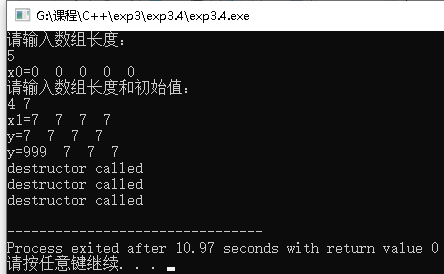
运行结果如下:
二、实验任务五
实现一个动态矩阵类Matrix,类Matrix的声明见文件Matrix.hpp。
① 实现类Matrix的定义
② 使用task5.cpp测试矩阵类Matrix。
经过分析后,Matrix.hpp如下:
 1 #ifndef MATRIX_H
 2 #define MATRIX_H
 3
 4 #include <iostream>
 5 #include <cassert>
 6 using namespace std;
 7 class Matrix
 8 {
 9 public:
10     Matrix(int n);                     // 构造函数,构造一个n*n的矩阵
11     Matrix(int n, int m);              // 构造函数,构造一个n*m的矩阵
12     Matrix(const Matrix &X);           // 复制构造函数,使用已有的矩阵X构造
13     ~Matrix() //析构函数
14     {
15         delete[] p;
16         cout<<"destructor called\n";
17     }
18     void set(const double *pvalue);     // 用pvalue指向的连续内存块数据为矩阵赋值
19     void set(int i, int j, int value); //设置矩阵第i行第j列元素值为value
20     double &at(int i, int j);          //返回矩阵第i行第j列元素的引用
21     double at(int i, int j) const;     // 返回矩阵第i行第j列元素的值
22     int get_lines() const;             //返回矩阵行数
23     int get_cols() const;              //返回矩列数
24     void print() const;                // 按行打印输出矩阵
25 private:
26     int lines; // 矩阵行数
27     int cols;  // 矩阵列数
28     double *p; // 指向存放矩阵数据的内存块的首地址
29 };
30
31 Matrix::Matrix(int n):lines(n),cols(n)
32 {
33     p=new double[n*n];
34 }
35
36 Matrix::Matrix(int n,int m):lines(n),cols(m)
37 {
38     p=new double[n*m];
39 }
40
41 Matrix::Matrix(const Matrix &X ):lines(X.lines),cols(X.cols)
42 {
43     p=new double[lines*cols];
44     for(int i=0;i<lines*cols;i++)
45         p[i]=X.p[i];
46 }
47
48 void Matrix::set(const double *pvalue)
49 {
50     for(int i=0; i<lines*cols; i++)
51         p[i]=*(pvalue+i);
52 }
53
54 void Matrix::set(int i,int j,int value)
55 {
56     assert((i >= 0 && i < lines) && (j >= 0 && j < cols));
57     p[i*cols+j]=value;
58 }
59
60 double Matrix::at(int i, int j) const {
61     assert((i >= 0 && i < lines) && (j >= 0 && j < cols));
62     return p[i*cols+j];
63 }
64 double & Matrix::at(int i, int j) {
65     return p[i*cols+j];
66 }
67
68 int Matrix::get_lines() const {
69     return lines;
70 }
71 int Matrix::get_cols() const {
72     return cols;
73 }
74
75 void Matrix::print() const {
76     for(int i=0; i<lines; i++) {
77         for(int j=0; j<cols; j++) {
78             cout<<p[i*cols+j]<<" ";
79         }
80
81         cout<<endl;
82     }
83 }
84
85
86
87
88
89 #endif
task5.cpp如下:
 1 #include <iostream>
 2 #include "Matrix.hpp"
 3
 4 int main()
 5 {
 6     using namespace std;
 7
 8     double x[] = {1, 2, 3, 4, 5, 6};
 9
10     Matrix m1(3, 2);    // 创建一个3×2的矩阵
11     m1.set(x);          // 用一维数组x的值按行为矩阵m1赋值
12     m1.print();         // 打印矩阵m1的值
13     cout << "the first line is: " << endl;
14     cout << m1.at(0, 0) << " " << m1.at(0, 1) << endl;
15     cout << endl;
16
17     Matrix m2(2, 3);
18     m2.set(x);
19     m2.print();
20     cout << "the first line is: " << endl;
21     cout << m2.at(0, 0) << " " << m2.at(0, 1) << " " << m2.at(0, 2) << endl;
22     cout << endl;
23
24     Matrix m3(m2);
25     m3.set(0, 0, 999);
26     m3.print();
27 }
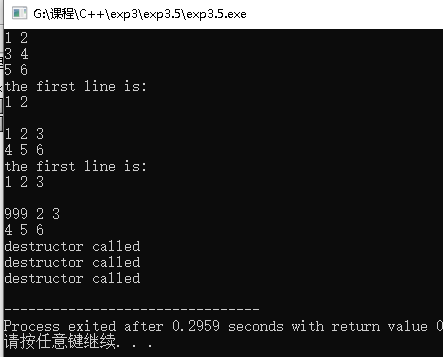
运行结果如图:
三、实验结论
1.引用是没有自己的地址的,指针有自己的地址
2.引用作为形参时,例如&x,作为实参时要用x;
指针作为形参时,例如*x,作为实参要用&x.
3.*pa=a时,&pa是自己的地址,pa是a的地址
&ra=a时,&ra是a的地址,ra是a的值
4.在类中如果需要一组数组,可以用指针来帮助解决这种问题,例如定义*p,p=new double[]
5.assert是标准c++头文件cassert中定义的一个宏,用来判断一个条件表达式的值是否为true。
如果是false,会终止。
6.引用类型的函数其实现时也要用引用类型,例如double & Matrix::at(int i, int j)
7.自己构造一个容器时,例如vector,有一个数组指针*p,在构造函数中也要初始化它,初始化具体语句为:
 p=new int[n];
        for(int i=0;i<n0;i++)
         p[i]=x;

 浙公网安备 33010602011771号