

C++--------类模版 - 教程
类模板语法
类模板作用:
- 建立一个通用类,类中的成员 数据类型可以不具体制定,用一个虚拟的类型来代表。
语法:
template
类
解释:
template --- 声明创建模板
typename --- 表面其后面的符号是一种数据类型,可以用class代替
T --- 通用的数据类型,名称可以替换,通常为大写字母
示例:
#include
//类模板
template
class Person
{
public:
    Person(NameType name, AgeType age)
    {
        this->mName = name;
        this->mAge = age;
    }
    void showPerson()
    {
        cout << "name: " << this->mName << " age: " << this->mAge << endl;
    }
public:
    NameType mName;
    AgeType mAge;
};
void test01()
{
    // 指定NameType 为string类型,AgeType 为 int类型
    PersonP1("孙悟空", 999);
    P1.showPerson();
}
int main() {
    test01();
    system("pause");
    return 0;
}
总结:类模板和函数模板语法相似,在声明模板template后面加类,此类称为类模板
#include
#include
using namespace std;
//类模版
template
class Person
{
public:
	Person(NameType name, AgeType age)
	{
		this->m_Name = name;
		this->m_Age = age;
	}
	void showPerson()
	{
		cout << "name: " << this->m_Name << " age: " << this->m_Age << endl;
	}
	NameType m_Name;
	AgeType m_Age;
};
void test01()
{
	Person p1("孙悟空", 999);
	p1.showPerson();
}
int main()
{
	test01();
	system("pause");
	return 0;
}
类模板与函数模板区别
类模板与函数模板区别主要有两点:
- 类模板没有自动类型推导的使用方式
- 类模板在模板参数列表中可以有默认参数
示例:
#include
//类模板
template
class Person
{
public:
    Person(NameType name, AgeType age)
    {
        this->mName = name;
        this->mAge = age;
    }
    void showPerson()
    {
        cout << "name: " << this->mName << " age: " << this->mAge << endl;
    }
public:
    NameType mName;
    AgeType mAge;
};
//1、类模板没有自动类型推导的使用方式
void test01()
{
    // Person p("孙悟空", 1000); // 错误 类模板使用时候,不可以用自动类型推导
    Person p("孙悟空", 1000); //必须使用显示指定类型的方式,使用类模板
    p.showPerson();
}
//2、类模板在模板参数列表中可以有默认参数
void test02()
{
    Person  p("猪八戒", 999); //类模板中的模板参数列表 可以指定默认参数
    p.showPerson();
}
int main() {
    test01();
    test02();
    system("pause");
    return 0;
}
总结:
- 类模板使用只能用显示指定类型方式
- 类模板中的模板参数列表可以有默认参数
#include
#include
using namespace std;
//类模板与函数模板区别
template
class Person
{
public:
	Person(NameType name, AgeType age )
	{
		this->m_Name = name;
		this->m_Age = age;
	}
	void showPerson()
	{
		cout << "name: " << this->m_Name << " age: " << this->m_Age << endl;
	}
	NameType m_Name;
	AgeType m_Age;
};
//1、类模板没有自动类型推导使用方式
void test01()
{
	//Person p("孙悟空", 1000);错误,无法用自动类型推导
	Personp("孙悟空", 1000);//正确,只能用显式指定类型
	p.showPerson();
}
//2、类模板在模板参数列表中可以有默认参数
void test02()
{
	Personp("猪八戒", 999);
	p.showPerson();
}
int main()
{
	test01();
	test02();
	system("pause");
	return 0;
}
类模板中成员函数创建时机
类模板中成员函数和普通类中成员函数创建时机是有区别的:
- 普通类中的成员函数一开始就可以创建
- 类模板中的成员函数在调用时才创建
示例:
class Person1
{
public:
    void showPerson1()
    {
        cout << "Person1 show" << endl;
    }
};
class Person2
{
public:
    void showPerson2()
    {
        cout << "Person2 show" << endl;
    }
};
template
class MyClass
{
public:
    T obj;
    //类模板中的成员函数,并不是一开始就创建的,而是在模板调用时再生成
    void fun1() { obj.showPerson1(); }
    void fun2() { obj.showPerson2(); }
};
void test01()
{
    MyClass m;
    m.fun1();
    //m.fun2();//编译会出错,说明函数调用才会去创建成员函数
}
int main() {
    test01();
    system("pause");
    return 0;
}
总结:类模板中的成员函数并不是一开始就创建的,在调用时才去创建
#include
#include
using namespace std;
//类模板中成员函数创建时机
//类模板中成员函数在调用时才去创建
class Person1
{
public:
	void showPerson1()
	{
		cout << "Person1 show" << endl;
	}
};
class Person2
{
public:
	void showPerson2()
	{
		cout << "Person2 show" << endl;
	}
};
template
class Myclass
{
public:
	T obj;
	//类模版中的成员函数
	void func1()
	{
		obj.showPerson1();
	}
	void func2()
	{
		obj.showPerson2();
	}
};
void test01()
{
	Myclassm;
	m.func1();
	//m.func2();
}
int main()
{
	test01();
	system("pause");
	return 0;
}
类模板对象做函数参数
学习目标:
- 类模板实例化出的对象,向函数传参的方式
一共有三种传入方式:
- 指定传入的类型 --- 直接显示对象的数据类型(常用)
- 参数模板化 --- 将对象中的参数变为模板进行传递
- 整个类模板化 --- 将这个对象类型 模板化进行传递
示例:
#include
//类模板
template
class Person
{
public:
    Person(NameType name, AgeType age)
    {
        this->mName = name;
        this->mAge = age;
    }
    void showPerson()
    {
        cout << "name: " << this->mName << " age: " << this->mAge << endl;
    }
public:
    NameType mName;
    AgeType mAge;
};
//1、指定传入的类型
void printPerson1(Person &p)
{
    p.showPerson();
}
void test01()
{
    Person p("孙悟空", 100);
    printPerson1(p);
}
//2、参数模板化
template
void printPerson2(Person&p)
{
    p.showPerson();
    cout << "T1的类型为: " << typeid(T1).name() << endl;
    cout << "T2的类型为: " << typeid(T2).name() << endl;
}
void test02()
{
    Person p("猪八戒", 90);
    printPerson2(p);
}
//3、整个类模板化
template
void printPerson3(T & p)
{
    cout << "T的类型为: " << typeid(T).name() << endl;
    p.showPerson();
}
void test03()
{
    Person p("唐僧", 30);
    printPerson3(p);
}
int main() {
    test01();
    test02();
    test03();
    system("pause");
    return 0;
}
总结:
- 通过类模板创建的对象,可以有三种方式向函数中进行传参
- 使用比较广泛是第一种:指定传入的类型
#include
#include
using namespace std;
//类模板对象做函数参数
template
class Person
{
public:
	Person(T1 name, T2 age)
	{
		this->m_Name = name;
		this->m_Age = age;
	}
	void showPerson()
	{
		cout << "姓名: " << this->m_Name << " 年龄: " << this->m_Age << endl;
	}
	T1 m_Name;
	T2 m_Age;
};
//1、指定传入类型
void printPerson1(Person&p)
{
	p.showPerson();
}
void test01()
{
	Personp("孙悟空", 100);
	printPerson1(p);
}
//2、参数模板化
template
void printPerson2(Person&p)
{
	p.showPerson();
	cout << "T1的类型为: " << typeid(T1).name() << endl;
	cout << "T2的类型为: " << typeid(T2).name() << endl;
}
void test02()
{
	Personp("猪八戒", 99);
	printPerson2(p);
}
//3、整个类模板化
template
void printPerson3(T &p)
{
	p.showPerson();
	cout << "T的类型为: " << typeid(T).name() << endl;
}
void test03()
{
	Personp("唐僧", 88);
	printPerson3(p);
}
int main()
{
	//test01();
	//test02();
	test03();
	system("pause");
	return 0;
}
类模板与继承
当类模板碰到继承时,需要注意一下几点:
- 当子类继承的父类是一个类模板时,子类在声明的时候,要指定出父类中T的类型
- 如果不指定,编译器无法给子类分配内存
- 如果想灵活指定出父类中T的类型,子类也需变为类模板
示例:
template
class Base
{
    T m;
};
//class Son:public Base  //错误,c++编译需要给子类分配内存,必须知道父类中T的类型才可以向下继承
class Son :public Base //必须指定一个类型
{
};
void test01()
{
    Son c;
}
//类模板继承类模板 ,可以用T2指定父类中的T类型
template
class Son2 :public Base
{
public:
    Son2()
    {
        cout << typeid(T1).name() << endl;
        cout << typeid(T2).name() << endl;
    }
};
void test02()
{
    Son2 child1;
}
int main() {
    test01();
    test02();
    system("pause");
    return 0;
}
总结:如果父类是类模板,子类需要指定出父类中T的数据类型
#include
#include
using namespace std;
//类模版与继承
template
class Base
{
	T m;
};
//class Son :public Base//错误,必须要知道父类中的T类型,才能继承给子类
class Son:public Base
{
};
void test01()
{
	Son s1;
}
//如果想灵活指定父类中T类型,子类也需要变类模板
template
class Son2 :public Base
{
public:
	Son2()
	{
		cout << "T1的类型为: " << typeid(T1).name() << endl;
		cout << "T2的类型为: " << typeid(T2).name() << endl;
	}
	T1 obj;
};
void test02()
{
	Son2s2;
}
int main()
{
	test01();
	test02();
	system("pause");
	return 0;
}
类模板成员函数类外实现
学习目标:能够掌握类模板中的成员函数类外实现
示例:
#include
//类模板中成员函数类外实现
template
class Person {
public:
    //成员函数类内声明
    Person(T1 name, T2 age);
    void showPerson();
public:
    T1 m_Name;
    T2 m_Age;
};
//构造函数 类外实现
template
Person::Person(T1 name, T2 age) {
    this->m_Name = name;
    this->m_Age = age;
}
//成员函数 类外实现
template
void Person::showPerson() {
    cout << "姓名: " << this->m_Name << " 年龄:" << this->m_Age << endl;
}
void test01()
{
    Person p("Tom", 20);
    p.showPerson();
}
int main() {
    test01();
    system("pause");
    return 0;
}
总结:类模板中成员函数类外实现时,需要加上模板参数列表
#include
#include
using namespace std;
//类模板成员函数类外实现
template
class Person
{
public:
	Person(T1 name, T2 age);
	/*{
		this->m_Name = name;
		this->m_Age = age;
	}*/
	void showPerson();
	/*{
		cout << "姓名: " << this->m_Name << " 年龄: " << this->m_Age << endl;
	}*/
	T1 m_Name;
	T2 m_Age;
};
//构造函数类外实现
template
Person::Person(T1 name, T2 age)
{
	this->m_Name = name;
	this->m_Age = age;
}
//成员函数类外实现
template
void Person::showPerson()
{
	cout << "姓名: " << this->m_Name << " 年龄: " << this->m_Age << endl;
}
void test01()
{
	Personp("tom", 20);
	p.showPerson();
}
int main()
{
	test01();
	system("pause");
	return 0;
}
类模板分文件编写
学习目标:
- 掌握类模板成员函数分文件编写产生的问题以及解决方式
问题:
- 类模板中成员函数创建时机是在调用阶段,导致分文件编写时链接不到
解决:
- 解决方式1:直接包含.cpp源文件
- 解决方式2:将声明和实现写到同一个文件中,并更改后缀名为.hpp,hpp是约定的名称,并不是强制
示例:
person.hpp中代码:
#pragma once
#include
using namespace std;
#include
template
class Person {
public:
    Person(T1 name, T2 age);
    void showPerson();
public:
    T1 m_Name;
    T2 m_Age;
};
//构造函数 类外实现
template
Person::Person(T1 name, T2 age) {
    this->m_Name = name;
    this->m_Age = age;
}
//成员函数 类外实现
template
void Person::showPerson() {
    cout << "姓名: " << this->m_Name << " 年龄:" << this->m_Age << endl;
}
类模板分文件编写.cpp中代码
#include
using namespace std;
//#include "person.h"
#include "person.cpp" //解决方式1,包含cpp源文件
//解决方式2,将声明和实现写到一起,文件后缀名改为.hpp
#include "person.hpp"
void test01()
{
    Person p("Tom", 10);
    p.showPerson();
}
int main() {
    test01();
    system("pause");
    return 0;
}
总结:主流的解决方式是第二种,将类模板成员函数写到一起,并将后缀名改为.hpp
#pragma once
#include
using namespace std;
#include
template
class Person
{
public:
	Person(T1 name, T2 age);
	void showPerson();
	T1 m_Name;
	T2 m_Age;
};
template
Person::Person(T1 name, T2 age)
{
	this->m_Name = name;
	this->m_Age = age;
}
template
void Person::showPerson()
{
	cout << "姓名: " << this->m_Name << " 年龄: " << this->m_Age << endl;
}
//#include "person.h"
//
//template
//Person::Person(T1 name, T2 age)
//{
// this->m_Name = name;
// this->m_Age = age;
//}
//
//template
//void Person::showPerson()
//{
// cout << "姓名: " << this->m_Name << " 年龄: " << this->m_Age << endl;
//} #include
#include
using namespace std;
//解决方式1:直接包含.cpp源文件
//#include "person.cpp"
//解决方式2:将.h和.cpp写到同一个文件中,并更改后缀名为.hpp,hpp是约定的名称,并不是强制
#include "person.hpp"
//类模板分文件编写问题以及解决
//template
//class Person
//{
//public:
// Person(T1 name, T2 age);
//
// void showPerson();
//
// T1 m_Name;
// T2 m_Age;
//};
//template
//Person::Person(T1 name, T2 age)
//{
// this->m_Name = name;
// this->m_Age = age;
//}
//
//template
//void Person::showPerson()
//{
// cout << "姓名: " << this->m_Name << " 年龄: " << this->m_Age << endl;
//}
void test01()
{
Personp("Jerry", 19);
p.showPerson();
}
int main()
{
test01();
system("pause");
return 0;
} 类模板与友元
学习目标:
- 掌握类模板配合友元函数的类内和类外实现
全局函数类内实现 - 直接在类内声明友元即可
全局函数类外实现 - 需要提前让编译器知道全局函数的存在
示例:
#include
//2、全局函数配合友元  类外实现 - 先做函数模板声明,下方在做函数模板定义,在做友元
template class Person;
//如果声明了函数模板,可以将实现写到后面,否则需要将实现体写到类的前面让编译器提前看到
//template void printPerson2(Person & p);
template
void printPerson2(Person & p)
{
    cout << "类外实现 ---- 姓名: " << p.m_Name << " 年龄:" << p.m_Age << endl;
}
template
class Person
{
    //1、全局函数配合友元   类内实现
    friend void printPerson(Person & p)
    {
        cout << "姓名: " << p.m_Name << " 年龄:" << p.m_Age << endl;
    }
    //全局函数配合友元  类外实现
    friend void printPerson2<>(Person & p);
public:
    Person(T1 name, T2 age)
    {
        this->m_Name = name;
        this->m_Age = age;
    }
private:
    T1 m_Name;
    T2 m_Age;
};
//1、全局函数在类内实现
void test01()
{
    Person p("Tom", 20);
    printPerson(p);
}
//2、全局函数在类外实现
void test02()
{
    Person p("Jerry", 30);
    printPerson2(p);
}
int main() {
    //test01();
    test02();
    system("pause");
    return 0;
}
总结:建议全局函数做类内实现,用法简单,而且编译器可以直接识别
#include
#include
using namespace std;
//通过全局函数 打印Person信息
//提前让编译器知道Person类存在
template
class Person;
//类外实现
template
void printPerson2(Person p)
{
	cout << "类外实现------姓名: " << p.m_Name << " 年龄: " << p.m_Age << endl;
}
template
class Person
{
	//全局函数 类内实现
	friend void printPerson(Person p)
	{
		cout << "姓名: " << p.m_Name << " 年龄: " << p.m_Age << endl;
	}
	//全局函数 类外实现
	//加空模板参数列表
	//如果全局函数 是类外实现,需要让编译器提前知道这个函数的存在
	friend void printPerson2<>(Person p);
public:
	Person(T1 name, T2 age)
	{
		this->m_Name = name;
		this->m_Age = age;
	}
private:
	T1 m_Name;
	T2 m_Age;
};
//1、全局函数在类内实现
void test01()
{
	Personp("Tom", 20);
	printPerson(p);
}
//1、全局函数在类外实现
void test02()
{
	Personp("Jerry", 18);
	printPerson2(p);
}
int main()
{
	test01();
	system("pause");
	return 0;
}
类模板案例
案例描述: 实现一个通用的数组类,要求如下:
- 可以对内置数据类型以及自定义数据类型的数据进行存储
- 将数组中的数据存储到堆区
- 构造函数中可以传入数组的容量
- 提供对应的拷贝构造函数以及operator=防止浅拷贝问题
- 提供尾插法和尾删法对数组中的数据进行增加和删除
- 可以通过下标的方式访问数组中的元素
- 可以获取数组中当前元素个数和数组的容量
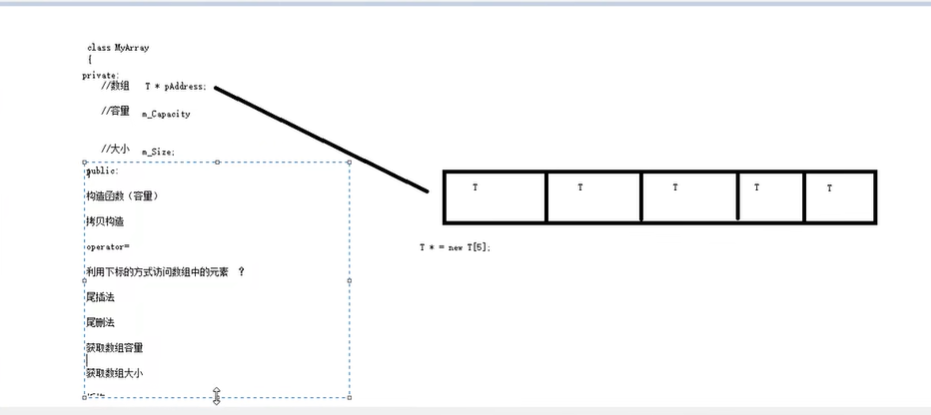
示例:
myArray.hpp中代码
#pragma once
#include
using namespace std;
template
class MyArray
{
public:
    //构造函数
    MyArray(int capacity)
    {
        this->m_Capacity = capacity;
        this->m_Size = 0;
        pAddress = new T[this->m_Capacity];
    }
    //拷贝构造
    MyArray(const MyArray & arr)
    {
        this->m_Capacity = arr.m_Capacity;
        this->m_Size = arr.m_Size;
        this->pAddress = new T[this->m_Capacity];
        for (int i = 0; i < this->m_Size; i++)
        {
            //如果T为对象,而且还包含指针,必须需要重载 = 操作符,因为这个等号不是 构造 而是赋值,
            // 普通类型可以直接= 但是指针类型需要深拷贝
            this->pAddress[i] = arr.pAddress[i];
        }
    }
    //重载= 操作符  防止浅拷贝问题
    MyArray& operator=(const MyArray& myarray) {
        if (this->pAddress != NULL) {
            delete[] this->pAddress;
            this->m_Capacity = 0;
            this->m_Size = 0;
        }
        this->m_Capacity = myarray.m_Capacity;
        this->m_Size = myarray.m_Size;
        this->pAddress = new T[this->m_Capacity];
        for (int i = 0; i < this->m_Size; i++) {
            this->pAddress[i] = myarray[i];
        }
        return *this;
    }
    //重载[] 操作符  arr[0]
    T& operator [](int index)
    {
        return this->pAddress[index]; //不考虑越界,用户自己去处理
    }
    //尾插法
    void Push_back(const T & val)
    {
        if (this->m_Capacity == this->m_Size)
        {
            return;
        }
        this->pAddress[this->m_Size] = val;
        this->m_Size++;
    }
    //尾删法
    void Pop_back()
    {
        if (this->m_Size == 0)
        {
            return;
        }
        this->m_Size--;
    }
    //获取数组容量
    int getCapacity()
    {
        return this->m_Capacity;
    }
    //获取数组大小
    int getSize()
    {
        return this->m_Size;
    }
    //析构
    ~MyArray()
    {
        if (this->pAddress != NULL)
        {
            delete[] this->pAddress;
            this->pAddress = NULL;
            this->m_Capacity = 0;
            this->m_Size = 0;
        }
    }
private:
    T * pAddress;  //指向一个堆空间,这个空间存储真正的数据
    int m_Capacity; //容量
    int m_Size;   // 大小
};
类模板案例—数组类封装.cpp中
#include "myArray.hpp"
#include
void printIntArray(MyArray& arr) {
    for (int i = 0; i < arr.getSize(); i++) {
        cout << arr[i] << " ";
    }
    cout << endl;
}
//测试内置数据类型
void test01()
{
    MyArray array1(10);
    for (int i = 0; i < 10; i++)
    {
        array1.Push_back(i);
    }
    cout << "array1打印输出:" << endl;
    printIntArray(array1);
    cout << "array1的大小:" << array1.getSize() << endl;
    cout << "array1的容量:" << array1.getCapacity() << endl;
    cout << "--------------------------" << endl;
    MyArray array2(array1);
    array2.Pop_back();
    cout << "array2打印输出:" << endl;
    printIntArray(array2);
    cout << "array2的大小:" << array2.getSize() << endl;
    cout << "array2的容量:" << array2.getCapacity() << endl;
}
//测试自定义数据类型
class Person {
public:
    Person() {}
        Person(string name, int age) {
        this->m_Name = name;
        this->m_Age = age;
    }
public:
    string m_Name;
    int m_Age;
};
void printPersonArray(MyArray& personArr)
{
    for (int i = 0; i < personArr.getSize(); i++) {
        cout << "姓名:" << personArr[i].m_Name << " 年龄: " << personArr[i].m_Age << endl;
    }
}
void test02()
{
    //创建数组
    MyArray pArray(10);
    Person p1("孙悟空", 30);
    Person p2("韩信", 20);
    Person p3("妲己", 18);
    Person p4("王昭君", 15);
    Person p5("赵云", 24);
    //插入数据
    pArray.Push_back(p1);
    pArray.Push_back(p2);
    pArray.Push_back(p3);
    pArray.Push_back(p4);
    pArray.Push_back(p5);
    printPersonArray(pArray);
    cout << "pArray的大小:" << pArray.getSize() << endl;
    cout << "pArray的容量:" << pArray.getCapacity() << endl;
}
int main() {
    //test01();
    test02();
    system("pause");
    return 0;
}
总结:
能够利用所学知识点实现通用的数组
//自己的通用的数组类
#pragma once
#include
using namespace std;
#include
template
class MyArray
{
public:
	//有参构造 参数 容量
	MyArray(int capacity)
	{
		//cout << "Myarray有参构造调用" << endl;
		this->m_Capacity = capacity;
		this->m_Size = 0;
		this->pAddress =new T[this->m_Capacity];
	}
	//尾插法
	void Push_Back(const T& val)
	{
		//判断容量是否等于大小
		if (this->m_Capacity == this->m_Size)
		{
			return;
		}
		this->pAddress[this->m_Size] = val;//在数组末尾插入数据
		this->m_Size++;//更新数组大小
	}
	//尾删法
	void Pop_Back()
	{
		//让用户访问不到最后一个元素,即为尾删,逻辑删除
		if (this->m_Size == 0)
		{
			return;
		}
		this->m_Size--;
	}
	//通过下标方式访问数组中的元素  arr[0]=100
	T& operator[](int index)
	{
		return this->pAddress[index];
	}
	//返回数组容量
	int getCapacity()
	{
		return this->m_Capacity;
	}
	//返回数组大小
	int getSize()
	{
		return this->m_Size;
	}
	//拷贝构造
	MyArray(const MyArray& arr)
	{
		//cout << "Myarray拷贝构造调用" << endl;
		this->m_Capacity = arr.m_Capacity;
		this->m_Size = arr.m_Size;
		//this->pAddress = arr.pAddress;
		//深拷贝
		this->pAddress = new T[arr.m_Capacity];
		//将arr中的数据都拷贝过来
		for (int i = 0; i < this->m_Size; i++)
		{
			this->pAddress[i] = arr.pAddress[i];
		}
	}
	//operator=防止浅拷贝问题
	MyArray& operator=(const MyArray& arr)
	{
		//cout << "Myarray的 operator=调用" << endl;
		//先判断原来堆区是否有数据,如果有先释放
		if (this->pAddress != NULL)
		{
			delete[]this->pAddress;
			this->pAddress = NULL;
			this->m_Capacity = 0;
			this->m_Size = 0;
		}
		//深拷贝
		this->m_Capacity = arr.m_Capacity;
		this->m_Size = arr.m_Size;
		this->pAddress = new T[arr.m_Capacity];
		for (int i = 0; i < this->m_Size; i++)
		{
			this->pAddress[i] = arr.pAddress[i];
		}
		return *this;
	}
	//析构函数
	~MyArray()
	{
		if (this->pAddress != NULL)
		{
			//cout << "Myarray析构函数调用" << endl;
			delete []this->pAddress;
			this->pAddress = NULL;
		}
	}
private:
	T* pAddress; //指针指向堆区开辟的真实数组
	int m_Capacity;//数组容量
	int m_Size;//数组大小
};
#include
#include
using namespace std;
#include"MyArray.hpp"
void printIntArray(MyArray & arr)
{
for (int i = 0; i < arr.getSize(); i++)
{
cout << arr[i] << endl;
}
}
void test01()
{
MyArray arr1(5);
for (int i = 0; i < 5; i++)
{
//利用尾插法向数组中插入数据
arr1.Push_Back(i);
}
cout << "arr1的打印输出为: " << endl;
printIntArray(arr1);
cout << "arr1的容量为: " << arr1.getCapacity() << endl;
cout << "arr1的大小为: " << arr1.getSize() << endl;
MyArray arr2(arr1);
cout << "arr2的打印输出为: " << endl;
printIntArray(arr2);
//尾删
arr2.Pop_Back();
cout << "arr2尾删后: " << endl;
cout << "arr2的容量为: " << arr2.getCapacity() << endl;
cout << "arr2的大小为: " << arr2.getSize() << endl;
/*MyArray arr2(arr1);
MyArray arr3(100);
arr3 = arr1;*/
}
//测试自定义数据类型
class Person
{
public:
Person() {};
Person(string name, int age)
{
this->m_Name = name;
this->m_Age = age;
}
string m_Name;
int m_Age;
};
void printPersonArray(MyArray& arr)
{
for (int i = 0; i < arr.getSize(); i++)
{
cout << "姓名: " << arr[i].m_Name << " 年龄: " << arr[i].m_Age << endl;
}
}
void test02()
{
MyArrayarr(10);
Person p1("孙悟空", 999);
Person p2("张三", 666);
Person p3("李四", 667);
Person p4("王五", 668);
Person p5("猪八戒", 669);
//将数据插入到数组中
arr.Push_Back(p1);
arr.Push_Back(p2);
arr.Push_Back(p3);
arr.Push_Back(p4);
arr.Push_Back(p5);
//打印数组
printPersonArray(arr);
//打印容量
cout << "arr容量为: " << arr.getCapacity() << endl;
//打印大小
cout << "arr大小为: " << arr.getSize() << endl;
}
int main()
{
//test01();
test02();
system("pause");
return 0;
} 
 浙公网安备 33010602011771号