
实验二 栈和队列
| 这个作业属于哪个课程 | |
|---|---|
| 这个作业的要求在哪里 | |
| 这个作业的目标 | |
| 学号 | |
| 一、 实验目的 |
- 掌握栈的结构特性及其入栈,出栈操作;
- 掌握队列的结构特性及其入队、出队的操作,掌握循环队列的特点及其操作。
二、 实验预习
说明以下概念
- 顺序栈(Sequential stack):栈的顺序存储结构简称为顺序栈;
- 链栈(Chain stack):栈的链式存储结构简称为链栈;
- 循环队列(Circular queue):向量首尾相接,这种意义下向量称为循环向量,并将循环向量中的队列称为循环队列;
- 链队列(Chain queue):队列的链式存储结构简称为链队列;
注:栈是限制仅在表的一端进行插入和删除运算的线性表。
三、 实验内容和要求
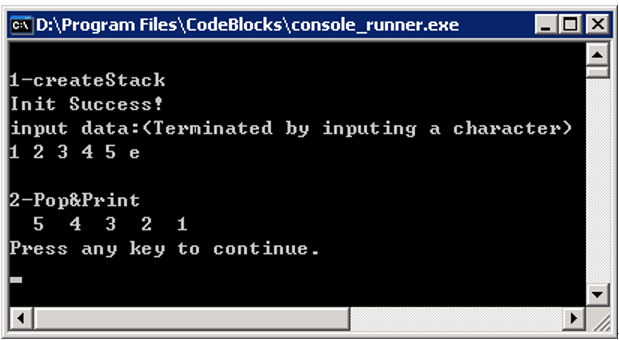
- 阅读下面程序,将函数Push和函数Pop补充完整。要求输入元素序列1 2 3 4 5 e,运行结果如下所示。
![]()
#include<stdio.h>
#include<malloc.h>
#define ERROR 0
#define OK 1
#define STACK_INT_SIZE 10  /*存储空间初始分配量*/
#define STACKINCREMENT 5  /*存储空间分配增量*/
typedef  int ElemType; /*定义元素的类型*/
typedef struct{
    ElemType *base;
    ElemType *top;
    int stacksize;     /*当前已分配的存储空间*/
}SqStack;

int InitStack(SqStack *S);   /*构造空栈*/
int push(SqStack *S,ElemType e); /*入栈*/
int Pop(SqStack *S,ElemType *e);  /*出栈*/
int CreateStack(SqStack *S);     /*创建栈*/
void PrintStack(SqStack *S);   /*出栈并输出栈中元素*/

int InitStack(SqStack *S){
    S->base=(ElemType *)malloc(STACK_INT_SIZE *sizeof(ElemType));
    if(!S->base) return ERROR;
    S->top=S->base;
    S->stacksize=STACK_INT_SIZE;
    return OK;
}/*InitStack*/

int Push(SqStack *S,ElemType e){
	if(S->top-S->base>=S->stacksize){
		S->base=(ElemType*)realloc(S->base,(S->stacksize+STACKINCREMENT)*sizeof(ElemType));
		S->top=S->base+S->stacksize;
		S->stacksize+=STACKINCREMENT;
	}
	*S->top++=e;
	return 1;

}/*Push*/

int Pop(SqStack *S,ElemType *e){
	if(S->top!=S->base) {
	*e=*--S->top;
	return OK;
	}
	else
	return ERROR;
}/*Pop*/

int CreateStack(SqStack *S){
    int e;
    if(InitStack(S))
        printf("Init Success!\n");
    else{
        printf("Init Fail!\n");
        return ERROR;
    }
    printf("input data:(Terminated by inputing a character)\n");
    while(scanf("%d",&e))
        Push(S,e);
    return OK;
}/*CreateStack*/

void PrintStack(SqStack *S){
    ElemType e;
    while(Pop(S,&e))
        printf("%3d",e);
}/*Pop_and_Print*/

int main(){
    SqStack ss;
    printf("\n1-createStack\n");
    CreateStack(&ss);
    printf("\n2-Pop&Print\n");
    PrintStack(&ss);
    return 0;
}
算法分析:输入元素序列1 2 3 4 5,为什么输出序列为5 4 3 2 1?体现了栈的什么特性?
- 输入和输出只在栈的一端进行
- 先进后出
- 在第1题的程序中,编写一个十进制转换为二进制的数制转换算法函数(要求利用栈来实现),并验证其正确性。
实现代码:
void PrintStack(SqStack *S){
    ElemType e;
    while(Pop(S,&e))
        printf("%3d",e);
}/*Pop_and_Print*/

void conveshen(SqStack*S){
	ElemType n,h;
	int m=0,k=0;
	InitStack(S);
	printf("Inputelement:\n");
	scanf("%d",&n);
	while(n){
		m++;
		Push(S,n%2);
		n=n/2;
	}
	while(k<m){
		k++;
		Pop(S,&h);
		printf("%d",h);
	}
}
int main(){
	SqStack S;
	conveshen(&S);
	printf("\n");
	return ERROR;
}
验证:

3、阅读并运行程序,并分析程序功能。
#include<stdio.h>
#include<malloc.h>
#include<string.h>
#define M 20
#define  elemtype  char
typedef struct
{
    elemtype stack[M];
    int top;
}
stacknode;
void init(stacknode *st);
void push(stacknode *st,elemtype x);
void pop(stacknode *st);

void init(stacknode *st)
{
    st->top=0;
}

void push(stacknode *st,elemtype x)
{
    if(st->top==M)
        printf("the stack is overflow!\n");
    else
    {
        st->top=st->top+1;
        st->stack[st->top]=x;
    }
}

void pop(stacknode *st)
{
if(st->top>0)  st->top--;
    else  printf(“Stack is Empty!\n”);
}

int main()
{
    char s[M];
    int i;
    stacknode *sp;
    printf("create a empty stack!\n");
    sp=malloc(sizeof(stacknode));
    init(sp);
    printf("input a expression:\n");
    gets(s);
    for(i=0;i<strlen(s);i++)
    {
        if(s[i]=='(')
            push(sp,s[i]);
        if(s[i]==')')
            pop(sp);
    }
    if(sp->top==0)
        printf("'('match')'!\n");
    else
        printf("'('not match')'!\n");
    return 0;
}
输入:2+((c-d)6-(f-7)a)/6
运行结果:

输入:a-((c-d)*6-(s/3-x)/2
运行结果:

程序的基本功能:
判断所输入多项式的左右括号是否配对。
以下为选做实验:
4. 设计算法,将一个表达式转换为后缀表达式,并按照后缀表达式进行计算,得出表达式得结果。
实现代码:
#define MaxSize 100
#define NUL '\0'
/*运算符栈类型*/
typedef struct{
	char data[MaxSize];
	int top;
}OP;

/*数值栈类型*/
typedef struct{
	float data[MaxSize];
	int top;
}ST;

 	void trans(char exp[], char postexp[])
 	{
 		char ch;
 		int i = 0, j = 0;
 		OP op;
 		op.top = -1;//初始化运算符栈

 		ch = exp[i]; i++;
 		while (ch != NUL)
 		{
 			switch (ch)
 			{
 			case '(':
 				op.top++;
 				op.data[op.top] = ch;
 				break;
 			case ')':
 				while (op.data[op.top] != '(')
 				{
 					postexp[j++] = op.data[op.top--];
 				}
 				op.top--;
 				break;
 			case '+':
 			case '-':
 				while (op.top != -1 && op.data[op.top] != '(')
 				{
 					postexp[j++] = op.data[op.top--];
 				}
 				op.top++; op.data[op.top] = ch;
 				break;
 			case '*':
 			case '/':
 				while (op.top != -1 && op.data[op.top] != '(' && (op.data[op.top] == '*' || op.data[op.top] == '/'))
 				{
 					postexp[j++] = op.data[op.top--];
 				}
 				op.top++;
 				op.data[op.top] = ch;
 				break;
 			case ' ':
 				break;//过滤掉空格
 			default:
 				while (ch >= '0'&&ch <= '9')
 				{
 					postexp[j++] = ch;
 					ch = exp[i++];
 				}
 				i--;
 				postexp[j++] = '#';
 				break;
 			}
 			ch = exp[i++];
 		}

 		while (op.top != -1)
 		{
 			postexp[j++] = op.data[op.top--];
 		}

 		postexp[j] = NUL;
 	}


 	float compvalue(char postexp[])
 	{
 		float d=0;
 		char ch;
 		int i = 0;
 		ST st;

 		st.top = -1;
 		ch = postexp[i++];
 		while (ch != NUL)
 		{
 			switch (ch)
 			{
 			case '+':   //从数值栈st退栈两个运算数,相加后进入数值栈st中
 				st.data[st.top - 1] += st.data[st.top];
 				st.top--;
 				break;
 			case '-':   //从数值栈st退栈两个运算数,相减后进入数值栈st中
 				st.data[st.top - 1] -= st.data[st.top];
 				st.top--;
 				break;
 			case '*':   //从数值栈st退栈两个运算数,相乘后进入数值栈st中
 				st.data[st.top - 1] *= st.data[st.top];
 				st.top--;
 				break;
 			case '/':   //从数值栈st退栈两个运算数,相除后进入数值栈st中
 				if (st.data[st.top] != 0)
 					st.data[st.top - 1] /= st.data[st.top];
 				else
 				{
 					printf("\n\t除零错误!\n");
 					exit(0);
 				}
 				st.top--;
 				break;
 			default:
 				d = 0;     //将数字字符转换成对应的数值存放在d中
 				while (ch >= '0'&&ch <= '9')	//判定为数字字符
 				{
 					d = 10 * d + ch - '0';
 					ch = postexp[i++];
 				}
 				st.top++;
 				st.data[st.top] = d;
 				break;
 			}
 			ch = postexp[i++];
 		}

 		return st.data[st.top];
 	}


 	int main()
 	{
 		char exp[MaxSize] = { "15*66-89*13+10" };
 		char postexp[MaxSize];
 		trans(exp, postexp);
 		float d = compvalue(postexp);
 		printf("%f", d);
 		return 0;
 	}

5. 假设以带头结点的循环链表表示队列,并且只设一个指针指向队尾结点(不设队头指针),试编写相应的置空队列、入队列、出队列的算法。
实现代码:
#include <stdio.h>
#include <stdlib.h>
#define ERROR 0
#define OK 1
#define OVERFLOW 0

typedef int qelemType;

typedef struct queue
{
	qelemType data;
	struct queue *next;
}queue,*linkqueue;
typedef struct
{
	linkqueue rear;
	int length;
}sqqueue;

void initQueue(sqqueue &queue)//置空队列
{
	queue.rear=(linkqueue)malloc(sizeof(queue));
	queue.rear->next=queue.rear;
}

int emptyQueue(sqqueue &queue)//判队列是否为空
{
	if(queue.rear->next==queue.rear)
		return OK;
	else
		return 0;
}

int enqueue(sqqueue &queue,qelemType e)
{
	linkqueue p;
	p=(linkqueue)malloc(sizeof(queue));
	if(!p)
		return OVERFLOW;
	p->data=e;
	p->next=queue.rear->next;
	queue.rear->next=p;
	queue.rear=p;
	return OK;
}

int delqueue(sqqueue &queue,qelemType &e)
{
	linkqueue p;
	if(queue.rear->next==queue.rear)
		return ERROR;//若队列为空返回0
	p=queue.rear->next->next;//循环链表队列队尾指针下一结点(也即头结点)的下一结点(即队头指针)
	e=p->data;
	queue.rear->next->next=p->next;
	free(p);
	//delete(p);//free函数与delete函数均可使用
	return OK;
}

int main()
{
	sqqueue queue2;
	qelemType num;
	initQueue(queue2);
	if(emptyQueue(queue2))
		printf("该队列目前为空!\n");
	else
		printf("该队列不为空!\n");
	for(int i=1;i<=10;i++)
		if(enqueue(queue2,i))
			printf("元素%d成功入列!\n",i);
	printf("\n\n");
	for(int j=1;j<=9;j++)
		if(delqueue(queue2,num))
			printf("元素%d成功出列!\n",num);
	if(emptyQueue(queue2))
		printf("该队列目前为空!\n");
	else
		printf("该队列不为空!\n");
	return 0;
}
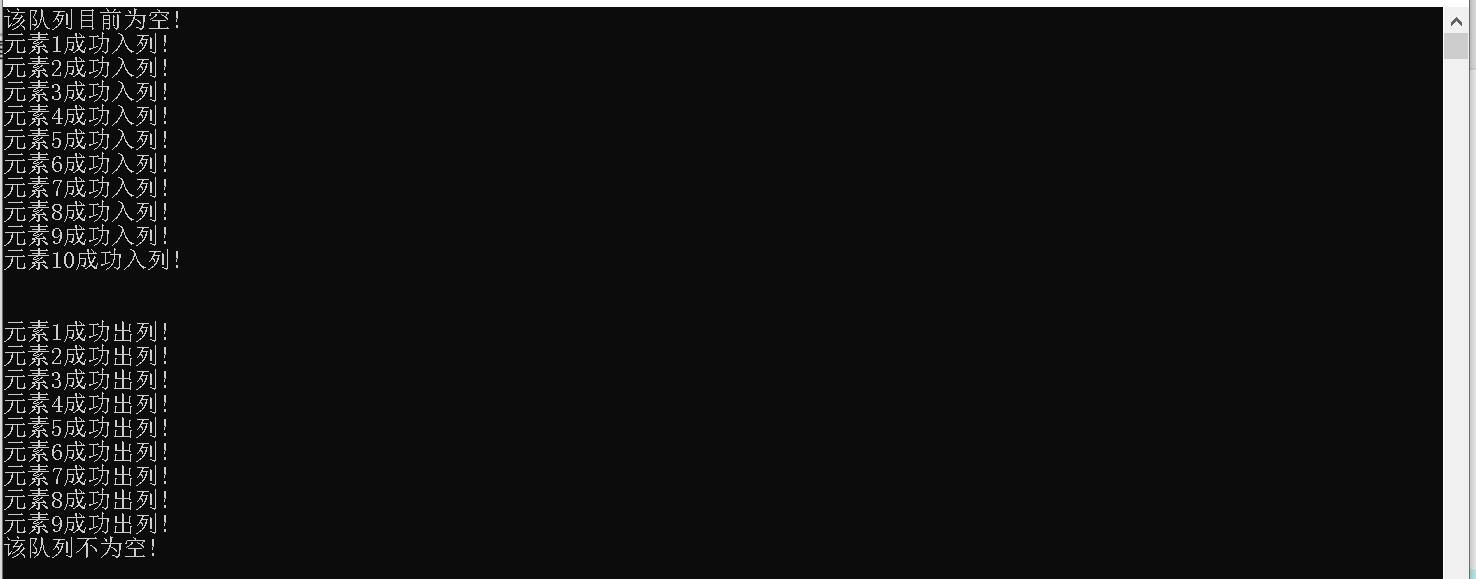
运行结果:
四、 实验小结
本实验以栈和队列的内容为基础,利用C++软件对其相关的应用和推广进行算法实现,从而加深我们对栈和队列的理解。我们先对数据结构的栈和队列进行基础性学习,了解相关的伪代码,为后面的的算法实现奠定基础。在充分学习了栈和队列的内容后,我们对所给的代码进行初步的学习和认识,以此方便我们下一步地编码。为了代码更好地实现,我们充分地利用网络及书籍等各种资源,并进行认真学习,对每部分代码模块的内容有了一定地了解后尝试编码。
五、 评语

 浙公网安备 33010602011771号