实验六
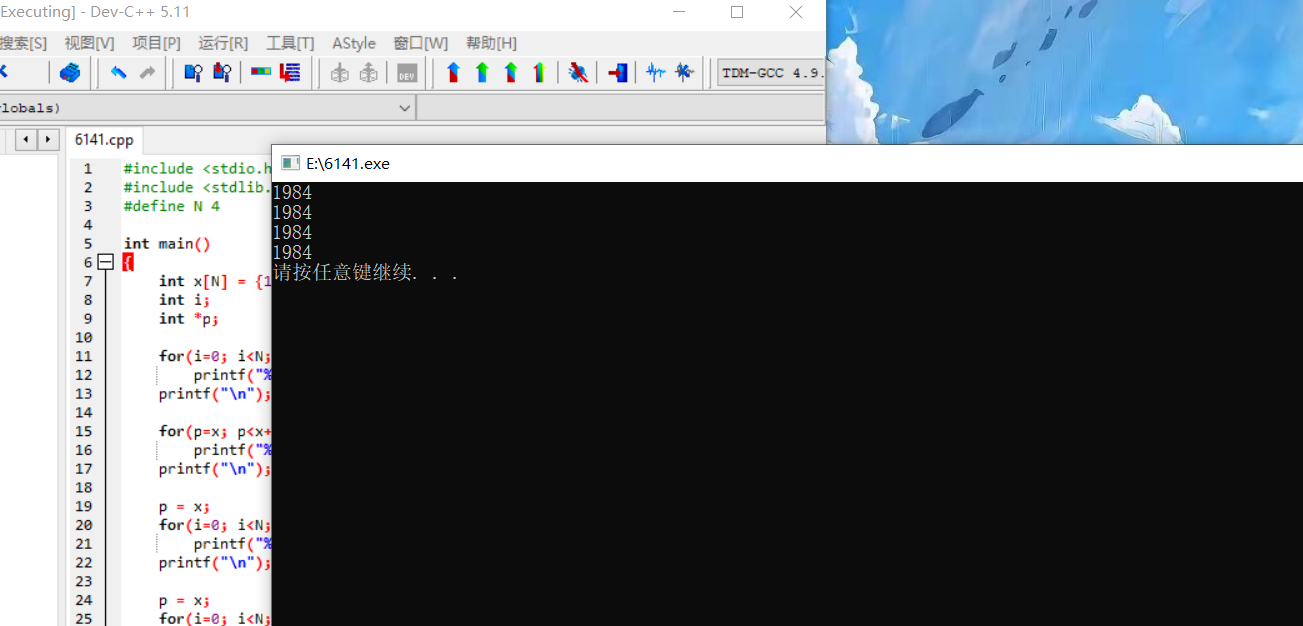
#include <stdio.h>
#include <stdlib.h>
#define N 4

int main()
{
    int x[N] = {1, 9, 8, 4};
    int i;
    int *p;

    for(i=0; i<N; ++i)
        printf("%d", x[i]);
    printf("\n");

    for(p=x; p<x+N; ++p)
        printf("%d", *p);
    printf("\n");

    p = x;
    for(i=0; i<N; ++i)
        printf("%d", *(p+i));
    printf("\n");

    p = x;
    for(i=0; i<N; ++i)
        printf("%d", p[i]);
    printf("\n");

    system("pause");

}
#include <stdio.h>
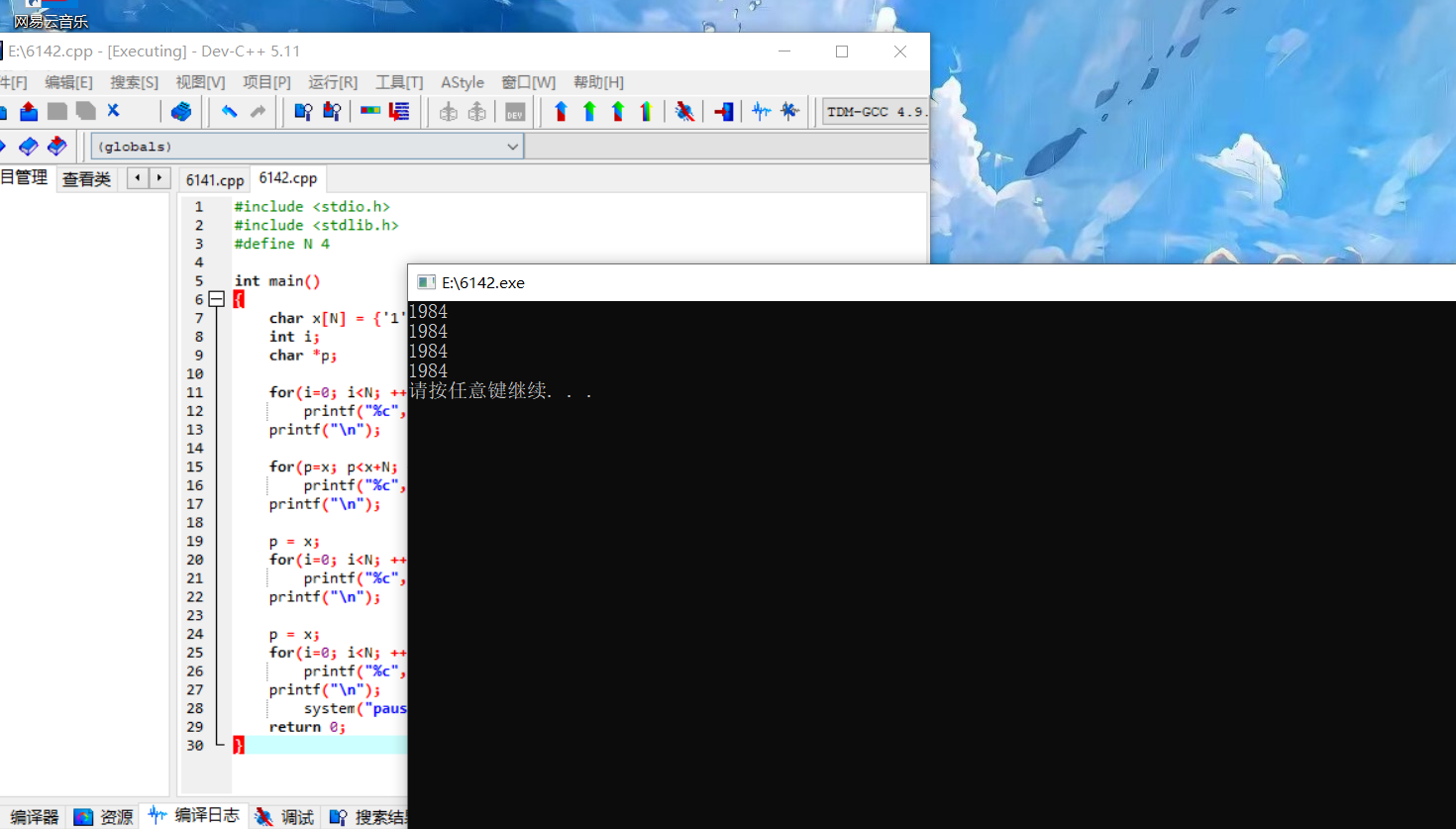
#include <stdlib.h>
#define N 4

int main()
{
    char x[N] = {'1', '9', '8', '4'};
    int i;
    char *p;

    for(i=0; i<N; ++i)
        printf("%c", x[i]);
    printf("\n");

    for(p=x; p<x+N; ++p)
        printf("%c", *p);
    printf("\n");

    p = x;
    for(i=0; i<N; ++i)
        printf("%c", *(p+i));
    printf("\n");

    p = x;
    for(i=0; i<N; ++i)
        printf("%c", p[i]);
    printf("\n");
        system("pause");
    return 0;
}
2004
2001
int型指针变量占四个字节的内存单元
char型指针变量占一个字节的内存单元
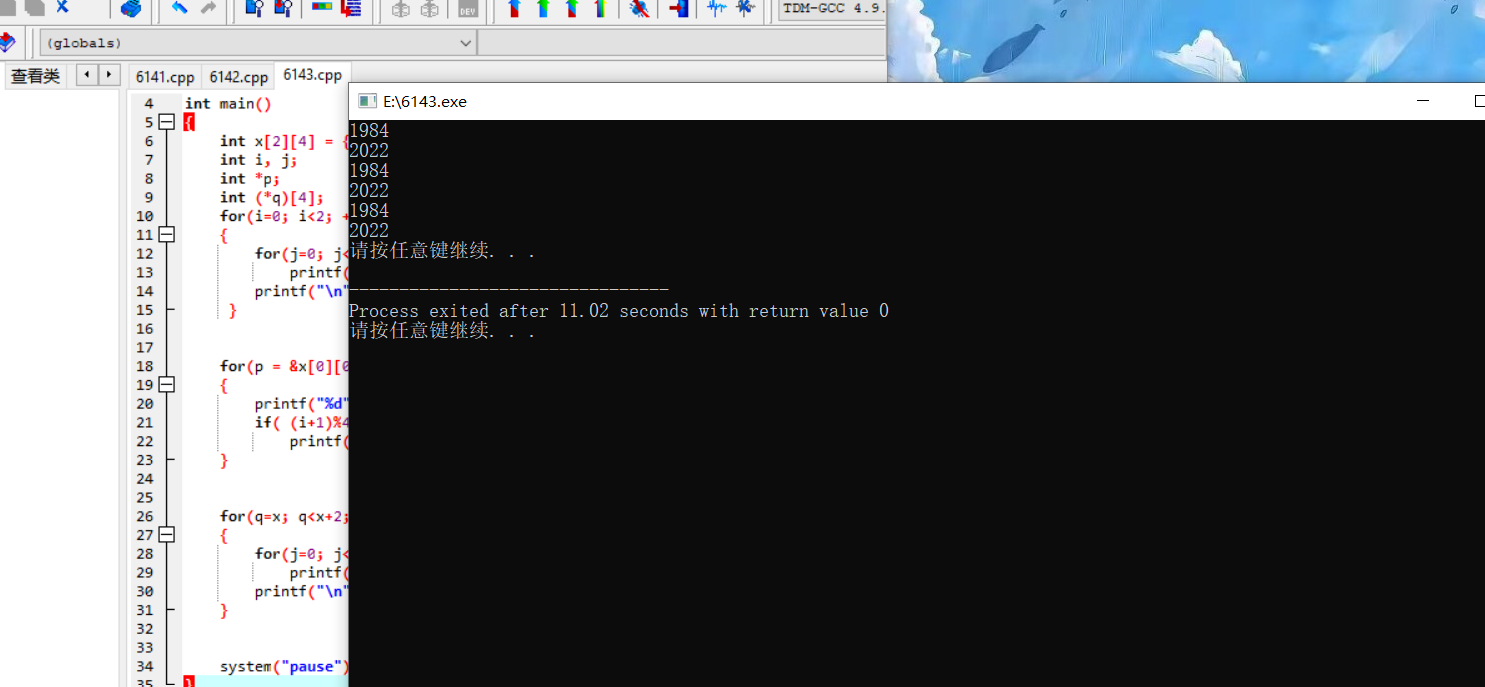
#include <stdio.h>
#include <stdlib.h>

int main()
{
    int x[2][4] = { {1,9,8,4}, {2,0,2,2}} ;
    int i, j;
    int *p;
    int (*q)[4];
    for(i=0; i<2; ++i)
    {
        for(j=0; j<4; ++j)
            printf("%d", x[i][j]);
        printf("\n");
     }


    for(p = &x[0][0], i = 0; p < &x[0][0] + 8; ++p, ++i)
    {
        printf("%d", *p);
        if( (i+1)%4 == 0)
            printf("\n");
    }


    for(q=x; q<x+2; ++q)
    {
        for(j=0; j<4; ++j)
            printf("%d", *(*q+j));
        printf("\n");
    }


    system("pause");
}
#include <stdio.h>
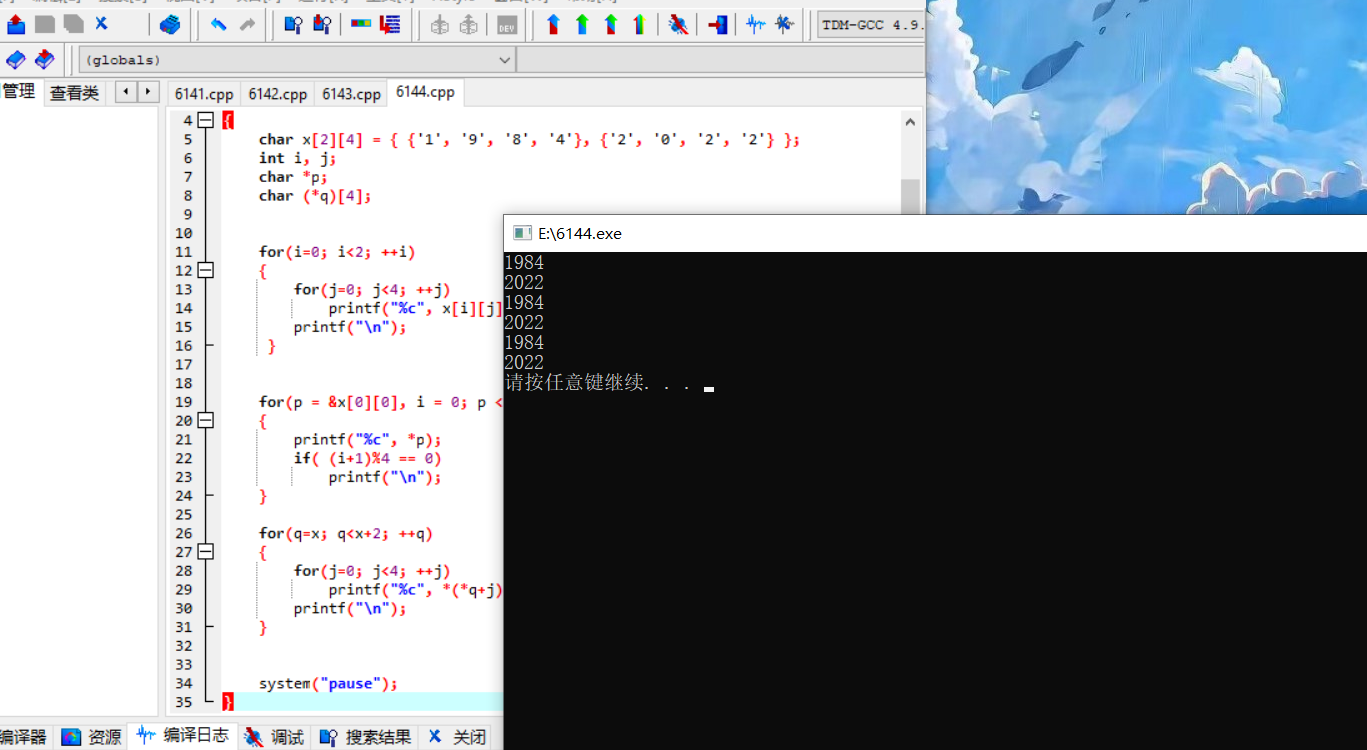
#include <stdlib.h>
int main()
{
    char x[2][4] = { {'1', '9', '8', '4'}, {'2', '0', '2', '2'} };
    int i, j;
    char *p;
    char (*q)[4];


    for(i=0; i<2; ++i)
    {
        for(j=0; j<4; ++j)
            printf("%c", x[i][j]);
        printf("\n");
     }


    for(p = &x[0][0], i = 0; p < &x[0][0] + 8; ++p, ++i)
    {
        printf("%c", *p);
        if( (i+1)%4 == 0)
            printf("\n");
    }

    for(q=x; q<x+2; ++q)
    {
        for(j=0; j<4; ++j)
            printf("%c", *(*q+j));
        printf("\n");
    }


    system("pause");
}
2004 2016
2001 2004
p指向的是二维数组的指针变量
q指向的是一维数组的指针变量
#include <stdio.h>
#include <string.h>
#define N 80

int main()
{
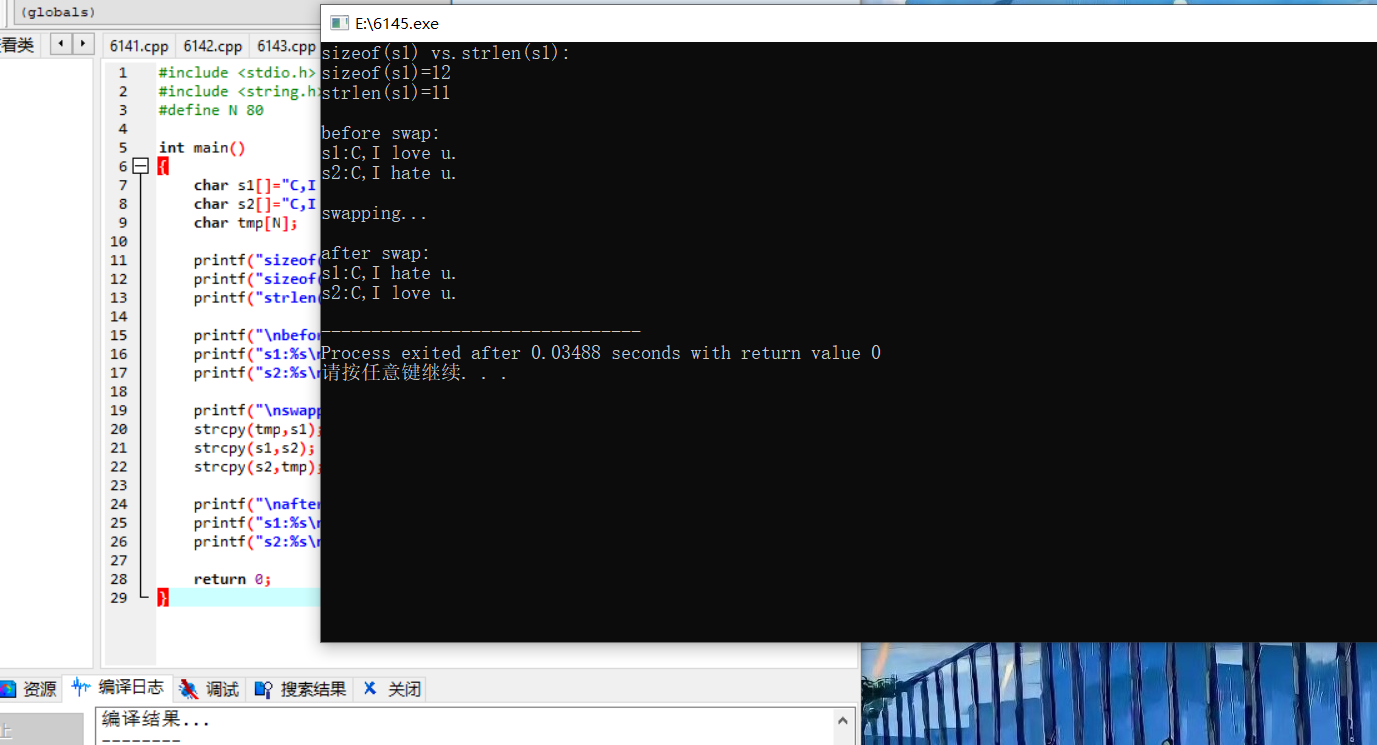
    char s1[]="C,I love u.";
    char s2[]="C,I hate u.";
    char tmp[N];

    printf("sizeof(s1) vs.strlen(s1):\n");
    printf("sizeof(s1)=%d\n",sizeof(s1));
    printf("strlen(s1)=%d\n",strlen(s1));

    printf("\nbefore swap: \n");
    printf("s1:%s\n",s1);
    printf("s2:%s\n",s2);

    printf("\nswapping...\n");
    strcpy(tmp,s1);
    strcpy(s1,s2);
    strcpy(s2,tmp);

    printf("\nafter swap: \n");
    printf("s1:%s\n",s1);
    printf("s2:%s\n",s2);

    return 0;
}
#include <stdio.h>
#include <string.h>
#define N 80
int main()
{
#include <stdio.h>
#include <string.h>
#define N 5
int check_id(char *str);

int main()
{
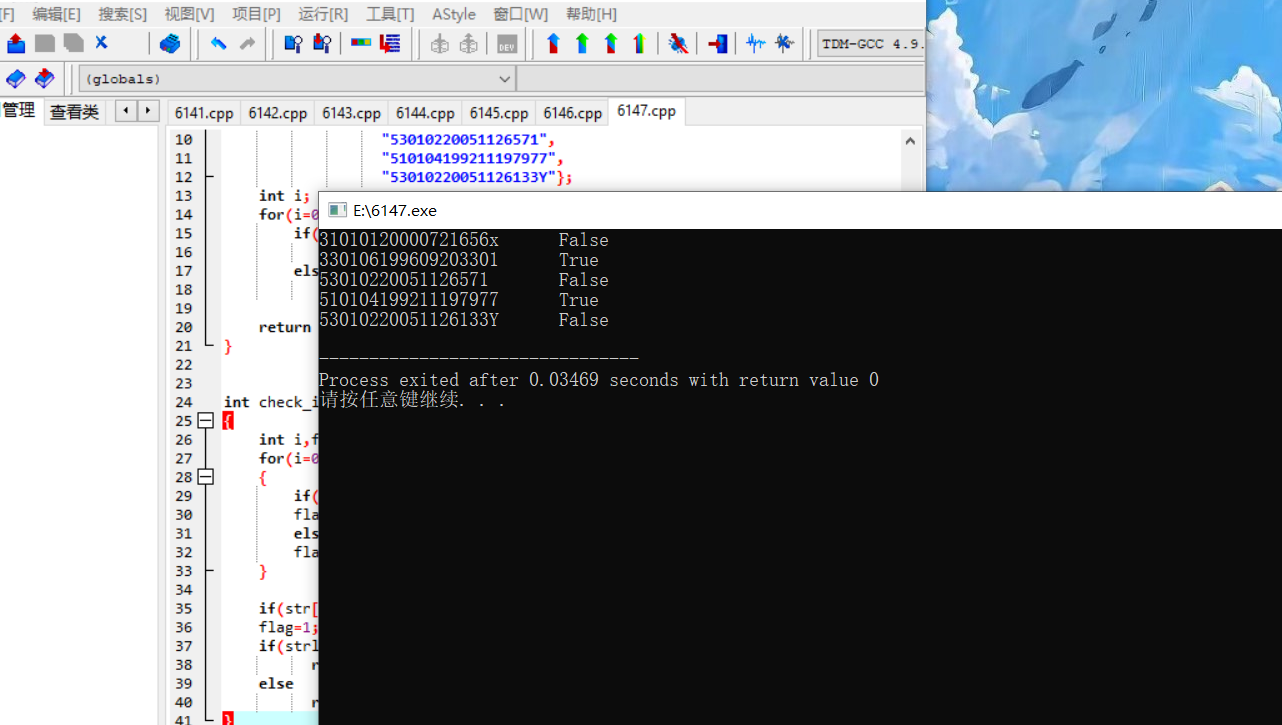
    char *pid[N]={"31010120000721656x",
                  "330106199609203301",
                  "53010220051126571",
                  "510104199211197977",
                  "53010220051126133Y"};
    int i;
    for(i=0;i<N;++i)
        if(check_id(pid[i]))
           printf("%s\tTrue\n",pid[i]);
        else
           printf("%s\tFalse\n",pid[i]);

    return 0;
}


int check_id(char *str)
{
    int i,flag;
    for(i=0;i<=17;i++)
    {
        if(str[i]>='0'&&str[i]<='9')
        flag=1;
        else
        flag=0;
    }

    if(str[17]=='X')
    flag=1;
    if(strlen(str)==18&&flag==1)
          return 1;
    else
          return 0;
}
#include <stdio.h>
#include <string.h>

#define N 80
int is_palindrome(char *s);
int main()
{
    char str[N];
    int flag;

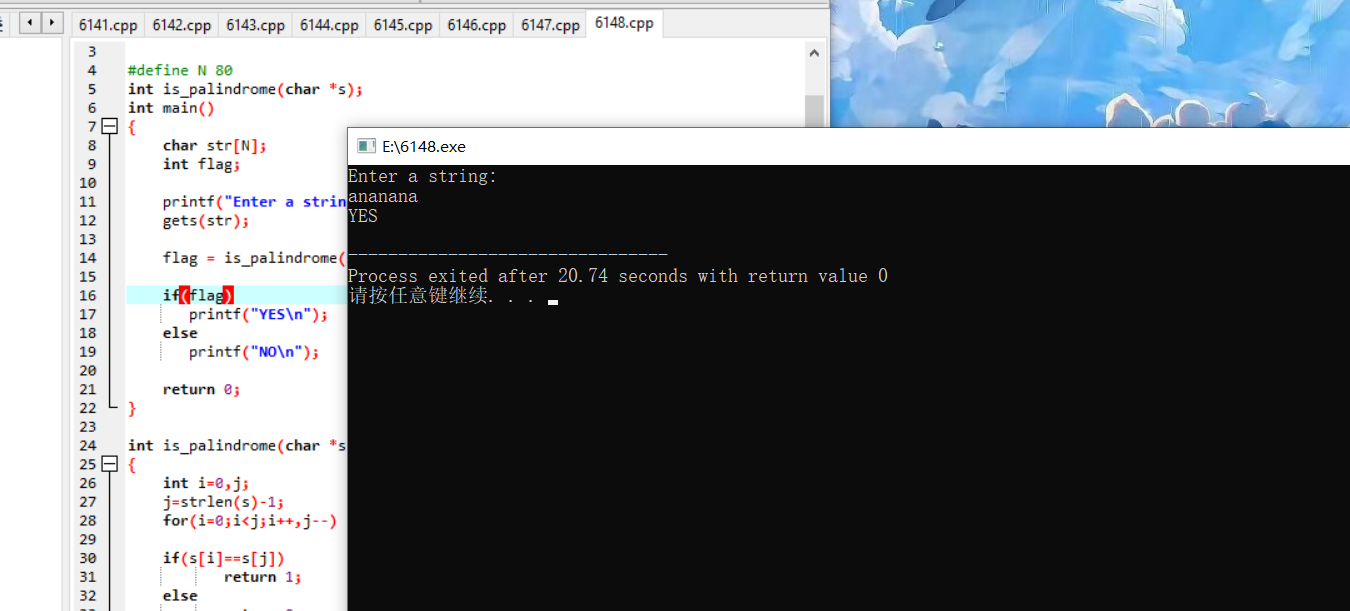
    printf("Enter a string:\n");
    gets(str);

    flag = is_palindrome(str);

    if(flag)
       printf("YES\n");
    else
       printf("NO\n");

    return 0;
}

int is_palindrome(char *s)
{
    int i=0,j;
    j=strlen(s)-1;
    for(i=0;i<j;i++,j--)

    if(s[i]==s[j])
           return 1;
    else
           return 0;
}
#include <stdio.h>
#define N 80
void encoder(char *s);
void decoder(char *s);

int main()
{
    char words[N];
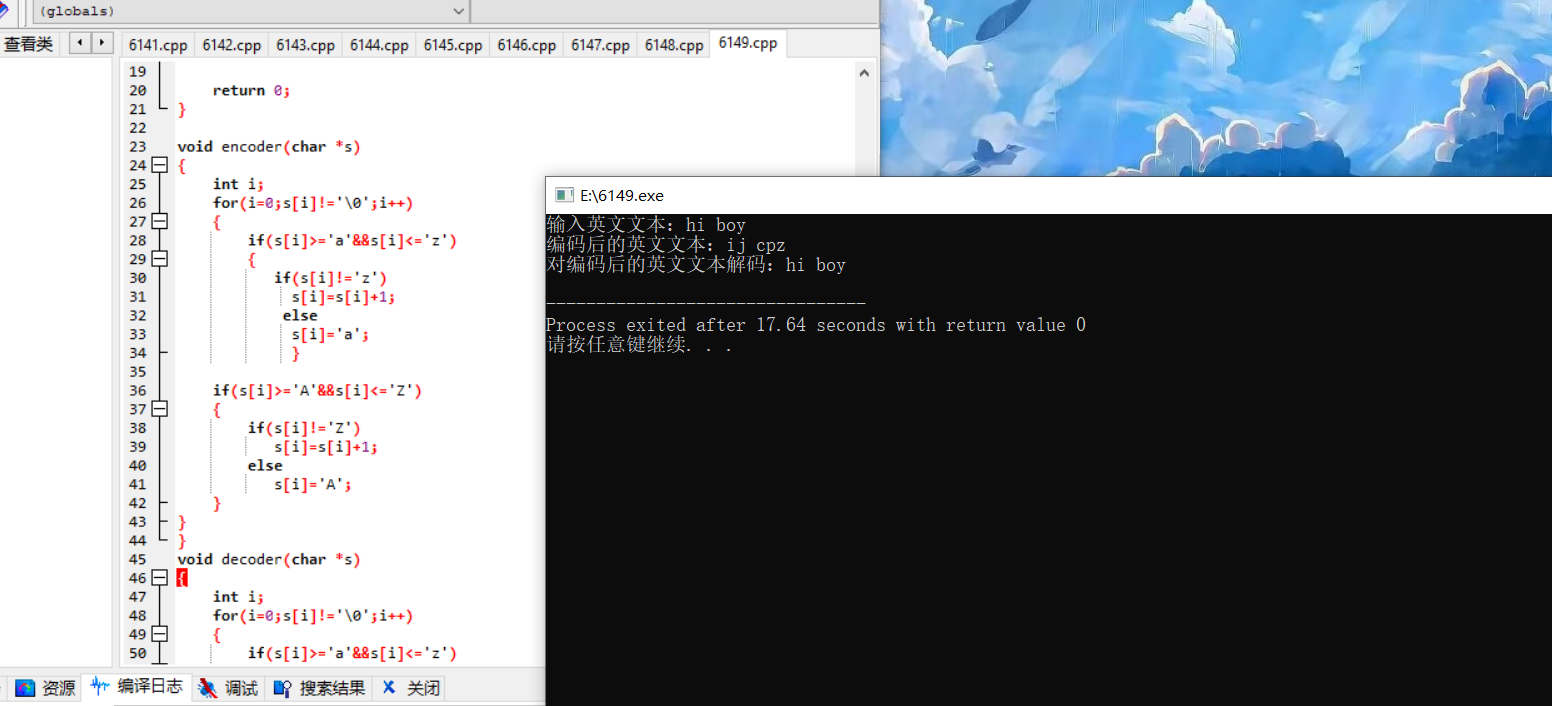
    printf("输入英文文本:");
    gets(words);

    printf("编码后的英文文本:");
    encoder(words);
    printf("%s\n",words);

    printf("对编码后的英文文本解码:");
    decoder(words);
    printf("%s\n",words);

    return 0;
}

void encoder(char *s)
{
    int i;
    for(i=0;s[i]!='\0';i++)
    {
        if(s[i]>='a'&&s[i]<='z')
        {
           if(s[i]!='z')
             s[i]=s[i]+1;
            else
             s[i]='a';
             }

    if(s[i]>='A'&&s[i]<='Z')
    {
        if(s[i]!='Z')
           s[i]=s[i]+1;
        else
           s[i]='A';
    }
}
}
void decoder(char *s)
{
    int i;
    for(i=0;s[i]!='\0';i++)
    {
        if(s[i]>='a'&&s[i]<='z')
        {
            if(s[i]!='a')
               s[i]=s[i]-1;
            else
               s[i]='z';
        }
    if(s[i]>='A'&&s[i]<='Z')
    {
        if(s[i]!='A')
           s[i]=s[i]-1;
        else
           s[i]='Z';
    }
    }
}
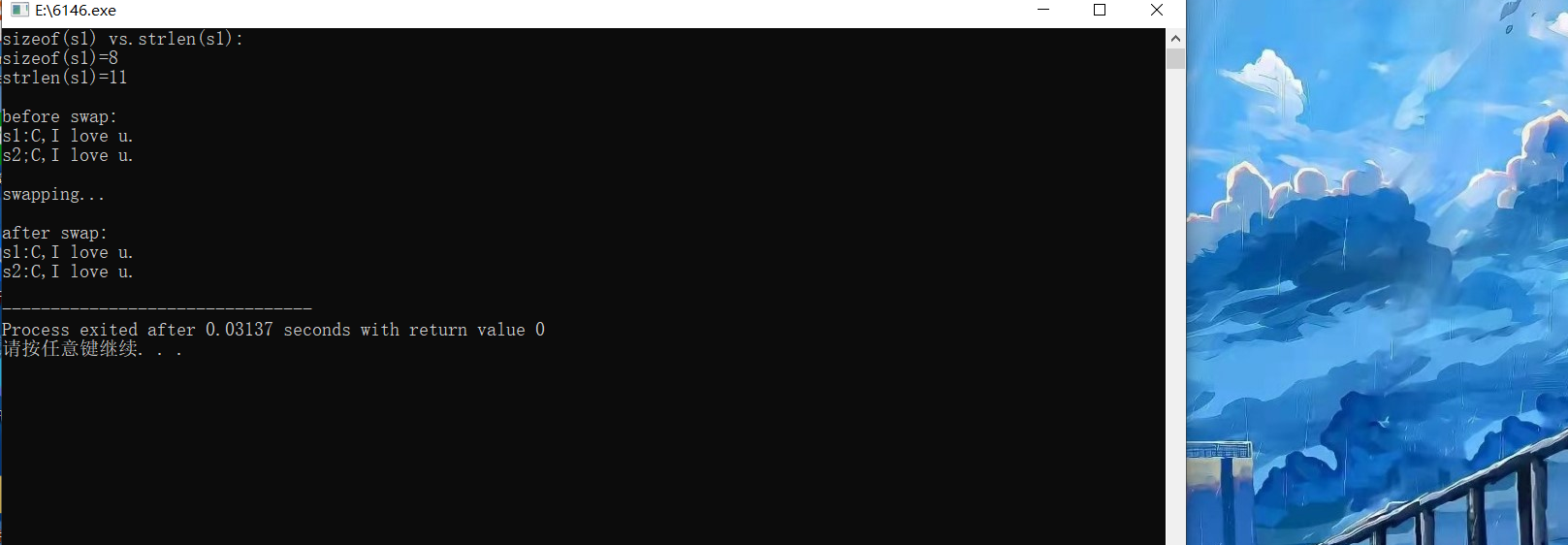
char *s1="C,I love u.";
    char *s2="C,I love u.";
    char *tmp;

    printf("sizeof(s1) vs.strlen(s1):\n");
    printf("sizeof(s1)=%d\n",sizeof(s1));
    printf("strlen(s1)=%d\n",strlen(s1));

    printf("\nbefore swap:\n");
    printf("s1:%s\n",s1);
    printf("s2;%s\n",s2);

    printf("\nswapping...\n");
    tmp=s1;
    s1=s2;
    s2=tmp;
    printf("\nafter swap:\n");
    printf("s1:%s\n",s1);
    printf("s2:%s\n",s2);

    return 0;
}

 浙公网安备 33010602011771号