
实验五
task1.1.c
#include <stdio.h>
#define N 4
int main()
{
    int x[N] = { 1, 9, 8, 4 };
    int i;
    int* p;
    // 方式1:通过数组名和下标遍历输出数组元素
    for (i = 0; i < N; ++i)
        printf("%d", x[i]);
    printf("\n");
    // 方式2:通过指针变量遍历输出数组元素 (写法1)
    for (p = x; p < x + N; ++p)
        printf("%d", *p);
    printf("\n");
    // 方式2:通过指针变量遍历输出数组元素(写法2)
    p = x;
    for (i = 0; i < N; ++i)
        printf("%d", *(p + i));
    printf("\n");
    // 方式2:通过指针变量遍历输出数组元素(写法3)
    p = x;
    for (i = 0; i < N; ++i)
        printf("%d", p[i]);
    printf("\n");
    return 0;
}
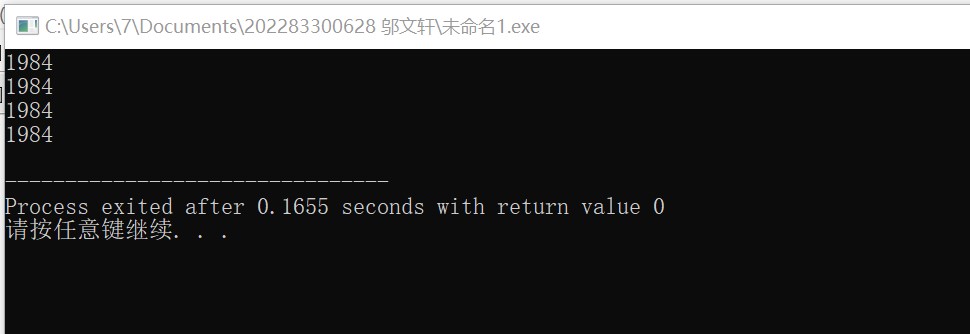
task1.2.c
#include <stdio.h>
int main()
{
    int x[2][4] = { {1, 9, 8, 4}, {2, 0, 4, 9} };
    int i, j;
    int* p; // 指针变量,存放int类型数据的地址
    int(*q)[4]; // 指针变量,指向包含4个int型元素的一维数组
    // 使用数组名、下标访问二维数组元素
    for (i = 0; i < 2; ++i)
    {
        for (j = 0; j < 4; ++j)
            printf("%d", x[i][j]);
        printf("\n");
    }
    // 使用指针变量p间接访问二维数组元素
    for (p = &x[0][0], i = 0; p < &x[0][0] + 8; ++p, ++i)
    {
        printf("%d", *p);
        if ((i + 1) % 4 == 0)
            printf("\n");
    }
    // 使用指针变量q间接访问二维数组元素
    for (q = x; q < x + 2; ++q)
    {
        for (j = 0; j < 4; ++j)
            printf("%d", *(*q + j));
        printf("\n");
    }
    return 0;
}
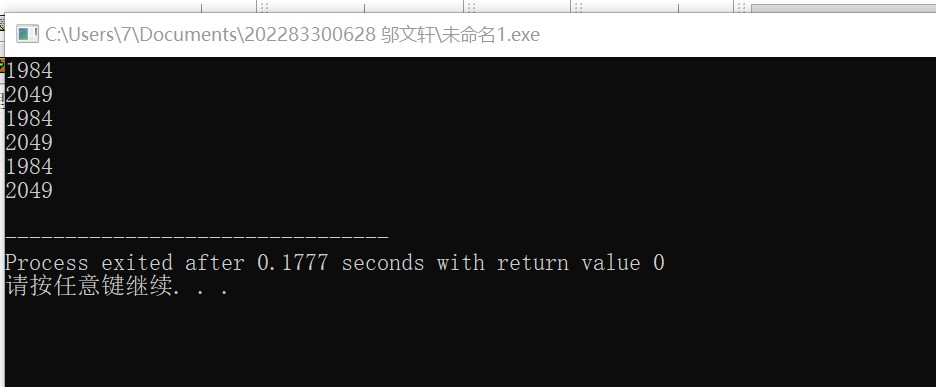
task2.1.c
#include <stdio.h>
#include <string.h>
#define N 80

int main()
{
    char s1[] = "Learning makes me happy";
    char s2[] = "Learning makes me sleepy";
    char tmp[N];
    printf("sizeof(s1) vs. strlen(s1): \n");
    printf("sizeof(s1) = %d\n", sizeof(s1));
    printf("strlen(s1) = %d\n", strlen(s1));
    printf("\nbefore swap: \n");
    printf("s1: %s\n", s1);
    printf("s2: %s\n", s2);
    printf("\nswapping...\n");
    strcpy(tmp, s1);
    strcpy(s1, s2);
    strcpy(s2, tmp);
    printf("\nafter swap: \n");
    printf("s1: %s\n", s1);
    printf("s2: %s\n", s2);
    return 0;
}
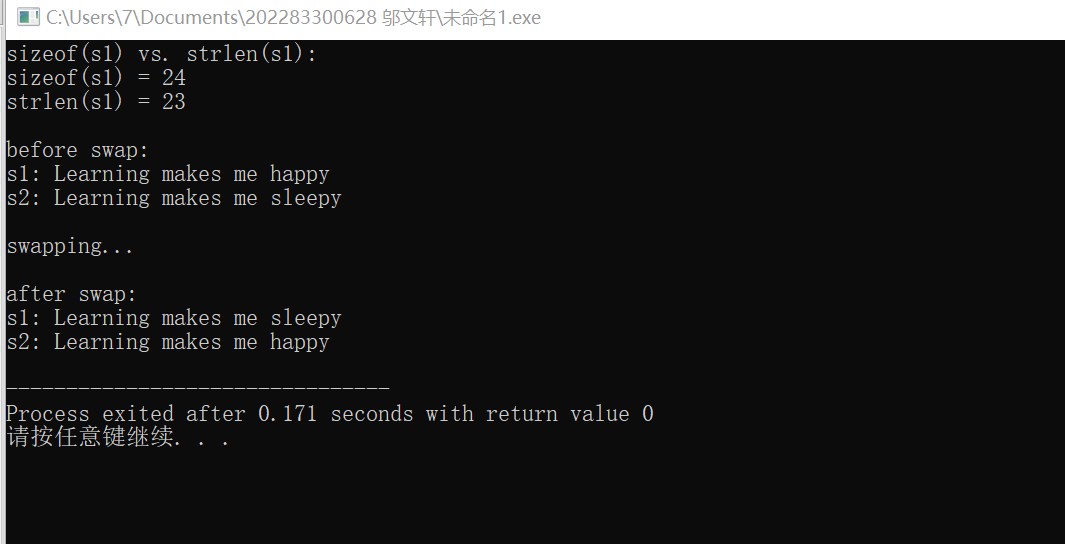
1.大小:24:;字节数;有效长度
2.不能;原因:s1是地址常量,不能赋值
task2.2.c
#include <stdio.h>
#include <string.h>
#define N 80
int main()
{
char *s1 = "Learning makes me happy";
char *s2 = "Learning makes me sleepy";
char *tmp;
printf("sizeof(s1) vs. strlen(s1): \n");
printf("sizeof(s1) = %d\n", sizeof(s1));
printf("strlen(s1) = %d\n", strlen(s1));
printf("\nbefore swap: \n");
printf("s1: %s\n", s1);
printf("s2: %s\n", s2);
printf("\nswapping...\n");
tmp = s1;
s1 = s2;
s2 = tmp;
printf("\nafter swap: \n");
printf("s1: %s\n", s1);
printf("s2: %s\n", s2);
return 0;
}
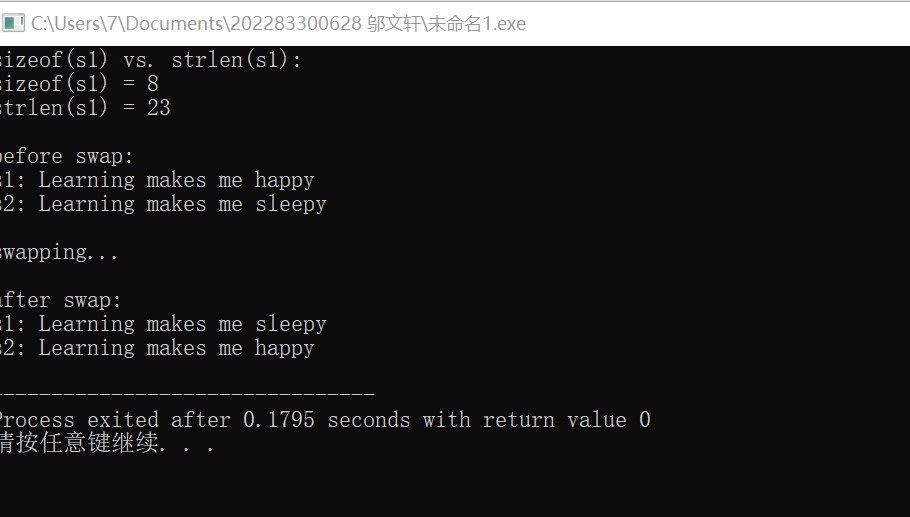
1.字符串的地址;地址的字节数(8字节即64位);字符串的有效长度
2.可以;task2_1.c中line7指定义字符串数组并初始化,该代码指定义指针变量,并使用字符串地址初始化,进而间接访问
task3.c
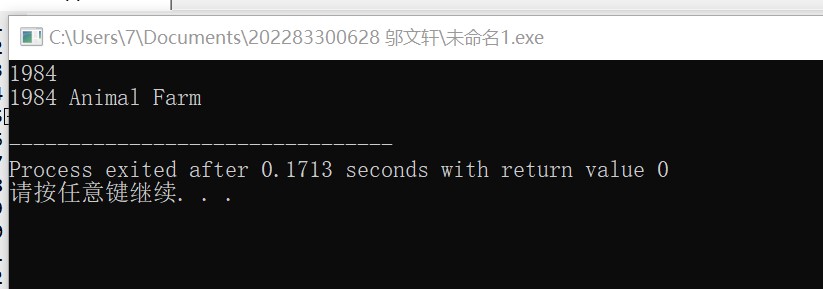
#include <stdio.h>
void str_cpy(char* target, const char* source);
void str_cat(char* str1, char* str2);
int main()
{
    char s1[80], s2[20] = "1984";
    str_cpy(s1, s2);
    puts(s1);
    str_cat(s1, " Animal Farm");
    puts(s1);
    return 0;
}
void str_cpy(char* target, const char* source)
{
    while (*target++ = *source++)
        ;
}
void str_cat(char* str1, char* str2)
{
    while (*str1)
        str1++;
    while (*str1++ = *str2++)
        ;
}
task4.c
#include <stdio.h>
#define N 80
int func(char*);
int main()
{
    char str[80];
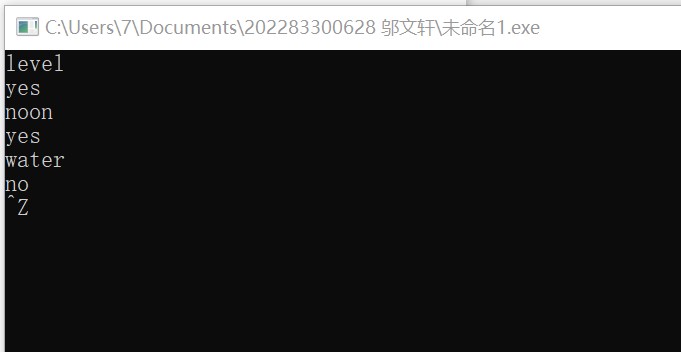
    while (gets(str) != NULL)
    {
        if (func(str))
            printf("yes\n");
        else
            printf("no\n");
    }
    return 0;
}
int func(char* str)
{
    char* begin, * end;
    begin = end = str;
    while (*end)
        end++;
    end--;
    while (begin < end)
    {
        if (*begin != *end)
            return 0;
        else
        {
            begin++;
            end--;
        }
    }return 1;
}
task5.c
#include <stdio.h>
#define N 80
void func(char*);
int main()
{
    char s[N];
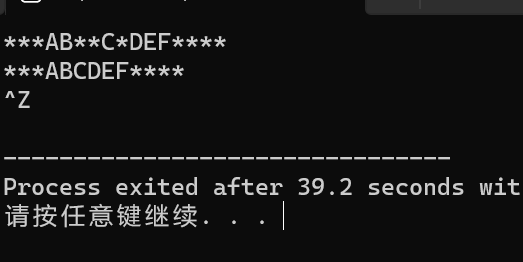
    while (scanf("%s", s) != EOF)
    {
        func(s);
        puts(s);
    }
    return 0;
}
void func(char* str)
{
    int i;
    char* p1, * p2, * p;
    p1 = str;
    while (*p1 == '*')
        p1++;
    p2 = str;
    while (*p2)
        p2++;
    p2--;
    while (*p2 == '*')
        p2--;
    p = str;
    i = 0;
    while (p < p1)
    {
        str[i] = *p;
        p++;
        i++;
    }
    while (p <= p2)
    {
        if (*p != '*')
        {
            str[i] = *p;
            i++;
        }
        p++;
    }
    while (*p != '\0')
    {
        str[i] = *p;
        p++;
        i++;
    }
    str[i] = '\0';
}
task6.1.c
#include <stdio.h>
#include <string.h>
void sort(char* name[], int n);
int main()
{
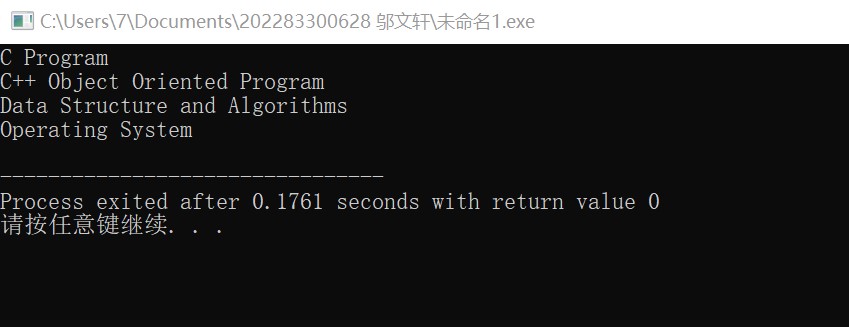
    char* course[4] = { "C Program",
    "C++ Object Oriented Program",
    "Operating System",
    "Data Structure and Algorithms" };
    int i;
    sort(course, 4);
    for (i = 0; i < 4; i++)
        printf("%s\n", course[i]);
    return 0;
}
void sort(char* name[], int n)
{
    int i, j;
    char* tmp;
    for (i = 0; i < n - 1; ++i)
        for (j = 0; j < n - 1 - i; ++j)
            if (strcmp(name[j], name[j + 1]) > 0)
            {
                tmp = name[j];
                name[j] = name[j + 1];
                name[j + 1] = tmp;
            }
}
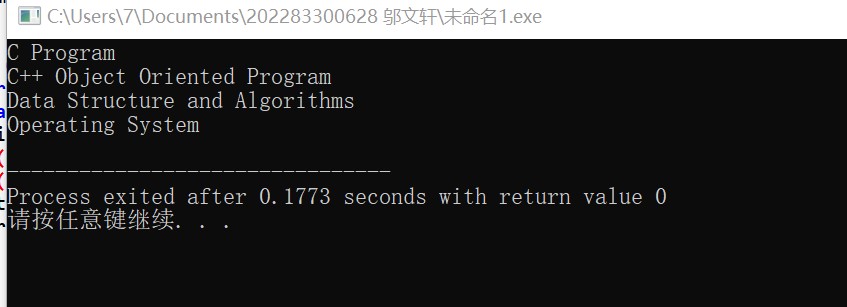
task6.2.c
#include <stdio.h>
#include <string.h>
void sort(char *name[], int n);
int main()
{
char *course[4] = {"C Program",
"C++ Object Oriented Program",
"Operating System",
"Data Structure and Algorithms"};
int i;
sort(course, 4);
for (i = 0; i < 4; i++)
printf("%s\n", course[i]);
return 0;
}
void sort(char *name[], int n)
{
int i, j, k;
char *tmp;
for (i = 0; i < n - 1; i++)
{
k = i;
for (j = i + 1; j < n; j++)
if (strcmp(name[j], name[k]) < 0)
k = j;
if (k != i)
{
tmp = name[i];
name[i] = name[k];
name[k] = tmp;
}
}
}
task7.c
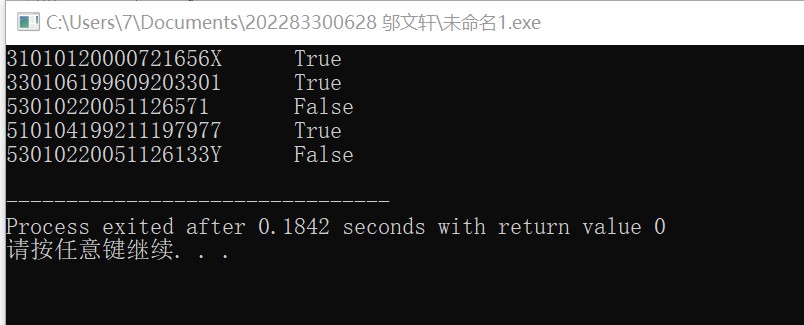
#include <stdio.h>
#include <string.h>
#define N 5

int check_id(char* str); // 函数声明

int main()
{
    char* pid[N] = { "31010120000721656X",
                    "330106199609203301",
                    "53010220051126571",
                    "510104199211197977",
                    "53010220051126133Y" };
    int i;

    for (i = 0; i < N; ++i)
        if (check_id(pid[i])) // 函数调用
            printf("%s\tTrue\n", pid[i]);
        else
            printf("%s\tFalse\n", pid[i]);

    return 0;
}

// 函数定义
// 功能: 检查指针str指向的身份证号码串形式上是否合法。
// 形式合法,返回1,否则,返回0
int check_id(char* str)
{
    int i;
    for (i = 0; str[i] != '\0'; i++);
    if (i != 18) return 0;
    if (str[i - 1] < '0' || str[i - 1] > '9' && str[i - 1] != 'X') return 0;
    for (i = 0; i < 17; i++)
    {
        if (str[i] > '9' || str[i] < '0')
            return 0;

    }int j, year = 0, month = 0, day = 0;

    for (j = 6; j <= 9; j++)
        year = 10 * year +(str[j]-'0');
    for (j = 10; j <= 11; j++)
        month = 10 * month + (str[j] - '0');
    for (j = 12; j <= 13; j++)
        day = 10 * day + (str[j] - '0');

    if (year>2023) { return 0; }
    switch (month)
    {
    case 1:
    case 3:
    case 5:
    case 7:
    case 8:
    case 10:
    case 12:if (day > 31) return 0; break;
    case 4:
    case 6:
    case 9:
    case 11:if (day > 30) return 0; break;
    }if (month == 2)

    {
        if (year % 4 == 0 && year % 100 != 0 || year % 400 == 0)

        {
            if (day > 29) return 0;
        }
        else
        {
            if (day > 28) return 0;
        }

    }

    return 1;

}
task8.c
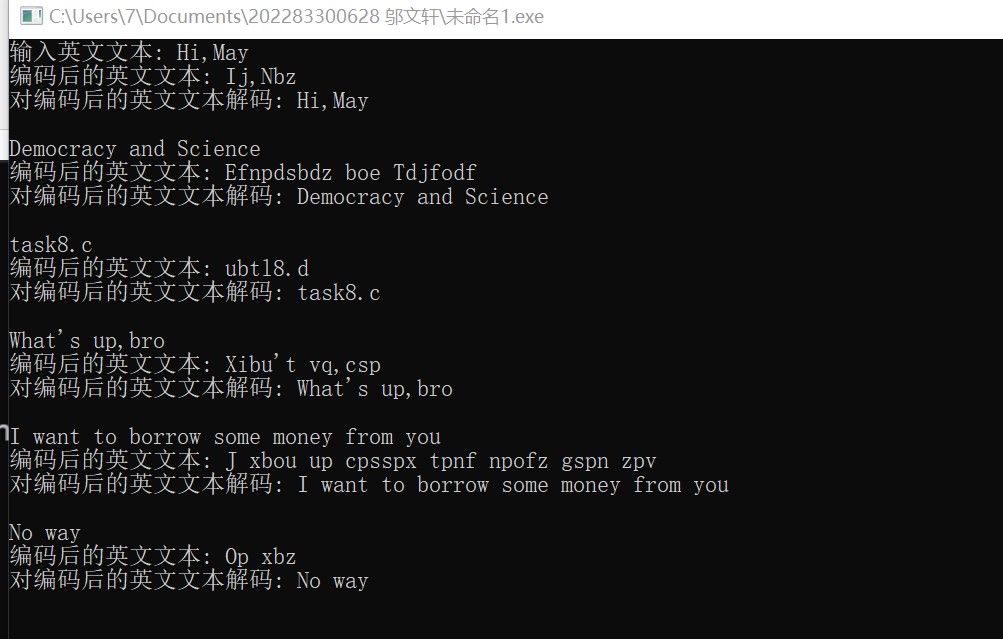
#include <stdio.h>
#define N 80
void encoder(char* s); // 函数声明
void decoder(char* s); // 函数声明

int main()
{
    char words[N];

    printf("输入英文文本: ");
    while (gets(words) != " ") {

        printf("编码后的英文文本: ");
        encoder(words); // 函数调用
        printf("%s\n", words);

        printf("对编码后的英文文本解码: ");
        decoder(words); // 函数调用
        printf("%s\n", words);
        printf("\n");
    }
    return 0;
}

/*函数定义
功能:对s指向的字符串进行编码处理
编码规则:
对于a~z或A~Z之间的字母字符,用其后的字符替换; 其中,z用a替换,Z用A替换
其它非字母字符,保持不变
*/
void encoder(char* s)
{
    int i;

    for (i = 0; s[i] != '\0'; i++)
    {
        if (s[i] < 'A' || s[i]>'Z' && s[i] < 'a' || s[i]>'z')
            s[i] = s[i];
        else if (s[i] != 'Z' && s[i] != 'z')
            s[i] = s[i] + 1;
        else if (s[i] == 'z')
            s[i] = 'a';
        else
            s[i] = 'A';
    }

}

/*函数定义
功能:对s指向的字符串进行解码处理
解码规则:
对于a~z或A~Z之间的字母字符,用其前面的字符替换; 其中,a用z替换,A用Z替换
其它非字母字符,保持不变
*/
    void decoder(char* s)
    {
        int i;
        for (i = 0; s[i] != '\0'; i++)
        {
            if (s[i] < 'A' || s[i]>'Z' && s[i] < 'a' || s[i]>'z')
                s[i] = s[i];
             else if (s[i] != 'A' && s[i] != 'a')
                s[i] = s[i] - 1;
            else if (s[i] == 'A')
                s[i] = 'Z';
            else
                s[i] = 'z';
        }
    }

 浙公网安备 33010602011771号