
12.6.0 头文件
import torch
from torch import nn
from d2l import torch as d2l
12.6.1 定义ResNet-18网络模型
# 定义ResNet-18网络模型
def resnet18(num_classes, in_channels=1):
    """稍加修改的ResNet-18模型"""
    def resnet_block(in_channels, out_channels, num_residuals,first_block=False):
        blk = []
        for i in range(num_residuals):
            if i == 0 and not first_block:
                blk.append(d2l.Residual(in_channels, out_channels,use_1x1conv=True, strides=2))
            else:
                blk.append(d2l.Residual(out_channels, out_channels))
        return nn.Sequential(*blk)

    # 该模型使用了更小的卷积核、步长和填充,而且删除了最大汇聚层
    net = nn.Sequential(
        nn.Conv2d(in_channels, 64, kernel_size=3, stride=1, padding=1),
        nn.BatchNorm2d(64),
        nn.ReLU())
    net.add_module("resnet_block1", resnet_block(64, 64, 2, first_block=True))
    net.add_module("resnet_block2", resnet_block(64, 128, 2))
    net.add_module("resnet_block3", resnet_block(128, 256, 2))
    net.add_module("resnet_block4", resnet_block(256, 512, 2))
    net.add_module("global_avg_pool", nn.AdaptiveAvgPool2d((1,1)))
    net.add_module("fc", nn.Sequential(nn.Flatten(),nn.Linear(512, num_classes)))
    return net
net = resnet18(10)

# 获取GPU列表
devices = d2l.try_all_gpus()
12.6.2 利用多GPU来训练网络模型
def train(net, num_gpus, batch_size, lr):
    # 下载fashion_mnist,并对数据集进行打乱和按批量大小进行切割的操作,得到可迭代的训练集和测试集(训练集和测试集的形式都为(特征数据集合,数字标签集合))
    train_iter, test_iter = d2l.load_data_fashion_mnist(batch_size)
    # 获取要求的GPU列表
    devices = [d2l.try_gpu(i) for i in range(num_gpus)]
    # 初始化全连接层和卷积层的权重
    def init_weights(m):
        if type(m) in [nn.Linear, nn.Conv2d]:
            nn.init.normal_(m.weight, std=0.01)
    net.apply(init_weights)
    # 在多个GPU上设置模型
    # 把模型参数拷贝到每个GPU上,把样本和标签均分到多个GPU上
    net = nn.DataParallel(net, device_ids=devices)
    # 定义梯度下降优化器
    trainer = torch.optim.SGD(net.parameters(), lr)
    # 定义交叉熵损失函数
    loss = nn.CrossEntropyLoss()
    # 定义定时器和训练轮数
    timer, num_epochs = d2l.Timer(), 10
    # 定义动画,用来显示训练图像
    animator = d2l.Animator('epoch', 'test acc', xlim=[1, num_epochs])

    for epoch in range(num_epochs):
        # 开始一轮的训练过程
        net.train()
        timer.start()
        for X, y in train_iter:
            # 开始一个批量的训练过程
            trainer.zero_grad()
            X, y = X.to(devices[0]), y.to(devices[0])
            # 更新模型参数
            l = loss(net(X), y)
            l.backward()
            trainer.step()
        timer.stop()
        # 经过一轮的训练,记录下此时更新参数后的网络模型在测试集上的平均准确率
        animator.add(epoch + 1, (d2l.evaluate_accuracy_gpu(net, test_iter),))
    # 输出最终的模型在测试集上的准确率、每轮训练的平均时间以及用到的GPU
    print(f'测试精度:{animator.Y[0][-1]:.2f},{timer.avg():.1f}秒/轮,'f'在{str(devices)}')
12.6.3 使用单GPU和使用多GPU的训练结果对比
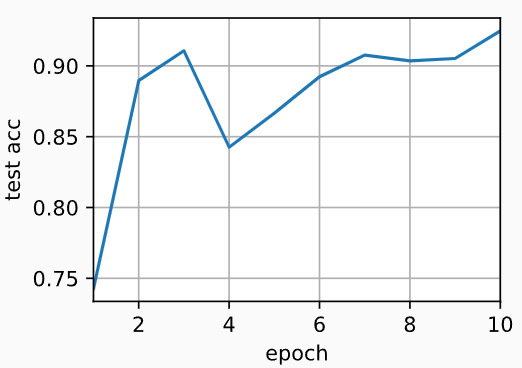
(1)单GPU
train(net, num_gpus=1, batch_size=256, lr=0.1)
# 输出:
# 测试精度:0.92,13.7秒/轮,在[device(type='cuda', index=0)]
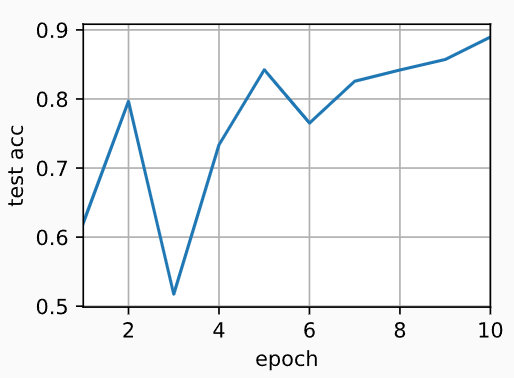
(2)双GPU
train(net, num_gpus=2, batch_size=512, lr=0.2)
# 输出:
# 测试精度:0.89,8.4秒/轮,在[device(type='cuda', index=0), device(type='cuda', index=1)]
本小节完整代码如下
import torch
from torch import nn
from d2l import torch as d2l

# ------------------------------定义ResNet-18网络模型------------------------------------

# 定义ResNet-18网络模型
def resnet18(num_classes, in_channels=1):
    """稍加修改的ResNet-18模型"""
    def resnet_block(in_channels, out_channels, num_residuals,first_block=False):
        blk = []
        for i in range(num_residuals):
            if i == 0 and not first_block:
                blk.append(d2l.Residual(in_channels, out_channels,use_1x1conv=True, strides=2))
            else:
                blk.append(d2l.Residual(out_channels, out_channels))
        return nn.Sequential(*blk)

    # 该模型使用了更小的卷积核、步长和填充,而且删除了最大汇聚层
    net = nn.Sequential(
        nn.Conv2d(in_channels, 64, kernel_size=3, stride=1, padding=1),
        nn.BatchNorm2d(64),
        nn.ReLU())
    net.add_module("resnet_block1", resnet_block(64, 64, 2, first_block=True))
    net.add_module("resnet_block2", resnet_block(64, 128, 2))
    net.add_module("resnet_block3", resnet_block(128, 256, 2))
    net.add_module("resnet_block4", resnet_block(256, 512, 2))
    net.add_module("global_avg_pool", nn.AdaptiveAvgPool2d((1,1)))
    net.add_module("fc", nn.Sequential(nn.Flatten(),nn.Linear(512, num_classes)))
    return net
net = resnet18(10)

# 获取GPU列表
devices = d2l.try_all_gpus()

# ------------------------------利用多GPU来训练网络模型------------------------------------

def train(net, num_gpus, batch_size, lr):
    # 下载fashion_mnist,并对数据集进行打乱和按批量大小进行切割的操作,得到可迭代的训练集和测试集(训练集和测试集的形式都为(特征数据集合,数字标签集合))
    train_iter, test_iter = d2l.load_data_fashion_mnist(batch_size)
    # 获取要求的GPU列表
    devices = [d2l.try_gpu(i) for i in range(num_gpus)]
    # 初始化全连接层和卷积层的权重
    def init_weights(m):
        if type(m) in [nn.Linear, nn.Conv2d]:
            nn.init.normal_(m.weight, std=0.01)
    net.apply(init_weights)
    # 在多个GPU上设置模型
    # 把模型参数拷贝到每个GPU上,把样本和标签均分到多个GPU上
    net = nn.DataParallel(net, device_ids=devices)
    # 定义梯度下降优化器
    trainer = torch.optim.SGD(net.parameters(), lr)
    # 定义交叉熵损失函数
    loss = nn.CrossEntropyLoss()
    # 定义定时器和训练轮数
    timer, num_epochs = d2l.Timer(), 10
    # 定义动画,用来显示训练图像
    animator = d2l.Animator('epoch', 'test acc', xlim=[1, num_epochs])

    for epoch in range(num_epochs):
        # 开始一轮的训练过程
        net.train()
        timer.start()
        for X, y in train_iter:
            # 开始一个批量的训练过程
            trainer.zero_grad()
            X, y = X.to(devices[0]), y.to(devices[0])
            # 更新模型参数
            l = loss(net(X), y)
            l.backward()
            trainer.step()
        timer.stop()
        # 经过一轮的训练,记录下此时更新参数后的网络模型在测试集上的平均准确率
        animator.add(epoch + 1, (d2l.evaluate_accuracy_gpu(net, test_iter),))
    # 输出最终的模型在测试集上的准确率、每轮训练的平均时间以及用到的GPU
    print(f'测试精度:{animator.Y[0][-1]:.2f},{timer.avg():.1f}秒/轮,'f'在{str(devices)}')

# ------------------------------使用单GPU和使用多GPU的训练结果对比------------------------------------

train(net, num_gpus=1, batch_size=256, lr=0.1)
# 输出:
# 测试精度:0.92,13.7秒/轮,在[device(type='cuda', index=0)]

train(net, num_gpus=2, batch_size=512, lr=0.2)
# 输出:
# 测试精度:0.89,8.4秒/轮,在[device(type='cuda', index=0), device(type='cuda', index=1)]

 浙公网安备 33010602011771号