
Open Deep Research (LANGCHAIN AI)
Open Deep Research
https://github.com/langchain-ai/open_deep_research
Open Deep Research is an experimental, fully open-source research assistant that automates deep research and produces comprehensive reports on any topic. It features two implementations - a workflow and a multi-agent architecture - each with distinct advantages. You can customize the entire research and writing process with specific models, prompts, report structure, and search tools.
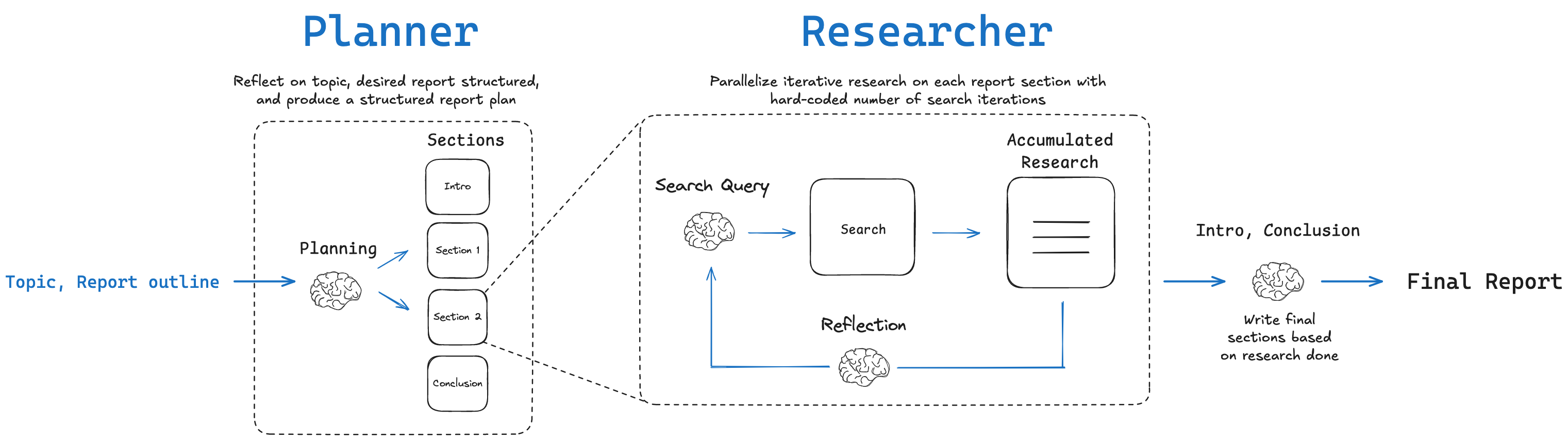


(1) Chat with the agent about your topic of interest, and it will initiate report generation:

(2) The report is produced as markdown.
(1) Provide a Topic:

(2) This will generate a report plan and present it to the user for review.
(3) We can pass a string ("...") with feedback to regenerate the plan based on the feedback.

(4) Or, we can just pass true to the JSON input box in Studio accept the plan.

(5) Once accepted, the report sections will be generated.

The report is produced as markdown.

Available search tools:
- Tavily API - General web search
- Perplexity API - General web search
- Exa API - Powerful neural search for web content
- ArXiv - Academic papers in physics, mathematics, computer science, and more
- PubMed - Biomedical literature from MEDLINE, life science journals, and online books
- Linkup API - General web search
- DuckDuckGo API - General web search
- Google Search API/Scrapper - Create custom search engine here and get API key here
- Microsoft Azure AI Search - Cloud based vector database solution
Open Deep Research is compatible with many different LLMs:
- You can select any model that is integrated with the
init_chat_model()API - See full list of supported integrations here
Using the package
code - multi agent
from typing import List, Annotated, TypedDict, Literal, cast
from pydantic import BaseModel, Field
import operator
import warnings

from langchain.chat_models import init_chat_model
from langchain_core.tools import tool, BaseTool
from langchain_core.runnables import RunnableConfig
from langchain_mcp_adapters.client import MultiServerMCPClient
from langgraph.graph import MessagesState

from langgraph.types import Command, Send
from langgraph.graph import START, END, StateGraph

from open_deep_research.configuration import Configuration
from open_deep_research.utils import (
    get_config_value,
    tavily_search,
    duckduckgo_search,
    get_today_str,
    load_mcp_server_config
)

from open_deep_research.prompts import SUPERVISOR_INSTRUCTIONS, RESEARCH_INSTRUCTIONS

## Tools factory - will be initialized based on configuration
def get_search_tool(config: RunnableConfig):
    """Get the appropriate search tool based on configuration"""
    configurable = Configuration.from_runnable_config(config)
    search_api = get_config_value(configurable.search_api)

    # Return None if no search tool is requested
    if search_api.lower() == "none":
        return None

    # TODO: Configure other search functions as tools
    if search_api.lower() == "tavily":
        search_tool = tavily_search
    elif search_api.lower() == "duckduckgo":
        search_tool = duckduckgo_search
    else:
        raise NotImplementedError(
            f"The search API '{search_api}' is not yet supported in the multi-agent implementation. "
            f"Currently, only Tavily/DuckDuckGo/None is supported. Please use the graph-based implementation in "
            f"src/open_deep_research/graph.py for other search APIs, or set search_api to 'tavily', 'duckduckgo', or 'none'."
        )

    tool_metadata = {**(search_tool.metadata or {}), "type": "search"}
    search_tool.metadata = tool_metadata
    return search_tool

class Section(BaseModel):
    """Section of the report."""
    name: str = Field(
        description="Name for this section of the report.",
    )
    description: str = Field(
        description="Research scope for this section of the report.",
    )
    content: str = Field(
        description="The content of the section."
    )

class Sections(BaseModel):
    """List of section titles of the report."""
    sections: List[str] = Field(
        description="Sections of the report.",
    )

class Introduction(BaseModel):
    """Introduction to the report."""
    name: str = Field(
        description="Name for the report.",
    )
    content: str = Field(
        description="The content of the introduction, giving an overview of the report."
    )

class Conclusion(BaseModel):
    """Conclusion to the report."""
    name: str = Field(
        description="Name for the conclusion of the report.",
    )
    content: str = Field(
        description="The content of the conclusion, summarizing the report."
    )

class Question(BaseModel):
    """Ask a follow-up question to clarify the report scope."""
    question: str = Field(
        description="A specific question to ask the user to clarify the scope, focus, or requirements of the report."
    )

# No-op tool to indicate that the research is complete
class FinishResearch(BaseModel):
    """Finish the research."""

# No-op tool to indicate that the report writing is complete
class FinishReport(BaseModel):
    """Finish the report."""

## State
class ReportStateOutput(TypedDict):
    final_report: str # Final report
    # for evaluation purposes only
    # this is included only if configurable.include_source_str is True
    source_str: str # String of formatted source content from web search

class ReportState(MessagesState):
    sections: list[str] # List of report sections
    completed_sections: Annotated[list[Section], operator.add] # Send() API key
    final_report: str # Final report
    question_asked: bool # Track if a clarifying question has been asked
    # for evaluation purposes only
    # this is included only if configurable.include_source_str is True
    source_str: Annotated[str, operator.add] # String of formatted source content from web search

class SectionState(MessagesState):
    section: str # Report section
    completed_sections: list[Section] # Final key we duplicate in outer state for Send() API
    # for evaluation purposes only
    # this is included only if configurable.include_source_str is True
    source_str: str # String of formatted source content from web search

class SectionOutputState(TypedDict):
    completed_sections: list[Section] # Final key we duplicate in outer state for Send() API
    # for evaluation purposes only
    # this is included only if configurable.include_source_str is True
    source_str: str # String of formatted source content from web search


async def _load_mcp_tools(
    config: RunnableConfig,
    existing_tool_names: set[str],
) -> list[BaseTool]:
    configurable = Configuration.from_runnable_config(config)
    if not configurable.mcp_server_config:
        return []

    mcp_server_config = configurable.mcp_server_config
    client = MultiServerMCPClient(mcp_server_config)
    mcp_tools = await client.get_tools()
    filtered_mcp_tools: list[BaseTool] = []
    for tool in mcp_tools:
        # TODO: this will likely be hard to manage
        # on a remote server that's not controlled by the developer
        # best solution here is allowing tool name prefixes in MultiServerMCPClient
        if tool.name in existing_tool_names:
            warnings.warn(
                f"Trying to add MCP tool with a name {tool.name} that is already in use - this tool will be ignored."
            )
            continue

        if configurable.mcp_tools_to_include and tool.name not in configurable.mcp_tools_to_include:
            continue

        filtered_mcp_tools.append(tool)

    return filtered_mcp_tools


# Tool lists will be built dynamically based on configuration
def get_supervisor_tools(config: RunnableConfig) -> list[BaseTool]:
    """Get supervisor tools based on configuration"""
    configurable = Configuration.from_runnable_config(config)
    search_tool = get_search_tool(config)
    tools = [tool(Sections), tool(Introduction), tool(Conclusion), tool(FinishReport)]
    if configurable.ask_for_clarification:
        tools.append(tool(Question))
    if search_tool is not None:
        tools.append(search_tool)  # Add search tool, if available
    return tools


async def get_research_tools(config: RunnableConfig) -> list[BaseTool]:
    """Get research tools based on configuration"""
    search_tool = get_search_tool(config)
    tools = [tool(Section), tool(FinishResearch)]
    if search_tool is not None:
        tools.append(search_tool)  # Add search tool, if available
    existing_tool_names = {cast(BaseTool, tool).name for tool in tools}
    mcp_tools = await _load_mcp_tools(config, existing_tool_names)
    tools.extend(mcp_tools)
    return tools


async def supervisor(state: ReportState, config: RunnableConfig):
    """LLM decides whether to call a tool or not"""

    # Messages
    messages = state["messages"]

    # Get configuration
    configurable = Configuration.from_runnable_config(config)
    supervisor_model = get_config_value(configurable.supervisor_model)

    # Initialize the model
    llm = init_chat_model(model=supervisor_model)

    # If sections have been completed, but we don't yet have the final report, then we need to initiate writing the introduction and conclusion
    if state.get("completed_sections") and not state.get("final_report"):
        research_complete_message = {"role": "user", "content": "Research is complete. Now write the introduction and conclusion for the report. Here are the completed main body sections: \n\n" + "\n\n".join([s.content for s in state["completed_sections"]])}
        messages = messages + [research_complete_message]

    # Get tools based on configuration
    supervisor_tool_list = get_supervisor_tools(config)

    # Remove Question tool if a question has already been asked
    if state.get("question_asked", False):
        supervisor_tool_list = [tool for tool in supervisor_tool_list if tool.name != "Question"]

    llm_with_tools = (
        llm
        .bind_tools(
            supervisor_tool_list,
            parallel_tool_calls=False,
            # force at least one tool call
            tool_choice="any"
        )
    )
    # Invoke
    return {
        "messages": [
            await llm_with_tools.ainvoke(
                [
                    {
                        "role": "system",
                        "content": SUPERVISOR_INSTRUCTIONS.format(today=get_today_str())
                    }
                ]
                + messages
            )
        ]
    }

async def supervisor_tools(state: ReportState, config: RunnableConfig)  -> Command[Literal["supervisor", "research_team", "__end__"]]:
    """Performs the tool call and sends to the research agent"""
    configurable = Configuration.from_runnable_config(config)

    result = []
    sections_list = []
    intro_content = None
    conclusion_content = None
    source_str = ""

    # Get tools based on configuration
    supervisor_tool_list = get_supervisor_tools(config)
    supervisor_tools_by_name = {tool.name: tool for tool in supervisor_tool_list}
    search_tool_names = {
        tool.name
        for tool in supervisor_tool_list
        if tool.metadata is not None and tool.metadata.get("type") == "search"
    }

    # First process all tool calls to ensure we respond to each one (required for OpenAI)
    for tool_call in state["messages"][-1].tool_calls:
        # Get the tool
        tool = supervisor_tools_by_name[tool_call["name"]]
        # Perform the tool call - use ainvoke for async tools
        try:
            observation = await tool.ainvoke(tool_call["args"], config)
        except NotImplementedError:
            observation = tool.invoke(tool_call["args"], config)

        # Append to messages
        result.append({"role": "tool",
                       "content": observation,
                       "name": tool_call["name"],
                       "tool_call_id": tool_call["id"]})

        # Store special tool results for processing after all tools have been called
        if tool_call["name"] == "Question":
            # Question tool was called - return to supervisor to ask the question
            question_obj = cast(Question, observation)
            result.append({"role": "assistant", "content": question_obj.question})
            return Command(goto=END, update={"messages": result, "question_asked": True})
        elif tool_call["name"] == "Sections":
            sections_list = cast(Sections, observation).sections
        elif tool_call["name"] == "Introduction":
            # Format introduction with proper H1 heading if not already formatted
            observation = cast(Introduction, observation)
            if not observation.content.startswith("# "):
                intro_content = f"# {observation.name}\n\n{observation.content}"
            else:
                intro_content = observation.content
        elif tool_call["name"] == "Conclusion":
            # Format conclusion with proper H2 heading if not already formatted
            observation = cast(Conclusion, observation)
            if not observation.content.startswith("## "):
                conclusion_content = f"## {observation.name}\n\n{observation.content}"
            else:
                conclusion_content = observation.content
        elif tool_call["name"] in search_tool_names and configurable.include_source_str:
            source_str += cast(str, observation)

    # After processing all tool calls, decide what to do next
    if sections_list:
        # Send the sections to the research agents
        return Command(goto=[Send("research_team", {"section": s}) for s in sections_list], update={"messages": result})
    elif intro_content:
        # Store introduction while waiting for conclusion
        # Append to messages to guide the LLM to write conclusion next
        result.append({"role": "user", "content": "Introduction written. Now write a conclusion section."})
        state_update = {
            "final_report": intro_content,
            "messages": result,
        }
    elif conclusion_content:
        # Get all sections and combine in proper order: Introduction, Body Sections, Conclusion
        intro = state.get("final_report", "")
        body_sections = "\n\n".join([s.content for s in state["completed_sections"]])

        # Assemble final report in correct order
        complete_report = f"{intro}\n\n{body_sections}\n\n{conclusion_content}"

        # Append to messages to indicate completion
        result.append({"role": "user", "content": "Report is now complete with introduction, body sections, and conclusion."})

        state_update = {
            "final_report": complete_report,
            "messages": result,
        }
    else:
        # Default case (for search tools, etc.)
        state_update = {"messages": result}

    # Include source string for evaluation
    if configurable.include_source_str and source_str:
        state_update["source_str"] = source_str

    return Command(goto="supervisor", update=state_update)

async def supervisor_should_continue(state: ReportState) -> str:
    """Decide if we should continue the loop or stop based upon whether the LLM made a tool call"""

    messages = state["messages"]
    last_message = messages[-1]
    # End because the supervisor asked a question or is finished
    if not last_message.tool_calls or (len(last_message.tool_calls) == 1 and last_message.tool_calls[0]["name"] == "FinishReport"):
        # Exit the graph
        return END

    # If the LLM makes a tool call, then perform an action
    return "supervisor_tools"

async def research_agent(state: SectionState, config: RunnableConfig):
    """LLM decides whether to call a tool or not"""

    # Get configuration
    configurable = Configuration.from_runnable_config(config)
    researcher_model = get_config_value(configurable.researcher_model)

    # Initialize the model
    llm = init_chat_model(model=researcher_model)

    # Get tools based on configuration
    research_tool_list = await get_research_tools(config)
    system_prompt = RESEARCH_INSTRUCTIONS.format(
        section_description=state["section"],
        number_of_queries=configurable.number_of_queries,
        today=get_today_str(),
    )
    if configurable.mcp_prompt:
        system_prompt += f"\n\n{configurable.mcp_prompt}"

    return {
        "messages": [
            # Enforce tool calling to either perform more search or call the Section tool to write the section
            await llm.bind_tools(research_tool_list,
                                 parallel_tool_calls=False,
                                 # force at least one tool call
                                 tool_choice="any").ainvoke(
                [
                    {
                        "role": "system",
                        "content": system_prompt
                    }
                ]
                + state["messages"]
            )
        ]
    }

async def research_agent_tools(state: SectionState, config: RunnableConfig):
    """Performs the tool call and route to supervisor or continue the research loop"""
    configurable = Configuration.from_runnable_config(config)

    result = []
    completed_section = None
    source_str = ""

    # Get tools based on configuration
    research_tool_list = await get_research_tools(config)
    research_tools_by_name = {tool.name: tool for tool in research_tool_list}
    search_tool_names = {
        tool.name
        for tool in research_tool_list
        if tool.metadata is not None and tool.metadata.get("type") == "search"
    }

    # Process all tool calls first (required for OpenAI)
    for tool_call in state["messages"][-1].tool_calls:
        # Get the tool
        tool = research_tools_by_name[tool_call["name"]]
        # Perform the tool call - use ainvoke for async tools
        try:
            observation = await tool.ainvoke(tool_call["args"], config)
        except NotImplementedError:
            observation = tool.invoke(tool_call["args"], config)

        # Append to messages
        result.append({"role": "tool",
                       "content": observation,
                       "name": tool_call["name"],
                       "tool_call_id": tool_call["id"]})

        # Store the section observation if a Section tool was called
        if tool_call["name"] == "Section":
            completed_section = cast(Section, observation)

        # Store the source string if a search tool was called
        if tool_call["name"] in search_tool_names and configurable.include_source_str:
            source_str += cast(str, observation)

    # After processing all tools, decide what to do next
    state_update = {"messages": result}
    if completed_section:
        # Write the completed section to state and return to the supervisor
        state_update["completed_sections"] = [completed_section]
    if configurable.include_source_str and source_str:
        state_update["source_str"] = source_str

    return state_update

async def research_agent_should_continue(state: SectionState) -> str:
    """Decide if we should continue the loop or stop based upon whether the LLM made a tool call"""

    messages = state["messages"]
    last_message = messages[-1]

    if last_message.tool_calls[0]["name"] == "FinishResearch":
        # Research is done - return to supervisor
        return END
    else:
        return "research_agent_tools"

"""Build the multi-agent workflow"""

# Research agent workflow
research_builder = StateGraph(SectionState, output=SectionOutputState, config_schema=Configuration)
research_builder.add_node("research_agent", research_agent)
research_builder.add_node("research_agent_tools", research_agent_tools)
research_builder.add_edge(START, "research_agent")
research_builder.add_conditional_edges(
    "research_agent",
    research_agent_should_continue,
    ["research_agent_tools", END]
)
research_builder.add_edge("research_agent_tools", "research_agent")

# Supervisor workflow
supervisor_builder = StateGraph(ReportState, input=MessagesState, output=ReportStateOutput, config_schema=Configuration)
supervisor_builder.add_node("supervisor", supervisor)
supervisor_builder.add_node("supervisor_tools", supervisor_tools)
supervisor_builder.add_node("research_team", research_builder.compile())

# Flow of the supervisor agent
supervisor_builder.add_edge(START, "supervisor")
supervisor_builder.add_conditional_edges(
    "supervisor",
    supervisor_should_continue,
    ["supervisor_tools", END]
)
supervisor_builder.add_edge("research_team", "supervisor")

graph = supervisor_builder.compile()
code - workflow
from typing import Literal

from langchain.chat_models import init_chat_model
from langchain_core.messages import HumanMessage, SystemMessage
from langchain_core.runnables import RunnableConfig

from langgraph.constants import Send
from langgraph.graph import START, END, StateGraph
from langgraph.types import interrupt, Command

from open_deep_research.state import (
    ReportStateInput,
    ReportStateOutput,
    Sections,
    ReportState,
    SectionState,
    SectionOutputState,
    Queries,
    Feedback
)

from open_deep_research.prompts import (
    report_planner_query_writer_instructions,
    report_planner_instructions,
    query_writer_instructions,
    section_writer_instructions,
    final_section_writer_instructions,
    section_grader_instructions,
    section_writer_inputs
)

from open_deep_research.configuration import Configuration
from open_deep_research.utils import (
    format_sections,
    get_config_value,
    get_search_params,
    select_and_execute_search,
    get_today_str
)

## Nodes --

async def generate_report_plan(state: ReportState, config: RunnableConfig):
    """Generate the initial report plan with sections.

    This node:
    1. Gets configuration for the report structure and search parameters
    2. Generates search queries to gather context for planning
    3. Performs web searches using those queries
    4. Uses an LLM to generate a structured plan with sections

    Args:
        state: Current graph state containing the report topic
        config: Configuration for models, search APIs, etc.

    Returns:
        Dict containing the generated sections
    """

    # Inputs
    topic = state["topic"]

    # Get list of feedback on the report plan
    feedback_list = state.get("feedback_on_report_plan", [])

    # Concatenate feedback on the report plan into a single string
    feedback = " /// ".join(feedback_list) if feedback_list else ""

    # Get configuration
    configurable = Configuration.from_runnable_config(config)
    report_structure = configurable.report_structure
    number_of_queries = configurable.number_of_queries
    search_api = get_config_value(configurable.search_api)
    search_api_config = configurable.search_api_config or {}  # Get the config dict, default to empty
    params_to_pass = get_search_params(search_api, search_api_config)  # Filter parameters

    # Convert JSON object to string if necessary
    if isinstance(report_structure, dict):
        report_structure = str(report_structure)

    # Set writer model (model used for query writing)
    writer_provider = get_config_value(configurable.writer_provider)
    writer_model_name = get_config_value(configurable.writer_model)
    writer_model_kwargs = get_config_value(configurable.writer_model_kwargs or {})
    writer_model = init_chat_model(model=writer_model_name, model_provider=writer_provider, model_kwargs=writer_model_kwargs)
    structured_llm = writer_model.with_structured_output(Queries)

    # Format system instructions
    system_instructions_query = report_planner_query_writer_instructions.format(
        topic=topic,
        report_organization=report_structure,
        number_of_queries=number_of_queries,
        today=get_today_str()
    )

    # Generate queries
    results = await structured_llm.ainvoke([SystemMessage(content=system_instructions_query),
                                     HumanMessage(content="Generate search queries that will help with planning the sections of the report.")])

    # Web search
    query_list = [query.search_query for query in results.queries]

    # Search the web with parameters
    source_str = await select_and_execute_search(search_api, query_list, params_to_pass)

    # Format system instructions
    system_instructions_sections = report_planner_instructions.format(topic=topic, report_organization=report_structure, context=source_str, feedback=feedback)

    # Set the planner
    planner_provider = get_config_value(configurable.planner_provider)
    planner_model = get_config_value(configurable.planner_model)
    planner_model_kwargs = get_config_value(configurable.planner_model_kwargs or {})

    # Report planner instructions
    planner_message = """Generate the sections of the report. Your response must include a 'sections' field containing a list of sections.
                        Each section must have: name, description, research, and content fields."""

    # Run the planner
    if planner_model == "claude-3-7-sonnet-latest":
        # Allocate a thinking budget for claude-3-7-sonnet-latest as the planner model
        planner_llm = init_chat_model(model=planner_model,
                                      model_provider=planner_provider,
                                      max_tokens=20_000,
                                      thinking={"type": "enabled", "budget_tokens": 16_000})

    else:
        # With other models, thinking tokens are not specifically allocated
        planner_llm = init_chat_model(model=planner_model,
                                      model_provider=planner_provider,
                                      model_kwargs=planner_model_kwargs)

    # Generate the report sections
    structured_llm = planner_llm.with_structured_output(Sections)
    report_sections = await structured_llm.ainvoke([SystemMessage(content=system_instructions_sections),
                                             HumanMessage(content=planner_message)])

    # Get sections
    sections = report_sections.sections

    return {"sections": sections}

def human_feedback(state: ReportState, config: RunnableConfig) -> Command[Literal["generate_report_plan","build_section_with_web_research"]]:
    """Get human feedback on the report plan and route to next steps.

    This node:
    1. Formats the current report plan for human review
    2. Gets feedback via an interrupt
    3. Routes to either:
       - Section writing if plan is approved
       - Plan regeneration if feedback is provided

    Args:
        state: Current graph state with sections to review
        config: Configuration for the workflow

    Returns:
        Command to either regenerate plan or start section writing
    """

    # Get sections
    topic = state["topic"]
    sections = state['sections']
    sections_str = "\n\n".join(
        f"Section: {section.name}\n"
        f"Description: {section.description}\n"
        f"Research needed: {'Yes' if section.research else 'No'}\n"
        for section in sections
    )

    # Get feedback on the report plan from interrupt
    interrupt_message = f"""Please provide feedback on the following report plan.
                        \n\n{sections_str}\n
                        \nDoes the report plan meet your needs?\nPass 'true' to approve the report plan.\nOr, provide feedback to regenerate the report plan:"""

    feedback = interrupt(interrupt_message)

    # If the user approves the report plan, kick off section writing
    if isinstance(feedback, bool) and feedback is True:
        # Treat this as approve and kick off section writing
        return Command(goto=[
            Send("build_section_with_web_research", {"topic": topic, "section": s, "search_iterations": 0})
            for s in sections
            if s.research
        ])

    # If the user provides feedback, regenerate the report plan
    elif isinstance(feedback, str):
        # Treat this as feedback and append it to the existing list
        return Command(goto="generate_report_plan",
                       update={"feedback_on_report_plan": [feedback]})
    else:
        raise TypeError(f"Interrupt value of type {type(feedback)} is not supported.")

async def generate_queries(state: SectionState, config: RunnableConfig):
    """Generate search queries for researching a specific section.

    This node uses an LLM to generate targeted search queries based on the
    section topic and description.

    Args:
        state: Current state containing section details
        config: Configuration including number of queries to generate

    Returns:
        Dict containing the generated search queries
    """

    # Get state
    topic = state["topic"]
    section = state["section"]

    # Get configuration
    configurable = Configuration.from_runnable_config(config)
    number_of_queries = configurable.number_of_queries

    # Generate queries
    writer_provider = get_config_value(configurable.writer_provider)
    writer_model_name = get_config_value(configurable.writer_model)
    writer_model_kwargs = get_config_value(configurable.writer_model_kwargs or {})
    writer_model = init_chat_model(model=writer_model_name, model_provider=writer_provider, model_kwargs=writer_model_kwargs)
    structured_llm = writer_model.with_structured_output(Queries)

    # Format system instructions
    system_instructions = query_writer_instructions.format(topic=topic,
                                                           section_topic=section.description,
                                                           number_of_queries=number_of_queries,
                                                           today=get_today_str())

    # Generate queries
    queries = await structured_llm.ainvoke([SystemMessage(content=system_instructions),
                                     HumanMessage(content="Generate search queries on the provided topic.")])

    return {"search_queries": queries.queries}

async def search_web(state: SectionState, config: RunnableConfig):
    """Execute web searches for the section queries.

    This node:
    1. Takes the generated queries
    2. Executes searches using configured search API
    3. Formats results into usable context

    Args:
        state: Current state with search queries
        config: Search API configuration

    Returns:
        Dict with search results and updated iteration count
    """

    # Get state
    search_queries = state["search_queries"]

    # Get configuration
    configurable = Configuration.from_runnable_config(config)
    search_api = get_config_value(configurable.search_api)
    search_api_config = configurable.search_api_config or {}  # Get the config dict, default to empty
    params_to_pass = get_search_params(search_api, search_api_config)  # Filter parameters

    # Web search
    query_list = [query.search_query for query in search_queries]

    # Search the web with parameters
    source_str = await select_and_execute_search(search_api, query_list, params_to_pass)

    return {"source_str": source_str, "search_iterations": state["search_iterations"] + 1}

async def write_section(state: SectionState, config: RunnableConfig) -> Command[Literal[END, "search_web"]]:
    """Write a section of the report and evaluate if more research is needed.

    This node:
    1. Writes section content using search results
    2. Evaluates the quality of the section
    3. Either:
       - Completes the section if quality passes
       - Triggers more research if quality fails

    Args:
        state: Current state with search results and section info
        config: Configuration for writing and evaluation

    Returns:
        Command to either complete section or do more research
    """

    # Get state
    topic = state["topic"]
    section = state["section"]
    source_str = state["source_str"]

    # Get configuration
    configurable = Configuration.from_runnable_config(config)

    # Format system instructions
    section_writer_inputs_formatted = section_writer_inputs.format(topic=topic,
                                                             section_name=section.name,
                                                             section_topic=section.description,
                                                             context=source_str,
                                                             section_content=section.content)

    # Generate section
    writer_provider = get_config_value(configurable.writer_provider)
    writer_model_name = get_config_value(configurable.writer_model)
    writer_model_kwargs = get_config_value(configurable.writer_model_kwargs or {})
    writer_model = init_chat_model(model=writer_model_name, model_provider=writer_provider, model_kwargs=writer_model_kwargs)

    section_content = await writer_model.ainvoke([SystemMessage(content=section_writer_instructions),
                                           HumanMessage(content=section_writer_inputs_formatted)])

    # Write content to the section object
    section.content = section_content.content

    # Grade prompt
    section_grader_message = ("Grade the report and consider follow-up questions for missing information. "
                              "If the grade is 'pass', return empty strings for all follow-up queries. "
                              "If the grade is 'fail', provide specific search queries to gather missing information.")

    section_grader_instructions_formatted = section_grader_instructions.format(topic=topic,
                                                                               section_topic=section.description,
                                                                               section=section.content,
                                                                               number_of_follow_up_queries=configurable.number_of_queries)

    # Use planner model for reflection
    planner_provider = get_config_value(configurable.planner_provider)
    planner_model = get_config_value(configurable.planner_model)
    planner_model_kwargs = get_config_value(configurable.planner_model_kwargs or {})

    if planner_model == "claude-3-7-sonnet-latest":
        # Allocate a thinking budget for claude-3-7-sonnet-latest as the planner model
        reflection_model = init_chat_model(model=planner_model,
                                           model_provider=planner_provider,
                                           max_tokens=20_000,
                                           thinking={"type": "enabled", "budget_tokens": 16_000}).with_structured_output(Feedback)
    else:
        reflection_model = init_chat_model(model=planner_model,
                                           model_provider=planner_provider, model_kwargs=planner_model_kwargs).with_structured_output(Feedback)
    # Generate feedback
    feedback = await reflection_model.ainvoke([SystemMessage(content=section_grader_instructions_formatted),
                                        HumanMessage(content=section_grader_message)])

    # If the section is passing or the max search depth is reached, publish the section to completed sections
    if feedback.grade == "pass" or state["search_iterations"] >= configurable.max_search_depth:
        # Publish the section to completed sections
        update = {"completed_sections": [section]}
        if configurable.include_source_str:
            update["source_str"] = source_str
        return Command(update=update, goto=END)

    # Update the existing section with new content and update search queries
    else:
        return Command(
            update={"search_queries": feedback.follow_up_queries, "section": section},
            goto="search_web"
        )

async def write_final_sections(state: SectionState, config: RunnableConfig):
    """Write sections that don't require research using completed sections as context.

    This node handles sections like conclusions or summaries that build on
    the researched sections rather than requiring direct research.

    Args:
        state: Current state with completed sections as context
        config: Configuration for the writing model

    Returns:
        Dict containing the newly written section
    """

    # Get configuration
    configurable = Configuration.from_runnable_config(config)

    # Get state
    topic = state["topic"]
    section = state["section"]
    completed_report_sections = state["report_sections_from_research"]

    # Format system instructions
    system_instructions = final_section_writer_instructions.format(topic=topic, section_name=section.name, section_topic=section.description, context=completed_report_sections)

    # Generate section
    writer_provider = get_config_value(configurable.writer_provider)
    writer_model_name = get_config_value(configurable.writer_model)
    writer_model_kwargs = get_config_value(configurable.writer_model_kwargs or {})
    writer_model = init_chat_model(model=writer_model_name, model_provider=writer_provider, model_kwargs=writer_model_kwargs)

    section_content = await writer_model.ainvoke([SystemMessage(content=system_instructions),
                                           HumanMessage(content="Generate a report section based on the provided sources.")])

    # Write content to section
    section.content = section_content.content

    # Write the updated section to completed sections
    return {"completed_sections": [section]}

def gather_completed_sections(state: ReportState):
    """Format completed sections as context for writing final sections.

    This node takes all completed research sections and formats them into
    a single context string for writing summary sections.

    Args:
        state: Current state with completed sections

    Returns:
        Dict with formatted sections as context
    """

    # List of completed sections
    completed_sections = state["completed_sections"]

    # Format completed section to str to use as context for final sections
    completed_report_sections = format_sections(completed_sections)

    return {"report_sections_from_research": completed_report_sections}

def compile_final_report(state: ReportState, config: RunnableConfig):
    """Compile all sections into the final report.

    This node:
    1. Gets all completed sections
    2. Orders them according to original plan
    3. Combines them into the final report

    Args:
        state: Current state with all completed sections

    Returns:
        Dict containing the complete report
    """

    # Get configuration
    configurable = Configuration.from_runnable_config(config)

    # Get sections
    sections = state["sections"]
    completed_sections = {s.name: s.content for s in state["completed_sections"]}

    # Update sections with completed content while maintaining original order
    for section in sections:
        section.content = completed_sections[section.name]

    # Compile final report
    all_sections = "\n\n".join([s.content for s in sections])

    if configurable.include_source_str:
        return {"final_report": all_sections, "source_str": state["source_str"]}
    else:
        return {"final_report": all_sections}

def initiate_final_section_writing(state: ReportState):
    """Create parallel tasks for writing non-research sections.

    This edge function identifies sections that don't need research and
    creates parallel writing tasks for each one.

    Args:
        state: Current state with all sections and research context

    Returns:
        List of Send commands for parallel section writing
    """

    # Kick off section writing in parallel via Send() API for any sections that do not require research
    return [
        Send("write_final_sections", {"topic": state["topic"], "section": s, "report_sections_from_research": state["report_sections_from_research"]})
        for s in state["sections"]
        if not s.research
    ]

# Report section sub-graph --

# Add nodes
section_builder = StateGraph(SectionState, output=SectionOutputState)
section_builder.add_node("generate_queries", generate_queries)
section_builder.add_node("search_web", search_web)
section_builder.add_node("write_section", write_section)

# Add edges
section_builder.add_edge(START, "generate_queries")
section_builder.add_edge("generate_queries", "search_web")
section_builder.add_edge("search_web", "write_section")

# Outer graph for initial report plan compiling results from each section --

# Add nodes
builder = StateGraph(ReportState, input=ReportStateInput, output=ReportStateOutput, config_schema=Configuration)
builder.add_node("generate_report_plan", generate_report_plan)
builder.add_node("human_feedback", human_feedback)
builder.add_node("build_section_with_web_research", section_builder.compile())
builder.add_node("gather_completed_sections", gather_completed_sections)
builder.add_node("write_final_sections", write_final_sections)
builder.add_node("compile_final_report", compile_final_report)

# Add edges
builder.add_edge(START, "generate_report_plan")
builder.add_edge("generate_report_plan", "human_feedback")
builder.add_edge("build_section_with_web_research", "gather_completed_sections")
builder.add_conditional_edges("gather_completed_sections", initiate_final_section_writing, ["write_final_sections"])
builder.add_edge("write_final_sections", "compile_final_report")
builder.add_edge("compile_final_report", END)

graph = builder.compile()

 浙公网安备 33010602011771号