
Gemini Fullstack LangGraph Quickstart
Gemini Fullstack LangGraph Quickstart
https://github.com/google-gemini/gemini-fullstack-langgraph-quickstart
This project demonstrates a fullstack application using a React frontend and a LangGraph-powered backend agent. The agent is designed to perform comprehensive research on a user's query by dynamically generating search terms, querying the web using Google Search, reflecting on the results to identify knowledge gaps, and iteratively refining its search until it can provide a well-supported answer with citations. This application serves as an example of building research-augmented conversational AI using LangGraph and Google's Gemini models.

- 💬 Fullstack application with a React frontend and LangGraph backend.
- 🧠 Powered by a LangGraph agent for advanced research and conversational AI.
- 🔍 Dynamic search query generation using Google Gemini models.
- 🌐 Integrated web research via Google Search API.
- 🤔 Reflective reasoning to identify knowledge gaps and refine searches.
- 📄 Generates answers with citations from gathered sources.
- 🔄 Hot-reloading for both frontend and backend development during development.
The core of the backend is a LangGraph agent defined in backend/src/agent/graph.py. It follows these steps:
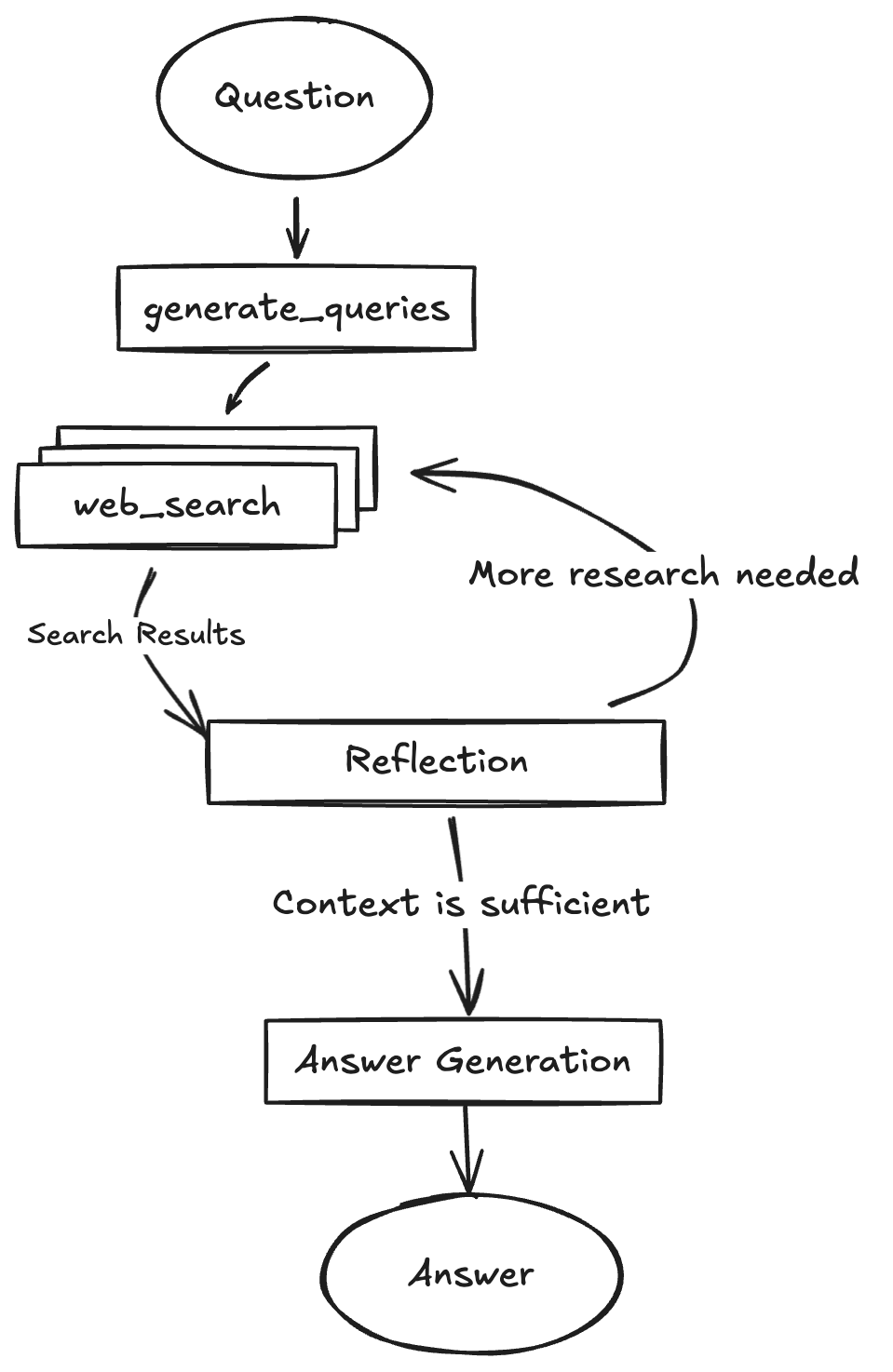

- Generate Initial Queries: Based on your input, it generates a set of initial search queries using a Gemini model.
- Web Research: For each query, it uses the Gemini model with the Google Search API to find relevant web pages.
- Reflection & Knowledge Gap Analysis: The agent analyzes the search results to determine if the information is sufficient or if there are knowledge gaps. It uses a Gemini model for this reflection process.
- Iterative Refinement: If gaps are found or the information is insufficient, it generates follow-up queries and repeats the web research and reflection steps (up to a configured maximum number of loops).
- Finalize Answer: Once the research is deemed sufficient, the agent synthesizes the gathered information into a coherent answer, including citations from the web sources, using a Gemini model.
https://blog.csdn.net/m0_59164304/article/details/148480715
import os

from agent.tools_and_schemas import SearchQueryList, Reflection
from dotenv import load_dotenv
from langchain_core.messages import AIMessage
from langgraph.types import Send
from langgraph.graph import StateGraph
from langgraph.graph import START, END
from langchain_core.runnables import RunnableConfig
from google.genai import Client

from agent.state import (
    OverallState,
    QueryGenerationState,
    ReflectionState,
    WebSearchState,
)
from agent.configuration import Configuration
from agent.prompts import (
    get_current_date,
    query_writer_instructions,
    web_searcher_instructions,
    reflection_instructions,
    answer_instructions,
)
from langchain_google_genai import ChatGoogleGenerativeAI
from agent.utils import (
    get_citations,
    get_research_topic,
    insert_citation_markers,
    resolve_urls,
)

load_dotenv()

if os.getenv("GEMINI_API_KEY") is None:
    raise ValueError("GEMINI_API_KEY is not set")

# Used for Google Search API
genai_client = Client(api_key=os.getenv("GEMINI_API_KEY"))


# Nodes
def generate_query(state: OverallState, config: RunnableConfig) -> QueryGenerationState:
    """LangGraph node that generates a search queries based on the User's question.

    Uses Gemini 2.0 Flash to create an optimized search query for web research based on
    the User's question.

    Args:
        state: Current graph state containing the User's question
        config: Configuration for the runnable, including LLM provider settings

    Returns:
        Dictionary with state update, including search_query key containing the generated query
    """
    configurable = Configuration.from_runnable_config(config)

    # check for custom initial search query count
    if state.get("initial_search_query_count") is None:
        state["initial_search_query_count"] = configurable.number_of_initial_queries

    # init Gemini 2.0 Flash
    llm = ChatGoogleGenerativeAI(
        model=configurable.query_generator_model,
        temperature=1.0,
        max_retries=2,
        api_key=os.getenv("GEMINI_API_KEY"),
    )
    structured_llm = llm.with_structured_output(SearchQueryList)

    # Format the prompt
    current_date = get_current_date()
    formatted_prompt = query_writer_instructions.format(
        current_date=current_date,
        research_topic=get_research_topic(state["messages"]),
        number_queries=state["initial_search_query_count"],
    )
    # Generate the search queries
    result = structured_llm.invoke(formatted_prompt)
    return {"query_list": result.query}


def continue_to_web_research(state: QueryGenerationState):
    """LangGraph node that sends the search queries to the web research node.

    This is used to spawn n number of web research nodes, one for each search query.
    """
    return [
        Send("web_research", {"search_query": search_query, "id": int(idx)})
        for idx, search_query in enumerate(state["query_list"])
    ]


def web_research(state: WebSearchState, config: RunnableConfig) -> OverallState:
    """LangGraph node that performs web research using the native Google Search API tool.

    Executes a web search using the native Google Search API tool in combination with Gemini 2.0 Flash.

    Args:
        state: Current graph state containing the search query and research loop count
        config: Configuration for the runnable, including search API settings

    Returns:
        Dictionary with state update, including sources_gathered, research_loop_count, and web_research_results
    """
    # Configure
    configurable = Configuration.from_runnable_config(config)
    formatted_prompt = web_searcher_instructions.format(
        current_date=get_current_date(),
        research_topic=state["search_query"],
    )

    # Uses the google genai client as the langchain client doesn't return grounding metadata
    response = genai_client.models.generate_content(
        model=configurable.query_generator_model,
        contents=formatted_prompt,
        config={
            "tools": [{"google_search": {}}],
            "temperature": 0,
        },
    )
    # resolve the urls to short urls for saving tokens and time
    resolved_urls = resolve_urls(
        response.candidates[0].grounding_metadata.grounding_chunks, state["id"]
    )
    # Gets the citations and adds them to the generated text
    citations = get_citations(response, resolved_urls)
    modified_text = insert_citation_markers(response.text, citations)
    sources_gathered = [item for citation in citations for item in citation["segments"]]

    return {
        "sources_gathered": sources_gathered,
        "search_query": [state["search_query"]],
        "web_research_result": [modified_text],
    }


def reflection(state: OverallState, config: RunnableConfig) -> ReflectionState:
    """LangGraph node that identifies knowledge gaps and generates potential follow-up queries.

    Analyzes the current summary to identify areas for further research and generates
    potential follow-up queries. Uses structured output to extract
    the follow-up query in JSON format.

    Args:
        state: Current graph state containing the running summary and research topic
        config: Configuration for the runnable, including LLM provider settings

    Returns:
        Dictionary with state update, including search_query key containing the generated follow-up query
    """
    configurable = Configuration.from_runnable_config(config)
    # Increment the research loop count and get the reasoning model
    state["research_loop_count"] = state.get("research_loop_count", 0) + 1
    reasoning_model = state.get("reasoning_model") or configurable.reasoning_model

    # Format the prompt
    current_date = get_current_date()
    formatted_prompt = reflection_instructions.format(
        current_date=current_date,
        research_topic=get_research_topic(state["messages"]),
        summaries="\n\n---\n\n".join(state["web_research_result"]),
    )
    # init Reasoning Model
    llm = ChatGoogleGenerativeAI(
        model=reasoning_model,
        temperature=1.0,
        max_retries=2,
        api_key=os.getenv("GEMINI_API_KEY"),
    )
    result = llm.with_structured_output(Reflection).invoke(formatted_prompt)

    return {
        "is_sufficient": result.is_sufficient,
        "knowledge_gap": result.knowledge_gap,
        "follow_up_queries": result.follow_up_queries,
        "research_loop_count": state["research_loop_count"],
        "number_of_ran_queries": len(state["search_query"]),
    }


def evaluate_research(
    state: ReflectionState,
    config: RunnableConfig,
) -> OverallState:
    """LangGraph routing function that determines the next step in the research flow.

    Controls the research loop by deciding whether to continue gathering information
    or to finalize the summary based on the configured maximum number of research loops.

    Args:
        state: Current graph state containing the research loop count
        config: Configuration for the runnable, including max_research_loops setting

    Returns:
        String literal indicating the next node to visit ("web_research" or "finalize_summary")
    """
    configurable = Configuration.from_runnable_config(config)
    max_research_loops = (
        state.get("max_research_loops")
        if state.get("max_research_loops") is not None
        else configurable.max_research_loops
    )
    if state["is_sufficient"] or state["research_loop_count"] >= max_research_loops:
        return "finalize_answer"
    else:
        return [
            Send(
                "web_research",
                {
                    "search_query": follow_up_query,
                    "id": state["number_of_ran_queries"] + int(idx),
                },
            )
            for idx, follow_up_query in enumerate(state["follow_up_queries"])
        ]


def finalize_answer(state: OverallState, config: RunnableConfig):
    """LangGraph node that finalizes the research summary.

    Prepares the final output by deduplicating and formatting sources, then
    combining them with the running summary to create a well-structured
    research report with proper citations.

    Args:
        state: Current graph state containing the running summary and sources gathered

    Returns:
        Dictionary with state update, including running_summary key containing the formatted final summary with sources
    """
    configurable = Configuration.from_runnable_config(config)
    reasoning_model = state.get("reasoning_model") or configurable.reasoning_model

    # Format the prompt
    current_date = get_current_date()
    formatted_prompt = answer_instructions.format(
        current_date=current_date,
        research_topic=get_research_topic(state["messages"]),
        summaries="\n---\n\n".join(state["web_research_result"]),
    )

    # init Reasoning Model, default to Gemini 2.5 Flash
    llm = ChatGoogleGenerativeAI(
        model=reasoning_model,
        temperature=0,
        max_retries=2,
        api_key=os.getenv("GEMINI_API_KEY"),
    )
    result = llm.invoke(formatted_prompt)

    # Replace the short urls with the original urls and add all used urls to the sources_gathered
    unique_sources = []
    for source in state["sources_gathered"]:
        if source["short_url"] in result.content:
            result.content = result.content.replace(
                source["short_url"], source["value"]
            )
            unique_sources.append(source)

    return {
        "messages": [AIMessage(content=result.content)],
        "sources_gathered": unique_sources,
    }


# Create our Agent Graph
builder = StateGraph(OverallState, config_schema=Configuration)

# Define the nodes we will cycle between
builder.add_node("generate_query", generate_query)
builder.add_node("web_research", web_research)
builder.add_node("reflection", reflection)
builder.add_node("finalize_answer", finalize_answer)

# Set the entrypoint as `generate_query`
# This means that this node is the first one called
builder.add_edge(START, "generate_query")
# Add conditional edge to continue with search queries in a parallel branch
builder.add_conditional_edges(
    "generate_query", continue_to_web_research, ["web_research"]
)
# Reflect on the web research
builder.add_edge("web_research", "reflection")
# Evaluate the research
builder.add_conditional_edges(
    "reflection", evaluate_research, ["web_research", "finalize_answer"]
)
# Finalize the answer
builder.add_edge("finalize_answer", END)

graph = builder.compile(name="pro-search-agent")

 浙公网安备 33010602011771号