
Logistic_regression exercise
Logistic Regression Example
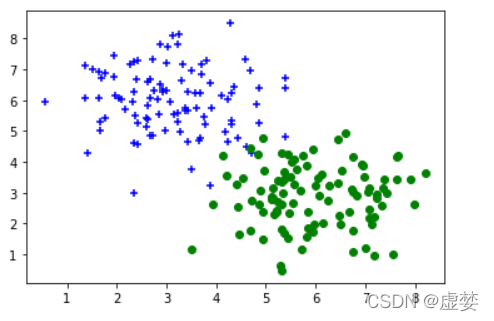
生成数据集
‘+’ 从高斯分布采样 (X, Y) ~ N(3, 6, 1, 1, 0).
‘o’ 从高斯分布采样 (X, Y) ~ N(6, 3, 1, 1, 0)
 1 import tensorflow as tf
 2 import matplotlib.pyplot as plt
 3
 4 from matplotlib import animation, rc
 5 from IPython.display import HTML
 6 import matplotlib.cm as cm
 7 import numpy as np
 8 %matplotlib inline
 9
10 dot_num = 100
11 x_p = np.random.normal(3., 1, dot_num)
12 y_p = np.random.normal(6., 1, dot_num)
13 y = np.ones(dot_num)
14 C1 = np.array([x_p, y_p, y]).T
15
16 x_n = np.random.normal(6., 1, dot_num)
17 y_n = np.random.normal(3., 1, dot_num)
18 y = np.zeros(dot_num)
19 C2 = np.array([x_n, y_n, y]).T
20
21 plt.scatter(C1[:, 0], C1[:, 1], c='b', marker='+')
22 plt.scatter(C2[:, 0], C2[:, 1], c='g', marker='o')
23
24 data_set = np.concatenate((C1, C2), axis=0)
25 np.random.shuffle(data_set)
建立模型
建立模型类,定义loss函数,定义一步梯度下降过程函数
填空一:实现sigmoid的交叉熵损失函数(不使用tf内置的loss 函数)
 1 epsilon = 1e-12
 2 class LogisticRegression():
 3     def __init__(self):
 4         self.W = tf.Variable(shape=[2, 1], dtype=tf.float32,
 5             initial_value=tf.random.uniform(shape=[2, 1], minval=-0.1, maxval=0.1))
 6         self.b = tf.Variable(shape=[1], dtype=tf.float32, initial_value=tf.zeros(shape=[1]))
 7
 8         self.trainable_variables = [self.W, self.b]
 9     @tf.function
10     def __call__(self, inp):
11         logits = tf.matmul(inp, self.W) + self.b # shape(N, 1)
12         pred = tf.nn.sigmoid(logits)
13         return pred
14
15 @tf.function
16 def compute_loss(pred, label):
17     if not isinstance(label, tf.Tensor):
18         label = tf.constant(label, dtype=tf.float32)
19     pred = tf.squeeze(pred, axis=1)
20
21     losses= -(label*(tf.math.log(pred+epsilon))+(1.-label)*(tf.math.log(1.-pred+epsilon)))
22     loss = tf.reduce_mean(losses)
23
24     pred = tf.where(pred>0.5, tf.ones_like(pred), tf.zeros_like(pred))
25     accuracy = tf.reduce_mean(tf.cast(tf.equal(label, pred), dtype=tf.float32))
26     return loss, accuracy
27 @tf.function
28 def train_one_step(model, optimizer, x, y):
29     with tf.GradientTape() as tape:
30         pred = model(x)
31         loss, accuracy = compute_loss(pred, y)
32
33     grads = tape.gradient(loss, model.trainable_variables)
34     optimizer.apply_gradients(zip(grads, model.trainable_variables))
35     return loss, accuracy, model.W, model.b
实例化一个模型,进行训练
 1 if __name__ == '__main__':
 2     model = LogisticRegression()
 3     opt = tf.keras.optimizers.SGD(learning_rate=0.01)
 4     x1, x2, y = list(zip(*data_set))
 5     x = list(zip(x1, x2))
 6     animation_fram = []
 7
 8     for i in range(200):
 9         loss, accuracy, W_opt, b_opt = train_one_step(model, opt, x, y)
10         animation_fram.append((W_opt.numpy()[0, 0], W_opt.numpy()[1, 0], b_opt.numpy(), loss.numpy()))
11         if i%20 == 0:
12             print(f'loss: {loss.numpy():.4}\t accuracy: {accuracy.numpy():.4}')
loss: 0.7504 accuracy: 0.5
loss: 0.5298 accuracy: 0.98
loss: 0.4236 accuracy: 0.98
loss: 0.356 accuracy: 0.98
loss: 0.3098 accuracy: 0.98
loss: 0.2764 accuracy: 0.98
loss: 0.2511 accuracy: 0.98
loss: 0.2313 accuracy: 0.98
loss: 0.2154 accuracy: 0.98
loss: 0.2023 accuracy: 0.98
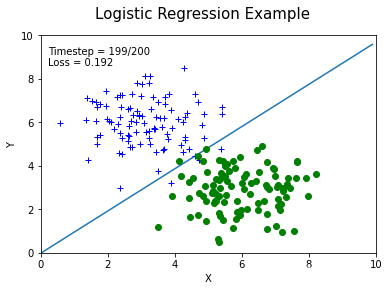
结果展示
 1 f, ax = plt.subplots(figsize=(6,4))
 2 f.suptitle('Logistic Regression Example', fontsize=15)
 3 plt.ylabel('Y')
 4 plt.xlabel('X')
 5 ax.set_xlim(0, 10)
 6 ax.set_ylim(0, 10)
 7
 8 line_d, = ax.plot([], [], label='fit_line')
 9 C1_dots, = ax.plot([], [], '+', c='b', label='actual_dots')
10 C2_dots, = ax.plot([], [], 'o', c='g' ,label='actual_dots')
11
12
13 frame_text = ax.text(0.02, 0.95,'',horizontalalignment='left',verticalalignment='top', transform=ax.transAxes)
14 # ax.legend()
15
16 def init():
17     line_d.set_data([],[])
18     C1_dots.set_data([],[])
19     C2_dots.set_data([],[])
20     return (line_d,) + (C1_dots,) + (C2_dots,)
21
22 def animate(i):
23     xx = np.arange(10, step=0.1)
24     a = animation_fram[i][0]
25     b = animation_fram[i][1]
26     c = animation_fram[i][2]
27     yy = a/-b * xx +c/-b
28     line_d.set_data(xx, yy)
29
30     C1_dots.set_data(C1[:, 0], C1[:, 1])
31     C2_dots.set_data(C2[:, 0], C2[:, 1])
32
33     frame_text.set_text('Timestep = %.1d/%.1d\nLoss = %.3f' % (i, len(animation_fram), animation_fram[i][3]))
34
35     return (line_d,) + (C1_dots,) + (C2_dots,)
36
37 anim = animation.FuncAnimation(f, animate, init_func=init,
38                                frames=len(animation_fram), interval=30, blit=True)
39
40 HTML(anim.to_html5_video())

 浙公网安备 33010602011771号