
第一次个人编程作业
论文查重
计算模块接口的设计与实现过程
- 面向网络编程了好些天,一开始看了好多java的实现方法,奈何Java刚开始学,只知道非常基础的东西,于是就转战python。最后学习到了这个利用jieba+余弦向量的方法。
大佬的链接呈上: 文本相似度算法的对比
2.流程图
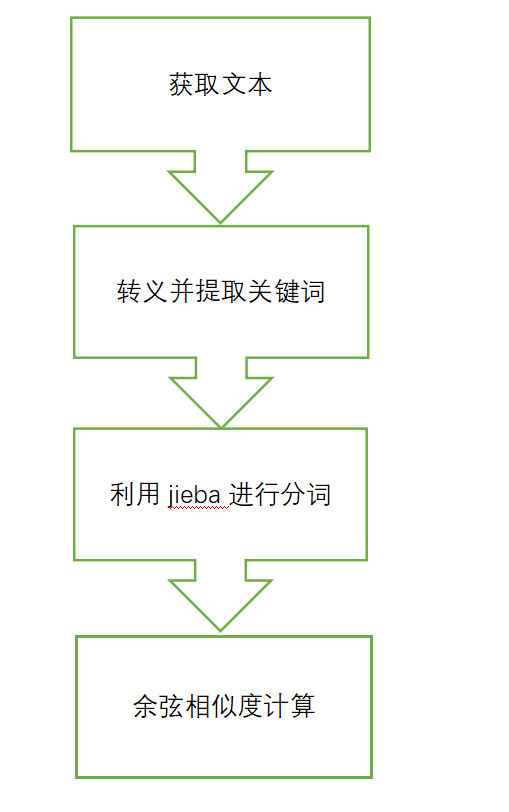
没错,流程就是这么简单
- 类的定义:
定义了一个CosineSimilarity类用来jieba分词与余弦相似度计算
从路径读取文本,通过extract_keyword(content)函数提取关键词,函数最后调用了 jieba.analyse.extract_tags( )来获取关键词
    def __init__(self, content_x1, content_y2):
        self.s1 = content_x1
        self.s2 = content_y2

    @staticmethod
    def extract_keyword(content):  # 提取关键词
        # 正则过滤 html 标签
        re_exp = re.compile(r'(<style>.*?</style>)|(<[^>]+>)', re.S)
        content = re_exp.sub(' ', content)
        # html 转义符实体化
        content = html.unescape(content)
        # 切割
        seg = [i for i in jieba.cut(content, cut_all=True) if i != '']
        # 提取关键词
        keywords = jieba.analyse.extract_tags("|".join(seg), topK=200, withWeight=False)
        return keywords
- 余弦相似度计算函数
    def main(self):
        # 提取关键词
        keywords1 = self.extract_keyword(self.s1)
        keywords2 = self.extract_keyword(self.s2)
        # 词的并集
        union = set(keywords1).union(set(keywords2))
        # 编码
        word_dict = {}
        i = 0
        for word in union:
            word_dict[word] = i
            i += 1
        # oneHot编码
        s1_cut_code = self.one_hot(word_dict, keywords1)
        s2_cut_code = self.one_hot(word_dict, keywords2)
        # 余弦相似度计算
        sample = [s1_cut_code, s2_cut_code]
        # 除零处理
        try:
            sim = cosine_similarity(sample)
            return sim[1][0]
        except Exception as e:
            print(e)
            return 0.0
计算模块接口部分的性能改进
用pycharm自带的profile分析性能
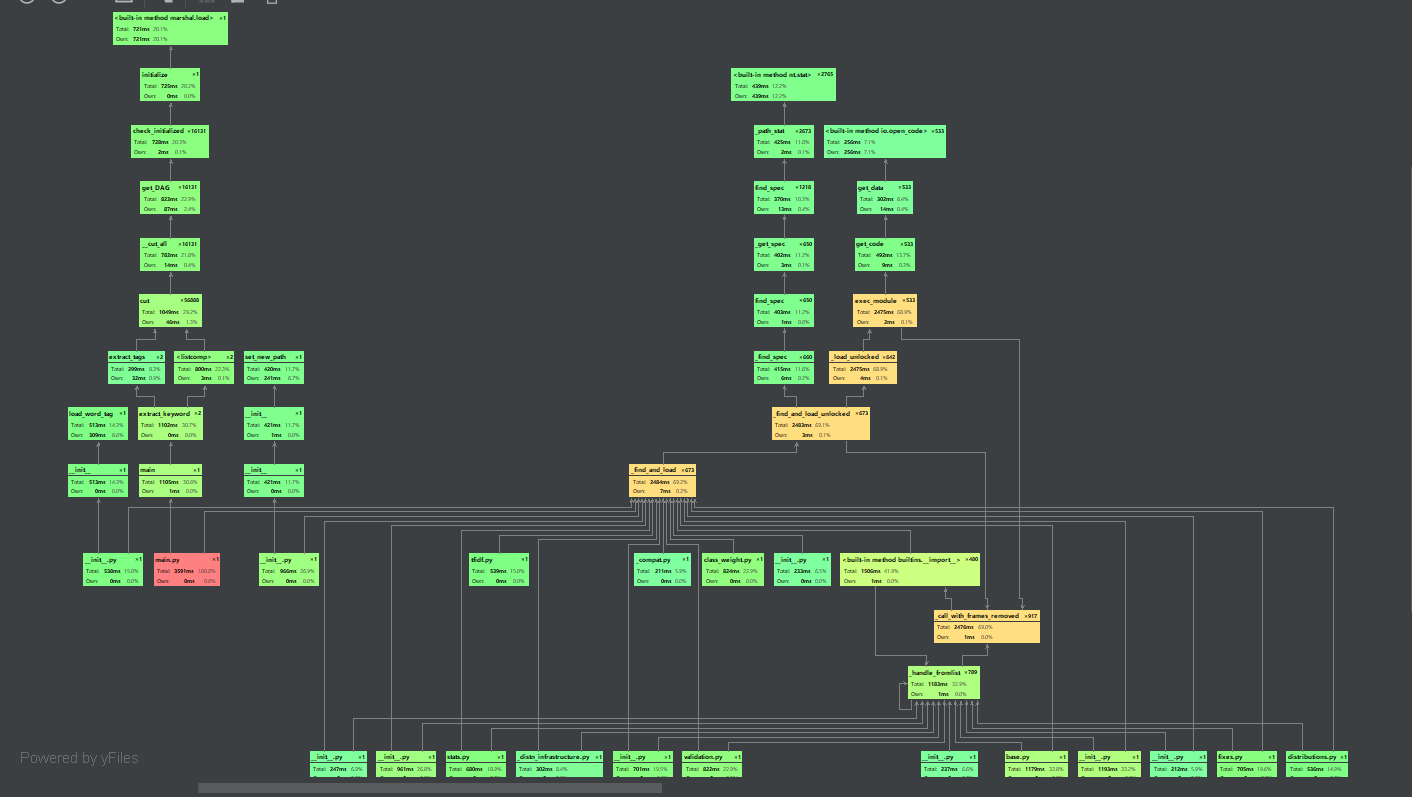
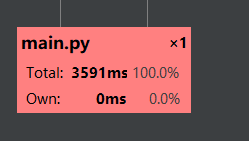
可以看到这次分析得到程序总共花了3591ms,整体来看大部分程序都花了3秒多
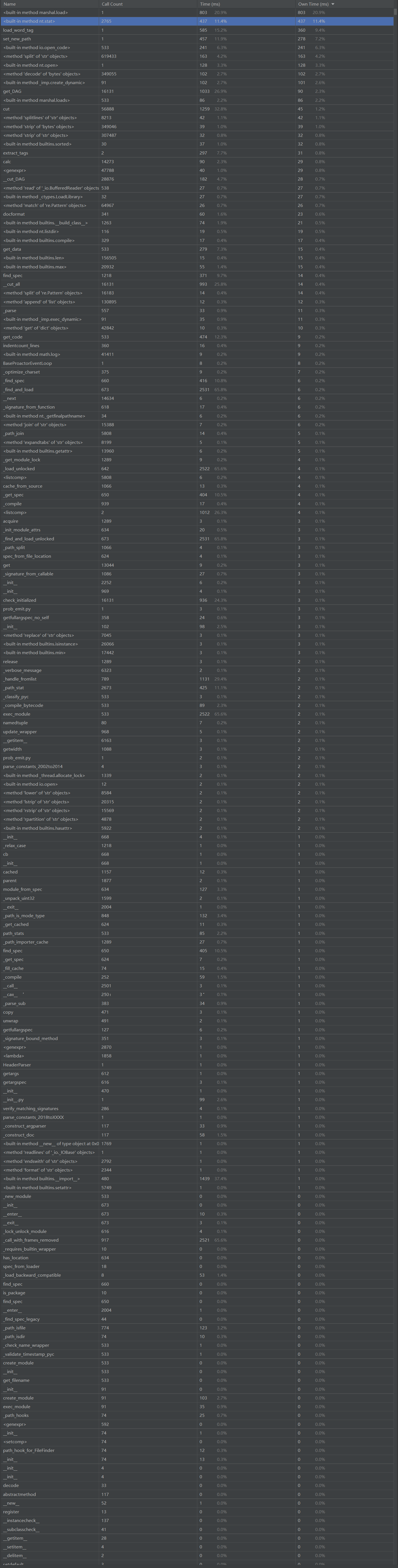
各部分耗时具体如下
计算模块部分单元测试展示
if __name__ == '__main__':
    with open("sys.argv[1], 'r', encoding='utf-8') as x, open("sys.argv[2], 'r', encoding='utf-8') as y :
        content_x = x.read()
        content_y = y.read()
        sim = CosineSimilarity(content_x, content_y)
        sim = sim.main()
        print("%.2f%%" % (sim * 100))

D:\software_practice\sim\orig.txt
D:\software_practice\sim\orig_0.8_add.txt
83.50%

D:\software_practice\sim\orig.txt
D:\software_practice\sim\orig_0.8_del.txt
73.00%

D:\software_practice\sim\orig.txt
D:\software_practice\sim\orig_0.8_dis_1.txt
88.50%

D:\software_practice\sim\orig.txt
D:\software_practice\sim\orig_0.8_dis_3.txt
87.00%

D:\software_practice\sim\orig.txt
D:\software_practice\sim\orig_0.8_dis_7.txt
83.50%

D:\software_practice\sim\orig.txt
D:\software_practice\sim\orig_0.8_dis_10.txt
75.00%

D:\software_practice\sim\orig.txt
D:\software_practice\sim\orig_0.8_dis_15.txt
63.00%

D:\software_practice\sim\orig.txt
D:\software_practice\sim\orig_0.8_mix.txt
80.00%

D:\software_practice\sim\orig.txt
D:\software_practice\sim\orig_rep.txt
73.50%
CosineSimilarity()类和 main()函数在上文都有所解释
计算模块异常处理
- 个人想不到其他什么异常了,我觉得助教给的这些测试用例已经足够了。
总结
- 对于这次的项目,面向网络花了好多天的时间,学习到了jieba+向量余弦值的方法来求得相似度。
- 发现了自己的很多不足,很多要求不知道要怎么去完成。也可以说学习到了很多新的东西,github的各种用法就够我学的。求学之路还是任重而道远
PSP表格
| PSP2.1 | Personal Software Process Stages | 预估耗时(分钟) | 实际耗时(分钟) |
|---|---|---|---|
| Planning | 计划 | 60 | 50 |
| Estimate | 估计这个任务需要多少时间 | 60 | 60 |
| Development | 开发 | 480 | 500 |
| Analysis | 需求分析(包括学习新技术) | 420 | 480 |
| Design Spec | 生成设计文档 | 60 | 75 |
| Design Review | 设计复审 | 45 | 45 |
| Coding Standard | 代码规范 (为目前的开发制定合适的规范) | 45 | 40 |
| Design | 具体分析 | 60 | 50 |
| Coding | 具体编码 | 400 | 420 |
| Code Review | 代码复审 | 45 | 45 |
| Test | 测试(自我测试,修改代码,提交修改) | 180 | 180 |
| Reporting | 报告 | 90 | 80 |
| Test Report | 测试报告 | 60 | 80 |
| Size Measurement | 计算工作量 | 30 | 45 |
| Postmorten & Process Improvement Plan | 事后总结, 并提出过程改进计划 | 60 | 60 |
| 合计 | 2095 | 2210 |

 浙公网安备 33010602011771号