

实验7
task1
#include <stdio.h>

#define N 80
#define M 100

typedef struct {
    char name[N];       // 书名
    char author[N];     // 作者
} Book;

void write();
void read();

int main() {
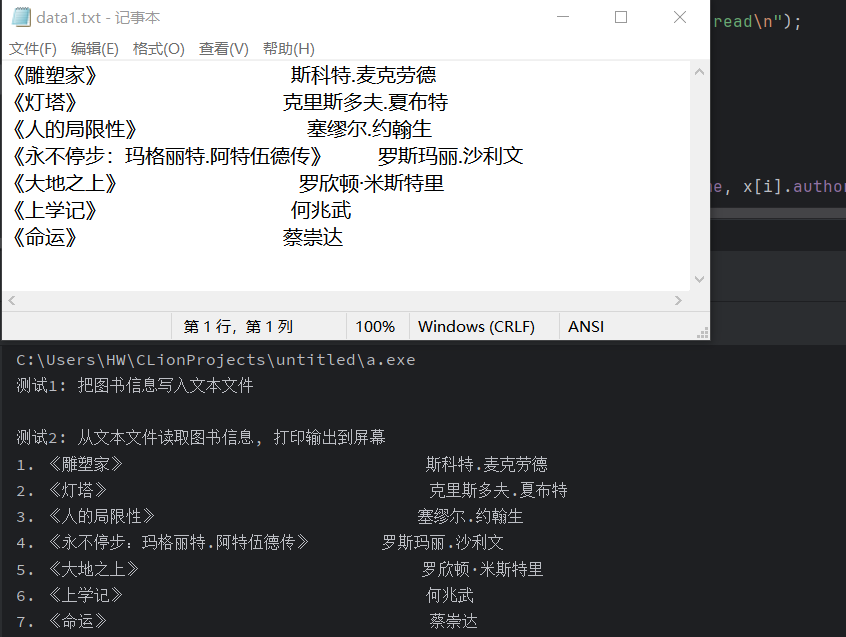
    printf("测试1: 把图书信息写入文本文件\n");
    write();

    printf("\n测试2: 从文本文件读取图书信息, 打印输出到屏幕\n");
    read();

    return 0;
}

void write() {
    Book x[] = { {"《雕塑家》", "斯科特.麦克劳德"},
                  {"《灯塔》", "克里斯多夫.夏布特"},
                  {"《人的局限性》", "塞缪尔.约翰生"},
                  {"《永不停步:玛格丽特.阿特伍德传》", "罗斯玛丽.沙利文"},
                  {"《大地之上》", "罗欣顿·米斯特里"},
                  {"《上学记》", "何兆武"},
                  {"《命运》", "蔡崇达"} };
    int n, i;
    FILE *fp;

    // 计算数组x中元素个数
    n = sizeof(x) / sizeof(x[0]);

    // 以写的方式打开文本文件data1.txt
    fp = fopen("data1.txt", "w");

    // 如果打开文件失败,输出提示信息并返回
    if(fp == NULL) {
        printf("fail to open file to write\n");
        return;
    }

    // 将结构体数组x中的图书信息格式化写到fp指向的文件data1.txt
    for(i = 0; i < n; ++i)
        fprintf(fp, "%-40s %-20s\n", x[i].name, x[i].author);

    fclose(fp);
}

void read() {
    Book x[M];
    int i, n;

    FILE *fp;

    // 以读的方式打开文本文件data1.txt
    fp = fopen("data1.txt", "r");

    // 如果打开文件失败,输出提示信息并返回
    if(fp == NULL) {
        printf("fail to open file to read\n");
        return;
    }

    // 从文件中读取图书信息,保存到结构体数组x中
    i = 0;
    while(fscanf(fp, "%s%s", x[i].name, x[i].author) != EOF)
        ++i;

    // 将图书信息打印输出到屏幕上
    n = i;
    for(i = 0; i < n; ++i)
        printf("%d. %-40s%-20s\n", i+1, x[i].name, x[i].author);

    fclose(fp);
}
2
#include <stdio.h>

#define N 80
#define M 100

typedef struct {
    char name[N];       // 书名
    char author[N];     // 作者
} Book;

void write();
void read();

int main() {
    printf("测试1: 把图书信息以数据块方式写入二进制文件\n");
    write();

    printf("\n测试2: 从二进制文件读取图书信息, 打印输出到屏幕\n");
    read();

    return 0;
}

void write() {
    Book x[] = { {"《雕塑家》", "斯科特.麦克劳德"},
                  {"《灯塔》", "克里斯多夫.夏布特"},
                  {"《人的局限性》", "塞缪尔.约翰生"},
                  {"《永不停步:玛格丽特.阿特伍德传》", "罗斯玛丽.沙利文"},
                  {"《大地之上》", "罗欣顿·米斯特里"},
                  {"《上学记》", "何兆武"},
                  {"《命运》", "蔡崇达"} };
    int n, i;
    FILE *fp;

    // 计算数组x中元素个数
    n = sizeof(x) / sizeof(x[0]);

    // 以写的方式打开二进制文件data2.dat
    fp = fopen("data2.dat", "wb");

    // 如果打开文件失败,输出提示信息并返回
    if(fp == NULL) {
        printf("fail to open file to write\n");
        return;
    }

    // 将结构体数组x中的图书信息以数据块方式写入二进制文件data2.dat
    fwrite(x, sizeof(Book), n, fp);

    fclose(fp);
}

void read() {
    Book x[M];
    int i, n;

    FILE *fp;

    // 以读的方式打开二进制文件data2.dat
    fp = fopen("data2.dat", "rb");

    // 如果打开文件失败,输出提示信息并返回
    if(fp == NULL) {
        printf("fail to open file to read\n");
        return;
    }

    // 从二进制文件data2.dat以数据块方式读取图书信息存储到结构体数组x
    i = 0;
    while(fread(&x[i], sizeof(Book), 1, fp) == 1)
        ++i;

    // 在屏幕上打印输出
    n = i;
    for(i = 0; i < n; ++i)
        printf("%d. %-40s%-20s\n", i+1, x[i].name, x[i].author);

    fclose(fp);
}
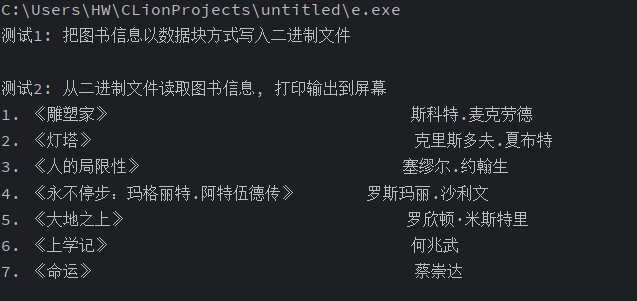
fopen,fclose是文件指针的打开和关闭,wb和rb控制了文件的打开方式,二进制只写和只读
fwrite(x, sizeof(Book), n, fp);这句话中,x是地址头,sizeof是每个块的内存,而n是这些块的个数,fp是文件指针
同理,fread是相对应的
3.task
#include <stdio.h>
#define N 100
#define M 80

void write();
void read_str();
void read_char();

int main() {
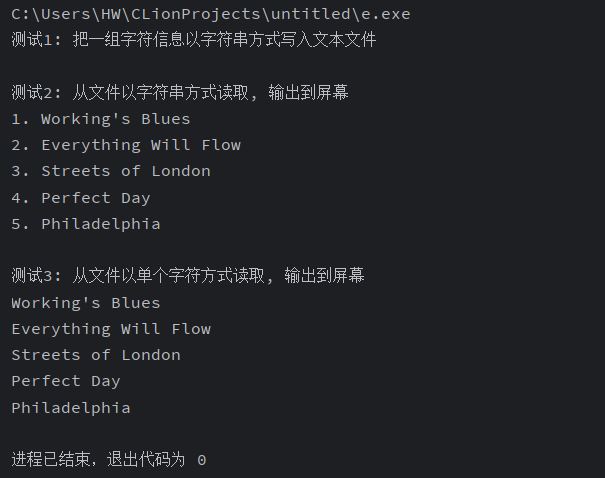
    printf("测试1: 把一组字符信息以字符串方式写入文本文件\n");
    write();

    printf("\n测试2: 从文件以字符串方式读取, 输出到屏幕\n");
    read_str();

    printf("\n测试3: 从文件以单个字符方式读取, 输出到屏幕\n");
    read_char();

    return 0;
}

void write() {
    char *ptr[] = { "Working\'s Blues",
                     "Everything Will Flow",
                     "Streets of London",
                     "Perfect Day",
                     "Philadelphia"};
    int i, n;
    FILE *fp;

    fp = fopen("data3.txt", "w");
    if(fp == NULL) {
        printf("fail to open file to write\n");
        return;
    }

    n = sizeof(ptr)/sizeof(ptr[0]);

    for(i = 0; i < n; ++i) {
        fputs(ptr[i], fp);
        fputs("\n", fp);
    }

    fclose(fp);
}

void read_str() {
    char songs[N][M];
    int i, n;
    FILE *fp;

    fp = fopen("data3.txt", "r");
    if(fp == NULL) {
        printf("fail to open file to read\n");
        return;
    }

    i = 0;
    while(i < N && (fgets(songs[i], M, fp) != NULL))
        ++i;

    n = i;
    for(i = 0; i < n; ++i)
        printf("%d. %s", i+1, songs[i]);

    fclose(fp);
}

void read_char() {
    int ch;
    FILE *fp;

    fp = fopen("data3.txt", "r");
    if(fp == NULL) {
        printf("fail to open file to read\n");
        return;
    }

    while((ch = fgetc(fp)) != EOF)
        putchar(ch);

    fclose(fp);
}
fputs(char *,FILE *stream),将str指向的字符串写入流文件中
fgets(char *,int ,FILE *stream),从流文件中读取最多num-1个字符,将他们存入str中
putchar(char)
fgetc(FILE *stream)
fputc(char,FILE *stream)向流文件中输入
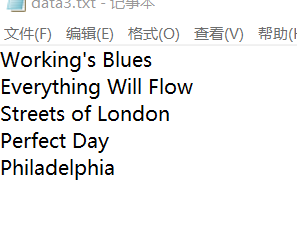
1. 当前路径下生成文本文件data3.txt(尝试用文本编辑器打开,查看其内容)
1. 代码line25字符串 "Working\'s Blues"输出时为什么没有显示反斜杠\?
因为\‘构成了转义字符
2. read_str() 函数中,条件 i < N 用途是?
读取每一行
task4
#include<stdio.h>
#include<stdlib.h>
#include<string.h>
#define M 40
int main() {
    FILE *fp = fopen("C:\\Users\\HW\\CLionProjects\\untitled\\test.txt", "w");
    char str[3][M];
    strcpy(str[0], "0123456789-0123456789\n");
    strcpy(str[1], "nuist2025\n");
    strcpy(str[2], "cosmos galaxy\n");
    for(int i = 0; i < 3; i++) {
        fputs(str[i], fp);
    }
    fclose(fp);
    fp = fopen("test.txt", "r");
    char ch;
    int count1 = 0,count2 = 0;
    while((ch = fgetc(fp)) != EOF) {
        if(ch == '\n') {
            count1++;
        }
        if(!(ch == '\n'|| ch == ' ') ) {
            count2++;
        }
    }
    fclose(fp);
    printf("data4.txt统计结果:\n");
    printf("行数: \t\t\t%d\n",count1);
    printf("字符数(不计空白符):\t%d",count2);
}

#include <stdio.h>
#include <stdlib.h>
#include <time.h>
#include<string.h>
#define N 100
int isflag(int *flag,int i) {
    for(int j=0;j<i-1;j++) {
        for(int k=j+1;k<i;k++) {
            if(flag[j]==flag[k]) {
                return 0;
            }
        }
    }
    return 1;
}

int main() {
    FILE *fp;
    srand(time(NULL));
    int n = 5,count = 0,flag[5] = {0};
    char s[N][N];
    char t[5][N];
    fp = fopen("C:\\Users\\HW\\Desktop\\C语言\\实验7数据文件及部分代码_gbk\\list.txt","r");
    if(fp == NULL) {
        printf("File could not be opened\n");
        exit(1);
    }
    for(int i=0;fgets(s[i],N,fp)!=NULL;i++) {
        count++;

    }
    fclose(fp);
    for(int i=0;i<5;) {
        int randNum = rand()%count;
        flag[i] = randNum;
        if (isflag(flag,i)==0){continue;}
        if(isflag(flag,i)==1) {

            strcpy(t[i],s[randNum]);
            i++;
        }

    }
    char str[N];
    char str2[N] = "C:\\Users\\HW\\Desktop\\C语言\\实验7数据文件及部分代码_gbk\\";
    scanf("%s",str);
    strcat(str2,str);
    fp = fopen(str2,"w");
    if(fp == NULL) {
        printf("File could not be opened\n");
    }
    for(int i=0;i<5;i++) {
      fprintf(fp,"%s\n",t[i]);
    }
    fclose(fp);

}

 浙公网安备 33010602011771号