

分离分层的 platform驱动
一、分离分层
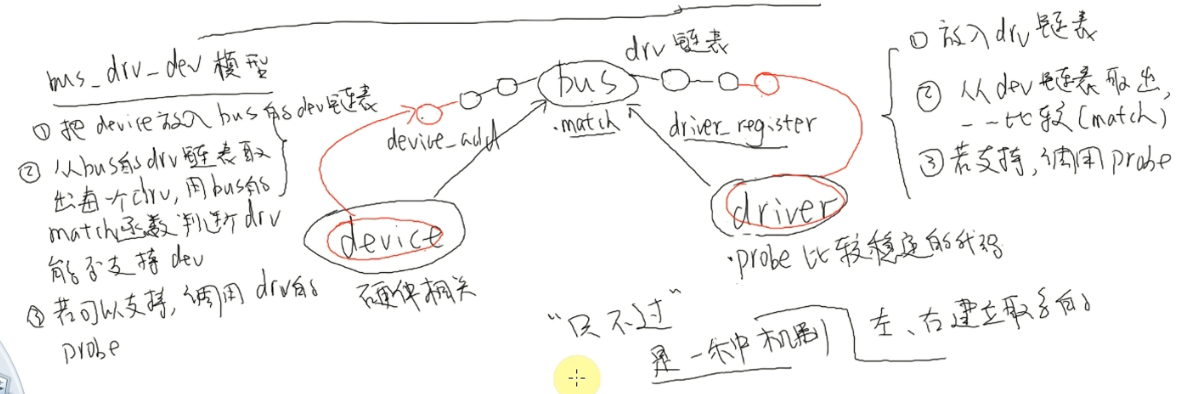
输入子系统、usb设备比驱动以及platform类型的驱动等都体现出分离分层机制;如下图所示,一种典型的分离分层框架:
二、platform机制下的分离
分离就是在驱动层中使用platform机制把硬件相关的代码(固定的,如板子的网卡、中断地址)和驱动(会根据程序作变动,如点哪一个灯)分离开来,即要编写两个文件:dev.c和drv.c(platform设备和platform驱动)。
会在开发板/sys/bus/platform目录下出现这两个文件,并且在两个文件目录下存在命名相同的设备和驱动程序。
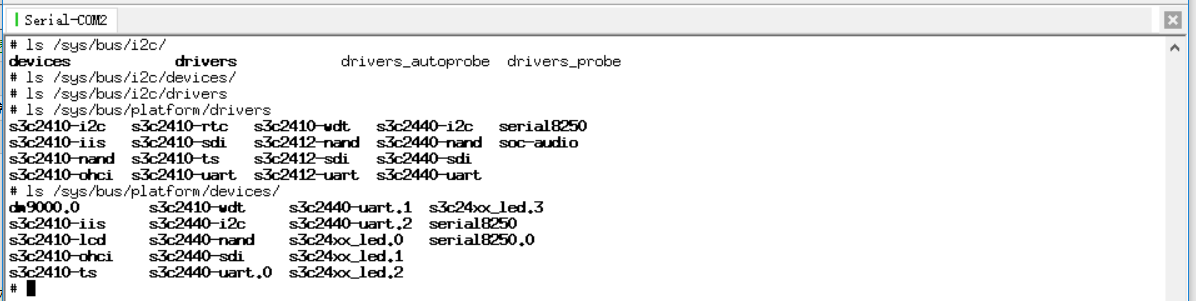
同样的,在/sys/bus/i2c等其它的总线类型目录下,也存在设备和驱动各自的目录。
platform总线:为platform_bus_type,是个全局变量,属于虚拟设备总线, 属于Linux中bus的一种:

 1 struct bus_type platform_bus_type = {
 2     .name            = "platform",
 3     .dev_attrs       = platform_dev_attrs,
 4     .match           = platform_match,
 5     .uevent          = platform_uevent,
 6     .suspend         = platform_suspend,
 7     .suspend_late    = platform_suspend_late,
 8     .resume_early    = platform_resume_early,
 9     .resume          = platform_resume,
10 };
利用该设备总线,一旦一方注册就会调用.match函数进行匹配,将driver和device连接在一起,匹配成功后会调用driver程序里的.probe函数:
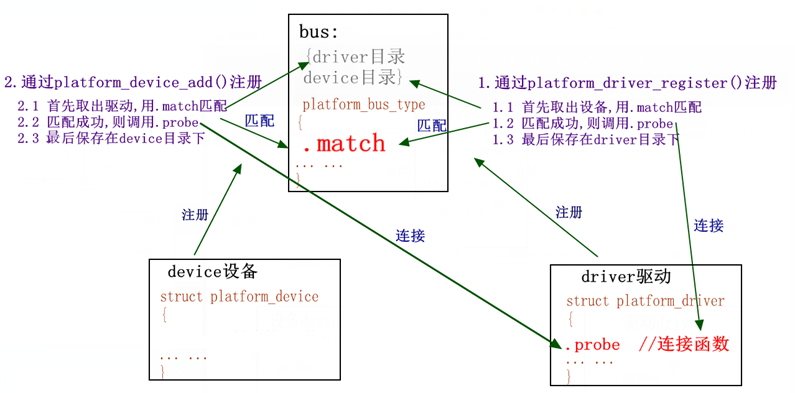
其中,device设备为挂接在platform总线下的设备, platform_device结构体类型,driver驱动为挂接在platform总线下,与某种设备相关的驱动程序, platform_driver结构体类型。
三、例程--基于platform机制,编写led设备和驱动程序
需要分别编写设备代码和驱动代码: led_dev.c 、led_drv.c。其中,
led_dev.c:指定设备硬件/寄存器资源。
led_drv.c:获取设备资源,初始化并操作led。
3.1 led_drv.c
  1 /* 分配/设置/注册一个platform_driver */
  3 #include <linux/module.h>
  4 #include <linux/version.h>
  6 #include <linux/init.h>
  7 #include <linux/fs.h>
  8 #include <linux/interrupt.h>
  9 #include <linux/irq.h>
 10 #include <linux/sched.h>
 11 #include <linux/pm.h>
 12 #include <linux/sysctl.h>
 13 #include <linux/proc_fs.h>
 14 #include <linux/delay.h>
 15 #include <linux/platform_device.h>
 16 #include <linux/input.h>
 17 #include <linux/irq.h>
 18 #include <asm/uaccess.h>
 19 #include <asm/io.h>
 20
 21 static int major;
 24 static struct class *cls;
 25 static volatile unsigned long *gpio_con;
 26 static volatile unsigned long *gpio_dat;
 27 static int pin;
 28
 29 static int led_open(struct inode *inode, struct file *file)
 30 {
 31     /* 配置为输出 */
 32     *gpio_con &= ~(0x3<<(pin*2));
 33     *gpio_con |= (0x1<<(pin*2));
 34      return 0;
 35 }
 37 static ssize_t led_write(struct file *file, const char __user *buf, size_t count, loff_t * ppos)
 38 {
 39     int val;
 41     copy_from_user(&val, buf, count); //    copy_to_user();
 42
 43     if (val == 1)
 44     {
 45         // 点灯
 46         *gpio_dat &= ~(1<<pin);
 47     }
 48     else
 49     {
 50         // 灭灯
 51         *gpio_dat |= (1<<pin);
 52     }
 54     return 0;
 55 }
 58 static struct file_operations led_fops = {
 59     .owner  =   THIS_MODULE,    /* 这是一个宏,推向编译模块时自动创建的__this_module变量 */
 60     .open   =   led_open,
 61     .write    =    led_write,
 62 };
 63
 64 /* 2.1 当驱动和设备都insmod加载后,然后bus总线会匹配成功,就进入.probe函数,
 65    2.2 在.probe函数中便使用platform_get_resource()函数获取LED的地址和引脚,然后初始化LED,并注册字符设备,和设备节点"led",
 66    2.3 编写注册时的file_operations成员函数
 67 */
 68 static int led_probe(struct platform_device *pdev)
 69 {
 70     struct resource        *res;
 71
 72     /* 根据platform_device的资源进行ioremap */
 73     res = platform_get_resource(pdev, IORESOURCE_MEM, 0);  //IORESOURCE_MEM资源中的第0个
 74     gpio_con = ioremap(res->start, res->end - res->start + 1);
 75     gpio_dat = gpio_con + 1;                //指针加1==》相当于+4
 76
 77     res = platform_get_resource(pdev, IORESOURCE_IRQ, 0);  //IORESOURCE_IRQ资源中的第0个
 78     pin = res->start;
 79
 80     /* 注册字符设备驱动程序 */
 82     printk("led_probe, found led\n");
 83
 84     major = register_chrdev(0, "myled", &led_fops);
 85
 86     cls = class_create(THIS_MODULE, "myled");
 87
 88     class_device_create(cls, NULL, MKDEV(major, 0), NULL, "led"); /* /dev/led */
 89
 90     return 0;
 91 }
 93 static int led_remove(struct platform_device *pdev)
 94 {
 95     /* 卸载字符设备驱动程序 */
 96     /* iounmap */
 97     printk("led_remove, remove led\n");
 98
 99     class_device_destroy(cls, MKDEV(major, 0));
100     class_destroy(cls);
101     unregister_chrdev(major, "myled");
102     iounmap(gpio_con);
103
104     return 0;
105 }
108 struct platform_driver led_drv = {
109     .probe        = led_probe,
110     .remove        = led_remove,
111     .driver        = {
112         .name    = "myled",
113     }
114 };
115
116 /*1. 注册的led驱动*/
117 static int led_drv_init(void)
118 {
119     platform_driver_register(&led_drv);
120     return 0;
121 }
123 static void led_drv_exit(void)
124 {
125     platform_driver_unregister(&led_drv);
126 }
128 module_init(led_drv_init);
129 module_exit(led_drv_exit);
131 MODULE_LICENSE("GPL");
其中, platform_get_resource函数为:
struct resource * platform_get_resource(struct platform_device *dev, unsigned int type,unsigned int num);
//获取设备的某个资源,获取成功,则返回一个resource资源结构体
//参数:
// *dev: 指向某个platform device设备
// type: 获取的资源类型
// num: type资源下的第几个数组
platform_driver结构体:
struct platform_driver {
       int (*probe)(struct platform_device *);
       int (*remove)(struct platform_device *);
       void (*shutdown)(struct platform_device *);         //断电
       int (*suspend)(struct platform_device *, pm_message_t state);  //休眠
       int (*suspend_late)(struct platform_device *, pm_message_t state);
       int (*resume_early)(struct platform_device *);
       int (*resume)(struct platform_device *);           //唤醒
       struct device_driver driver;       //内嵌的driver, 主要是name成员:设备的名称
};
3.2 led_dev.c
 1 #include <linux/module.h>
 2 #include <linux/version.h>
 3 #include <linux/init.h>
 4 #include <linux/kernel.h>
 5 #include <linux/types.h>
 6 /* 分配/设置/注册一个platform_device */
 7 #include <linux/interrupt.h>
 8 #include <linux/list.h>
 9 #include <linux/timer.h>
10 #include <linux/init.h>
11 #include <linux/serial_core.h>
12 #include <linux/platform_device.h>
13
14 static struct resource led_resource[] = {
15     [0] = {
16         .start = 0x56000050,               //寄存器的起始物理地址  GPFCON 0x56000050
17         .end   = 0x56000050 + 8 - 1,
18         .flags = IORESOURCE_MEM,           //哪一类资源
19     },
20     [1] = {
21         .start = 5,                        //哪(位)个引脚
22         .end   = 5,
23         .flags = IORESOURCE_IRQ,
24     }
25
26 };
27
28 static void led_release(struct device * dev)
29 {
30 }
32 static struct platform_device led_dev = {
33     .name         = "myled",
34     .id       = -1,        //表示只有一个设备
35     .num_resources    = ARRAY_SIZE(led_resource),//资源数量,ARRAY_SIZE()函数:获取数量
36     .resource     = led_resource,
37     .dev = {
38         .release = led_release,
39     },
40 };
41
42 static int led_dev_init(void)
43 {
44     platform_device_register(&led_dev);
45     return 0;
46 }
47
48 static void led_dev_exit(void)
49 {
50     platform_device_unregister(&led_dev);
51 }
52 module_init(led_dev_init);
53 module_exit(led_dev_exit);
54 MODULE_LICENSE("GPL");
其中,platform_driver结构体:
struct platform_device {
  const char       * name; //设备名称,要与platform_driver的name一样,这样总线才能匹配成功
  u32          id;         //id号,插入总线下相同name的设备编号(一个驱动可以有多个设备),如果只有一个设备填-1
  struct  device  dev;     //内嵌的具体的device结构体,其中成员platform_data,是个void *类型,可以给平台driver提供各种数据(比如:GPIO引脚等等)
  u32 num_resources;                 //资源数量,
  struct resource         * resource;    //资源结构体,保存设备的信息
};
struct resource {
         resource_size_t start;                    //起始资源,如果是地址的话,必须是物理地址
         resource_size_t end;                      //结束资源,如果是地址的话,必须是物理地址
         const char *name;                         //资源名
         unsigned long flags;                      //资源的标志
         //比如IORESOURCE_MEM,表示地址资源, IORESOURCE_IRQ表示中断引脚... ...
         struct resource *parent, *sibling, *child;   //资源拓扑指针父、兄、子,可以构成链表
};
3.3 测试程序
 1 #include <sys/types.h>
 2 #include <sys/stat.h>
 3 #include <fcntl.h>
 4 #include <stdio.h>
 5
 6 /* led_test on
 7  * led_test off
 8  */
 9 int main(int argc, char **argv)
10 {
11     int fd;
12     int val = 1;
13     fd = open("/dev/led", O_RDWR);
14     if (fd < 0)
15     {
16         printf("can't open!\n");
17     }
18     if (argc != 2)
19     {
20         printf("Usage :\n");
21         printf("%s <on|off>\n", argv[0]);
22         return 0;
23     }
24
25     if (strcmp(argv[1], "on") == 0)
26     {
27         val  = 1;
28     }
29     else
30     {
31         val = 0;
32     }
34     write(fd, &val, 4);
35     return 0;
36 }
1)将led_dev和led_drv编译为模块,加载。会在sys/bus/platform/devices目录下分别生成一个"myled"。
2)最后,编译应用程序,并在开发板运行可执行程序,控制led:
# led_test on
# led_test off

 浙公网安备 33010602011771号