反射方式获取构造方法并使用
Constructor<T>对象
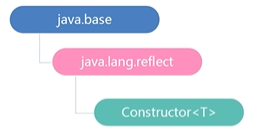
构造器对象,属于java.base模块,java.lang.reflect包中
-
getConstructor(Class <?>... parameterType)
    //返回公共构造方法
-
getDeclaredConstructor(Class <?>... parameterType) //返回私有构造方法 -
getConstructors()
    //返回所有构造方法,但不包括私有狗杂方法
Constructor的常用方法
String getName()
    //返回构造方法名
T newinstance(Object... initargs)
    //使用此构造函数和指定参数创建并初始化对象
构造方法的使用举例
Student.java
package Demo01;
import java.lang.reflect.Constructor;
/**
* @author :K;
*/
public class Student {
public Student() {
}
public Student(String name){
System.out.println("输入的姓名为:"+name);
}
private Student(int age){
System.out.println("你的年龄为:"+age);
}
}
Reflect_GetConstructor.java
package Demo01;
import java.lang.reflect.Constructor;
import java.lang.reflect.InvocationTargetException;
public class Reflect_GetConstructor {
public static void main(String[] args) throws ClassNotFoundException, NoSuchMethodException, IllegalAccessException, InvocationTargetException, InstantiationException {
//1.获取Student类的字节码文件对象
//2.根据字节码文件对象,获取指定的构造器对象
//3.根据构造器对象和参数,创建对应的Student对象
Class aClass = Class.forName("Demo01.Student");
System.out.println(aClass.getName());
//获取公共的无参构造
Constructor constructor01 = aClass.getConstructor();
System.out.println(constructor01);
//获得公共的有参构造
Constructor constructor02 = aClass.getConstructor(String.class);
System.out.println(constructor02);
//获取私有的有参构造
Constructor declaredConstructor = aClass.getDeclaredConstructor(int.class);
System.out.println(declaredConstructor);
//获取所有的构造方法,除去私有的构造方法
Constructor[] constructors = aClass.getConstructors();
for(Constructor constructor:constructors){
System.out.println(constructor);
}
System.out.println("-------------");
//构造器对象
System.out.println(constructor01);
String name = constructor01.getName();
//构造器的名字
System.out.println(name);
//根据构造器对象和参数,创建对应的Student对象
Student stu = (Student) constructor02.newInstance("李白");
//打印输出结果
System.out.println(stu);
}
}

 浙公网安备 33010602011771号