
C++面试题
一、题目描述:
  1 #include <iostream>
  2 using namespace std;
  3
  4 class http_request{
  5     public:
  6         void funA(){cout << "call funA" << endl;}
  7
  8         void funB(){cout << "call funB" << endl;}
  9
 10         void funC(){num = 0;}
 11
 12     private:
 13         int num;
 14 };
 15
 16 int main()
 17 {
 18     http_request *p = nullptr;
 19
 20     p->funA();
 21     p->funB();
 22     p->funC();
 23
 24     return 0;
 25 }
主要是定义一个类,然后使用这个类类型定义一个指针,并且将指针置为nullptr,访问类的成员函数,会出现什么情况。
看到这个空指针立马就会想到core dump,但是在机器上跑了下发现对于funA()、funB()的调用是对的,funC()的调用确实会core dump,Linux下跑的结果:

看到这个结果想不通为什么有的函数空指针可以调用,有的就不可以,看了下网上大家的解释,原来这个结果和this指针相关,对于类的成员函数,在类定义的时候地址就已经确定了,它不占用对象的空间,也就是说这个类的所有对象都使用的同一个函数,只不过是在具体的对象生成后去调用这个成员函数的时候,会默认传入一个this指针,存储着当前对象的地址,那么,拿到当前对象的地址,就可以操作当前对象的数据成员了,即对类数据成员的操作都本质上是this->数据成员。对于funA和funB因为只是输出语句,并没有操作类的数据成员,虽然在通过指针调用的时候传入了this指针,并且为nullptr,但是在成员函数funA、funB中并不操作数据成员,即没使用这个传入的空this指针,就没问题;但是对于funC,操作了类的数据成员,本质上为this->num = 0,而此时指针并没有指向具体的对象,this指针没有确切的空间,所以调用funC会发生core dump。
看了网上的解释后,突然感觉自己面试的时候想的好简单,看到空指针就觉得会core dump,知识盲点很多,很多东西要跑一跑才知道正确的结果。
二、二维数组中寻找给定值并输出下标
1 #include<iostream>
  2 #include<vector>
  3 using namespace std;
  4
  5 typedef vector<pair<int, int> > result;
  6
  7 result FindPoint(int data[][5], int num, int width, int height)
  8 {
  9     result ret;
 10     for (int i = 0; i < width; ++i)
 11     {
 12         for (int j = 0; j < height; ++j)
 13         {
 14             if (data[i][j] == num)
 15             {
 16                 pair<int, int> val;
 17                 val.first = i;
 18                 val.second = j;
 19                 ret.push_back(val);
 20             }
 21         }
 22     }
 23     return ret;
 24 }
 25
 26 int main()
 27 {
 28     const int width = 3;
 29     const int height = 5;
 30     int data[width][height] = {{4,7,9,3,0}, {3,6,90,22,1}, {80,56,3,3,3}};
 31 #if 0
 32     for (int i = 0; i < width; ++i)
 33     {
 34         for (int j = 0; j < height; ++j)
 35         {
 36             data[i][j] = i * j;
 37         }
 38     }
 39 #endif
 40
 41     result ret = FindPoint(data, 3, width, height);
 42     for(vector<pair<int, int> >::iterator i = ret.begin(); i < ret.end(); ++i)
 43     {
 44         cout << "[" << (*i).first << "," << (*i).second << "]" << endl;
 45     }
 46
 47     return 0;
 48 }
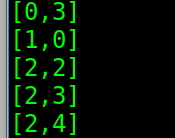
运行结果:
三、54张扑克牌顺序存放在vector中,乱序后输出到控制台
主要是使用STL算法中的random_shuffle()算法,可以在输入区间值的排列中任取一种,调用这个算法即可
  1 #include <iostream>
  2 #include <vector>
  3 #include <algorithm>
  4 using namespace std;
  5
  6 int main()
  7 {
  8     vector<int> vec;
  9     for (int i = 1; i <= 54; ++i)
 10     {
 11         vec.push_back(i);
 12     }
 13     random_shuffle(vec.begin(), vec.end());
 14
 15     for (vector<int>::iterator i = vec.begin(); i < vec.end(); ++i)
 16     {
 17         cout << *i << " ";
 18     }
 19     cout << endl;
 20
 21     return 0;
 22 }

 浙公网安备 33010602011771号