
NLP FROM SCRATCH: GENERATING NAMES WITH A CHARACTER-LEVEL RNN(2)
Author: Sean Robertson
从头开始NLP的第二篇。第一篇用于对给定的名字进行分类,分类属于哪种语言。这次将学习如何从给定语言生成名字。

仍然手动实现一个小型RNN,不同的是之前输入一个名字的所有字母来输出一个类别,这次输入类别一次输出一个字母。递归预测来形成语言。也被称为“语言模型”。
推荐阅读:
I assume you have at least installed PyTorch, know Python, and understand Tensors:
- https://pytorch.org/ For installation instructions
- Deep Learning with PyTorch: A 60 Minute Blitz to get started with PyTorch in general
- Learning PyTorch with Examples for a wide and deep overview
- PyTorch for Former Torch Users if you are former Lua Torch user
It would also be useful to know about RNNs and how they work:
- The Unreasonable Effectiveness of Recurrent Neural Networks shows a bunch of real life examples
- Understanding LSTM Networks is about LSTMs specifically but also informative about RNNs in general
I also suggest the previous tutorial, NLP From Scratch: Classifying Names with a Character-Level RNN
数据准备
下载:Download the data from here and extract it to the current directory.(参考上一节)
 1 from __future__ import unicode_literals, print_function, division
 2 from io import open
 3 import glob
 4 import os
 5 import unicodedata
 6 import string
 7
 8 all_letters = string.ascii_letters + " .,;'-"
 9 n_letters = len(all_letters) + 1 # Plus EOS marker
10
11 def findFiles(path): return glob.glob(path)
12
13 # Turn a Unicode string to plain ASCII, thanks to https://stackoverflow.com/a/518232/2809427
14 def unicodeToAscii(s):
15     return ''.join(
16         c for c in unicodedata.normalize('NFD', s)
17         if unicodedata.category(c) != 'Mn'
18         and c in all_letters
19     )
20
21 # Read a file and split into lines
22 def readLines(filename):
23     lines = open(filename, encoding='utf-8').read().strip().split('\n')
24     return [unicodeToAscii(line) for line in lines]
25
26 # Build the category_lines dictionary, a list of lines per category
27 category_lines = {}
28 all_categories = []
29 for filename in findFiles('data/names/*.txt'):
30     category = os.path.splitext(os.path.basename(filename))[0]
31     all_categories.append(category)
32     lines = readLines(filename)
33     category_lines[category] = lines
34
35 n_categories = len(all_categories)
36
37 if n_categories == 0:
38     raise RuntimeError('Data not found. Make sure that you downloaded data '
39         'from https://download.pytorch.org/tutorial/data.zip and extract it to '
40         'the current directory.')
41
42 print('# categories:', n_categories, all_categories)
43 print(unicodeToAscii("O'Néàl"))

构建网络
在上一节的基础上进行扩展,额外的类别tensor和字母输入的格式是一样,都是独热编码。输出的是下个字母的概率。在采样的时候概率最高的字母作为下个输入字母。加入了一个线性层o2o来提高效率。也有一个dropout层,来避免过拟合。故意在网络最后使用dropout来增加采样多样性。
import torch
import torch.nn as nn

class RNN(nn.Module):
    def __init__(self, input_size, hidden_size, output_size):
        super(RNN, self).__init__()
        self.hidden_size = hidden_size

        self.i2h = nn.Linear(n_categories + input_size + hidden_size, hidden_size)
        self.i2o = nn.Linear(n_categories + input_size + hidden_size, output_size)
        self.o2o = nn.Linear(hidden_size + output_size, output_size)
        self.dropout = nn.Dropout(0.1)
        self.softmax = nn.LogSoftmax(dim=1)

    def forward(self, category, input, hidden):
        input_combined = torch.cat((category, input, hidden), 1)
        hidden = self.i2h(input_combined)
        output = self.i2o(input_combined)
        output_combined = torch.cat((hidden, output), 1)
        output = self.o2o(output_combined)
        output = self.dropout(output)
        output = self.softmax(output)
        return output, hidden

    def initHidden(self):
        return torch.zeros(1, self.hidden_size)
训练
准备工作:定义一些帮助函数随机生成一些语言-名字组合。
import random

# Random item from a list
def randomChoice(l):
    return l[random.randint(0, len(l) - 1)]

# Get a random category and random line from that category
def randomTrainingPair():
    category = randomChoice(all_categories)
    line = randomChoice(category_lines[category])
    return category, line
每一步,对于每个生成的字母,网络的输入为(类别、当前字母、隐藏态),输出为(下个字母、下个隐藏态)。对于每次训练过程,需要类别和与一组输入字母,和一组输出/目标字母。
因为根据当前字母来预测下个字母,字母对是行中连续的一组字母。例如:对于ABCD,将会创建(‘A’,'B'),('B','C')...
类别tensor是独热类型,当训练的时候输入到网络。这个操作可以包含在隐藏态中或用其他策略。
 1 # One-hot vector for category
 2 def categoryTensor(category):
 3     li = all_categories.index(category)
 4     tensor = torch.zeros(1, n_categories)
 5     tensor[0][li] = 1
 6     return tensor
 7
 8 # One-hot matrix of first to last letters (not including EOS) for input
 9 def inputTensor(line):
10     tensor = torch.zeros(len(line), 1, n_letters)
11     for li in range(len(line)):
12         letter = line[li]
13         tensor[li][0][all_letters.find(letter)] = 1
14     return tensor
15
16 # LongTensor of second letter to end (EOS) for target
17 def targetTensor(line):
18     letter_indexes = [all_letters.find(line[li]) for li in range(1, len(line))]
19     letter_indexes.append(n_letters - 1) # EOS
20     return torch.LongTensor(letter_indexes)
为了方便训练,利用randomTrainingExample 函数来随机获取(类别、name行)对,并转为tensor。
# Make category, input, and target tensors from a random category, line pair
def randomTrainingExample():
    category, line = randomTrainingPair()
    category_tensor = categoryTensor(category)
    input_line_tensor = inputTensor(line)
    target_line_tensor = targetTensor(line)
    return category_tensor, input_line_tensor, target_line_tensor
训练网络
相对于分类仅仅利用最后的输出,而这次在每一步都要进行预测,素以每一步都计算损失。
自动求导机制可以帮助实现计算损失并反向传播。
criterion = nn.NLLLoss()

learning_rate = 0.0005

def train(category_tensor, input_line_tensor, target_line_tensor):
    target_line_tensor.unsqueeze_(-1)
    hidden = rnn.initHidden()

    rnn.zero_grad()

    loss = 0

    for i in range(input_line_tensor.size(0)):
        output, hidden = rnn(category_tensor, input_line_tensor[i], hidden)
        l = criterion(output, target_line_tensor[i])
        loss += l

    loss.backward()

    for p in rnn.parameters():
        p.data.add_(-learning_rate, p.grad.data)

    return output, loss.item() / input_line_tensor.size(0)
为了跟踪训练过程,加入一个时间函数:
import time
import math

def timeSince(since):
    now = time.time()
    s = now - since
    m = math.floor(s / 60)
    s -= m * 60
    return '%dm %ds' % (m, s)
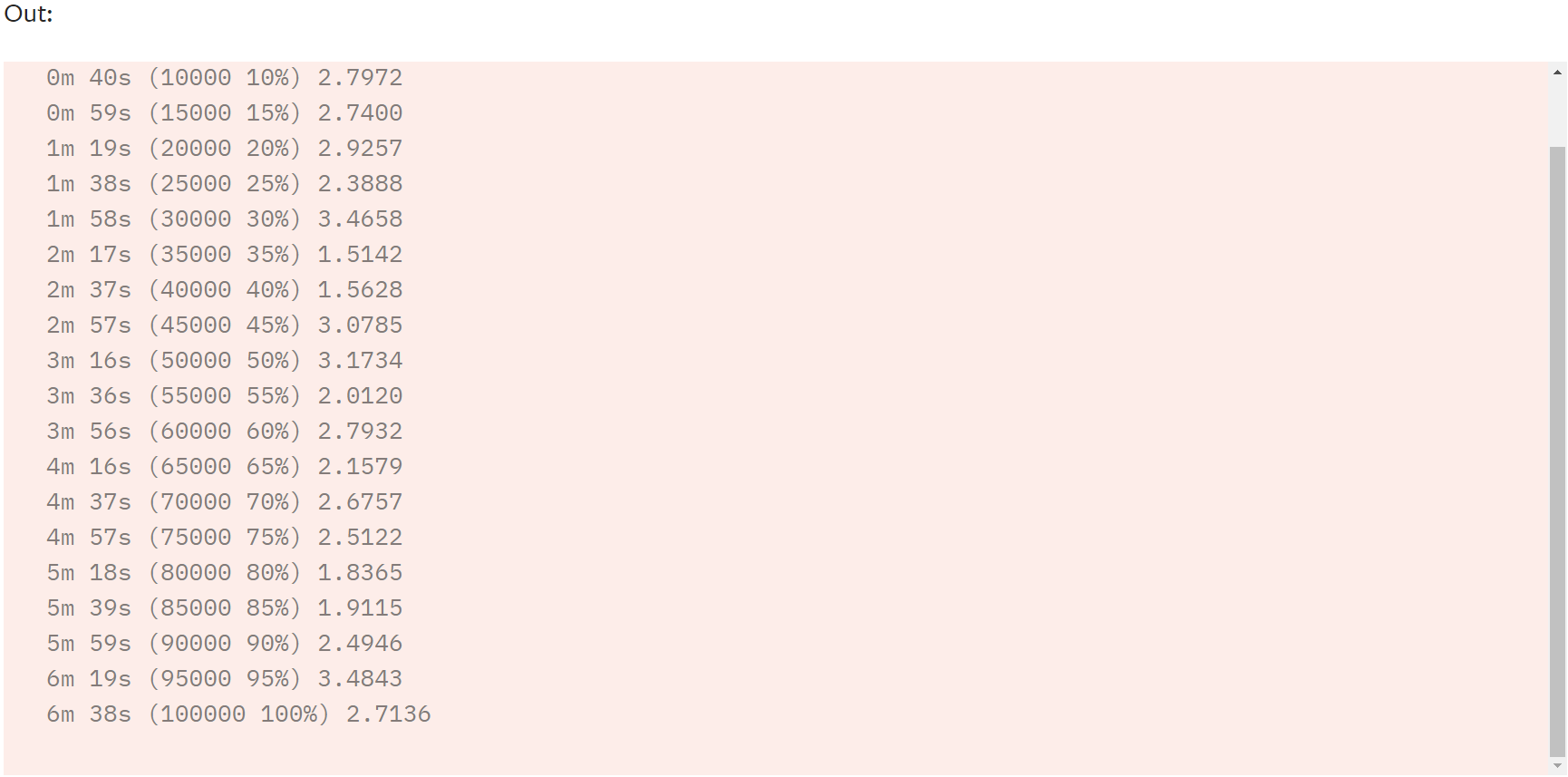
训练、打印并记录一些loss值用于后续可视化。
rnn = RNN(n_letters, 128, n_letters)

n_iters = 100000
print_every = 5000
plot_every = 500
all_losses = []
total_loss = 0 # Reset every plot_every iters

start = time.time()

for iter in range(1, n_iters + 1):
    output, loss = train(*randomTrainingExample())
    total_loss += loss

    if iter % print_every == 0:
        print('%s (%d %d%%) %.4f' % (timeSince(start), iter, iter / n_iters * 100, loss))

    if iter % plot_every == 0:
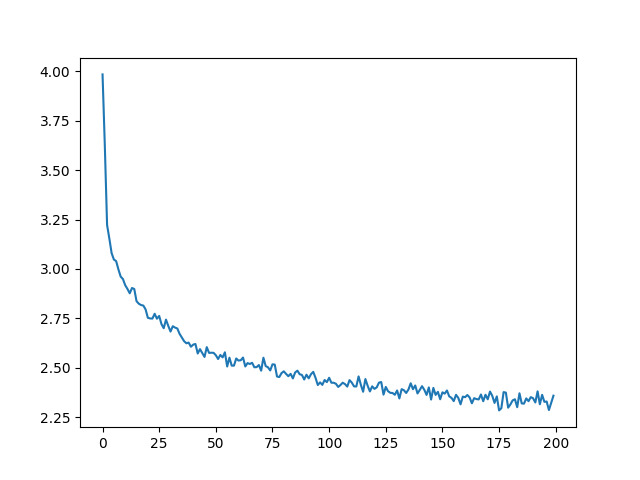
        all_losses.append(total_loss / plot_every)
        total_loss = 0
损失可视化
import matplotlib.pyplot as plt
import matplotlib.ticker as ticker

plt.figure()
plt.plot(all_losses)
采样
为了采样,给网络一个字母然后网络预测出下一个字母,然后继续这个过程直到结束。
- 创建一个类别tensor,开始字母和初始隐藏态
- 创建一个含开始字母的output_name串
- 直到输出长度足够
- 输入当前字母给网络
- 根据最高概率得到下个字母,和下一个隐藏态
- 如果到末尾EOS则终止
- 如果是常规字母,输出output_name并继续
- 返回最终的名字
另一种策略:不必给定起始字母,初始串也可以,网络来选择初始字母。
max_length = 20

# Sample from a category and starting letter
def sample(category, start_letter='A'):
    with torch.no_grad():  # no need to track history in sampling
        category_tensor = categoryTensor(category)
        input = inputTensor(start_letter)
        hidden = rnn.initHidden()

        output_name = start_letter

        for i in range(max_length):
            output, hidden = rnn(category_tensor, input[0], hidden)
            topv, topi = output.topk(1)
            topi = topi[0][0]
            if topi == n_letters - 1:
                break
            else:
                letter = all_letters[topi]
                output_name += letter
            input = inputTensor(letter)

        return output_name

# Get multiple samples from one category and multiple starting letters
def samples(category, start_letters='ABC'):
    for start_letter in start_letters:
        print(sample(category, start_letter))

samples('Russian', 'RUS')

samples('German', 'GER')

samples('Spanish', 'SPA')

samples('Chinese', 'CHI')

Exercises
- Try with a different dataset of category -> line, for example:Use a “start of sentence” token so that sampling can be done without choosing a start letter
- Fictional series -> Character name
- Part of speech -> Word
- Country -> City
- Get better results with a bigger and/or better shaped network
- Try the nn.LSTM and nn.GRU layers
- Combine multiple of these RNNs as a higher level network
Total running time of the script: ( 6 minutes 39.119 seconds

 浙公网安备 33010602011771号