
NLP FROM SCRATCH: CLASSIFYING NAMES WITH A CHARACTER-LEVEL RNN
翻译总结于 pytorch官网 Author: Sean Robertson
构建一个基础的character-level RNN来分类单词。本文和接下来的两篇文章将会从头(数据处理)开始构建NLP模型。特别的没有利用各种已有的操作(torchtext),所以可以从底层来学习NLP模型的处理过程。
character-level RNN按照序列读取单词,每步输出一个预测和“隐藏态”(hidden state),将前一个隐藏态输入到下一步。利用最终的预测作为输出,即预测的类别。
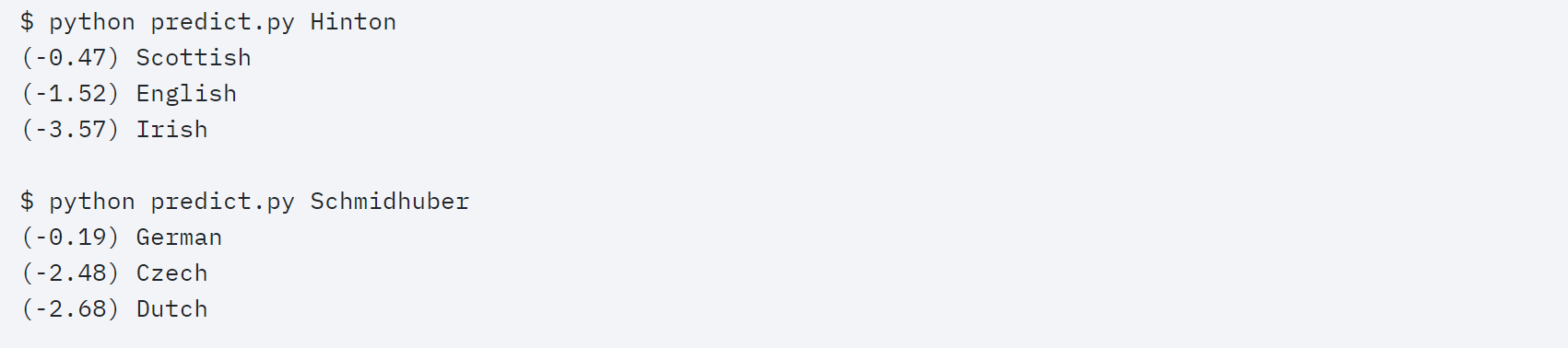
特别的,将对来自18种语言的几千个姓氏进行训练,并根据拼写来预测该姓氏来自哪种语言。例如:
推荐阅读:
I assume you have at least installed PyTorch, know Python, and understand Tensors:
- https://pytorch.org/ For installation instructions
- Deep Learning with PyTorch: A 60 Minute Blitz to get started with PyTorch in general
- Learning PyTorch with Examples for a wide and deep overview
- PyTorch for Former Torch Users if you are former Lua Torch user
It would also be useful to know about RNNs and how they work:
- The Unreasonable Effectiveness of Recurrent Neural Networks shows a bunch of real life examples
- Understanding LSTM Networks is about LSTMs specifically but also informative about RNNs in general
数据准备
数据下载:Download the data from here and extract it to the current directory.
在data/names文件下有18个txt文件,以[language].txt命名。每个文件包含了一些名字,一行一个名字(需要将其从unicode转为ascii)。
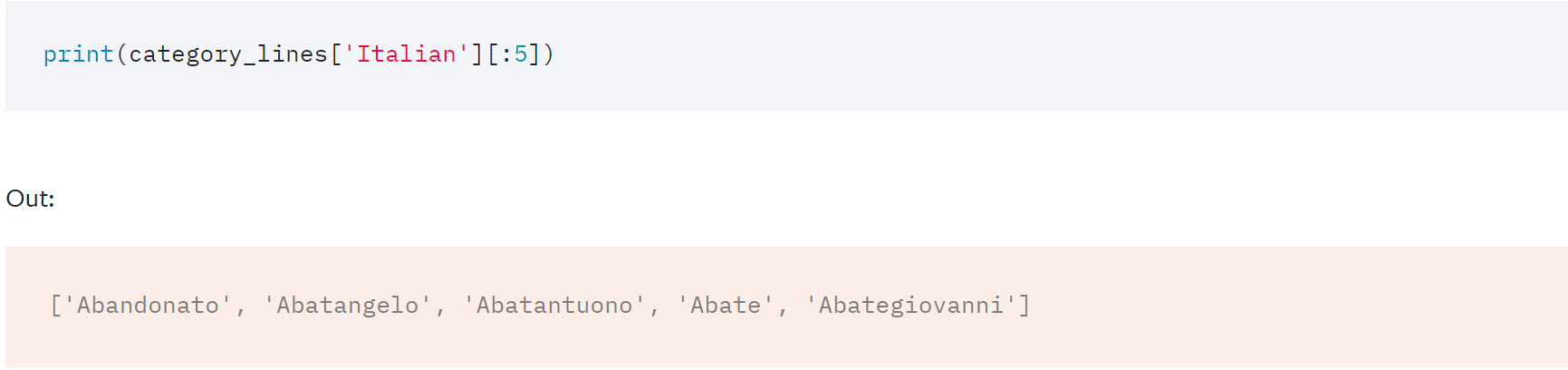
最后生成字典列表,每个字典元素都是:{language:[names...]}。字典格式:变量“category”和“line”(表示语言和名字)在后面会用到。
 1 # -*- coding: utf-8 -*-
 2 """
 3 Created on Tue Apr 14 11:12:13 2020
 4
 5 @author: lenovo
 6 """
 7
 8 from __future__ import unicode_literals, print_function, division
 9 from io import open
10 import glob
11 import os
12
13 def findFiles(path): return glob.glob(path)
14
15 print(findFiles('data/names/*.txt'))
16
17 import unicodedata
18 import string
19
20 all_letters = string.ascii_letters + " .,;'"
21 n_letters = len(all_letters)         # 57
22
23 # Turn a Unicode string to plain ASCII, thanks to https://stackoverflow.com/a/518232/2809427
24 def unicodeToAscii(s):
25     return ''.join(
26         c for c in unicodedata.normalize('NFD', s)
27         if unicodedata.category(c) != 'Mn'
28         and c in all_letters
29     )
30
31 print(unicodeToAscii('Ślusàrski'))
32
33 # Build the category_lines dictionary, a list of names per language
34 category_lines = {}
35 all_categories = []
36
37 # Read a file and split into lines
38 def readLines(filename):
39     lines = open(filename, encoding='utf-8').read().strip().split('\n')
40     return [unicodeToAscii(line) for line in lines]
41
42 for filename in findFiles('data/names/*.txt'):
43     category = os.path.splitext(os.path.basename(filename))[0]
44     all_categories.append(category)
45     lines = readLines(filename)
46     category_lines[category] = lines     # 字典 语言到名字
47
48 n_categories = len(all_categories)   # 字典长度 18
category_lines变量里面就是一个字典,包括从category(不同语言)到名字names(列表)的映射。同时all_categories就是所有语言的list,而n_categories是list长度,即语言数。
将名字转为Tensor
为利用数据,需要将name转为tensor。利用独热编码实现编码字母,例如b就是<0 1 0 0 0 ...>。所以一个名字就是2维的矩阵(由字母组成)。在批量这个维度上有维度1(pytorch语法格式)。
 1 import torch
 2
 3 # Find letter index from all_letters, e.g. "a" = 0
 4 def letterToIndex(letter):
 5     return all_letters.find(letter)
 6
 7 # Just for demonstration, turn a letter into a <1 x n_letters> Tensor
 8 def letterToTensor(letter):
 9     tensor = torch.zeros(1, n_letters)
10     tensor[0][letterToIndex(letter)] = 1
11     return tensor
12
13 # Turn a line into a <line_length x 1 x n_letters>,
14 # or an array of one-hot letter vectors
15 def lineToTensor(line):
16     tensor = torch.zeros(len(line), 1, n_letters)
17     for li, letter in enumerate(line):
18         tensor[li][0][letterToIndex(letter)] = 1
19     return tensor
20
21 print(letterToTensor('J'))
22
23 print(lineToTensor('Jones').size())

建立网络
在自动求导前,toch里构建循环神经网络包括在几个时间步骤中复制网络层参数。该网络层包括隐藏状态和梯度。因为是自动求导,所以可以构建一个非常纯的RNN实现。本文的RNN模型主要copy自the PyTorch for Torch users tutorial,仅仅有两层组成。包括输入、隐藏态、logsoftmax层。
 1 class RNN(nn.Module):
 2     def __init__(self, input_size, hidden_size, output_size):
 3         super(RNN, self).__init__()
 4
 5         self.hidden_size = hidden_size
 6
 7         self.i2h = nn.Linear(input_size + hidden_size, hidden_size)
 8         self.i2o = nn.Linear(input_size + hidden_size, output_size)
 9         self.softmax = nn.LogSoftmax(dim=1)
10
11     def forward(self, input, hidden):
12         combined = torch.cat((input, hidden), 1)
13         hidden = self.i2h(combined)
14         output = self.i2o(combined)
15         output = self.softmax(output)
16         return output, hidden
17
18     def initHidden(self):
19         return torch.zeros(1, self.hidden_size)
20
21 n_hidden = 128
22 rnn = RNN(n_letters, n_hidden, n_categories)
这步需要给一个输入(当前字母的tensor)和之前的隐藏态(最初初始化为全零)。得到的是输出(每个语言的概率)和下一个隐藏态(存起来为了下一步)。
1 input = letterToTensor('A')
2 hidden =torch.zeros(1, n_hidden)
3
4 output, next_hidden = rnn(input, hidden)
为了效率,不想每一步都创一个新的tensor,利用lineToTensor而不是letterToTensor,并利用切片。预处理批量tensors时可以进一步优化。
1 input = lineToTensor('Albert')
2 hidden = torch.zeros(1, n_hidden)
3
4 output, next_hidden = rnn(input[0], hidden)
5 print(output)

这个就是对所有类别的预测,给定一个名字,哪个概率最高,就属于哪类。
训练(准备工作)
正式训练之前需要一些帮助函数。首先是网络的输出,即类别概率,利用Tensor.topk来得到最大值的索引。
1 def categoryFromOutput(output):
2     top_n, top_i = output.topk(1)
3     category_i = top_i[0].item()
4     return all_categories[category_i], category_i
5
6 print(categoryFromOutput(output))

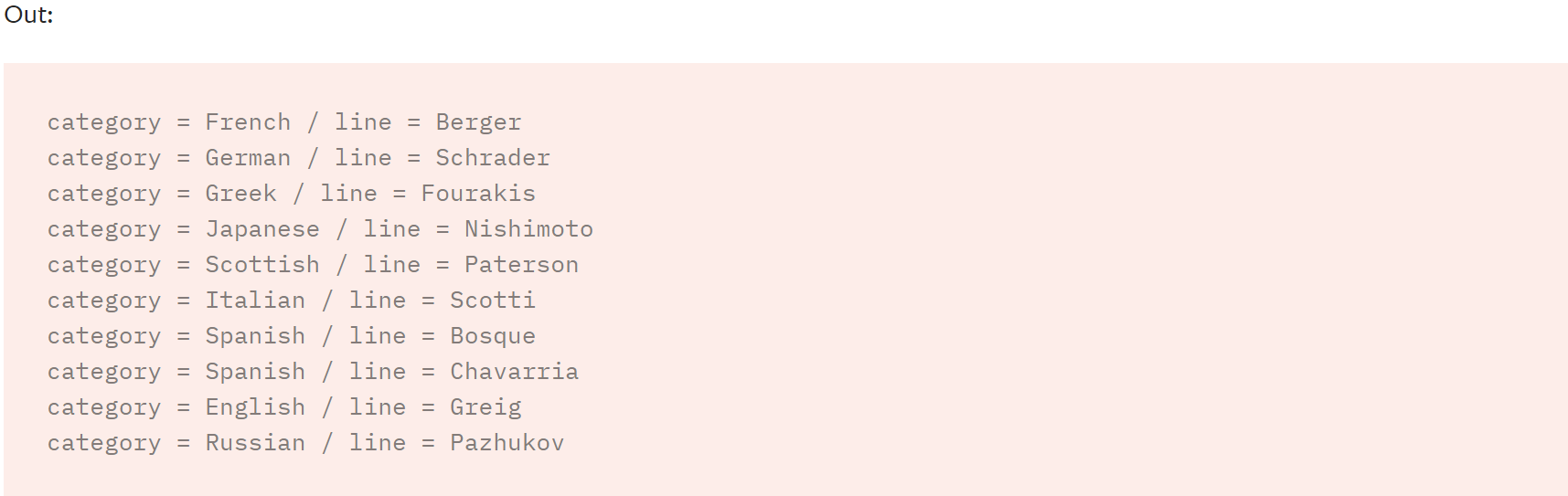
以下是一个随即整的训练样本:
 1 import random
 2
 3 def randomChoice(l):
 4     return l[random.randint(0, len(l) - 1)]
 5
 6 def randomTrainingExample():
 7     category = randomChoice(all_categories)
 8     line = randomChoice(category_lines[category])
 9     category_tensor = torch.tensor([all_categories.index(category)], dtype=torch.long)
10     line_tensor = lineToTensor(line)
11     return category, line, category_tensor, line_tensor
12
13 for i in range(10):
14     category, line, category_tensor, line_tensor = randomTrainingExample()
15     print('category =', category, '/ line =', line)
训练网络
对于损失函数,可以利用nn.NLLLoss,RNN的最后一层为nn.LogSoftmax
criterion = nn.NLLLoss()
每个循环过程分别执行:
- 创建输入和目标tensor
- 创建初始的隐藏态为全零
- 读取每个字母并为下个字母保持隐藏态
- 对比输出和目标
- 反向传播
- 输出loss
 1 learning_rate = 0.005 # If you set this too high, it might explode. If too low, it might not learn
 2
 3 def train(category_tensor, line_tensor):
 4     hidden = rnn.initHidden()
 5
 6     rnn.zero_grad()
 7
 8     for i in range(line_tensor.size()[0]):
 9         output, hidden = rnn(line_tensor[i], hidden)
10
11     loss = criterion(output, category_tensor)
12     loss.backward()
13
14     # Add parameters' gradients to their values, multiplied by learning rate
15     for p in rnn.parameters():
16         p.data.add_(-learning_rate, p.grad.data)
17
18     return output, loss.item()
现在可以跑了。train函数返回输出和损失,可以打印一波看看。因为有1000多个样本,仅仅打印一部分看看。
 1 import time
 2 import math
 3
 4 n_iters = 100000
 5 print_every = 5000
 6 plot_every = 1000
 7
 8
 9
10 # Keep track of losses for plotting
11 current_loss = 0
12 all_losses = []
13
14 def timeSince(since):
15     now = time.time()
16     s = now - since
17     m = math.floor(s / 60)
18     s -= m * 60
19     return '%dm %ds' % (m, s)
20
21 start = time.time()
22
23 for iter in range(1, n_iters + 1):
24     category, line, category_tensor, line_tensor = randomTrainingExample()
25     output, loss = train(category_tensor, line_tensor)
26     current_loss += loss
27
28     # Print iter number, loss, name and guess
29     if iter % print_every == 0:
30         guess, guess_i = categoryFromOutput(output)
31         correct = '✓' if guess == category else '✗ (%s)' % category
32         print('%d %d%% (%s) %.4f %s / %s %s' % (iter, iter / n_iters * 100, timeSince(start), loss, line, guess, correct))
33
34     # Add current loss avg to list of losses
35     if iter % plot_every == 0:
36         all_losses.append(current_loss / plot_every)
37         current_loss = 0

画出结果图
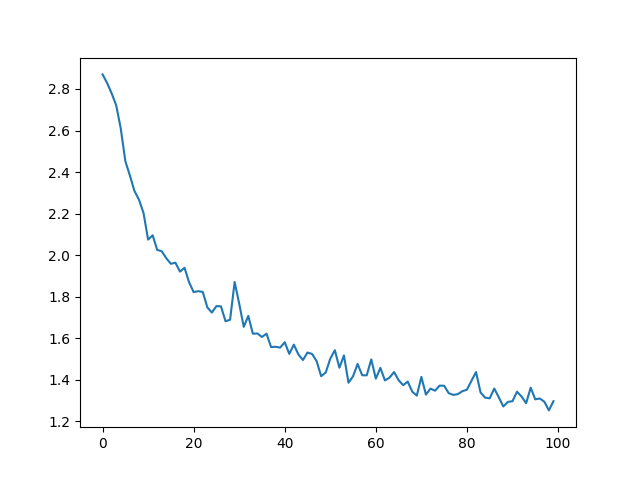
画出累计的损失值
import matplotlib.pyplot as plt
import matplotlib.ticker as ticker

plt.figure()
plt.plot(all_losses)
结果评估
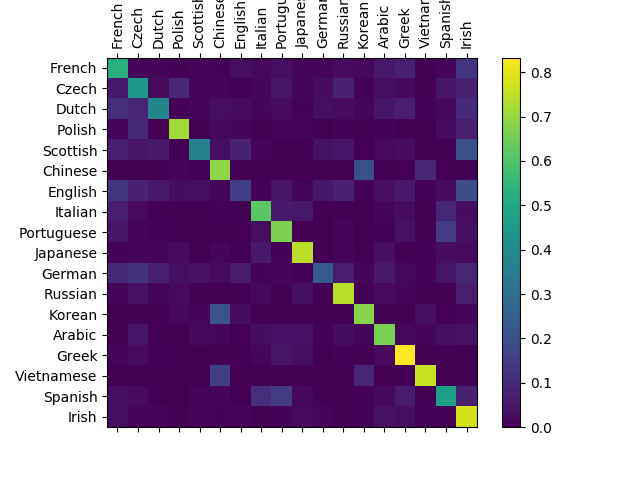
为了对比在不同类别的表现,构建一个混淆矩阵,每行表示一个语言,列为各个语言的预测。为了计算混合矩阵,使用evaluate()在网络中运行一组样本,与train()中除去backprop相同。
 1 # Keep track of correct guesses in a confusion matrix
 2 confusion = torch.zeros(n_categories, n_categories)
 3 n_confusion = 10000
 4
 5 # Just return an output given a line
 6 def evaluate(line_tensor):
 7     hidden = rnn.initHidden()
 8
 9     for i in range(line_tensor.size()[0]):
10         output, hidden = rnn(line_tensor[i], hidden)
11
12     return output
13
14 # Go through a bunch of examples and record which are correctly guessed
15 for i in range(n_confusion):
16     category, line, category_tensor, line_tensor = randomTrainingExample()
17     output = evaluate(line_tensor)
18     guess, guess_i = categoryFromOutput(output)
19     category_i = all_categories.index(category)
20     confusion[category_i][guess_i] += 1
21
22 # Normalize by dividing every row by its sum
23 for i in range(n_categories):
24     confusion[i] = confusion[i] / confusion[i].sum()
25
26 # Set up plot
27 fig = plt.figure()
28 ax = fig.add_subplot(111)
29 cax = ax.matshow(confusion.numpy())
30 fig.colorbar(cax)
31
32 # Set up axes
33 ax.set_xticklabels([''] + all_categories, rotation=90)
34 ax.set_yticklabels([''] + all_categories)
35
36 # Force label at every tick
37 ax.xaxis.set_major_locator(ticker.MultipleLocator(1))
38 ax.yaxis.set_major_locator(ticker.MultipleLocator(1))
39
40 # sphinx_gallery_thumbnail_number = 2
41 plt.show()
用户预测
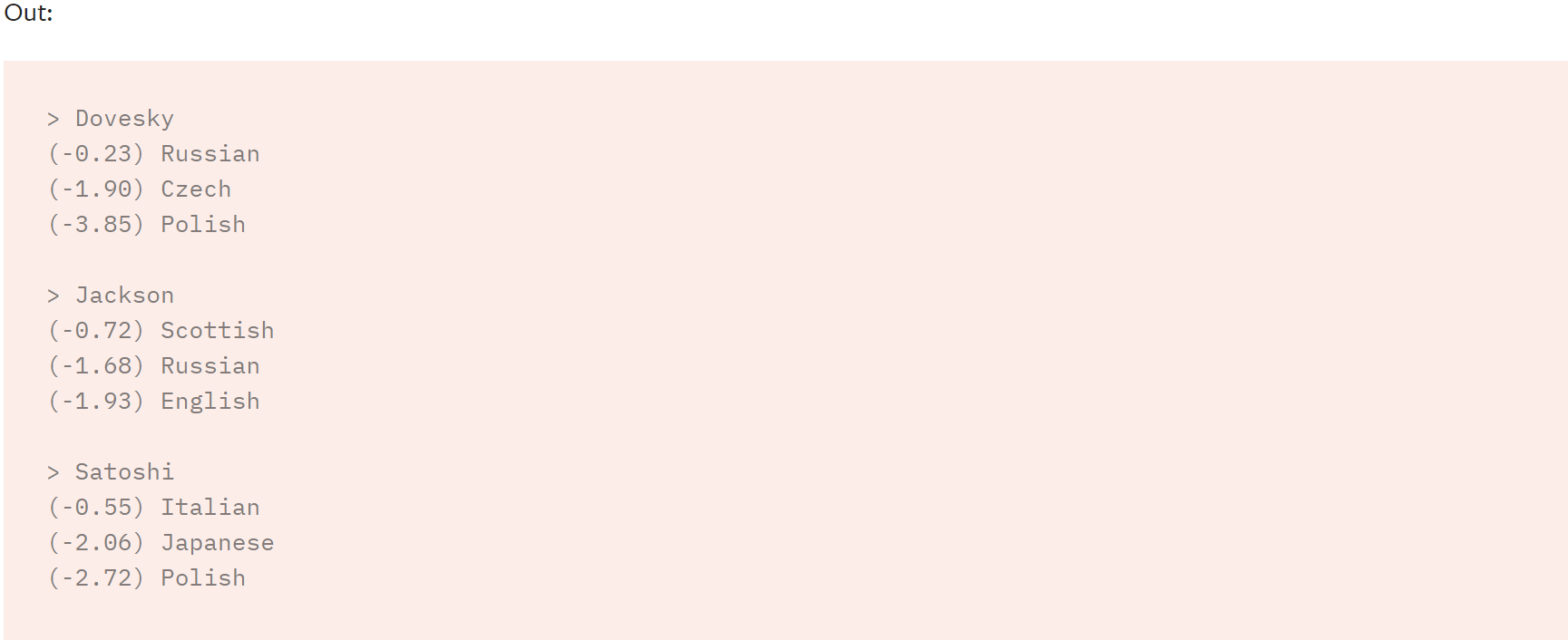
 1 def predict(input_line, n_predictions=3):
 2     print('\n> %s' % input_line)
 3     with torch.no_grad():
 4         output = evaluate(lineToTensor(input_line))
 5
 6         # Get top N categories
 7         topv, topi = output.topk(n_predictions, 1, True)
 8         predictions = []
 9
10         for i in range(n_predictions):
11             value = topv[0][i].item()
12             category_index = topi[0][i].item()
13             print('(%.2f) %s' % (value, all_categories[category_index]))
14             predictions.append([value, all_categories[category_index]])
15
16 predict('Dovesky')
17 predict('Jackson')
18 predict('Satoshi')
The final versions of the scripts in the Practical PyTorch repo split the above code into a few files:
data.py(loads files)model.py(defines the RNN)train.py(runs training)predict.py(runspredict()with command line arguments)server.py(serve prediction as a JSON API with bottle.py)
Run train.py to train and save the network.
Run predict.py with a name to view predictions:

Run server.py and visit http://localhost:5533/Yourname to get JSON output of predictions.
Exercises
- Try with a different dataset of line -> category, for example:
- Any word -> language
- First name -> gender
- Character name -> writer
- Page title -> blog or subreddit
- Get better results with a bigger and/or better shaped network
- Add more linear layers
- Try the
nn.LSTMandnn.GRUlayers - Combine multiple of these RNNs as a higher level network
Total running time of the script: ( 3 minutes 6.446 seconds)
整体代码:


  1 # -*- coding: utf-8 -*-
  2 """
  3 Created on Tue Apr 14 11:12:13 2020
  4
  5 @author: lenovo
  6 """
  7
  8 from __future__ import unicode_literals, print_function, division
  9 from io import open
 10 import glob
 11 import os
 12
 13 def findFiles(path): return glob.glob(path)
 14
 15 print(findFiles('data/names/*.txt'))
 16
 17 import unicodedata
 18 import string
 19
 20 all_letters = string.ascii_letters + " .,;'"
 21 n_letters = len(all_letters)
 22
 23 # Turn a Unicode string to plain ASCII, thanks to https://stackoverflow.com/a/518232/2809427
 24 def unicodeToAscii(s):
 25     return ''.join(
 26         c for c in unicodedata.normalize('NFD', s)
 27         if unicodedata.category(c) != 'Mn'
 28         and c in all_letters
 29     )
 30
 31 print(unicodeToAscii('Ślusàrski'))
 32
 33 # Build the category_lines dictionary, a list of names per language
 34 category_lines = {}
 35 all_categories = []
 36
 37 # Read a file and split into lines
 38 def readLines(filename):
 39     lines = open(filename, encoding='utf-8').read().strip().split('\n')
 40     return [unicodeToAscii(line) for line in lines]
 41
 42 for filename in findFiles('data/names/*.txt'):
 43     category = os.path.splitext(os.path.basename(filename))[0]
 44     all_categories.append(category)
 45     lines = readLines(filename)
 46     category_lines[category] = lines
 47
 48 n_categories = len(all_categories)
 49
 50
 51
 52 import torch
 53
 54 # Find letter index from all_letters, e.g. "a" = 0
 55 def letterToIndex(letter):
 56     return all_letters.find(letter)
 57
 58 # Just for demonstration, turn a letter into a <1 x n_letters> Tensor
 59 def letterToTensor(letter):
 60     tensor = torch.zeros(1, n_letters)
 61     tensor[0][letterToIndex(letter)] = 1
 62     return tensor
 63
 64 # Turn a line into a <line_length x 1 x n_letters>,
 65 # or an array of one-hot letter vectors
 66 def lineToTensor(line):
 67     tensor = torch.zeros(len(line), 1, n_letters)
 68     for li, letter in enumerate(line):
 69         tensor[li][0][letterToIndex(letter)] = 1
 70     return tensor
 71
 72 print(letterToTensor('J'))
 73
 74 print(lineToTensor('Jones').size())
 75
 76
 77 import torch.nn as nn
 78
 79 class RNN(nn.Module):
 80     def __init__(self, input_size, hidden_size, output_size):
 81         super(RNN, self).__init__()
 82
 83         self.hidden_size = hidden_size
 84
 85         self.i2h = nn.Linear(input_size + hidden_size, hidden_size)
 86         self.i2o = nn.Linear(input_size + hidden_size, output_size)
 87         self.softmax = nn.LogSoftmax(dim=1)
 88
 89     def forward(self, input, hidden):
 90         combined = torch.cat((input, hidden), 1)
 91         hidden = self.i2h(combined)
 92         output = self.i2o(combined)
 93         output = self.softmax(output)
 94         return output, hidden
 95
 96     def initHidden(self):
 97         return torch.zeros(1, self.hidden_size)
 98
 99 n_hidden = 128
100 rnn = RNN(n_letters, n_hidden, n_categories)
101
102 input = letterToTensor('A')
103 hidden =torch.zeros(1, n_hidden)
104
105 output, next_hidden = rnn(input, hidden)
106
107 def categoryFromOutput(output):
108     top_n, top_i = output.topk(1)
109     category_i = top_i[0].item()
110     return all_categories[category_i], category_i
111
112 print(categoryFromOutput(output))
113
114 import random
115
116 def randomChoice(l):
117     return l[random.randint(0, len(l) - 1)]
118
119 def randomTrainingExample():
120     category = randomChoice(all_categories)
121     line = randomChoice(category_lines[category])
122     category_tensor = torch.tensor([all_categories.index(category)], dtype=torch.long)
123     line_tensor = lineToTensor(line)
124     return category, line, category_tensor, line_tensor
125
126 for i in range(10):
127     category, line, category_tensor, line_tensor = randomTrainingExample()
128     print('category =', category, '/ line =', line)
129
130 criterion = nn.NLLLoss()
131
132 learning_rate = 0.005 # If you set this too high, it might explode. If too low, it might not learn
133
134 def train(category_tensor, line_tensor):
135     hidden = rnn.initHidden()
136
137     rnn.zero_grad()
138
139     for i in range(line_tensor.size()[0]):
140         output, hidden = rnn(line_tensor[i], hidden)
141
142     loss = criterion(output, category_tensor)
143     loss.backward()
144
145     # Add parameters' gradients to their values, multiplied by learning rate
146     for p in rnn.parameters():
147         p.data.add_(-learning_rate, p.grad.data)
148
149     return output, loss.item()
150
151
152 import time
153 import math
154
155 n_iters = 100000
156 print_every = 5000
157 plot_every = 1000
158
159
160
161 # Keep track of losses for plotting
162 current_loss = 0
163 all_losses = []
164
165 def timeSince(since):
166     now = time.time()
167     s = now - since
168     m = math.floor(s / 60)
169     s -= m * 60
170     return '%dm %ds' % (m, s)
171
172 start = time.time()
173
174 for iter in range(1, n_iters + 1):
175     category, line, category_tensor, line_tensor = randomTrainingExample()
176     output, loss = train(category_tensor, line_tensor)
177     current_loss += loss
178
179     # Print iter number, loss, name and guess
180     if iter % print_every == 0:
181         guess, guess_i = categoryFromOutput(output)
182         correct = '✓' if guess == category else '✗ (%s)' % category
183         print('%d %d%% (%s) %.4f %s / %s %s' % (iter, iter / n_iters * 100, timeSince(start), loss, line, guess, correct))
184
185     # Add current loss avg to list of losses
186     if iter % plot_every == 0:
187         all_losses.append(current_loss / plot_every)
188         current_loss = 0
189
190 import time
191 import math
192
193 n_iters = 100000
194 print_every = 5000
195 plot_every = 1000
196
197
198
199 # Keep track of losses for plotting
200 current_loss = 0
201 all_losses = []
202
203 def timeSince(since):
204     now = time.time()
205     s = now - since
206     m = math.floor(s / 60)
207     s -= m * 60
208     return '%dm %ds' % (m, s)
209
210 start = time.time()
211
212 for iter in range(1, n_iters + 1):
213     category, line, category_tensor, line_tensor = randomTrainingExample()
214     output, loss = train(category_tensor, line_tensor)
215     current_loss += loss
216
217     # Print iter number, loss, name and guess
218     if iter % print_every == 0:
219         guess, guess_i = categoryFromOutput(output)
220         correct = '✓' if guess == category else '✗ (%s)' % category
221         print('%d %d%% (%s) %.4f %s / %s %s' % (iter, iter / n_iters * 100, timeSince(start), loss, line, guess, correct))
222
223     # Add current loss avg to list of losses
224     if iter % plot_every == 0:
225         all_losses.append(current_loss / plot_every)
226         current_loss = 0
227
228 import matplotlib.pyplot as plt
229 import matplotlib.ticker as ticker
230
231 plt.figure()
232 plt.plot(all_losses)

 浙公网安备 33010602011771号