RabbitMQ Publish/Subscribe
In the previous tutorial we created a work queue. The assumption behind a work queue is that each task is delivered to exactly one worker. In this part we'll do something completely different -- we'll deliver a message to multiple consumers. This pattern is known as "publish/subscribe".
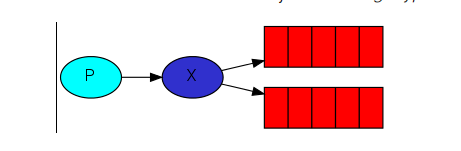
1. send messages to exchange
  public static void Main(string[] args)
        {
            var factory = new ConnectionFactory() { HostName = "localhost" };
            using (var connection = factory.CreateConnection())
            using (var channel = connection.CreateModel())
            {
                channel.ExchangeDeclare(exchange: "logs", type: ExchangeType.Fanout);

                var message = GetMessage(args);
                var body = Encoding.UTF8.GetBytes(message);
                channel.BasicPublish(exchange: "logs",
                                     routingKey: "",
                                     basicProperties: null,
                                     body: body);
                Console.WriteLine(" [x] Sent {0}", message);
            }

            Console.WriteLine(" Press [enter] to exit.");
            Console.ReadLine();
        }

        private static string GetMessage(string[] args)
        {
            return ((args.Length > 0)
                   ? string.Join(" ", args)
                   : "Producer: Hello World!" + DateTime.Now);
        }
2. create two consumer to bind to exchange
 public static void Main()
        {
            var factory = new ConnectionFactory() { HostName = "localhost" };
            using (var connection = factory.CreateConnection())
            using (var channel = connection.CreateModel())
            {
                channel.ExchangeDeclare(exchange: "logs", type: ExchangeType.Fanout);

                var queueName = channel.QueueDeclare().QueueName;
                channel.QueueBind(queue: queueName,
                                  exchange: "logs",
                                  routingKey: "");

                Console.WriteLine(" Consumer 1 Waiting for logs.");

                var consumer = new EventingBasicConsumer(channel);
                consumer.Received += (model, ea) =>
                {
                    var body = ea.Body.ToArray();
                    var message = Encoding.UTF8.GetString(body);
                    Console.WriteLine(" [x] {0}", message);
                };
                channel.BasicConsume(queue: queueName,
                                     autoAck: true,
                                     consumer: consumer);

                Console.WriteLine(" Press [enter] to exit.");
                Console.ReadLine();
            }
        }
3. attentions

4. testing


 浙公网安备 33010602011771号