【图像超分】论文复现:轻量化超分 | SPAN的Pytorch源码复现,跑通源码进行训练、测试
前言
论文题目:Swift Parameter-free Attention Network for Efficient Super-Resolution
论文地址:https://arxiv.org/abs/2311.12770
论文源码:https://github.com/hongyuanyu/SPAN?tab=readme-ov-file
NTIRE 2024高效超分辨率挑战赛运行赛道第一名
摘要:Single Image Super-Resolution (SISR) is a crucial task in low-level computer vision, aiming to reconstruct high-resolution images from low-resolution counterparts. Conventional attention mechanisms have significantly improved SISR performance but often result in complex network structures and large number of parameters, leading to slow inference speed and large model size. To address this issue, we propose the Swift Parameter-free Attention Network (SPAN), a highly efficient SISR model that balances parameter count, inference speed, and image quality. SPAN employs a novel parameter-free attention mechanism, which leverages symmetric activation functions and residual connections to enhance high-contribution information and suppress redundant information. Our theoretical analysis demonstrates the effectiveness of this design in achieving the attention mechanism’s purpose. We evaluate SPAN on multiple benchmarks, showing that it outperforms existing efficient super-resolution models in terms of both image quality and inference speed, achieving a significant quality-speed trade-off. This makes SPAN highly suitable for real-world applications, particularly in resource-constrained scenarios. Notably, we won the first place both in the overall performance track and runtime track of the NTIRE 2024 efficient super-resolution challenge. Our code and models are made publicly available at this https URL.
网络结构
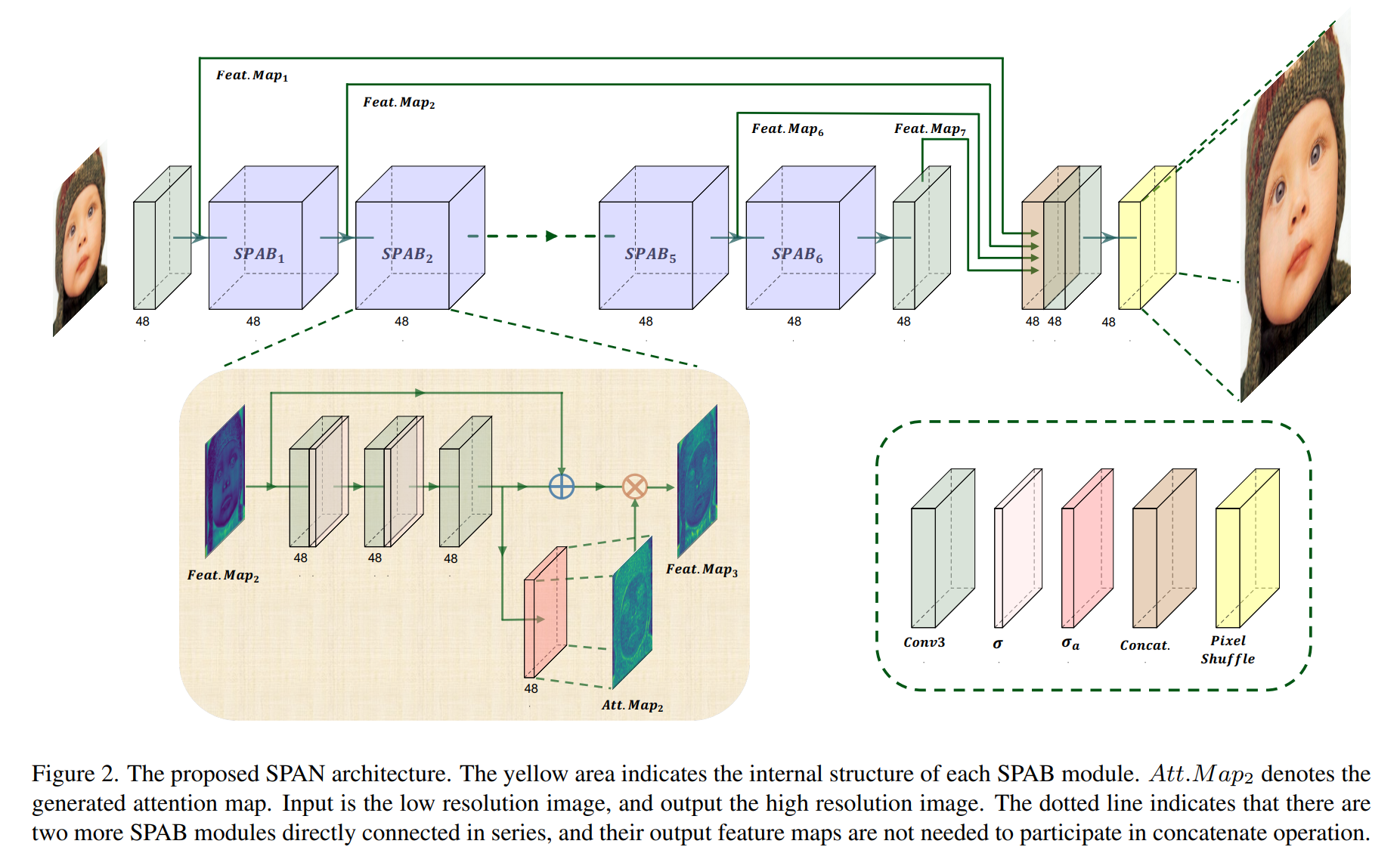
结果
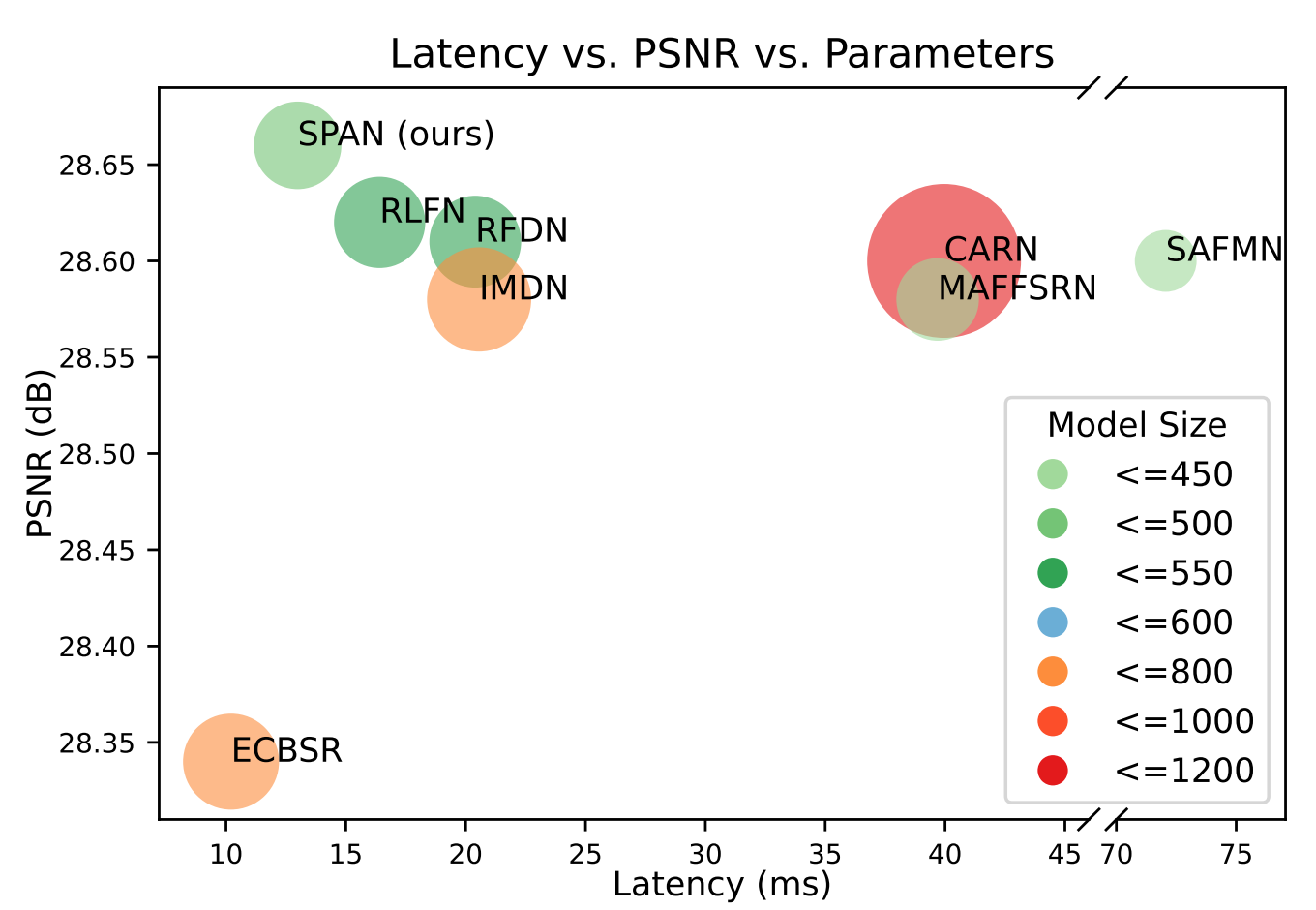
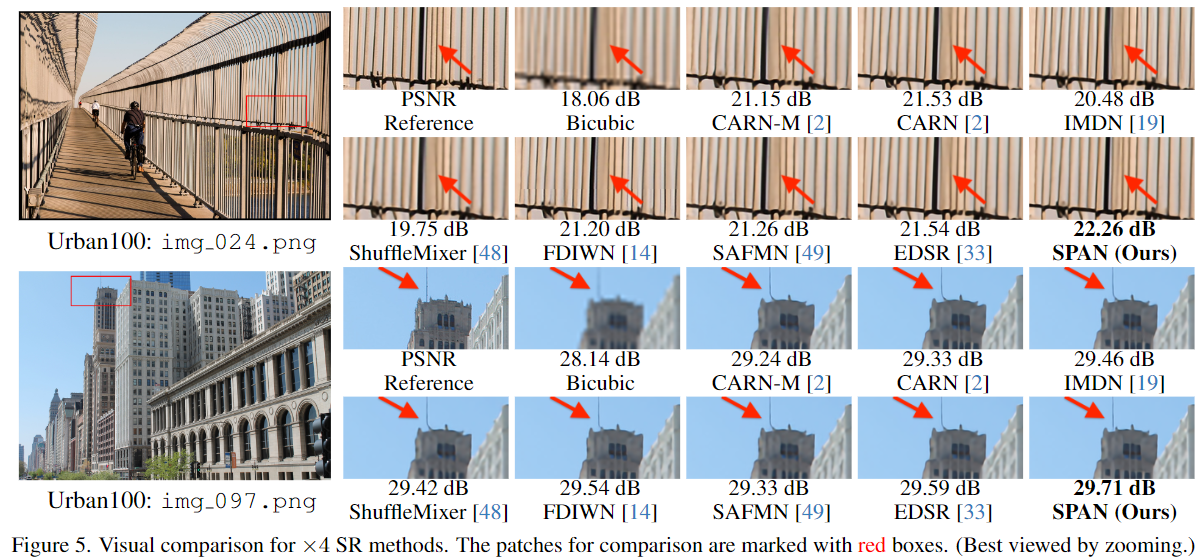
模型代码
from collections import OrderedDict
import torch
from torch import nn as nn
import torch.nn.functional as F
from basicsr.utils.registry import ARCH_REGISTRY
def _make_pair(value):
if isinstance(value, int):
value = (value,) * 2
return value
def conv_layer(in_channels,
out_channels,
kernel_size,
bias=True):
"""
Re-write convolution layer for adaptive `padding`.
"""
kernel_size = _make_pair(kernel_size)
padding = (int((kernel_size[0] - 1) / 2),
int((kernel_size[1] - 1) / 2))
return nn.Conv2d(in_channels,
out_channels,
kernel_size,
padding=padding,
bias=bias)
def activation(act_type, inplace=True, neg_slope=0.05, n_prelu=1):
"""
Activation functions for ['relu', 'lrelu', 'prelu'].
Parameters
----------
act_type: str
one of ['relu', 'lrelu', 'prelu'].
inplace: bool
whether to use inplace operator.
neg_slope: float
slope of negative region for `lrelu` or `prelu`.
n_prelu: int
`num_parameters` for `prelu`.
----------
"""
act_type = act_type.lower()
if act_type == 'relu':
layer = nn.ReLU(inplace)
elif act_type == 'lrelu':
layer = nn.LeakyReLU(neg_slope, inplace)
elif act_type == 'prelu':
layer = nn.PReLU(num_parameters=n_prelu, init=neg_slope)
else:
raise NotImplementedError(
'activation layer [{:s}] is not found'.format(act_type))
return layer
def sequential(*args):
"""
Modules will be added to the a Sequential Container in the order they
are passed.
Parameters
----------
args: Definition of Modules in order.
-------
"""
if len(args) == 1:
if isinstance(args[0], OrderedDict):
raise NotImplementedError(
'sequential does not support OrderedDict input.')
return args[0]
modules = []
for module in args:
if isinstance(module, nn.Sequential):
for submodule in module.children():
modules.append(submodule)
elif isinstance(module, nn.Module):
modules.append(module)
return nn.Sequential(*modules)
def pixelshuffle_block(in_channels,
out_channels,
upscale_factor=2,
kernel_size=3):
"""
Upsample features according to `upscale_factor`.
"""
conv = conv_layer(in_channels,
out_channels * (upscale_factor ** 2),
kernel_size)
pixel_shuffle = nn.PixelShuffle(upscale_factor)
return sequential(conv, pixel_shuffle)
class Conv3XC(nn.Module):
def __init__(self, c_in, c_out, gain1=1, gain2=0, s=1, bias=True, relu=False):
super(Conv3XC, self).__init__()
self.weight_concat = None
self.bias_concat = None
self.update_params_flag = False
self.stride = s
self.has_relu = relu
gain = gain1
self.sk = nn.Conv2d(in_channels=c_in, out_channels=c_out, kernel_size=1, padding=0, stride=s, bias=bias)
self.conv = nn.Sequential(
nn.Conv2d(in_channels=c_in, out_channels=c_in * gain, kernel_size=1, padding=0, bias=bias),
nn.Conv2d(in_channels=c_in * gain, out_channels=c_out * gain, kernel_size=3, stride=s, padding=0, bias=bias),
nn.Conv2d(in_channels=c_out * gain, out_channels=c_out, kernel_size=1, padding=0, bias=bias),
)
self.eval_conv = nn.Conv2d(in_channels=c_in, out_channels=c_out, kernel_size=3, padding=1, stride=s, bias=bias)
self.eval_conv.weight.requires_grad = False
self.eval_conv.bias.requires_grad = False
self.update_params()
def update_params(self):
w1 = self.conv[0].weight.data.clone().detach()
b1 = self.conv[0].bias.data.clone().detach()
w2 = self.conv[1].weight.data.clone().detach()
b2 = self.conv[1].bias.data.clone().detach()
w3 = self.conv[2].weight.data.clone().detach()
b3 = self.conv[2].bias.data.clone().detach()
w = F.conv2d(w1.flip(2, 3).permute(1, 0, 2, 3), w2, padding=2, stride=1).flip(2, 3).permute(1, 0, 2, 3)
b = (w2 * b1.reshape(1, -1, 1, 1)).sum((1, 2, 3)) + b2
self.weight_concat = F.conv2d(w.flip(2, 3).permute(1, 0, 2, 3), w3, padding=0, stride=1).flip(2, 3).permute(1, 0, 2, 3)
self.bias_concat = (w3 * b.reshape(1, -1, 1, 1)).sum((1, 2, 3)) + b3
sk_w = self.sk.weight.data.clone().detach()
sk_b = self.sk.bias.data.clone().detach()
target_kernel_size = 3
H_pixels_to_pad = (target_kernel_size - 1) // 2
W_pixels_to_pad = (target_kernel_size - 1) // 2
sk_w = F.pad(sk_w, [H_pixels_to_pad, H_pixels_to_pad, W_pixels_to_pad, W_pixels_to_pad])
self.weight_concat = self.weight_concat + sk_w
self.bias_concat = self.bias_concat + sk_b
self.eval_conv.weight.data = self.weight_concat
self.eval_conv.bias.data = self.bias_concat
def forward(self, x):
if self.training:
pad = 1
x_pad = F.pad(x, (pad, pad, pad, pad), "constant", 0)
out = self.conv(x_pad) + self.sk(x)
else:
self.update_params()
out = self.eval_conv(x)
if self.has_relu:
out = F.leaky_relu(out, negative_slope=0.05)
return out
class SPAB(nn.Module):
def __init__(self,
in_channels,
mid_channels=None,
out_channels=None,
bias=False):
super(SPAB, self).__init__()
if mid_channels is None:
mid_channels = in_channels
if out_channels is None:
out_channels = in_channels
self.in_channels = in_channels
self.c1_r = Conv3XC(in_channels, mid_channels, gain1=2, s=1)
self.c2_r = Conv3XC(mid_channels, mid_channels, gain1=2, s=1)
self.c3_r = Conv3XC(mid_channels, out_channels, gain1=2, s=1)
self.act1 = torch.nn.SiLU(inplace=True)
self.act2 = activation('lrelu', neg_slope=0.1, inplace=True)
def forward(self, x):
out1 = (self.c1_r(x))
out1_act = self.act1(out1)
out2 = (self.c2_r(out1_act))
out2_act = self.act1(out2)
out3 = (self.c3_r(out2_act))
sim_att = torch.sigmoid(out3) - 0.5
out = (out3 + x) * sim_att
return out, out1, sim_att
@ARCH_REGISTRY.register()
class SPAN(nn.Module):
"""
Swift Parameter-free Attention Network for Efficient Super-Resolution
"""
def __init__(self,
num_in_ch,
num_out_ch,
feature_channels=48,
upscale=4,
bias=True,
img_range=255.,
rgb_mean=(0.4488, 0.4371, 0.4040)
):
super(SPAN, self).__init__()
in_channels = num_in_ch
out_channels = num_out_ch
self.img_range = img_range
self.mean = torch.Tensor(rgb_mean).view(1, 3, 1, 1)
self.conv_1 = Conv3XC(in_channels, feature_channels, gain1=2, s=1)
self.block_1 = SPAB(feature_channels, bias=bias)
self.block_2 = SPAB(feature_channels, bias=bias)
self.block_3 = SPAB(feature_channels, bias=bias)
self.block_4 = SPAB(feature_channels, bias=bias)
self.block_5 = SPAB(feature_channels, bias=bias)
self.block_6 = SPAB(feature_channels, bias=bias)
self.conv_cat = conv_layer(feature_channels * 4, feature_channels, kernel_size=1, bias=True)
self.conv_2 = Conv3XC(feature_channels, feature_channels, gain1=2, s=1)
self.upsampler = pixelshuffle_block(feature_channels, out_channels, upscale_factor=upscale)
def forward(self, x):
self.mean = self.mean.type_as(x)
x = (x - self.mean) * self.img_range
out_feature = self.conv_1(x)
out_b1, _, att1 = self.block_1(out_feature)
out_b2, _, att2 = self.block_2(out_b1)
out_b3, _, att3 = self.block_3(out_b2)
out_b4, _, att4 = self.block_4(out_b3)
out_b5, _, att5 = self.block_5(out_b4)
out_b6, out_b5_2, att6 = self.block_6(out_b5)
out_b6 = self.conv_2(out_b6)
out = self.conv_cat(torch.cat([out_feature, out_b6, out_b1, out_b5_2], 1))
output = self.upsampler(out)
return output
if __name__ == "__main__":
from fvcore.nn import FlopCountAnalysis, flop_count_table
import time
model = SPAN(3, 3, upscale=4, feature_channels=48).cuda()
model.eval()
inputs = (torch.rand(1, 3, 256, 256).cuda(),)
print(flop_count_table(FlopCountAnalysis(model, inputs)))
复现过程
下载数据集DIV2K(https://data.vision.ee.ethz.ch/cvl/DIV2K/)以及Flickr2K(http://cv.snu.ac.kr/research/EDSR/Flickr2K.tar)
更改train配置文件
# general settings
name: 206_EDSR_Lx4_f256b32_DIV2K_300k_B16G1_204pretrain_wandb
model_type: SRModel
scale: 4
num_gpu: 1  # set num_gpu: 0 for cpu mode
manual_seed: 10
# dataset and data loader settings
datasets:
train:
name: DIV2K
type: PairedImageDataset
dataroot_gt: C:\Users\27879\jiangguolong\EDSR-PyTorch-master\EDSR-PyTorch-master\datasets\DIV2K\DIV2K\DIV2K_train_HR
dataroot_lq: C:\Users\27879\jiangguolong\EDSR-PyTorch-master\EDSR-PyTorch-master\datasets\DIV2K\DIV2K\DIV2K_train_LR_bicubic\X4
# (for lmdb)
# dataroot_gt: datasets/DIV2K/DIV2K_train_HR_sub.lmdb
# dataroot_lq: datasets/DIV2K/DIV2K_train_LR_bicubic_X4_sub.lmdb
filename_tmpl: '{}'
io_backend:
type: disk
# (for lmdb)
# type: lmdb
gt_size: 192
use_hflip: true
use_rot: true
# data loader
num_worker_per_gpu: 12
batch_size_per_gpu: 32
dataset_enlarge_ratio: 1
prefetch_mode: ~
val:
name: Set5
type: PairedImageDataset
dataroot_gt: datasets/Set5/image_SRF_4/HR
dataroot_lq: datasets/Set5/image_SRF_4/LR
io_backend:
type: disk
# network structures
network_g:
type: SPAN
num_in_ch: 3
num_out_ch: 3
upscale: 4
img_range: 255.
rgb_mean: [0.4488, 0.4371, 0.4040]
# path
path:
pretrain_network_g: ~
strict_load_g: false
resume_state: ~
# training settings
train:
ema_decay: 0.999
optim_g:
type: Adam
lr: !!float 1e-4
weight_decay: 0
betas: [0.9, 0.99]
scheduler:
type: MultiStepLR
milestones: [200000]
gamma: 0.5
total_iter: 300000
warmup_iter: -1  # no warm up
# losses
pixel_opt:
type: L1Loss
loss_weight: 1.0
reduction: mean
# validation settings
val:
val_freq: !!float 5e3
save_img: false
metrics:
psnr: # metric name, can be arbitrary
type: calculate_psnr
crop_border: 4
test_y_channel: false
# logging settings
logger:
print_freq: 100
save_checkpoint_freq: !!float 5e3
use_tb_logger: true
wandb:
project: ~
resume_id: ~
# dist training settings
dist_params:
backend: nccl
port: 29500
训练命令
python .\basicsr\train.py -opt .\options\train\EDSR\train_EDSR_Lx4.yml

 浙公网安备 33010602011771号