
Java设计模式---七大设计原则
几道面试题:
- 使用设计模式,可是代码具有
- 重用性(相同代码,不用多次编写)
- 可读性(编程规范性,便于其他程序员的阅读和理解)
- 可扩展性(当需要增加新的功能时,非常的方便,称为可维护性)
- 可靠性(当我们增加新的功能后,对原来的功能没有影响)
- 是程序呈现高内聚,低耦合的特性。
- 设计模式在软件中的哪里:面向对象=>功能模块【设计模式+算法(数据结构)】=>框架【使用到多种设计模式】=>架构【服务器集群】
单一职责原则
- 概念:
- 对类来说的,即一个类应该只负责一项职责。
- 作用:
- 降低类的复杂度,一个类只负责一项职责
- 提高类的可读性,可维护性
- 降低变更引起的风险
- 注意:通常情况下,我们应当遵守单一职责原则,只有逻辑足够简单,才可以在代码级违反单一职责原则;只有类中方法数量足够少,可以在方法级别保持单一职责原则。
- 代码示例:
- 错误示例
-
package com.atguigu.principle.singleresponsibility;

public class SingleResponsibility1 {

    public static void main(String[] args) {
        // TODO Auto-generated method stub
        Vehicle vehicle = new Vehicle();
        vehicle.run("摩托车");
        vehicle.run("汽车");
        vehicle.run("飞机");
    }

}

// 交通工具类
// 方式1
// 1. 在方式1 的run方法中,违反了单一职责原则
// 2. 解决的方案非常的简单,根据交通工具运行方法不同,分解成不同类即可
class Vehicle {
    public void run(String vehicle) {
        System.out.println(vehicle + " 在公路上运行....");
    }
}
-
- 正确示例
- 错误示例
package com.atguigu.principle.singleresponsibility; public class SingleResponsibility2 { public static void main(String[] args) { // TODO Auto-generated method stub RoadVehicle roadVehicle = new RoadVehicle(); roadVehicle.run("摩托车"); roadVehicle.run("汽车"); AirVehicle airVehicle = new AirVehicle(); airVehicle.run("飞机"); } } //方案2的分析 //1. 遵守单一职责原则 //2. 但是这样做的改动很大,即将类分解,同时修改客户端 //3. 改进:直接修改Vehicle 类,改动的代码会比较少=>方案3 class RoadVehicle { public void run(String vehicle) { System.out.println(vehicle + "公路运行"); } } class AirVehicle { public void run(String vehicle) { System.out.println(vehicle + "天空运行"); } } class WaterVehicle { public void run(String vehicle) { System.out.println(vehicle + "水中运行"); } } |
package com.atguigu.principle.singleresponsibility; public class SingleResponsibility3 { public static void main(String[] args) { // TODO Auto-generated method stub Vehicle2 vehicle2 = new Vehicle2(); vehicle2.run("汽车"); vehicle2.runWater("轮船"); vehicle2.runAir("飞机"); } } //方式3的分析 //1. 这种修改方法没有对原来的类做大的修改,只是增加方法 //2. 这里虽然没有在类这个级别上遵守单一职责原则,但是在方法级别上,仍然是遵守单一职责 class Vehicle2 { public void run(String vehicle) { //处理 System.out.println(vehicle + " 在公路上运行...."); } public void runAir(String vehicle) { System.out.println(vehicle + " 在天空上运行...."); } public void runWater(String vehicle) { System.out.println(vehicle + " 在水中行...."); } //方法2. //.. //.. //... } |
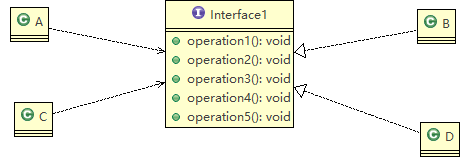
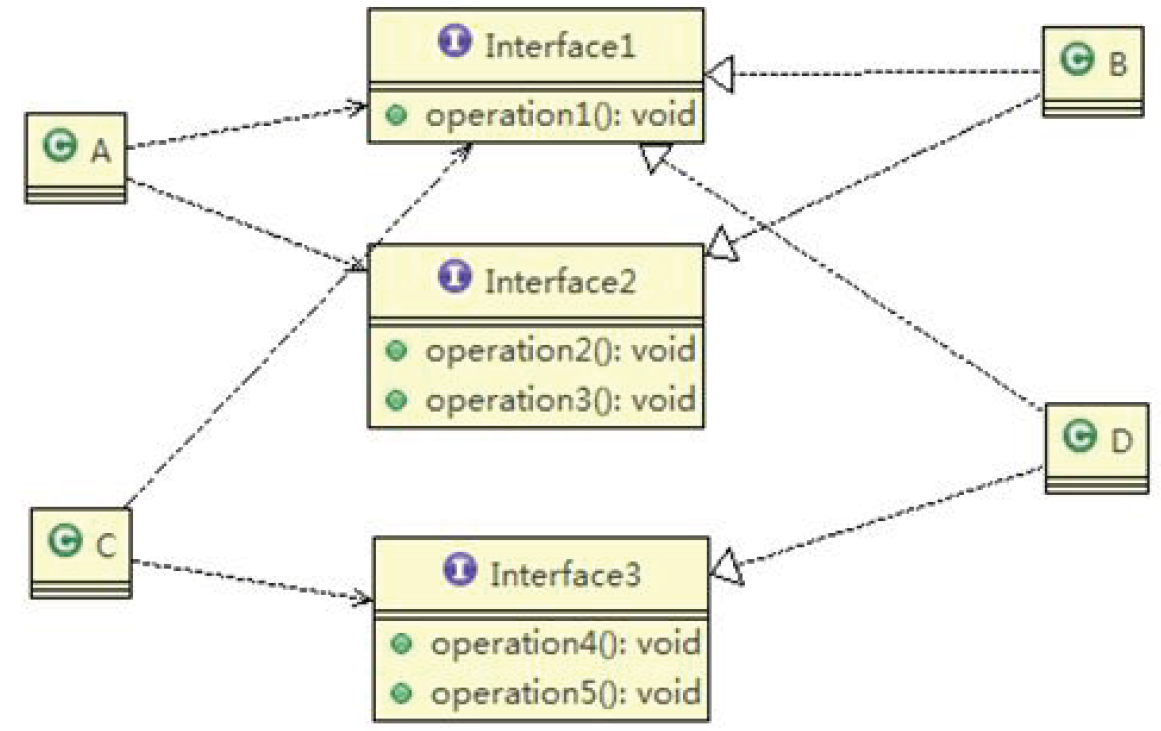
接口隔离原则
- 概念:
- 客户端不应该依赖它不需要的接口,即一个类对另一个类的依赖应该建立在最小的接口上。
- 作用:
- 代码示例:
- 错误示例 | 正确示例
 |
 |
package com.atguigu.principle.segregation; public class Segregation1 { public static void main(String[] args) { // TODO Auto-generated method stub } } //接口 interface Interface1 { void operation1(); void operation2(); void operation3(); void operation4(); void operation5(); } class B implements Interface1 { public void operation1() { System.out.println("B 实现了 operation1"); } public void operation2() { System.out.println("B 实现了 operation2"); } public void operation3() { System.out.println("B 实现了 operation3"); } public void operation4() { System.out.println("B 实现了 operation4"); } public void operation5() { System.out.println("B 实现了 operation5"); } } class D implements Interface1 { public void operation1() { System.out.println("D 实现了 operation1"); } public void operation2() { System.out.println("D 实现了 operation2"); } public void operation3() { System.out.println("D 实现了 operation3"); } public void operation4() { System.out.println("D 实现了 operation4"); } public void operation5() { System.out.println("D 实现了 operation5"); } } class A { //A 类通过接口Interface1 依赖(使用) B类,但是只会用到1,2,3方法 public void depend1(Interface1 i) { i.operation1(); } public void depend2(Interface1 i) { i.operation2(); } public void depend3(Interface1 i) { i.operation3(); } } class C { //C 类通过接口Interface1 依赖(使用) D类,但是只会用到1,4,5方法 public void depend1(Interface1 i) { i.operation1(); } public void depend4(Interface1 i) { i.operation4(); } public void depend5(Interface1 i) { i.operation5(); } } |
package com.atguigu.principle.segregation.improve; public class Segregation1 { public static void main(String[] args) { // TODO Auto-generated method stub // 使用一把 A a = new A(); a.depend1(new B()); // A类通过接口去依赖B类 a.depend2(new B()); a.depend3(new B()); C c = new C(); c.depend1(new D()); // C类通过接口去依赖(使用)D类 c.depend4(new D()); c.depend5(new D()); } } // 接口1 interface Interface1 { void operation1(); } // 接口2 interface Interface2 { void operation2(); void operation3(); } // 接口3 interface Interface3 { void operation4(); void operation5(); } |
依赖倒转原则
- 概念:
- 高层模块不应该依赖底层模块,二者都应该依赖其抽象。
- 抽象不应该依赖细节,细节应该依赖抽象。
- 依赖倒转(倒置)的中心思想是面向接口编程。
- 使用接口或抽象类的目的是制定好规范,而不涉及任何具体的操作,把展现细节的任务交给他们的实现类去实现完成。
- 说明:
- 依赖关系传递的三种方式和应用案例
- 接口传递 | 构造方法传递 | setter方式传递
- 依赖关系传递的三种方式和应用案例
package com.atguigu.principle.inversion.improve; public class DependencyPass { public static void main(String[] args) { // TODO Auto-generated method stub ChangHong changHong = new ChangHong(); // OpenAndClose openAndClose = new OpenAndClose(); // openAndClose.open(changHong); //通过构造器进行依赖传递 // OpenAndClose openAndClose = new OpenAndClose(changHong); // openAndClose.open(); //通过setter方法进行依赖传递 OpenAndClose openAndClose = new OpenAndClose(); openAndClose.setTv(changHong); openAndClose.open(); } } // 方式1: 通过接口传递实现依赖 // 开关的接口 // interface IOpenAndClose { // public void open(ITV tv); //抽象方法,接收接口 // } // // interface ITV { //ITV接口 // public void play(); // } // // class ChangHong implements ITV { // // @Override // public void play() { // // TODO Auto-generated method stub // System.out.println("长虹电视机,打开"); // } // // } //// 实现接口 // class OpenAndClose implements IOpenAndClose{ // public void open(ITV tv){ // tv.play(); // } // } class ChangHong implements ITV { @Override public void play() { // TODO Auto-generated method stub System.out.println("长虹电视机,打开"); } } |
package com.atguigu.principle.inversion.improve; public class DependencyPass { public static void main(String[] args) { // TODO Auto-generated method stub ChangHong changHong = new ChangHong(); // OpenAndClose openAndClose = new OpenAndClose(); // openAndClose.open(changHong); //通过构造器进行依赖传递 // OpenAndClose openAndClose = new OpenAndClose(changHong); // openAndClose.open(); //通过setter方法进行依赖传递 OpenAndClose openAndClose = new OpenAndClose(); openAndClose.setTv(changHong); openAndClose.open(); } } // 方式2: 通过构造方法依赖传递 // interface IOpenAndClose { // public void open(); //抽象方法 // } // interface ITV { //ITV接口 // public void play(); // } // class OpenAndClose implements IOpenAndClose{ // public ITV tv; //成员 // public OpenAndClose(ITV tv){ //构造器 // this.tv = tv; // } // public void open(){ // this.tv.play(); // } // } class ChangHong implements ITV { @Override public void play() { // TODO Auto-generated method stub System.out.println("长虹电视机,打开"); } } |
package com.atguigu.principle.inversion.improve; public class DependencyPass { public static void main(String[] args) { // TODO Auto-generated method stub ChangHong changHong = new ChangHong(); // OpenAndClose openAndClose = new OpenAndClose(); // openAndClose.open(changHong); //通过构造器进行依赖传递 // OpenAndClose openAndClose = new OpenAndClose(changHong); // openAndClose.open(); //通过setter方法进行依赖传递 OpenAndClose openAndClose = new OpenAndClose(); openAndClose.setTv(changHong); openAndClose.open(); } } // 方式3 , 通过setter方法传递 interface IOpenAndClose { public void open(); // 抽象方法 public void setTv(ITV tv); } interface ITV { // ITV接口 public void play(); } class OpenAndClose implements IOpenAndClose { private ITV tv; public void setTv(ITV tv) { this.tv = tv; } public void open() { this.tv.play(); } } class ChangHong implements ITV { @Override public void play() { // TODO Auto-generated method stub System.out.println("长虹电视机,打开"); } } |
- 底层模块尽量都要有抽象类和接口,或者两者都有,程序稳定性更好。
- 变量的声明类型尽量是抽象类和接口,这样我们的变量引用和实际对象之间,就存在一个缓冲层,利于程序扩展和优化。
作用:
示例代码:
- 错误示例 | 正确示例
package com.atguigu.principle.inversion;

public class DependecyInversion {

    public static void main(String[] args) {
        Person person = new Person();
        person.receive(new Email());
    }

}


class Email {
    public String getInfo() {
        return "电子邮件信息: hello,world";
    }
}

//完成Person接收消息的功能
//方式1分析
//1. 简单,比较容易想到
//2. 如果我们获取的对象是 微信,短信等等,则新增类,同时Perons也要增加相应的接收方法
//3. 解决思路:引入一个抽象的接口IReceiver, 表示接收者, 这样Person类与接口IReceiver发生依赖
//   因为Email, WeiXin 等等属于接收的范围,他们各自实现IReceiver 接口就ok, 这样我们就符号依赖倒转原则
class Person {
    public void receive(Email email ) {
        System.out.println(email.getInfo());
    }
}
|
package com.atguigu.principle.inversion.improve; public class DependecyInversion { public static void main(String[] args) { //客户端无需改变 Person person = new Person(); person.receive(new Email()); person.receive(new WeiXin()); } } //定义接口 interface IReceiver { public String getInfo(); } class Email implements IReceiver { public String getInfo() { return "电子邮件信息: hello,world"; } } //增加微信 class WeiXin implements IReceiver { public String getInfo() { return "微信信息: hello,ok"; } } //方式2 class Person { //这里我们是对接口的依赖 public void receive(IReceiver receiver ) { System.out.println(receiver.getInfo()); } } |
里氏替换原则
概念:
- 所有引用基类的地方必须能透明地使用其子类的对象。
- 在使用继承时,遵循里氏替换原则,在子类中尽量不要重写父类的方法。
- 里氏替换原则告诉我们,继承实际上让两个类耦合性增强了,在适当的情况下,可以通过聚合,组合,依赖来解决问题。
作用:
说明:
- 解决不符合里氏替换原则的做法,原来的父类和子类都继承一个更通俗的基类,原有的继承关系去掉,采用依赖,聚合,组合等关系来代替。
示例代码:
- 错误示例 | 正确示例
package com.atguigu.principle.liskov;

public class Liskov {

    public static void main(String[] args) {
        // TODO Auto-generated method stub
        A a = new A();
        System.out.println("11-3=" + a.func1(11, 3));
        System.out.println("1-8=" + a.func1(1, 8));

        System.out.println("-----------------------");
        B b = new B();
        System.out.println("11-3=" + b.func1(11, 3));//这里本意是求出11-3
        System.out.println("1-8=" + b.func1(1, 8));// 1-8
        System.out.println("11+3+9=" + b.func2(11, 3));

    }

}

// A类
class A {
    // 返回两个数的差
    public int func1(int num1, int num2) {
        return num1 - num2;
    }
}

// B类继承了A
// 增加了一个新功能:完成两个数相加,然后和9求和
class B extends A {
    //这里,重写了A类的方法, 可能是无意识
    public int func1(int a, int b) {
        return a + b;
    }

    public int func2(int a, int b) {
        return func1(a, b) + 9;
    }
}
|
package com.atguigu.principle.liskov.improve; public class Liskov { public static void main(String[] args) { // TODO Auto-generated method stub A a = new A(); System.out.println("11-3=" + a.func1(11, 3)); System.out.println("1-8=" + a.func1(1, 8)); System.out.println("-----------------------"); B b = new B(); //因为B类不再继承A类,因此调用者,不会再func1是求减法 //调用完成的功能就会很明确 System.out.println("11+3=" + b.func1(11, 3));//这里本意是求出11+3 System.out.println("1+8=" + b.func1(1, 8));// 1+8 System.out.println("11+3+9=" + b.func2(11, 3)); //使用组合仍然可以使用到A类相关方法 System.out.println("11-3=" + b.func3(11, 3));// 这里本意是求出11-3 } } //创建一个更加基础的基类 class Base { //把更加基础的方法和成员写到Base类 } // A类 class A extends Base { // 返回两个数的差 public int func1(int num1, int num2) { return num1 - num2; } } // B类继承了A // 增加了一个新功能:完成两个数相加,然后和9求和 class B extends Base { //如果B需要使用A类的方法,使用组合关系 private A a = new A(); //这里,重写了A类的方法, 可能是无意识 public int func1(int a, int b) { return a + b; } public int func2(int a, int b) { return func1(a, b) + 9; } //我们仍然想使用A的方法 public int func3(int a, int b) { return this.a.func1(a, b); } } |
开闭原则ocp
- 概念:
- 开闭原则是编程中最基础、最重要的设计原则
- 一个软件实体如类,模块和函数对扩展开放(对提供方),对修改关闭(对使用方)。用抽象构建框架,用实现扩展细节。
- 当软件需要变化时,尽量通过扩展软件实体的行为来实现变化,而不是通过修改已有的代码来实现变化。
- 编程中遵循其他原则,以及使用设计模式的目的就是遵循开闭原则。
- 作用:
- 代码说明:
- 代码示例:
- 错误示例 | 正确示例
package com.atguigu.principle.ocp;

public class Ocp {

    public static void main(String[] args) {
        //使用看看存在的问题
        GraphicEditor graphicEditor = new GraphicEditor();
        graphicEditor.drawShape(new Rectangle());
        graphicEditor.drawShape(new Circle());
        graphicEditor.drawShape(new Triangle());
    }

}

//这是一个用于绘图的类 [使用方]
class GraphicEditor {
    //接收Shape对象,然后根据type,来绘制不同的图形
    public void drawShape(Shape s) {
        if (s.m_type == 1)
            drawRectangle(s);
        else if (s.m_type == 2)
            drawCircle(s);
        else if (s.m_type == 3)
            drawTriangle(s);
    }

    //绘制矩形
    public void drawRectangle(Shape r) {
        System.out.println(" 绘制矩形 ");
    }

    //绘制圆形
    public void drawCircle(Shape r) {
        System.out.println(" 绘制圆形 ");
    }

    //绘制三角形
    public void drawTriangle(Shape r) {
        System.out.println(" 绘制三角形 ");
    }
}

//Shape类,基类
class Shape {
    int m_type;
}

class Rectangle extends Shape {
    Rectangle() {
        super.m_type = 1;
    }
}

class Circle extends Shape {
    Circle() {
        super.m_type = 2;
    }
}

//新增画三角形
class Triangle extends Shape {
    Triangle() {
        super.m_type = 3;
    }
}
|
package com.atguigu.principle.ocp.improve; public class Ocp { public static void main(String[] args) { //使用看看存在的问题 GraphicEditor graphicEditor = new GraphicEditor(); graphicEditor.drawShape(new Rectangle()); graphicEditor.drawShape(new Circle()); graphicEditor.drawShape(new Triangle()); graphicEditor.drawShape(new OtherGraphic()); } } //这是一个用于绘图的类 [使用方] class GraphicEditor { //接收Shape对象,调用draw方法 public void drawShape(Shape s) { s.draw(); } } //Shape类,基类 abstract class Shape { int m_type; public abstract void draw();//抽象方法 } class Rectangle extends Shape { Rectangle() { super.m_type = 1; } @Override public void draw() { // TODO Auto-generated method stub System.out.println(" 绘制矩形 "); } } class Circle extends Shape { Circle() { super.m_type = 2; } @Override public void draw() { // TODO Auto-generated method stub System.out.println(" 绘制圆形 "); } } //新增画三角形 class Triangle extends Shape { Triangle() { super.m_type = 3; } @Override public void draw() { // TODO Auto-generated method stub System.out.println(" 绘制三角形 "); } } //新增一个图形 class OtherGraphic extends Shape { OtherGraphic() { super.m_type = 4; } @Override public void draw() { // TODO Auto-generated method stub System.out.println(" 绘制其它图形 "); } } |
迪米特法则
- 概念:
- 迪米特法则又称最少知道原则,即一个类对自己依赖的类知道的越少越好。也就是说,对于被依赖的类不管多么复杂,都尽量将逻辑封装在类的内部。对外除了提供的public方法,不对外泄露任何信息。迪米特法则还有个更简单的定义:只与直接的朋友通信。
- 作用:
- 说明:
- “直接的朋友”:
- 每个对象都会与其他对象有耦合关系,只要两个对象之间有耦合关系,我们就说这两个都对象之间是朋友关系。耦合的方式很多,依赖,关联,组合,聚合等。其中,我们称出现成员变量,方法参数,方法返回值中的类为直接的朋友,而出现在局部变量中的类不是直接的朋友。也就是说,陌生的类最好不要以局部变量的形式出现在类的内部。
- 迪米特法则的核心是降低类之间的耦合,需要注意的是,迪米特法则只是要求降低类间(对象间)耦合关系,并不是要求完全没有依赖关系。
- “直接的朋友”:
- 代码示例:
- 代码示例
- 错误代码 | 正确代码
- 代码示例
package com.atguigu.principle.demeter; import java.util.ArrayList; import java.util.List; //客户端 public class Demeter1 { public static void main(String[] args) { //创建了一个 SchoolManager 对象 SchoolManager schoolManager = new SchoolManager(); //输出学院的员工id 和 学校总部的员工信息 schoolManager.printAllEmployee(new CollegeManager()); } } //学校总部员工类 class Employee { private String id; public void setId(String id) { this.id = id; } public String getId() { return id; } } //学院的员工类 class CollegeEmployee { private String id; public void setId(String id) { this.id = id; } public String getId() { return id; } } //管理学院员工的管理类 class CollegeManager { //返回学院的所有员工 public List<CollegeEmployee> getAllEmployee() { List<CollegeEmployee> list = new ArrayList<CollegeEmployee>(); for (int i = 0; i < 10; i++) { //这里我们增加了10个员工到 list CollegeEmployee emp = new CollegeEmployee(); emp.setId("学院员工id= " + i); list.add(emp); } return list; } } //学校管理类 //分析 SchoolManager 类的直接朋友类有哪些 Employee、CollegeManager //CollegeEmployee 不是 直接朋友 而是一个陌生类,这样违背了 迪米特法则 class SchoolManager { //返回学校总部的员工 public List<Employee> getAllEmployee() { List<Employee> list = new ArrayList<Employee>(); for (int i = 0; i < 5; i++) { //这里我们增加了5个员工到 list Employee emp = new Employee(); emp.setId("学校总部员工id= " + i); list.add(emp); } return list; } //该方法完成输出学校总部和学院员工信息(id) void printAllEmployee(CollegeManager sub) { //分析问题 //1. 这里的 CollegeEmployee 不是 SchoolManager的直接朋友 //2. CollegeEmployee 是以局部变量方式出现在 SchoolManager //3. 违反了 迪米特法则 //获取到学院员工 List<CollegeEmployee> list1 = sub.getAllEmployee(); System.out.println("------------学院员工------------"); for (CollegeEmployee e : list1) { System.out.println(e.getId()); } //获取到学校总部员工 List<Employee> list2 = this.getAllEmployee(); System.out.println("------------学校总部员工------------"); for (Employee e : list2) { System.out.println(e.getId()); } } } |
package com.atguigu.principle.demeter.improve; import java.util.ArrayList; import java.util.List; //客户端 public class Demeter1 { public static void main(String[] args) { System.out.println("~~~使用迪米特法则的改进~~~"); //创建了一个 SchoolManager 对象 SchoolManager schoolManager = new SchoolManager(); //输出学院的员工id 和 学校总部的员工信息 schoolManager.printAllEmployee(new CollegeManager()); } } //学校总部员工类 class Employee { private String id; public void setId(String id) { this.id = id; } public String getId() { return id; } } //学院的员工类 class CollegeEmployee { private String id; public void setId(String id) { this.id = id; } public String getId() { return id; } } //管理学院员工的管理类 class CollegeManager { //返回学院的所有员工 public List<CollegeEmployee> getAllEmployee() { List<CollegeEmployee> list = new ArrayList<CollegeEmployee>(); for (int i = 0; i < 10; i++) { //这里我们增加了10个员工到 list CollegeEmployee emp = new CollegeEmployee(); emp.setId("学院员工id= " + i); list.add(emp); } return list; } //输出学院员工的信息 public void printEmployee() { //获取到学院员工 List<CollegeEmployee> list1 = getAllEmployee(); System.out.println("------------学院员工------------"); for (CollegeEmployee e : list1) { System.out.println(e.getId()); } } } //学校管理类 //分析 SchoolManager 类的直接朋友类有哪些 Employee、CollegeManager //CollegeEmployee 不是 直接朋友 而是一个陌生类,这样违背了 迪米特法则 class SchoolManager { //返回学校总部的员工 public List<Employee> getAllEmployee() { List<Employee> list = new ArrayList<Employee>(); for (int i = 0; i < 5; i++) { //这里我们增加了5个员工到 list Employee emp = new Employee(); emp.setId("学校总部员工id= " + i); list.add(emp); } return list; } //该方法完成输出学校总部和学院员工信息(id) void printAllEmployee(CollegeManager sub) { //分析问题 //1. 将输出学院的员工方法,封装到CollegeManager sub.printEmployee(); //获取到学校总部员工 List<Employee> list2 = this.getAllEmployee(); System.out.println("------------学校总部员工------------"); for (Employee e : list2) { System.out.println(e.getId()); } } } |
合成复用原则
- 概念:
- 原则是尽量使用合成/聚合的方式,而不是使用继承。
- 作用:
- 说明
- 代码示例:
总结:设计原则核心思想:
- 找出应用中可能需要变化之处,把他们独立出来,不要和哪些不需要变化的代码混在一起
- 针对接口编程,而不是针对实现编程。
- 为了交互对象之间的松耦合设计而努力。

 浙公网安备 33010602011771号