

题目集4~6总结
一.前言:
题目集四:
题量较小,2,3题难度适中,但由于第一题需要使用正则表达式,所以当时对我较为困难,很多测试点很难过,所以题目集四虽然题量小,但所花时间还是不会少的。
题目集五:
相较题目集四,题量有较小提升,但难度差异不大,题目集五的第四题与题目集四的第一题都要用到正则表达式,但这次的第四题测试点更加难过。这次的第五题又让我们以另一种类间关系完成题目,感觉这次方法比上次更加好用。
题目集六;
题目集六虽然题量较大,但总体难度低,更偏向让我们练练手,熟悉一下正则表达式,接口等操作。唯一要花些时间的可能是第五题,需要思考的测试点较多。
二.设计与分析
一.题目集4(7-2)、题目集5(7-4)两种日期类聚合设计的优劣比较:
参考题目7-2的要求,设计如下几个类:DateUtil、Year、Month、Day,其中年、月、日的取值范围依然为:year∈[1900,2050] ,month∈[1,12] ,day∈[1,31] , 设计类图如下:
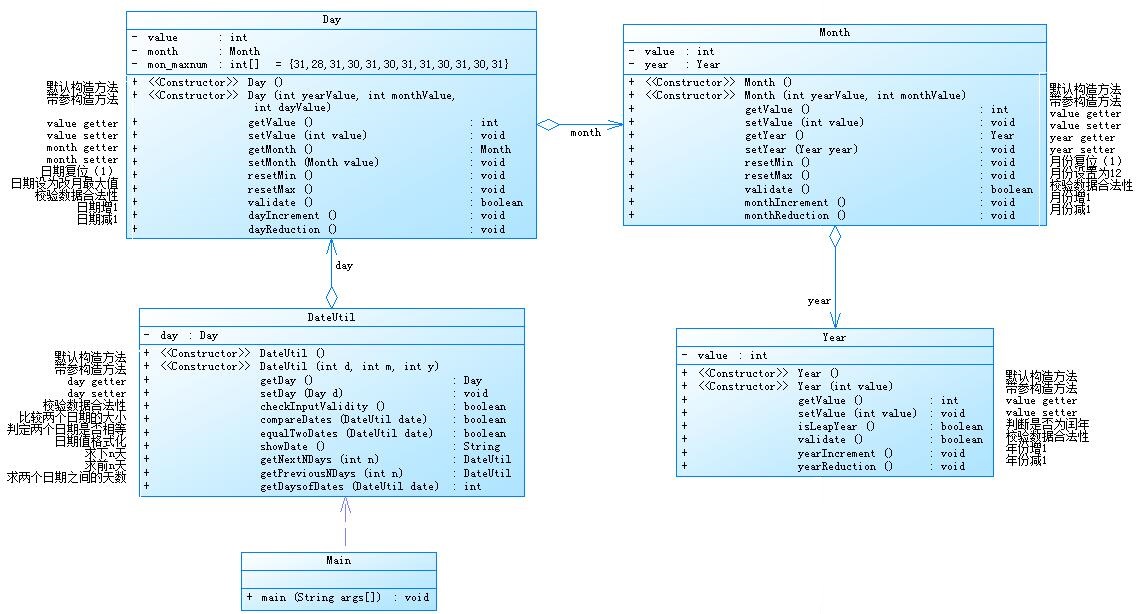
应用程序共测试三个功能:
- 求下n天
- 求前n天
- 求两个日期相差的天数
import java.util.Scanner;
public class Main {
    public static void main(String[] args) {
        Scanner input = new Scanner(System.in);
        int year = 0;
        int month = 0;
        int day = 0;

        int choice = input.nextInt();

        if (choice == 1) { // test getNextNDays method
            int m = 0;
            year = Integer.parseInt(input.next());
            month = Integer.parseInt(input.next());
            day = Integer.parseInt(input.next());

            DateUtil date = new DateUtil(year, month, day);

            if (!date.checkInputValidity()) {
                System.out.println("Wrong Format");
               return ;
            }

            m = input.nextInt();

            if (m < 0) {
                System.out.println("Wrong Format");
                return ;
            }


            System.out.println(date.getNextNDays(m).showDate());
        } else if (choice == 2) { // test getPreviousNDays method
            int n = 0;
            year = Integer.parseInt(input.next());
            month = Integer.parseInt(input.next());
            day = Integer.parseInt(input.next());

            DateUtil date = new DateUtil(year, month, day);

            if (!date.checkInputValidity()) {
                System.out.println("Wrong Format");
                return ;
            }

            n = input.nextInt();

            if (n < 0) {
                System.out.println("Wrong Format");
                return ;
            }

            System.out.println(date.getPreviousNDays(n).showDate());
        } else if (choice == 3) { // test getDaysofDates method
            year = Integer.parseInt(input.next());
            month = Integer.parseInt(input.next());
            day = Integer.parseInt(input.next());

            int anotherYear = Integer.parseInt(input.next());
            int anotherMonth = Integer.parseInt(input.next());
            int anotherDay = Integer.parseInt(input.next());

            DateUtil fromDate = new DateUtil(year, month, day);
            DateUtil toDate = new DateUtil(anotherYear, anotherMonth, anotherDay);

            if (fromDate.checkInputValidity() && toDate.checkInputValidity()) {
                System.out.println(" " +fromDate.getDaysofDates(toDate));
            } else {
                System.out.println("Wrong Format");
             return ;
            }
        } else {
            System.out.println("Wrong Format");
            System.exit(0);
        }
    }
}
class DateUtil {
    Day day;

    public DateUtil(){

    }
    public DateUtil(int d, int m, int y){
        this.day = new Day(d,m,y);
    }
    public Day getDay() {
        return day;
    }
    public void setDay(Day d) {
        this.day = d;
    }

    public boolean checkInputValidity(){//检测输入的年、月、日是否合法
        if(this.getDay().getMonth().getYear().validate()&&this.getDay().getMonth().validate()&&day.validate())
            return true;
        return false;
    }

    public boolean compareDates(DateUtil date){//比较当前日期与date的大小(先后)
        if (date.getDay().getMonth().getYear().getValue()<this.getDay().getMonth().getYear().getValue())
            return false;

        else if (date.getDay().getMonth().getYear().getValue()==this.getDay().getMonth().getYear().getValue()
                &&date.getDay().getMonth().getValue()<this.getDay().getMonth().getValue())
            return false;

        if (date.getDay().getMonth().getYear().getValue()==this.getDay().getMonth().getYear().getValue()
                &&date.getDay().getMonth().getValue()==this.getDay().getMonth().getValue()
                &&date.getDay().getValue()<this.getDay().getValue())
            return false;

        return true;
    }

    public boolean equalTwoDates(DateUtil date){//判断两个日期是否相等
        if (this.getDay().getValue()==date.getDay().getValue()
                && this.getDay().getMonth().getYear().getValue()==date.getDay().getMonth().getYear().getValue()
                && this.getDay().getMonth().getValue()==date.getDay().getMonth().getValue())
            return true;

        return false;
    }

    public String showDate(){//以“year-month-day”格式返回日期值
        return this.getDay().getMonth().getYear().getValue()+"-"+this.getDay().getMonth().getValue()+"-"+this.getDay().getValue();

    }

    public DateUtil getNextNDays(int n){//取得year-month-day的下n天日期
        int arr[] = {0,31,28,31,30,31,30,31,31,30,31,30,31};
        int year=0, month=0, day=0;
        int rest = restday(this);
        if (rest>n) {//本年
            year=this.getDay().getMonth().getYear().getValue();
            int mday = arr[this.getDay().getMonth().getValue()];
            if (this.getDay().getMonth().getYear().isLeapYear()&&this.getDay().getMonth().getValue()==2) {
                mday++;
            }
            mday-=this.getDay().getValue();//本月剩余的日期
            if (mday>=n) {    //本月
                month = this.getDay().getMonth().getValue();
                day = n+this.getDay().getValue();
            }
            else{    //其他月
                n-=mday;
                month = this.getDay().getMonth().getValue()+1;
                int k = month;
                while(n-arr[k]>0&&k<=12){
                    n -= arr[k];
                    month++;
                    k++;
                }
                day = n;
            }
        }
        else {
            n-=rest;
            year = this.getDay().getMonth().getYear().getValue()+1;
            int y = 365;
            if (new Year(year).isLeapYear()) {
                y++;
            }
            while(n-y>0){
                n-=y;
                year++;
                y=365;
                if (new Year(year).isLeapYear())
                    y++;
            }
            int k = 1;
            while(n-arr[k]>0&&k<=12){
                n -= arr[k];
                k++;
            }
            month = k;
            day = n;
        }

//        System.out.println(this.showDate()+" next "+n+" days is:"+year+"-"+month+"-"+day);

        return new DateUtil(year, month, day);
    }

    public int restday(DateUtil d) {
        int n = 0;
        int arr[] = {0,31,28,31,30,31,30,31,31,30,31,30,31};
        for (int i = d.getDay().getMonth().getValue()+1; i <=12; i++) {
            n+=arr[i];
        }
        n+=arr[d.getDay().getMonth().getValue()]-d.getDay().getValue();
        if(d.getDay().getMonth().getYear().isLeapYear()&&d.getDay().getMonth().getValue()<=2)
            n++;
        return n;
    }

    public DateUtil getPreviousNDays(int n){//取得year-month-day的前n天日期
        int arr[] = {0,31,28,31,30,31,30,31,31,30,31,30,31};
        int year=0, month=0, day=0;
        int rest = 365-restday(this);
        if (this.getDay().getMonth().getYear().isLeapYear()) {
            rest++;
        }
        if (rest>n) {//本年
            year=this.getDay().getMonth().getYear().getValue();
            int mday=this.getDay().getValue();//本月剩余的日期
            if (mday>n) {    //本月
                month = this.getDay().getMonth().getValue();
                day = mday-n;
            }
            else{    //其他月
                n-=mday;
                month = this.getDay().getMonth().getValue()-1;
                if (month==0) {
                    month = 12;
                    year=this.getDay().getMonth().getYear().getValue()-1;
                }
                int k = month;
                while(n-arr[k]>0&&k>=0){
                    n -= arr[k];
                    month--;
                    k--;
                }
                day = arr[k]-n;
                if (new Year(year).isLeapYear()&&month==2) {
                    day++;
                }
            }
        }
        else {
            n-=rest;
            year = this.getDay().getMonth().getYear().getValue()-1;
            int y = 365;
            if (new Year(year).isLeapYear()) {
                y++;
            }
            while(n-y>0){
                n-=y;
                year--;
                y=365;
                if (new Year(year).isLeapYear())
                    y++;
            }
            int k = 12;
            while(n-arr[k]>0&&k>=0){
                n -= arr[k];
                k--;
            }
            month = k;
            day = arr[k]-n;
            if (new Year(year).isLeapYear()&&month==2) {
                day++;
            }
        }
//        System.out.println(this.showDate()+" previous "+n+" days is:"+year+"-"+month+"-"+day);
        return new DateUtil(year, month, day);
    }


    public int getDaysofDates(DateUtil date){//求当前日期与date之间相差的天数
        DateUtil pred = this;
        DateUtil nextd = date;
        if (this.equalTwoDates(date)) {
            return 0;
        }
        else if (!this.compareDates(date)) {
            pred = date;
            nextd = this;
        }
        int arr[] = {0,31,28,31,30,31,30,31,31,30,31,30,31};
        int i,j,d = 0;
        for(i=pred.getDay().getMonth().getYear().getValue()+1;i<nextd.getDay().getMonth().getYear().getValue();i++) {
            d=d+365;
            if(new Year(i).isLeapYear())
                d++;
        }
        if (pred.getDay().getMonth().getYear().getValue()!=nextd.getDay().getMonth().getYear().getValue()) {
            for(j=pred.getDay().getMonth().getValue()+1;j<=12;j++)
                d=d+arr[j];
            d+=arr[pred.getDay().getMonth().getValue()]-pred.getDay().getValue();
            for(j=1;j<nextd.getDay().getMonth().getValue();j++)
                d+=arr[j];
            d+=nextd.getDay().getValue();
            if(pred.getDay().getMonth().getYear().isLeapYear()&&pred.getDay().getMonth().getValue()<=2)
                d++;
            if (nextd.getDay().getMonth().getYear().isLeapYear()&&nextd.getDay().getMonth().getValue()>2) {
                d++;
            }
        }
        else if(pred.getDay().getMonth().getYear().getValue()==nextd.getDay().getMonth().getYear().getValue()&&pred.getDay().getMonth().getValue()!=nextd.getDay().getMonth().getValue()){
            for(j=pred.getDay().getMonth().getValue()+1;j<=nextd.getDay().getMonth().getValue()-1;j++)
                d+=arr[j];
            d+=arr[pred.getDay().getMonth().getValue()]-pred.getDay().getValue();
            d+=nextd.getDay().getValue();
            if(pred.getDay().getMonth().getYear().isLeapYear()&&pred.getDay().getMonth().getValue()<=2)
                d++;
        }
        else if(pred.getDay().getMonth().getYear().getValue()==nextd.getDay().getMonth().getYear().getValue()&&pred.getDay().getMonth().getValue()==nextd.getDay().getMonth().getValue()){
            d=nextd.getDay().getValue()-pred.getDay().getValue();
        }
        return d;
    }


}
class Day{
    int value;
    Month month;
    int mon_maxnum[]= {31,28,31,30,31,30,31,31,30,31,30,31};
    public Day() {

    }
    public Day(int yearValue,int monthValue,int dayValue) {
        this.month = new Month(yearValue,monthValue);
        this.value = dayValue;
    }
    public int getValue() {
        return value;
    }
    public void setValue(int value) {
        this.value = value;
    }
    public Month getMonth() {
        return month;
    }
    public void setMonth(Month value) {
        this.month = value;
    }
    public void resetMin() {
        value=1;
    }
    public void resetMax() {
        value=mon_maxnum[month.getValue()-1];
    }
    public boolean validate() {
        if(this.getMonth().getYear().isLeapYear())
            mon_maxnum[1]++;
        if(1<=value&&mon_maxnum[month.getValue()-1]>=value)
            return true;
        return false;
    }
    public void dayIncrement() {
        value++;
    }
    public void dayReduction() {
        value--;
    }
}
class Month{
    int value;
    Year year;
    public Month() {

    }
    public Month(int yearValue,int monthValue) {
        this.year = new Year(yearValue);
        this.value = monthValue;
    }
    public int getValue() {
        return value;
    }
    public void setValue(int value) {
        this.value = value;
    }
    public Year getYear() {
        return year;
    }
    public void setYear(Year year) {
        this.year = year;
    }
    public void resetMin() {
        value=1;
    }
    public void resetMax() {
        value=12;
    }
    public boolean validate() {
        if(1<=value&&12>=value)
            return true;
        return false;
    }
    public void monthIncrement() {
        value++;
    }
    public void monthReduction() {
        value--;
    }
}
class Year{
    int value;
    public Year() {

    }
    public Year(int value) {
        this.value = value;
    }
    public int getValue() {
        return value;
    }
    public void setValue(int value) {
        this.value = value;
    }
    public boolean isLeapYear(){//判断year是否为闰年
        boolean y1 = value%4 == 0;
        boolean y2 = value%100 != 0;
        boolean y3 = value%400 == 0;

        if((y1&&y2)||y3)
            return true;
        else
            return false;
    }
    public boolean validate() {
        if(value<=2020&&value>=1820)
            return true;
        return false;
    }
    public void yearIncrement() {
        value++;
    }
    public void yearReduction() {
        value--;
    }
}
题目集四7-2,采用层层调用,使用时较为麻烦,而且类与类之间的关系过于紧密,会增加处理bug时的难度',写代码时也较为繁琐,代码长度感觉也太长了
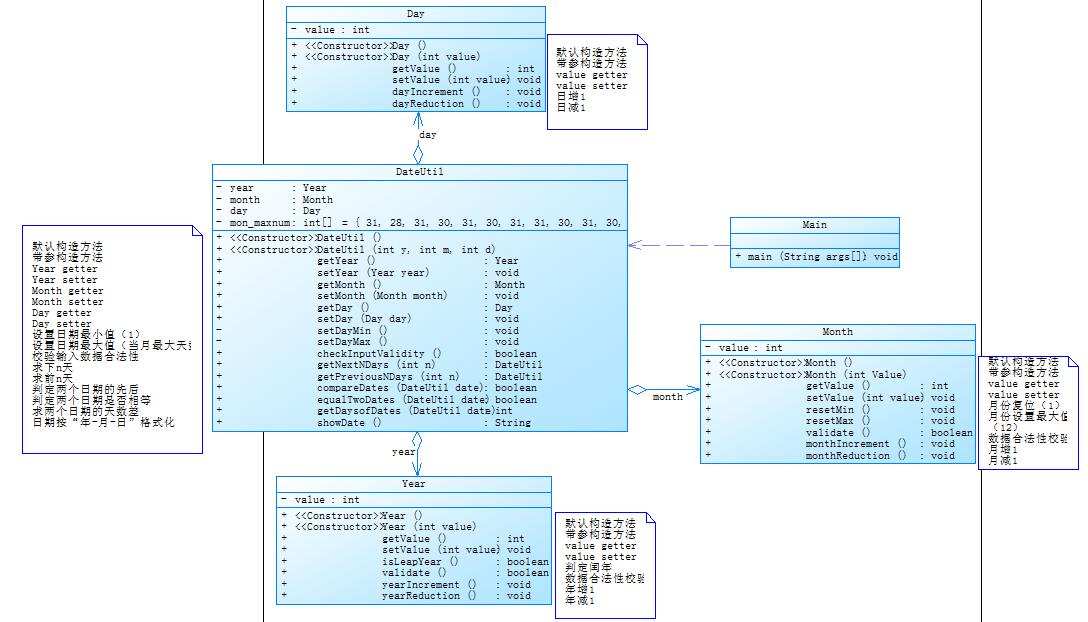
这是题目集五7-4的类图,类与类之间的耦合度相对于上个题目有着明显降低,不但使程序变得更具有可读性,而且在编写代码时也更简洁,降低了类与类之间的关联性。
总的来说,我觉得题目集五7-4的类图设计比题目集四7-2的类图设计要好,降低了类与类直接的依赖性。
二.题目集4(7-3)、题目集6(7-5、7-6)三种渐进式图形继承设计的思路与技术运用(封装、继承、多态、接口等)
题目集4(7-3):
编写程序,实现图形类的继承,并定义相应类对象并进行测试。
- 类Shape,无属性,有一个返回0.0的求图形面积的公有方法
public double getArea();//求图形面积 - 类Circle,继承自Shape,有一个私有实型的属性radius(半径),重写父类继承来的求面积方法,求圆的面积
- 类Rectangle,继承自Shape,有两个私有实型属性width和length,重写父类继承来的求面积方法,求矩形的面积
- 类Ball,继承自Circle,其属性从父类继承,重写父类求面积方法,求球表面积,此外,定义一求球体积的方法
public double getVolume();//求球体积 - 类Box,继承自Rectangle,除从父类继承的属性外,再定义一个属性height,重写父类继承来的求面积方法,求立方体表面积,此外,定义一求立方体体积的方法
public double getVolume();//求立方体体积 - 注意:
- 每个类均有构造方法,且构造方法内必须输出如下内容:
Constructing 类名 - 每个类属性均为私有,且必须有getter和setter方法(可用Eclipse自动生成)
- 输出的数值均保留两位小数
主方法内,主要实现四个功能(1-4): 从键盘输入1,则定义圆类,从键盘输入圆的半径后,主要输出圆的面积; 从键盘输入2,则定义矩形类,从键盘输入矩形的宽和长后,主要输出矩形的面积; 从键盘输入3,则定义球类,从键盘输入球的半径后,主要输出球的表面积和体积; 从键盘输入4,则定义立方体类,从键盘输入立方体的宽、长和高度后,主要输出立方体的表面积和体积;
假如数据输入非法(包括圆、矩形、球及立方体对象的属性不大于0和输入选择值非1-4),系统输出Wrong Format
import java.util.Scanner;

class Shape{
	Shape(){
		System.out.println("Constructing Shape");
	}
	public double getArea() {
		return 0.0;
	}
}

class Circle extends Shape{
	private double radius;
	Circle() {
		System.out.println("Constructing Circle");
	}

	public double getArea() {
		return radius*radius*Math.PI ;
	}
	public void setRadius(double radius) {
		this.radius = radius;
	}
	public double getRadius() {
		return radius;
	}

}

class Rectangle extends Shape{
	private double width,length;
	Rectangle() {
		System.out.println("Constructing Rectangle");
	}

	public double getArea() {
		return width*length;
	}
	public void setWidth(double width) {
		this.width = width;
	}
	public void setLength(double length) {
		this.length = length;
	}
	public double getWidth() {
		return width;
	}
	public double getLength() {
		return length;
	}

}

class Ball extends Circle{
	Ball(){
		System.out.println("Constructing Ball");
	}

	public double getArea() {
		return super.getArea()*4;
	}
	public double getVolume() {
		return getArea()/3*getRadius();
	}
}

class Box extends Rectangle{
	private double height;
	Box(){
		System.out.println("Constructing Box");
	}

	public double getArea() {
		return 2*(getWidth()*getLength()+getWidth()*getHeight()+getLength()*getHeight());
	}
	public double getVolume() {
		return super.getArea()*height;
	}
	public void setHeight(double height) {
		this.height = height;
	}
	public double getHeight() {
		return height;
	}

}


public class Main {

	public static void main(String[] args) {
		Scanner in=new Scanner(System.in);
		int n=in.nextInt();
		switch(n) {
		case 1:
			double r;
			r=in.nextDouble();
			if(r<0)
			{
				System.out.println("Wrong Format");

			}
			else
			{
				Circle circle=new Circle() ;
				circle.setRadius(r);
				System.out.printf("Circle's area:%.2f\n",circle.getArea());
			}
			break;
		case 2:
			double a,b;
			a=in.nextDouble();
			b=in.nextDouble();
			if(a<=0||b<=0) {
				System.out.println("Wrong Format");
			}
			else
			{
				Rectangle f=new Rectangle();
				f.setWidth(a);
				f.setLength(b);
				System.out.printf("Rectangle's area:%.2f\n",f.getArea());
			}
			break;
		case 3:
			double c;
			c=in.nextDouble();

			if(c>=0) {
				Ball ball=new Ball();
				ball.setRadius(c);
				System.out.printf("Ball's surface area:%.2f\n",ball.getArea());
				System.out.printf("Ball's volume:%.2f\n",ball.getVolume());}
			else {

				System.out.println("Wrong Format");}
			break;
		case 4:
			double e,f,g;
			e=in.nextDouble();
			f=in.nextDouble();
			g=in.nextDouble();
			if(e<=0||f<=0||g<=0) {
				System.out.println("Wrong Format");
			}
			else
			{
				Box box=new Box();

				box.setWidth(e);
				box.setLength(f);
				box.setHeight(g);
				System.out.printf("Box's surface area:%.2f\n",box.getArea());
                System.out.printf("Box's volume:%.2f\n",box.getVolume());
			}
			break;

		default :
			System.out.println("Wrong Format");

		}

	}

}
类图如下:
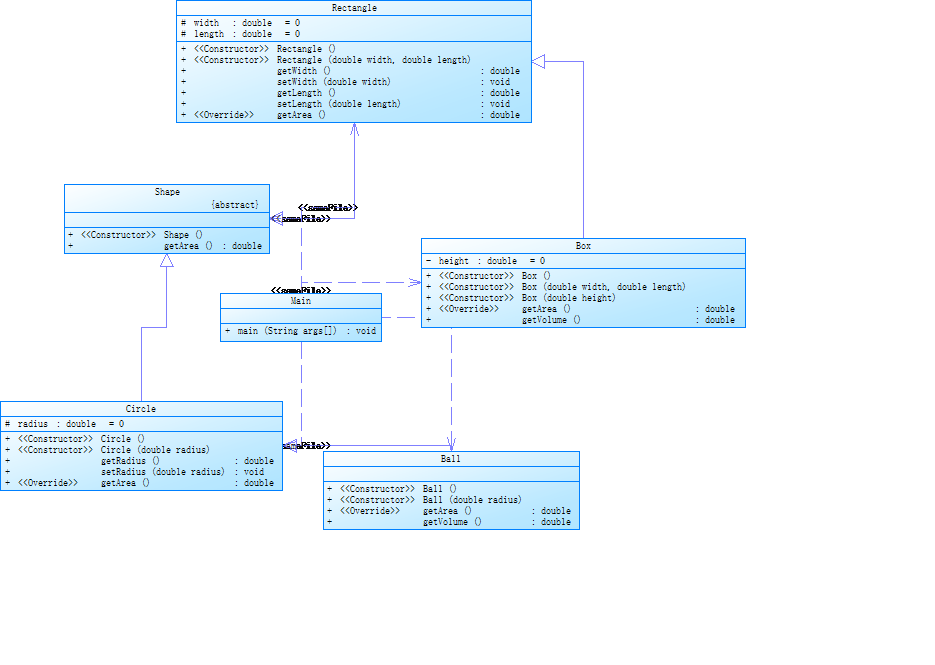
题目较简单,让Circle,Ball,Box,Rectangle继承自Shape,Shape是父类,Circle,Ball,Box,Rectangle是子类,其中Shape类还是一个抽象的类,其中有getArea()方法,在子类中分别重写该方法。
题目集6(7-5)
输入格式:
从键盘首先输入三个整型值(例如a b c),分别代表想要创建的Circle、Rectangle及Triangle对象的数量,然后根据图形数量继续输入各对象的属性值(均为实型数),数与数之间可以用一个或多个空格或回车分隔。
输出格式:
- 如果图形数量非法(小于0)或图形属性值非法(数值小于0以及三角形三边关系),则输出
Wrong Format。 - 如果输入合法,则正常输出,输出内容如下(输出格式见输入输出示例):
- 各个图形的面积;
- 所有图形的面积总和;
- 排序后的各个图形面积;
- 再次所有图形的面积总和。
import java.util.Scanner;
import java.util.Arrays;
public class Main {
public static void main(String []args) {

	  Scanner in = new Scanner(System.in);
	int a =  in.nextInt();
	int b = in.nextInt();
	int c = in.nextInt();
	if(a<0||b<0||c<0) {
	  	System.out.print("Wrong Format");
		System.exit(0);
	}

	Circle []s=new Circle[a];
    Rectangle []d=new Rectangle[b];
    Triangle []f=new Triangle[c];
    double[] area=new double [a+b+c];
  int []k = new int [3];
    int o = 0;
    double sum = 0;


		  for(int i=0;i<a;i++){
	            double radius=in.nextDouble();
	            s[i]=new Circle(radius);
	            area[o++] = s[i].getArea();
                   if(s[i].validate()) {
                	   k [0]= 0;

                   }
                   else k [0]= 1;
	        }

	        for(int i=0;i<b;i++){
	            double width=in.nextDouble();
	            double length=in.nextDouble();
	            d[i] = new Rectangle(width,length);
                 area[o++] = d[i].getArea();
                 if(d[i].validate()) {
              	   k [1]= 0;

                 }
                 else k [1]= 1;

	        }

	        for(int i=0;i<c;i++){
	            double l=in.nextDouble(),w=in.nextDouble(),h=in.nextDouble();
	            f[i] = new Triangle(l,w,h);
	            area[o++] = f[i].getArea();
                if(f[i].validate()) {
             	   k [2]= 0;

                }
                else k [2]= 1;
	        }
	        if(k[0] == 1 || k[1] == 1 ||k[2] == 1) {
	        	System.out.print("Wrong Format");


	        }

	        else {
    System.out.println("Original area:");
    for(int i=0;i<a+b+c;i++){
        System.out.printf("%.2f ",area[i]);
      sum+=area[i];
    }
    System.out.println();
    System.out.printf("Sum of area:");
    System.out.printf("%.2f\n",sum);
    System.out.println("Sorted area:");
    Arrays.sort(area);
    for(int i=0;i<a+b+c;i++){
        System.out.printf("%.2f ",area[i]);
    }
    System.out.println();

    System.out.printf("Sum of area:%.2f",sum);
	        }}


}


abstract class Shape{

	boolean   validate() {

	            return false;
	        }


}

class Circle extends Shape {
	private double radius;
	Circle() {

	}

	public double getArea() {
		return radius*radius*Math.PI ;
	}
	public void setRadius(double radius) {
		this.radius = radius;
	}
	public double getRadius() {
		return radius;
	}

	  public Circle(double radius) {
		super();
		this.radius = radius;
	}

	boolean validate() {
		  if(radius >0)
			 return true;
		  else
			  return false;

		 }
}

class Rectangle extends Shape{
	private double width,length;
	Rectangle() {

	}

	 public Rectangle(double width, double length) {
		super();
		this.width = width;
		this.length = length;
	}

	boolean validate() {
	if(	 width > 0 && length > 0)
		return true;
	else

		 return false;

	 }
	public double getArea() {
		return width*length;
	}
	public void setWidth(double width) {
		this.width = width;
	}
	public void setLength(double length) {
		this.length = length;
	}
	public double getWidth() {
		return width;
	}
	public double getLength() {
		return length;
	}

}

class Triangle  extends Shape{
	private double l,w,h;

	public Triangle() {
		super();
		// TODO Auto-generated constructor stub
	}

	public Triangle(double l, double w, double h) {
		super();
		this.l = l;
		this.w = w;
		this.h = h;
	}

	public double getL() {
		return l;
	}

	public void setL(double l) {
		this.l = l;
	}

	public double getW() {
		return w;
	}

	public void setW(double w) {
		this.w = w;
	}

	public double getH() {
		return h;
	}

	public void setH(double h) {
		this.h = h;
	}
public double getArea() {

	 double p = (l+ w + h) / 2;
     return Math.sqrt(p * (p - l) * (p - w) * (p - h));


}
 boolean validate() {
	   if (l<=0 || w <=0 || h <= 0||l+w<=h||w+h<=l||l+h<=w)
           return false;
	   else
			  return true;


 }

}
类图如下:
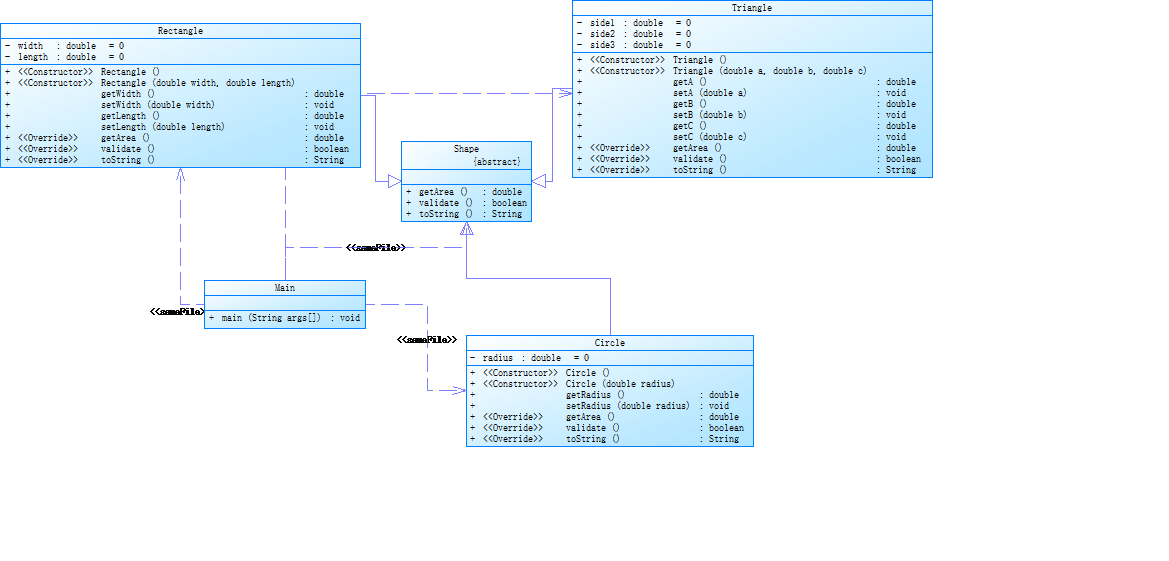
。该题将类中的属性都是私有属性,这样就保证了各个类属性的封装性。还设计了一个抽象的Shape类,Circle,Rectangle,Triangle类均是继承自Shape类,Shape类中写了getArea(),validate(),toString()三个抽象方法,三个子类均从父类中继承各个方法,并且在各自的类中对三个方法进行复写,实现代码的多态。
题目集6(7-6)
输入格式:
从键盘分别输入圆的半径值及矩形的宽、长的值,用空格分开。
输出格式:
- 如果输入的圆的半径值及矩形的宽、长的值非法(≤0),则输出
Wrong Format - 如果输入合法,则分别输出圆的面积和矩形的面积值(各占一行),保留两位小数。
import java.lang.*;
import java.util.Scanner;

  interface GetArea {
	public double getArea();


}
public class Main {
public static void main(String []args) {

	  Scanner in = new Scanner(System.in);
	double a =  in.nextDouble();
	double b = in.nextDouble();
	double o = in.nextDouble();
	double c = 0;
	double u = 0;
	int []k = new int[100];
	Circle d = new Circle();
	Rectangle e = new Rectangle();
	d = new Circle(a);
	u = d.getArea();
	e = new Rectangle(b,o);
	c = e.getArea();
	if(d.validate()) {
		k[1] = 1;

	}
	else
		k[1] = 0;
	if(e.validate()) {
		k[2] = 1;

	}
	else
		k[2] = 0;
	if(k[1] == 1&&k[2] == 1) {

	System.out.println(String.format("%.2f", u));
	System.out.println(String.format("%.2f", c));
	}


	else
		System.out.print("Wrong Format");
}


}


class Circle implements GetArea{
	private double radius;
	Circle() {

	}

	public double getArea() {
		return radius*radius*Math.PI ;
	}
	public void setRadius(double radius) {
		this.radius = radius;
	}
	public double getRadius() {
		return radius;
	}

	  public Circle(double radius) {
		super();
		this.radius = radius;
	}

	boolean validate() {
		  if(radius >0)
			 return true;
		  else
			  return false;

		 }
}

class Rectangle implements GetArea{
	private double width,length;
	Rectangle() {

	}

	 public Rectangle(double width, double length) {
		super();
		this.width = width;
		this.length = length;
	}

	boolean validate() {
	if(	 width > 0 && length > 0)
		return true;
	else

		 return false;

	 }
	public double getArea() {
		return width*length;
	}
	public void setWidth(double width) {
		this.width = width;
	}
	public void setLength(double length) {
		this.length = length;
	}
	public double getWidth() {
		return width;
	}
	public double getLength() {
		return length;
	}

}
类图如下:
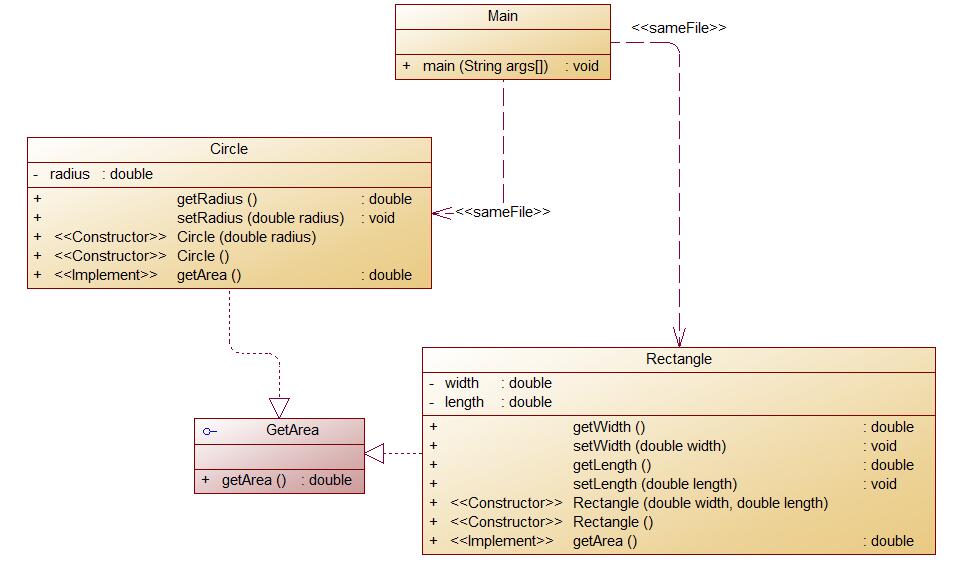
这次使用了一个接口GetArea,和类有些不同,接口是公开的,不能有私有的方法或变量,接口中的所有方法都没有方法体,通过关键字interface实现。抽象类是可以有私有方法或私有变量的,通过把类或者类中的方法声明为abstract来表示一个类是抽象类,被声明为抽象的方法不能包含方法体。子类实现方法必须含有相同的或者更低的访问级别(public->protected->private)。抽象类的子类为父类中所有抽象方法的具体实现,否则也是抽象类。该题也实现了封装性与多态。
③对三次题目集中用到的正则表达式技术的分析总结
题目集四:7-1
这一题的重点是正则表达式的匹配还有分组。经过前三次的作业,对正则表达式已经有一点熟悉了,而这次则是对数字和日期的匹配进行练习。在编写代码的过程中,首先遇到了对小数点后几位的匹配出现问题,因为有的是一位小数,有的是两位或者是三位,没有办法去确定。后来我通过 对数字进行 ( ?) 加上问号的处理,这样位数就可以出现0次或多次。首先是对输入的数据一行一行的读入处理,对输入的数据判断之后就是对数据进行分组,在这里我采用的是group()的方法,将一行中的数据分为五部分:测量时间、目标水位、实际水位、开度(包含目标开度和实际开度,以“/” 分隔)、流量,然后挨个对数据进行处理并且记录下行与列。
题目集六中
7-1是匹配QQ号,算是最简单的一道题,直接对数字挨个进行匹配,只需注意QQ号的位数是5-15位不等,所以需要用 ? 去判断。
7-3是匹配验证码,在这就存在一个出现的字符可以是数字也可以是字母,所以使用了 [0-9a-zA-Z] 这样的匹配方式,代码的意思就是出现0-9数字或者a-z,A-Z的字母即可匹配,这样就可以解决这个问题。其次是验证码刚好是四位数的验证码,所以就存在一个出现次数的问题,[0-9a-zA-Z]{4} 这样就代表可以出现四次。
7-4是学号校验,一共是八位数,均是数字,首先是班级的问题,只存在固定的几个班,,将班级的部分用括号括起来中间,将三个不同的方向班级用 | 分开,再用括号将学号的两位数括起来,将学号分为个位数匹配 0[1-9] 和10-39的两位数匹配 [1-3][0-9] 和 40 三个类型用 | 去隔开就可以匹配01-40的学号。
④题目集5(7-4)中Java集合框架应用的分析总结
首先说说集合与数组的区别
数组的长度是固定的,如果想增加长度,只能创建新的数组。
集合的长度是可变的,数据理论可以无限添加,自动扩容。
数组元素的类型必须是同一种类型,比如 String[] arr = ["aaa","bbb"];
集合元素可以是不同的类型 ArrayList

 浙公网安备 33010602011771号