


Spring 源码解析(三)加载配置文件3
继续上一章,我们来分析XmlBeanDefinitionReader的loadBeanDefinitions(configLocation)方法,跟踪方法最后调用的是其父类org.springframework.beans.factory.support.AbstractBeanDefinitionReader中的loadBeanDefinitions(String location, Set<Resource> actualResources)方法
 //org.springframework.beans.factory.support.AbstractBeanDefinitionReader
 1 /**
 2      * Load bean definitions from the specified resource location.
 3      * <p>The location can also be a location pattern, provided that the
 4      * ResourceLoader of this bean definition reader is a ResourcePatternResolver.
 5      * @param location the resource location, to be loaded with the ResourceLoader
 6      * (or ResourcePatternResolver) of this bean definition reader
 7      * @param actualResources a Set to be filled with the actual Resource objects
 8      * that have been resolved during the loading process. May be {@code null}
 9      * to indicate that the caller is not interested in those Resource objects.
10      * @return the number of bean definitions found
11      * @throws BeanDefinitionStoreException in case of loading or parsing errors
12      * @see #getResourceLoader()
13      * @see #loadBeanDefinitions(org.springframework.core.io.Resource)
14      * @see #loadBeanDefinitions(org.springframework.core.io.Resource[])
15      */
16     public int loadBeanDefinitions(String location, Set<Resource> actualResources) throws BeanDefinitionStoreException {
17         ResourceLoader resourceLoader = getResourceLoader();
18         if (resourceLoader == null) {
19             throw new BeanDefinitionStoreException(
20                     "Cannot import bean definitions from location [" + location + "]: no ResourceLoader available");
21         }
22
23         if (resourceLoader instanceof ResourcePatternResolver) {
24             // Resource pattern matching available.
25             try {
26                 Resource[] resources = ((ResourcePatternResolver) resourceLoader).getResources(location);
27                 int loadCount = loadBeanDefinitions(resources);
28                 if (actualResources != null) {
29                     for (Resource resource : resources) {
30                         actualResources.add(resource);
31                     }
32                 }
33                 if (logger.isDebugEnabled()) {
34                     logger.debug("Loaded " + loadCount + " bean definitions from location pattern [" + location + "]");
35                 }
36                 return loadCount;
37             }
38             catch (IOException ex) {
39                 throw new BeanDefinitionStoreException(
40                         "Could not resolve bean definition resource pattern [" + location + "]", ex);
41             }
42         }
43         else {
44             // Can only load single resources by absolute URL.
45             Resource resource = resourceLoader.getResource(location);
46             int loadCount = loadBeanDefinitions(resource);
47             if (actualResources != null) {
48                 actualResources.add(resource);
49             }
50             if (logger.isDebugEnabled()) {
51                 logger.debug("Loaded " + loadCount + " bean definitions from location [" + location + "]");
52             }
53             return loadCount;
54         }
55     }
从注释的第一句话--Load bean definitions from the specified resource location,我们就能明白这个方法做了什么事情。
第17行,获取ResourceLoader,其实就是前面创建的XmlWebApplicationContext实例。下图清楚表明了两者之间的关系
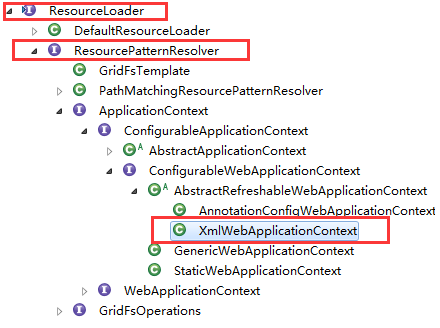
第26行,按照配置文件路径location获取Resource类型数组,实际的实现类为ServletContextResource,这个类中包装了servletContext和配置文件路径path,还提供了一些访问资源的方法。
第27行,解析了配置文件,跟踪方法,最终调用的是类中的loadBeanDefinitions(EncodedResource encodedResource)方法
 //org.springframework.beans.factory.xml.XmlBeanDefinitionReader
 1     /**
 2      * Load bean definitions from the specified XML file.
 3      * @param encodedResource the resource descriptor for the XML file,
 4      * allowing to specify an encoding to use for parsing the file
 5      * @return the number of bean definitions found
 6      * @throws BeanDefinitionStoreException in case of loading or parsing errors
 7      */
 8     public int loadBeanDefinitions(EncodedResource encodedResource) throws BeanDefinitionStoreException {
 9         Assert.notNull(encodedResource, "EncodedResource must not be null");
10         if (logger.isInfoEnabled()) {
11             logger.info("Loading XML bean definitions from " + encodedResource.getResource());
12         }
13
14         Set<EncodedResource> currentResources = this.resourcesCurrentlyBeingLoaded.get();
15         if (currentResources == null) {
16             currentResources = new HashSet<EncodedResource>(4);
17             this.resourcesCurrentlyBeingLoaded.set(currentResources);
18         }
19         if (!currentResources.add(encodedResource)) {
20             throw new BeanDefinitionStoreException(
21                     "Detected cyclic loading of " + encodedResource + " - check your import definitions!");
22         }
23         try {
24             InputStream inputStream = encodedResource.getResource().getInputStream();
25             try {
26                 InputSource inputSource = new InputSource(inputStream);
27                 if (encodedResource.getEncoding() != null) {
28                     inputSource.setEncoding(encodedResource.getEncoding());
29                 }
30                 return doLoadBeanDefinitions(inputSource, encodedResource.getResource());
31             }
32             finally {
33                 inputStream.close();
34             }
35         }
36         catch (IOException ex) {
37             throw new BeanDefinitionStoreException(
38                     "IOException parsing XML document from " + encodedResource.getResource(), ex);
39         }
40         finally {
41             currentResources.remove(encodedResource);
42             if (currentResources.isEmpty()) {
43                 this.resourcesCurrentlyBeingLoaded.remove();
44             }
45         }
46     }
第24行,从Resource(实际是前边创建的servletContextResource)获取输入流。
第26行,根据数据流创建InputSource。
第30行,处理InputSource,即解析配置文件,进入方法
 //org.springframework.beans.factory.xml.XmlBeanDefinitionReader
 1     /**
 2      * Actually load bean definitions from the specified XML file.
 3      * @param inputSource the SAX InputSource to read from
 4      * @param resource the resource descriptor for the XML file
 5      * @return the number of bean definitions found
 6      * @throws BeanDefinitionStoreException in case of loading or parsing errors
 7      * @see #doLoadDocument
 8      * @see #registerBeanDefinitions
 9      */
10     protected int doLoadBeanDefinitions(InputSource inputSource, Resource resource)
11             throws BeanDefinitionStoreException {
12         try {
13             Document doc = doLoadDocument(inputSource, resource);
14             return registerBeanDefinitions(doc, resource);
15         }
16             //省略catch
17     }
从注释的第一行--Actually load bean definitions from the specified XML file,这个方法是真正从指定的配置文件加载bean。
第13行,将配置文件转换Document实例。
第14行,解析Document实例,进入方法
 //org.springframework.beans.factory.xml.XmlBeanDefinitionReader
 1     /**
 2      * Register the bean definitions contained in the given DOM document.
 3      * Called by {@code loadBeanDefinitions}.
 4      * <p>Creates a new instance of the parser class and invokes
 5      * {@code registerBeanDefinitions} on it.
 6      * @param doc the DOM document
 7      * @param resource the resource descriptor (for context information)
 8      * @return the number of bean definitions found
 9      * @throws BeanDefinitionStoreException in case of parsing errors
10      * @see #loadBeanDefinitions
11      * @see #setDocumentReaderClass
12      * @see BeanDefinitionDocumentReader#registerBeanDefinitions
13      */
14     public int registerBeanDefinitions(Document doc, Resource resource) throws BeanDefinitionStoreException {
15         BeanDefinitionDocumentReader documentReader = createBeanDefinitionDocumentReader();
16         documentReader.setEnvironment(this.getEnvironment());
17         int countBefore = getRegistry().getBeanDefinitionCount();
18         documentReader.registerBeanDefinitions(doc, createReaderContext(resource));
19         return getRegistry().getBeanDefinitionCount() - countBefore;
20     }
第15行,创建BeanDefinitionDocumentReader实例(实际上是其实现类DefaultBeanDefinitionDocumentReader实例),用来解析Document。
第18行,创建了XmlReaderContext实例,调用DefaultBeanDefinitionDocumentReader的registerBeanDefinitions()方法解析document。
我们先来总结下XmlBeanDefinitionReader的工作,下一章介绍BeanDefinitionDocumentReader如何解析document。
1、根据配置文件路径创建Resource实例(实际上是其实现类servletContextResource实例,包含了servletContext和配置文件路径path),
2、通过Resource实例创建InputSource,
3、根据InputSource、Resource创建Document,
4、创建XmlReaderContext实例,包含了Resource、ProblemReporter、EventListener 、SourceExtractor、XmlBeanDefinitionReader、NamespaceHandlerResolver,
4、创建BeanDefinitionDocumentReader实例(实际上是其实现类DefaultBeanDefinitionDocumentReader实例),
5、调用DefaultBeanDefinitionDocumentReader的registerBeanDefinitions(Document doc, XmlReaderContext readerContext)方法解析Document。

 浙公网安备 33010602011771号