

Spring 源码解析(一)加载配置文件1
Spring初始化入口是org.springframework.web.context.ContextLoaderListener类中的contextInitialized方法,如果不清楚contextInitialized是如何被调用的请参考本人另一篇随笔:http://www.cnblogs.com/jintian315/p/8628873.html。
//org.springframework.web.context.ContextLoaderListener 1     /**
2      * Initialize the root web application context.
3      */
4     @Override
5     public void contextInitialized(ServletContextEvent event) {
6         initWebApplicationContext(event.getServletContext());
7     }
进入initWebApplicationContext方法,为了方便阅读,省略了部分不影响流程的代码,并将关键代码行加了下划线,同时会在代码开头标注此是在哪个类中。注意:阅读代码中的注释是个好习惯,哪怕你的英文水平
 //org.springframework.web.context.ContextLoaderListener
 1 /**
 2      * Initialize Spring's web application context for the given servlet context,
 3      * using the application context provided at construction time, or creating a new one
 4      * according to the "{@link #CONTEXT_CLASS_PARAM contextClass}" and
 5      * "{@link #CONFIG_LOCATION_PARAM contextConfigLocation}" context-params.
 6      * @param servletContext current servlet context
 7      * @return the new WebApplicationContext
 8      * @see #ContextLoader(WebApplicationContext)
 9      * @see #CONTEXT_CLASS_PARAM
10      * @see #CONFIG_LOCATION_PARAM
11      */
12     public WebApplicationContext initWebApplicationContext(ServletContext servletContext) {
13         if (servletContext.getAttribute(WebApplicationContext.ROOT_WEB_APPLICATION_CONTEXT_ATTRIBUTE) != null) {
14             throw new IllegalStateException(
15                     "Cannot initialize context because there is already a root application context present - " +
16                     "check whether you have multiple ContextLoader* definitions in your web.xml!");
17         }18
19      Log logger = LogFactory.getLog(ContextLoader.class);
20      servletContext.log("Initializing Spring root WebApplicationContext");
21      if (logger.isInfoEnabled()) {
22        logger.info("Root WebApplicationContext: initialization started");
23      }
24      long startTime = System.currentTimeMillis();
25
26         try {
27             // Store context in local instance variable, to guarantee that
28             // it is available on ServletContext shutdown.
29             if (this.context == null) {
30                 this.context = createWebApplicationContext(servletContext);
31             }
32             if (this.context instanceof ConfigurableWebApplicationContext) {
33                 ConfigurableWebApplicationContext cwac = (ConfigurableWebApplicationContext) this.context;
34                 if (!cwac.isActive()) {
35                     // The context has not yet been refreshed -> provide services such as
36                     // setting the parent context, setting the application context id, etc
37                     if (cwac.getParent() == null) {
38                         // The context instance was injected without an explicit parent ->
39                         // determine parent for root web application context, if any.
40                         ApplicationContext parent = loadParentContext(servletContext);
41                         cwac.setParent(parent);
42                     }
43                   configureAndRefreshWebApplicationContext(cwac, servletContext);
44                 }
45             }
46             servletContext.setAttribute(WebApplicationContext.ROOT_WEB_APPLICATION_CONTEXT_ATTRIBUTE, this.context);
47
48             ClassLoader ccl = Thread.currentThread().getContextClassLoader();
49             if (ccl == ContextLoader.class.getClassLoader()) {
50                 currentContext = this.context;
51             }77     }
第13行首先判断servletContex中是否有值为WebApplicationContext.ROOT_WEB_APPLICATION_CONTEXT_ATTRIBUTE的属性,有则抛出异常。
//org.springframework.web.context.WebApplicationContext
1 String ROOT_WEB_APPLICATION_CONTEXT_ATTRIBUTE = WebApplicationContext.class.getName() + ".ROOT";
第30行创建了WebApplicationContext并赋给this.context,创建的实例对象为org.springframework.web.context.support.XmlWebApplicationContext。那么是如何创建这个实例对象的呢?下面我们就进入到createWebApplicationContext方法中一探究竟
//org.springframework.web.context.ContextLoaderListener
1     protected WebApplicationContext createWebApplicationContext(ServletContext sc) {
2         Class<?> contextClass = determineContextClass(sc);
3         if (!ConfigurableWebApplicationContext.class.isAssignableFrom(contextClass)) {
4             throw new ApplicationContextException("Custom context class [" + contextClass.getName() +
5                     "] is not of type [" + ConfigurableWebApplicationContext.class.getName() + "]");
6         }
7         return (ConfigurableWebApplicationContext) BeanUtils.instantiateClass(contextClass);
8     }
第2行查找Class类,第7行生成类的实例。主要关注下第2行的determineContextClass方法
 //org.springframework.web.context.ContextLoaderListener
 1     /**
 2      * Return the WebApplicationContext implementation class to use, either the
 3      * default XmlWebApplicationContext or a custom context class if specified.
 4      * @param servletContext current servlet context
 5      * @return the WebApplicationContext implementation class to use
 6      * @see #CONTEXT_CLASS_PARAM
 7      * @see org.springframework.web.context.support.XmlWebApplicationContext
 8      */
 9     protected Class<?> determineContextClass(ServletContext servletContext) {
10         String contextClassName = servletContext.getInitParameter(CONTEXT_CLASS_PARAM);
11         if (contextClassName != null) {
12             try {
13                 return ClassUtils.forName(contextClassName, ClassUtils.getDefaultClassLoader());
14             }
15             catch (ClassNotFoundException ex) {
16                 throw new ApplicationContextException(
17                         "Failed to load custom context class [" + contextClassName + "]", ex);
18             }
19         }
20         else {
21             contextClassName = defaultStrategies.getProperty(WebApplicationContext.class.getName());
22             try {
23                 return ClassUtils.forName(contextClassName, ContextLoader.class.getClassLoader());
24             }
25             catch (ClassNotFoundException ex) {
26                 throw new ApplicationContextException(
27                         "Failed to load default context class [" + contextClassName + "]", ex);
28             }
29         }
30     }
第10行是从web.xml中查找<context-param>标签定义的context值作为类名,此参数一般不设置,除非有特殊需求。
第21是从类型为Properties的defaultStrategies对象中,将以WebApplicationContext.class.getName()(得到的值为org.springframework.web.context.WebApplicationContext)为key获得值作为类名。defaultStrategies的在ContextLoaderListener类的静态代码块中初始化的。
//org.springframework.web.context.ContextLoaderListener
 1     /**
 2      * Name of the class path resource (relative to the ContextLoader class)
 3      * that defines ContextLoader's default strategy names.
 4      */
 5     private static final String DEFAULT_STRATEGIES_PATH = "ContextLoader.properties";
 6
 7
 8     private static final Properties defaultStrategies;
 9
10     static {
11         // Load default strategy implementations from properties file.
12         // This is currently strictly internal and not meant to be customized
13         // by application developers.
14         try {
15             ClassPathResource resource = new ClassPathResource(DEFAULT_STRATEGIES_PATH, ContextLoader.class);
16             defaultStrategies = PropertiesLoaderUtils.loadProperties(resource);
17         }
18         catch (IOException ex) {
19             throw new IllegalStateException("Could not load 'ContextLoader.properties': " + ex.getMessage());
20         }
21     }
不难发现其实是加载ContextLoader.properties文件了,让我们看下这个文件的具体内容
# Default WebApplicationContext implementation class for ContextLoader.
# Used as fallback when no explicit context implementation has been specified as context-param.
# Not meant to be customized by application developers.

org.springframework.web.context.WebApplicationContext=org.springframework.web.context.support.XmlWebApplicationContext
从这个文件中可验证了我们前边所说的:创建WebApplicationContext是org.springframework.web.context.support.XmlWebApplicationContext实例。createWebApplicationContext方法生成的对象,经过了类型转换,为了让大家不至于生产混淆,下面列出WebApplicationContext、ConfigurableWebApplicationContext、XmlWebApplicationContext之间的关系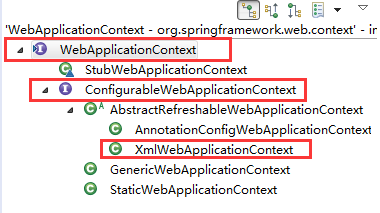
让我们回到ContextLoaderListener的initWebApplicationContext方法中,看看这个方法接下来会做什么
 //org.springframework.web.context.ContextLoaderListener
 1 /**
 2      * Initialize Spring's web application context for the given servlet context,
 3      * using the application context provided at construction time, or creating a new one
 4      * according to the "{@link #CONTEXT_CLASS_PARAM contextClass}" and
 5      * "{@link #CONFIG_LOCATION_PARAM contextConfigLocation}" context-params.
 6      * @param servletContext current servlet context
 7      * @return the new WebApplicationContext
 8      * @see #ContextLoader(WebApplicationContext)
 9      * @see #CONTEXT_CLASS_PARAM
10      * @see #CONFIG_LOCATION_PARAM
11      */
12     public WebApplicationContext initWebApplicationContext(ServletContext servletContext) {
13         if (servletContext.getAttribute(WebApplicationContext.ROOT_WEB_APPLICATION_CONTEXT_ATTRIBUTE) != null) {
14             throw new IllegalStateException(
15                     "Cannot initialize context because there is already a root application context present - " +
16                     "check whether you have multiple ContextLoader* definitions in your web.xml!");
17         }
18  19      Log logger = LogFactory.getLog(ContextLoader.class); 20      servletContext.log("Initializing Spring root WebApplicationContext"); 21      if (logger.isInfoEnabled()) { 22        logger.info("Root WebApplicationContext: initialization started"); 23      } 24      long startTime = System.currentTimeMillis(); 25
26         try {
27             // Store context in local instance variable, to guarantee that
28             // it is available on ServletContext shutdown.
29             if (this.context == null) {
30                 this.context = createWebApplicationContext(servletContext);
31             }
32             if (this.context instanceof ConfigurableWebApplicationContext) {
33                 ConfigurableWebApplicationContext cwac = (ConfigurableWebApplicationContext) this.context;
34                 if (!cwac.isActive()) {
35                     // The context has not yet been refreshed -> provide services such as
36                     // setting the parent context, setting the application context id, etc
37                     if (cwac.getParent() == null) {
38                         // The context instance was injected without an explicit parent ->
39                         // determine parent for root web application context, if any.
40                         ApplicationContext parent = loadParentContext(servletContext);
41                         cwac.setParent(parent);
42                     }
43                   configureAndRefreshWebApplicationContext(cwac, servletContext);
44   }
45             }
46             servletContext.setAttribute(WebApplicationContext.ROOT_WEB_APPLICATION_CONTEXT_ATTRIBUTE, this.context);
47
48             ClassLoader ccl = Thread.currentThread().getContextClassLoader();
49             if (ccl == ContextLoader.class.getClassLoader()) {
50                 currentContext = this.context;
51             }
77     }
通过上面的分析得知会执行43行代码,也就是configureAndRefreshWebApplicationContext方法(核心方法,完成了配置文件解析、bean加载等很多工作,下章讨论),之后执行46行(将webapplicationcontext设置到servletContext中)。
总结:ContextLoaderListener的initWebApplicationContext方法主要干了三件事情
1:30行,生成XmlWebApplicationContext实例,并赋给this.context
2:43行,初始化this.context(暂且用初始化,其实做了大量的工作,如配置文件解析、bean加载等)
3:46行,将this.context设置到servleContext中

 浙公网安备 33010602011771号