
GMP,GC
GMP 以及简单GC
后续会补上GC的实现原理 2022.12.16 23点12分
gc查看
func test() {
	//slice 会动态扩容,用slice来做堆内存申请
	container := make([]int, 8)

	log.Println(" ===> loop begin.")
	for i := 0; i < 32*1000*1000; i++ {
		container = append(container, i)
	}
	log.Println(" ===> loop end.")
}

func main() {
	log.Println("Start.")

	test()

	log.Println("force gc.")
	runtime.GC() //强制调用gc回收

	log.Println("Done.")

	time.Sleep(3600 * time.Second) //睡眠,保持程序不退出
}
go build -o main.go main.go && GODEBUG='gotrace 1' ./main
gc   1 				@0.001s     		 0%: 			0.003+0.30+0.004 ms clock,			0.024+0/0.044/0.086+0.034 ms cpu, 			4->5->2 MB, 					5 MB goal,					 8 P
   编号		   		运行时长				gc模块占了		 垃圾回收时长							垃圾回收占用cpu时间										 堆大小								本次GC使用了2个P(调度器中的Processer)
会依次增加								运行时长的多少				STW 清除 + 并发扫描标记 + STW标记									gc开始前->gc接收后->当前活跃的推内存	 全局堆大小
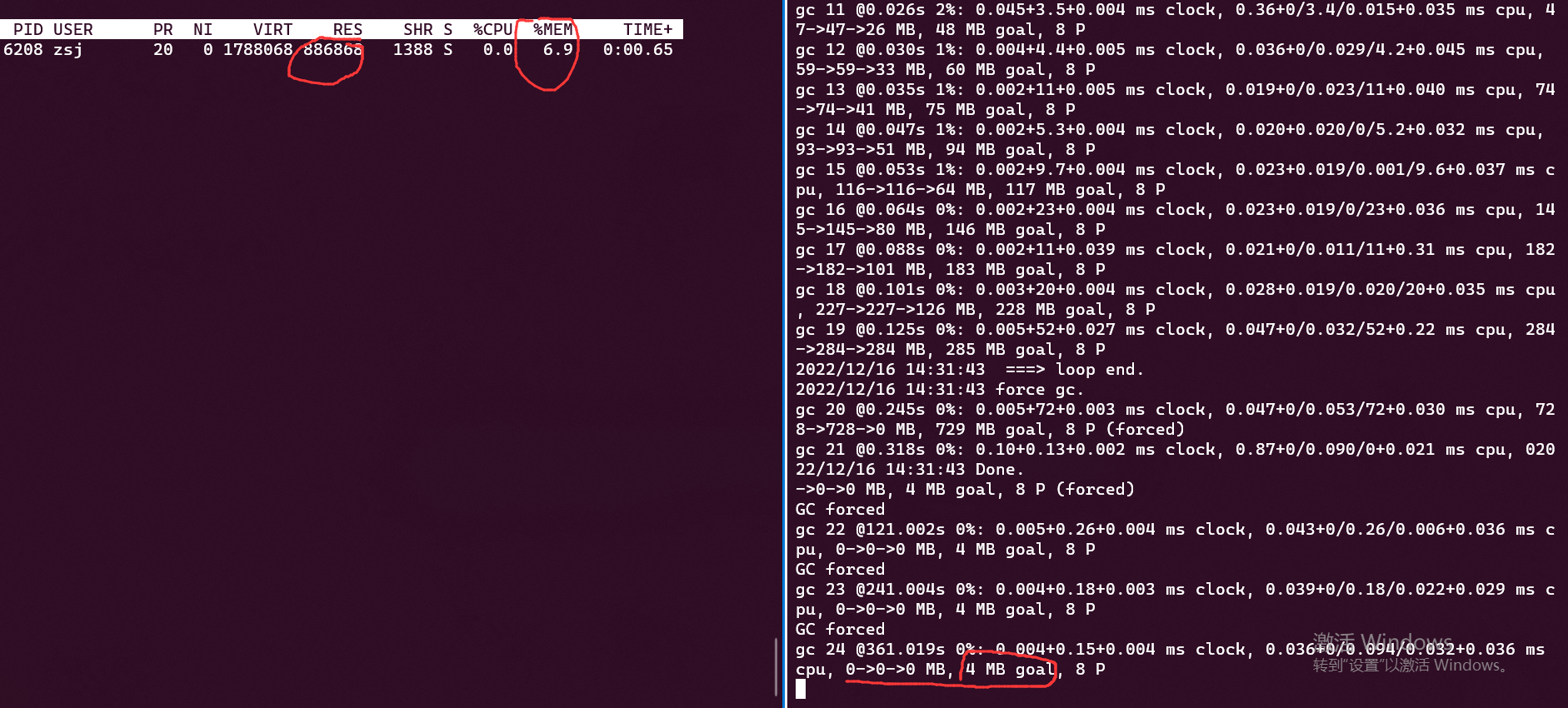
- 在test函数执行完后,demo程序中的切片容器所申请的堆空间都被垃圾回收器回收了。
- 如果此时在
top指令查询内存的时候,如果依然是800+MB,说明垃圾回收器回收了应用层的内存后,(可能)并不会立即将内存归还给系统。
gmp
相关概念:
- runtime ,包含了 调度,内存管理,垃圾回收等内部数据结构的实现。
- scheduler,
The scheduler's job is to distribute ready-to-run goroutines over worker threads. - TLS 线程内部数据(其他线程不可见),go的 协程实现十分依赖于TLS,会用于获取系统线程中当前的G和G所属的M实例。
- spaining 自旋
- systemstack,mcall,asmcgocall 每个M启动都有一个叫 g0的系统堆栈。
调度的基本组件
G(goroutine)
就是 goroutine ,调度的基本单位,存储了 goroutine 的执行 stack 信息,goroutine 状态以及G的任务函数(也就是我们 go func() 的 func ),G 眼中只有P,P就是G的"CPU"
P(processor)
逻辑的处理器,代表线程M的执行上下文。
P 的最大作用时其拥有各种G对象的队列,链表,cache和状态。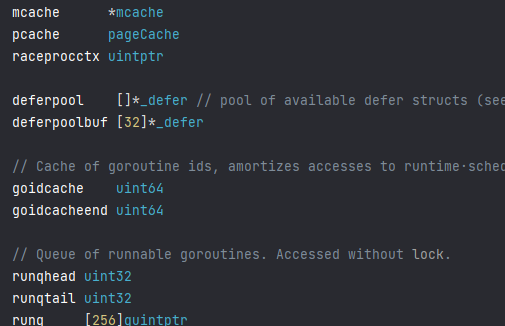
P的数量也代表了执行并发度,既有多少个goroutine可以同时运行(一般 MAXPROCS就是cpu 的核数)
P不执行任何代码,执行是由 M 来执行的,P提供环境如 缓存,defer pool(我们代码中使用到defer可能会条用defer more stack,可运行的G(从G队列队列拿或者偷)
M(mchine)
真正的执行计算资源,就是系统线程,
找P绑定然后找可运行的G,M可以是多个,与P的数量不一定时1:1,因为可能执行某个G的M因为某种原因阻塞,M再绑定P后,进入循环调度,并且M不保留G的状态,这是G可以跨M调度的基础。
GPM的关系示意图
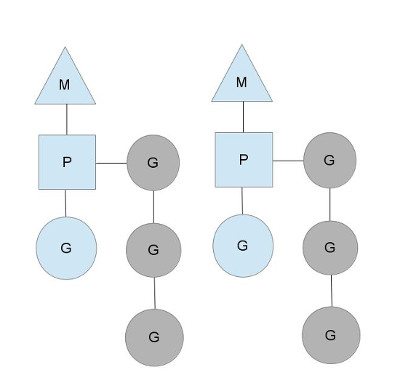
大致的流程(这些图都是转载的)
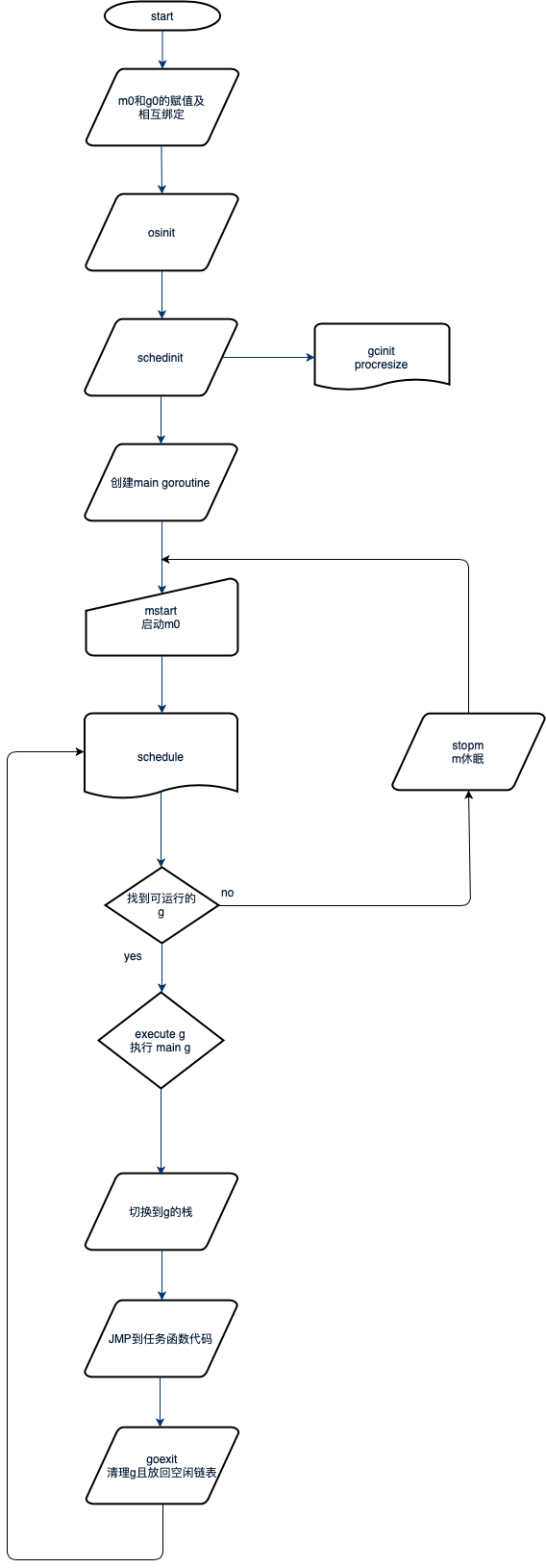
1. golang 进程的启动
判断一个数是不是
2的幂次 x & (x - 1)
我们知道,运行一个程序最开始必定创建一个进程,这个进程有一个线程,我们称他为m0,然后一个m或绑定一个g,成为g0
这边贴下 schedinit 的注释
// The bootstrap sequence is: 启动的大致流程
//
// call osinit
// call schedinit
// make & queue new G 创建队列并新建 runtime.main 的 G
// call runtime·mstart
//
// The new G calls runtime·main.
大致流程
// set the per-goroutine and per-mach "registers"
	get_tls(BX)
	LEAQ	runtime·g0(SB), CX
	MOVQ	CX, g(BX)
	LEAQ	runtime·m0(SB), AX

// 我们开始时,会将 m0->g0 = g0, g0->m = m0也就是将 g0 和 m0相互绑定,那么这个g0是干什么的呢?
	// save m->g0 = g0
	MOVQ	CX, m_g0(AX)
	// save m0 to g0->m
	MOVQ	AX, g_m(CX)

	CLD				// convention is D is always left cleared
	CALL	runtime·check(SB)

// main(argc,argv) 也就是传递的参数
	MOVL	16(SP), AX		// copy argc
	MOVL	AX, 0(SP)
	MOVQ	24(SP), AX		// copy argv
	MOVQ	AX, 8(SP)
	CALL	runtime·args(SB)
	CALL	runtime·osinit(SB) // CPU数量,页大小和 操作系统初始化工作。
	CALL	runtime·schedinit(SB) // 调度系统初始化, proc.go

	// create a new goroutine to start program
	MOVQ	$runtime·mainPC(SB), AX		// entry
	PUSHQ	AX
	PUSHQ	$0			// arg size
	CALL	runtime·newproc(SB) // 这就是 runtime.main
	POPQ	AX
	POPQ	AX

	// start this M
	CALL	runtime·mstart(SB) // 开始执行程序

	CALL	runtime·abort(SB)	// mstart should never return
	RET

	// Prevent dead-code elimination of debugCallV1, which is
	// intended to be called by debuggers.
	MOVQ	$runtime·debugCallV1(SB), AX
	RET
细看
**func osinit()**
func osinit() {
    // 获得 cpu个数,最大页的大小
	ncpu = getproccount()
	physHugePageSize = getHugePageSize()
	osArchInit()
}
func schedinit()
func schedinit() {
    // 初始化调度相关的锁
    lockInit(&sched.lock, lockRankSched)
    lockInit(&sched.sysmonlock, lockRankSysmon)
    lockInit(&sched.deferlock, lockRankDefer) // 保护 defer 池
	 ...
    // Enforce that this lock is always a leaf lock.
    // All of this lock's critical sections should be
    // extremely short.
    lockInit(&memstats.heapStats.noPLock, lockRankLeafRank)  // 内存状态

    // raceinit must be the first call to race detector.
    // In particular, it must be done before mallocinit below calls racemapshadow.
    _g_ := getg()
    if raceenabled {
        _g_.racectx, raceprocctx0 = raceinit() // 轨迹?
    }

    sched.maxmcount = 10000 // maximum number of m's allowed (or die) 最大的M个数

    // The world starts stopped.
    worldStopped()

    ... 初始化工作

    lock(&sched.lock)
    sched.lastpoll = uint64(nanotime())
    procs := ncpu // 确认cpu的数量有 osinit得到的
    // 如果没有设置GOMAXPROCS 就按照cpu有几个核来。


    if n, ok := atoi32(gogetenv("GOMAXPROCS")); ok && n > 0 {
        procs = n
    }
    // 根据给定的数量,少造,多截断并释放。
        /*
		_g_ := getg()
	if _g_.m.p != 0 && _g_.m.p.ptr().id < nprocs {
		// continue to use the current P
		_g_.m.p.ptr().status = _Prunning // 如果当期的 P id<nprocs 继续用,
	}else{
    	//release the current P and acquire allp[0].
    	释放 当前的P 并绑定 P[0] -> m
    	1.如果当前m绑定p了,取消p绑定m
    	2.取消m绑定p
        3.去除 allp[0] 更改状态
	// Associate p and the current m.
    	4. acquirep(allp[0])

*/
    if procresize(procs) != nil {
        throw("unknown runnable goroutine during bootstrap")
    }
    unlock(&sched.lock)

    // World is effectively started now, as P's can run.
    worldStarted()
	...
}
func mstart()
// mstart is the entry-point for new Ms.
// It is written in assembly, uses ABI0, is marked TOPFRAME, and calls mstart0.
// 调用 mstart0
func mstart0() {
	_g_ := getg()

	osStack := _g_.stack.lo == 0 // 看是否初始化系统栈
	if osStack {
		// Initialize stack bounds from system stack.
		// Cgo may have left stack size in stack.hi.
		// minit may update the stack bounds.
		//
		// Note: these bounds may not be very accurate.
		// We set hi to &size, but there are things above
		// it. The 1024 is supposed to compensate this,
		// but is somewhat arbitrary.
		size := _g_.stack.hi
		if size == 0 {
			size = 8192 * sys.StackGuardMultiplier
		}
		_g_.stack.hi = uintptr(noescape(unsafe.Pointer(&size)))
		_g_.stack.lo = _g_.stack.hi - size + 1024
	}
	// Initialize stack guard so that we can start calling regular
	// Go code.
	_g_.stackguard0 = _g_.stack.lo + _StackGuard // 保护页
	// This is the g0, so we can also call go:systemstack
	// functions, which check stackguard1.
	_g_.stackguard1 = _g_.stackguard0
	mstart1() // 看下面

	// Exit this thread.
	if mStackIsSystemAllocated() {
		// Windows, Solaris, illumos, Darwin, AIX and Plan 9 always system-allocate
		// the stack, but put it in _g_.stack before mstart,
		// so the logic above hasn't set osStack yet.
		osStack = true
	}
	mexit(osStack)
}
// The go:noinline is to guarantee the getcallerpc/getcallersp below are safe,
// so that we can set up g0.sched to return to the call of mstart1 above.
//go:noinline
func mstart1() {
	_g_ := getg()

	if _g_ != _g_.m.g0 { // 新开的m运行的g 一定是 g0
		throw("bad runtime·mstart")
	}

	// Set up m.g0.sched as a label returning to just
	// after the mstart1 call in mstart0 above, for use by goexit0 and mcall.
	// We're never coming back to mstart1 after we call schedule,
	// so other calls can reuse the current frame.
	// And goexit0 does a gogo that needs to return from mstart1
	// and let mstart0 exit the thread.
	_g_.sched.g = guintptr(unsafe.Pointer(_g_))
	_g_.sched.pc = getcallerpc()
	_g_.sched.sp = getcallersp()

	asminit()
	minit()

	// Install signal handlers; after minit so that minit can
	// prepare the thread to be able to handle the signals.
	if _g_.m == &m0 { // 如果是 初始的线程 m0 的
		mstartm0() // 初始化信号栈
        /*
		辅M线程 服务非Go线程(cgo产生)的回调的M。
			func mstartm0()
		// 创建一个额外的 M 服务 non-Go 线程(cgo 调用中产生的线程)的回调,并且只创建一个
		// windows 上也需要额外 M 来服务 syscall.NewCallback 产生的回调
		*/
	if fn := _g_.m.mstartfn; fn != nil {
		fn()
	}

	if _g_.m != &m0 {
		acquirep(_g_.m.nextp.ptr())
		_g_.m.nextp = 0
	}
	schedule() // 最重要的,启动调度系统从不返回
}
func schedule()
可以看到调度程序本质就是尽力找到可运行的g,然后去运行g上面的任务函数。查找g的流程如下,
- 如果当前GC需要停止整个世界(STW), 则调用gcstopm休眠当前的M。
- 每隔61次调度轮回从全局队列找,避免全局队列中的g被饿死。
- 从p.runnext获取g,从p的本地队列中获取。
- 调用 findrunnable (
local global netpoll steal)找g,找不到的话就将m休眠,等待唤醒。
// One round of scheduler: find a runnable goroutine and execute it.
// Never returns.
func schedule() {

	_g_ := getg()

top:
	// 如果当前GC需要停止整个世界(STW), 则调用gcstopm休眠当前的M
	if sched.gcwaiting != 0 {
		gcstopm() // 为了STW,停止当前的M
		goto top
	}
	if pp.runSafePointFn != 0 {
		runSafePointFn()
	}


	var gp *g
	var inheritTime bool

	if gp == nil {
		// Check the global runnable queue once in a while to ensure fairness.
		// Otherwise two goroutines can completely occupy the local runqueue
		// by constantly respawning each other.
        // 每隔61次调度,尝试从全局队列种获取G
		if _g_.m.p.ptr().schedtick%61 == 0 && sched.runqsize > 0 {
			lock(&sched.lock)
			gp = globrunqget(_g_.m.p.ptr(), 1)
			unlock(&sched.lock)
		}
	}
	if gp == nil {
        // 从p的本地队列中获取
		gp, inheritTime = runqget(_g_.m.p.ptr())
		// We can see gp != nil here even if the M is spinning,
		// if checkTimers added a local goroutine via goready.
	}
	if gp == nil {
// 想尽办法找到可运行的G,找不到就不用返回了
// runqget gp := globrunqget(_p_, 0) 取 globalsize / maxprocs + 1 netpoll 这是个优化
// 然后随机从allp选择一个p然后从里面偷取
		gp, inheritTime = findrunnable() // blocks until work is available
	}

// 找到了g,那就执行g上的任务函数
	execute(gp, inheritTime)
}
func main()
// The main goroutine.
func main() {
    g := getg()

    // Racectx of m0->g0 is used only as the parent of the main goroutine.
    // It must not be used for anything else.
    g.m.g0.racectx = 0

	// 在系统栈上运行 sysmon
    if GOARCH != "wasm" { // no threads on wasm yet, so no sysmon
       systemstack(func() {
           // 分配一个新的m,运行sysmon系统后台监控
		// (定期垃圾回收和调度抢占)
          newm(sysmon, nil, -1)
      })
   }

    // Lock the main goroutine onto this, the main OS thread,
    // during initialization. Most programs won't care, but a few
    // do require certain calls to be made by the main thread.
    // Those can arrange for main.main to run in the main thread
    // by calling runtime.LockOSThread during initialization
    // to preserve the lock.
    lockOSThread()
// 确保是主线程
    if g.m != &m0 {
       throw("runtime.main not on m0")
   }
	main_init_done = make(chan bool) // init 函数
	doInit(&main_inittask)
  ...
// 后台清理程序goroutine,并启用GC。
    gcenable()
    // 调用 main.main 也就是我们的主函数 ok结束!!!!!
    fn := main_main // make an indirect call, as the linker doesn't know the address of the main package when laying down the runtime
    fn()
    exit(0)
    for {
       var x *int32
       *x = 0 // x 是 nil 空指针异常 保证 真正退出
   }
}
调度机制
main 函数的启动过程正如上面一样,如果用户再代码中新建 goroutine ,runtime 该怎么管理呢?
TODO:
面试题一道
package main
import "fmt"
import "runtime"
func main() {
	runtime.GOMAXPROCS(1)
	for i :=0; i<10; i++ {
		i := i
		go func() {
			fmt.Println("A:",i)
		}()
	}
	var ch = make(chan int)
	<- ch
}
============
A: 9
A: 0
A: 1
A: 2
A: 3
A: 4
A: 5
A: 6
A: 7
A: 8
解析,首先 i := i ,发生拷贝,避免 引用同一个i
然后设置一个 P ,那么我们就只有一个 local queue,
加上全局的queue,一共两个,按理说应该是顺序打印,为什么先打印 9 呢?
G的初始化
newproc(fn) -> runqput(_p_, newg, true)
// runqput tries to put g on the local runnable queue.
// If next is false, runqput adds g to the tail of the runnable queue.
// If next is true, runqput puts g in the _p_.runnext slot.
// If the run queue is full, runnext puts g on the global queue.
// Executed only by the owner P.
// 尝试将 g 放在local 可运行队列里面,如果next是false的话,那么加入可执行队列的尾部,如果next
//  是true的话,设置当前 p.runnext,如果当前队列满了的话,加入全局队列
func runqput(_p_ *p, gp *g, next bool) {
    //这个是调度的随进行
	if randomizeScheduler && next && fastrandn(2) == 0 {
		next = false
	}

	if next {
	retryNext:
		oldnext := _p_.runnext
		if !_p_.runnext.cas(oldnext, guintptr(unsafe.Pointer(gp))) {
			goto retryNext
		}
		if oldnext == 0 {
			return
		}
		// 将旧的runext踢出常规运行队列。
		gp = oldnext.ptr()
	}

retry:
	h := atomic.LoadAcq(&_p_.runqhead) // load-acquire, synchronize with consumers
	t := _p_.runqtail
	if t-h < uint32(len(_p_.runq)) {
		_p_.runq[t%uint32(len(_p_.runq))].set(gp)
		atomic.StoreRel(&_p_.runqtail, t+1) // store-release, makes the item available for consumption
		return
	}
    // 将本地可运行队列中的g和一批工作放到全局队列中。
	if runqputslow(_p_, gp, h, t) {
		return
	}
	// 本地队列没满,那么一定能加入成功,重试。
	goto retry
}

 浙公网安备 33010602011771号