
dubbo-spi
ExtensionLoader 获取扩展点原理
ExtensionLoader 容器作为 Dubbo 内部扩展点、成员变量等元素的加载容器。内部含有以下成员变量及其用途:
// dubbo-spi 扫描的文件目录
    private static final String SERVICES_DIRECTORY = "META-INF/services/";
    private static final String DUBBO_DIRECTORY = "META-INF/dubbo/";
    private static final String DUBBO_INTERNAL_DIRECTORY = DUBBO_DIRECTORY + "internal/";

// class 对象到 ExtensionLoader 的映射
    private static final ConcurrentMap<Class<?>, ExtensionLoader<?>> EXTENSION_LOADERS = new ConcurrentHashMap<>();
// class 对象到扩展点对象实例的映射
    private static final ConcurrentMap<Class<?>, Object> EXTENSION_INSTANCES = new ConcurrentHashMap<>();

// class 对象到扩展点名称的映射
    private final ConcurrentMap<Class<?>, String> cachedNames = new ConcurrentHashMap<>();
// 扩展点名称到 class 对象的映射
    private final Holder<Map<String, Class<?>>> cachedClasses = new Holder<>();

// Holder 用于保存已经实例化的扩展点对象
    private final ConcurrentMap<String, Holder<Object>> cachedInstances = new ConcurrentHashMap<>();
// 自适应扩展点对象
    private final Holder<Object> cachedAdaptiveInstance = new Holder<>();
// 自适应扩展点 class
    private volatile Class<?> cachedAdaptiveClass = null;
核心方法
getExtensionLoader:根据扩展点原始类型初始化ExtensionLoader加载器。
public static <T> ExtensionLoader<T> getExtensionLoader(Class<T> type) {
    // 校验扩展点类型,检查过滤
    if (type == null) {
        throw new IllegalArgumentException("Extension type == null");
    }
    if (!type.isInterface()) {
        throw new IllegalArgumentException("Extension type (" + type + ") is not an interface!");
    }
    if (!withExtensionAnnotation(type)) {
        throw new IllegalArgumentException("Extension type (" + type +
                ") is not an extension, because it is NOT annotated with @" + SPI.class.getSimpleName() + "!");
    }
    // 实例化 ExtensionLoader 并保存到全局容器中
    ExtensionLoader<T> loader = (ExtensionLoader<T>) EXTENSION_LOADERS.get(type);
    if (loader == null) {
        EXTENSION_LOADERS.putIfAbsent(type, new ExtensionLoader<T>(type));
        loader = (ExtensionLoader<T>) EXTENSION_LOADERS.get(type);
    }
    return loader;
}
getExtension(String name):根据对象名称获取扩展点的入口方法,首先从cachedInstances集合中根据 Name 获取扩展点实现对象;如果为空,通过createExtension(String name)方法创建扩展点对象,方法内会依次调用getExtensionClasses()、loadExtensionClasses()方法来加载扩展点 Class 对象。
public T getExtension(String name) {
    if (StringUtils.isEmpty(name)) {
        throw new IllegalArgumentException("Extension name == null");
    }
    // 获取默认扩展点
    if ("true".equals(name)) {
        return getDefaultExtension();
    }
    // 从本地缓存 cachedInstances 中获取扩展点 Holder 对象
    final Holder<Object> holder = getOrCreateHolder(name);
    Object instance = holder.get();
    if (instance == null) {
        synchronized (holder) {
            instance = holder.get();
            if (instance == null) {
                // 缓存扩展点为空,单例模式创建扩展点对象
                instance = createExtension(name);
                holder.set(instance);
            }
        }
    }
    return (T) instance;
}
// 根据名称创建扩展点实例
private T createExtension(String name) {
    // 获取扩展点 Class 对象
    Class<?> clazz = getExtensionClasses().get(name);
    if (clazz == null) {
        throw findException(name);
    }
    try {
        // 从全局容器中获取扩展点对象
        T instance = (T) EXTENSION_INSTANCES.get(clazz);
        // 反射创建扩展点对象
        if (instance == null) {
            EXTENSION_INSTANCES.putIfAbsent(clazz, clazz.newInstance());
            instance = (T) EXTENSION_INSTANCES.get(clazz);
        }
        // 依赖注入
        injectExtension(instance);
        // 如果对象含有包装类,进一步增强
        Set<Class<?>> wrapperClasses = cachedWrapperClasses;
        if (CollectionUtils.isNotEmpty(wrapperClasses)) {
            for (Class<?> wrapperClass : wrapperClasses) {
                instance = injectExtension((T) wrapperClass.getConstructor(type).newInstance(instance));
            }
        }
        return instance;
    } catch (Throwable t) {
        throw new IllegalStateException("Extension instance (name: " + name + ", class: " +
                type + ") couldn't be instantiated: " + t.getMessage(), t);
    }
}
// 加载扩展点 Class 对象
private Map<String, Class<?>> getExtensionClasses() {
    Map<String, Class<?>> classes = cachedClasses.get();
    if (classes == null) {
        synchronized (cachedClasses) {
            classes = cachedClasses.get();
            if (classes == null) {
                classes = loadExtensionClasses();
                cachedClasses.set(classes);
            }
        }
    }
    return classes;
}
private Map<String, Class<?>> loadExtensionClasses() {
    // 根据 @SPI 注解加载默认扩展点名
    cacheDefaultExtensionName();

    // 加载 META-INF/services/、META-INF/dubbo/、META-INF/dubbo/internal 目录下扩展点的 Class 对象
    Map<String, Class<?>> extensionClasses = new HashMap<>();
    loadDirectory(extensionClasses, DUBBO_INTERNAL_DIRECTORY, type.getName());
    loadDirectory(extensionClasses, DUBBO_INTERNAL_DIRECTORY, type.getName().replace("org.apache", "com.alibaba"));
    loadDirectory(extensionClasses, DUBBO_DIRECTORY, type.getName());
    loadDirectory(extensionClasses, DUBBO_DIRECTORY, type.getName().replace("org.apache", "com.alibaba"));
    loadDirectory(extensionClasses, SERVICES_DIRECTORY, type.getName());
    loadDirectory(extensionClasses, SERVICES_DIRECTORY, type.getName().replace("org.apache", "com.alibaba"));
    return extensionClasses;
}
// 加载指定配置文件,根据实例名解析 Class 对象并存储到 extensionClasses 集合中
private void loadDirectory(Map<String, Class<?>> extensionClasses, String dir, String type) {
    String fileName = dir + type;
    try {
        Enumeration<java.net.URL> urls;
        ClassLoader classLoader = findClassLoader();
        if (classLoader != null) {
            urls = classLoader.getResources(fileName);
        } else {
            urls = ClassLoader.getSystemResources(fileName);
        }
        if (urls != null) {
            while (urls.hasMoreElements()) {
                java.net.URL resourceURL = urls.nextElement();
                loadResource(extensionClasses, classLoader, resourceURL);
            }
        }
    } catch (Throwable t) {
        logger.error("Exception occurred when loading extension class (interface: " +
                type + ", description file: " + fileName + ").", t);
    }
}
ExtensionLoader 依赖注入实现原理
private T injectExtension(T instance) {

    if (objectFactory == null) {
        return instance;
    }

    try {
        for (Method method : instance.getClass().getMethods()) {
            // 获取目标 setter 方法
            if (!isSetter(method)) {
                continue;
            }
            /**
             * Check {@link DisableInject} to see if we need auto injection for this property
             */
            if (method.getAnnotation(DisableInject.class) != null) {
                continue;
            }
            Class<?> pt = method.getParameterTypes()[0];
            if (ReflectUtils.isPrimitives(pt)) {
                continue;
            }

            // 获取方法对应属性(首字母小写然后拼接)
            try {
                String property = getSetterProperty(method);
                // 反射调用属性 set 方法
                Object object = objectFactory.getExtension(pt, property);
                if (object != null) {
                    method.invoke(instance, object);
                }
            } catch (Exception e) {
                logger.error("Failed to inject via method " + method.getName()
                        + " of interface " + type.getName() + ": " + e.getMessage(), e);
            }

        }
    } catch (Exception e) {
        logger.error(e.getMessage(), e);
    }
    return instance;
}
自适应扩展点原理
自适应扩展点在框架方法运行时才决定应该调用哪一个扩展点实现,因此不能指定某个扩展点而是依赖一个代理,这个代理就是自适应扩展点。
Dubbo 自适应扩展点的原理如下:
- 定义
@Adaptive注解,标记在类或者方法上,有此标记都支持自适应扩展点; - 通过
ExtensionLoader.getAdaptiveExtension()获取自适应扩展点,获取过程中拼接自适应扩展点 Class 文件,编译为 Class 并实例化。
public T getAdaptiveExtension() {
    Object instance = cachedAdaptiveInstance.get();
    if (instance == null) {
        if (createAdaptiveInstanceError != null) {
            throw new IllegalStateException("Failed to create adaptive instance: " +
                    createAdaptiveInstanceError.toString(),
                    createAdaptiveInstanceError);
        }

        synchronized (cachedAdaptiveInstance) {
            instance = cachedAdaptiveInstance.get();
            if (instance == null) {
                try {
                    instance = createAdaptiveExtension();
                    cachedAdaptiveInstance.set(instance);
                } catch (Throwable t) {
                    createAdaptiveInstanceError = t;
                    throw new IllegalStateException("Failed to create adaptive instance: " + t.toString(), t);
                }
            }
        }
    }

    return (T) instance;
}

// 加载自适应扩展点对象
private T createAdaptiveExtension() {
    try {
        return injectExtension((T) getAdaptiveExtensionClass().newInstance());
    } catch (Exception e) {
        throw new IllegalStateException("Can't create adaptive extension " + type + ", cause: " + e.getMessage(), e);
    }
}

private Class<?> getAdaptiveExtensionClass() {
    // 读取配置文件,加载获取扩展点 Class 对象实例
    getExtensionClasses();
    if (cachedAdaptiveClass != null) {
        return cachedAdaptiveClass;
    }
    return cachedAdaptiveClass = createAdaptiveExtensionClass();
}

// 创建自适应扩展点对象
private Class<?> createAdaptiveExtensionClass() {
    // 生成 Class 字符串
    String code = new AdaptiveClassCodeGenerator(type, cachedDefaultName).generate();
    ClassLoader classLoader = findClassLoader();
    // 编译 Class 字符串并返回 Class 对象
    org.apache.dubbo.common.compiler.Compiler compiler = ExtensionLoader.getExtensionLoader(org.apache.dubbo.common.compiler.Compiler.class).getAdaptiveExtension();
    return compiler.compile(code, classLoader);
}
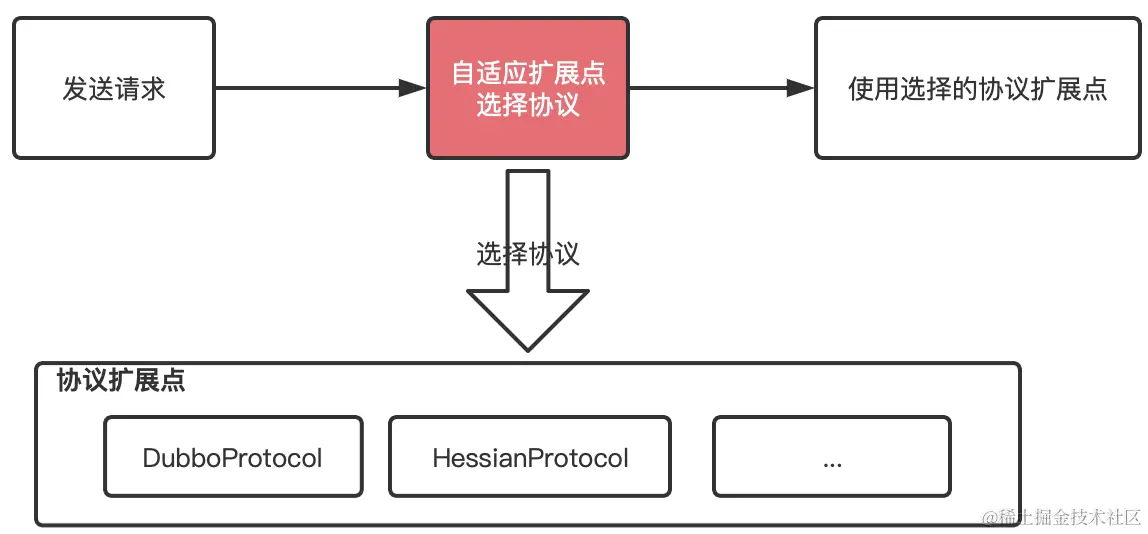
比如 Protocol 这个接口:
@SPI("protocol")
public interface Protocol {
    @Adaptive({"protocol"})
    <T> Exporter<T> export(Invoker<T> invoker) thorws RpcException;
}
使用时如果想要暂时获取自适应扩展点:
Protocol protocol = ExtensionLoader.getExtensionLoader(Protocol.class).getAdaptiveExtension();
我们跟进 getAdaptiveExtension():
//ExtensionLoader.getAdaptiveExtension()
private Class<?> getAdaptiveExtensionClass() {
    //加载扩展点Class
    //此处的getExtensionClasses(),包含了解析配置文件、加载类等逻辑。
    getExtensionClasses();
    if (cachedAdaptiveClass != null) {
        return cachedAdaptiveClass;
    }
    // 创建自适应扩展点Class,这里有点动态代理的意思了
    return cachedAdaptiveClass = createAdaptiveExtensionClass();
}

//ExtensionLoader.createAdaptiveExtensionClass()
private Class<?> createAdaptiveExtensionClass() {
    //生成Class字符串,里面通过拼接字符串实现。可以跟进去generate()看一看。
    String code = new AdaptiveClassCodeGenerator(type, cachedDefaultName).generate();
    //将Class字符串编译为Class,并返回
    ClassLoader classLoader = findClassLoader();
    org.apache.dubbo.common.compiler.Compiler compiler = ExtensionLoader.getExtensionLoader(org.apache.dubbo.common.compiler.Compiler.class).getAdaptiveExtension();
    return compiler.compile(code, classLoader);
}
接下来就是拼接 Class 字符串,生成后的 Protocol 自适应扩展点 Class 内容为:
package org.apache.dubbo.rpc;
import org.apache.dubbo.common.extension.ExtensionLoader;
//类名=扩展点接口名$Adaptive
public class Protocol$Adaptive implements org.apache.dubbo.rpc.Protocol {
        //生成标记有@Adaptive的方法
	public org.apache.dubbo.rpc.Exporter export(org.apache.dubbo.rpc.Invoker arg0) throws org.apache.dubbo.rpc.RpcException {
		if (arg0 == null) throw new IllegalArgumentException("org.apache.dubbo.rpc.Invoker argument == null");
		if (arg0.getUrl() == null) throw new IllegalArgumentException("org.apache.dubbo.rpc.Invoker argument getUrl() == null");
		org.apache.dubbo.common.URL url = arg0.getUrl();
                //核心代码在这里,运行时解析url里的protocol参数
                //这里还有个默认值的处理,取的是Protocol接口@SPI注解里的value
		String extName = ( url.getProtocol() == null ? "dubbo" : url.getProtocol() );
		if(extName == null) throw new IllegalStateException("Failed to get extension (org.apache.dubbo.rpc.Protocol) name from url (" + url.toString() + ") use keys([protocol])");
                //根据protocol参数,选择指定的protocol扩展点
		org.apache.dubbo.rpc.Protocol extension = (org.apache.dubbo.rpc.Protocol)ExtensionLoader.getExtensionLoader(org.apache.dubbo.rpc.Protocol.class).getExtension(extName);
		return extension.export(arg0);
	}
        //没标记@Adaptive的方法,调用时直接抛异常
	public void destroy()  {
		throw new UnsupportedOperationException("The method public abstract void org.apache.dubbo.rpc.Protocol.destroy() of interface org.apache.dubbo.rpc.Protocol is not adaptive method!");
	}
        //没标记@Adaptive的方法,调用时直接抛异常
	public int getDefaultPort()  {
		throw new UnsupportedOperationException("The method public abstract int org.apache.dubbo.rpc.Protocol.getDefaultPort() of interface org.apache.dubbo.rpc.Protocol is not adaptive method!");
	}
        //生成标记有@Adaptive的方法
	public org.apache.dubbo.rpc.Invoker refer(java.lang.Class arg0, org.apache.dubbo.common.URL arg1) throws org.apache.dubbo.rpc.RpcException {
		if (arg1 == null) throw new IllegalArgumentException("url == null");
		org.apache.dubbo.common.URL url = arg1;
		String extName = ( url.getProtocol() == null ? "dubbo" : url.getProtocol() );
		if(extName == null) throw new IllegalStateException("Failed to get extension (org.apache.dubbo.rpc.Protocol) name from url (" + url.toString() + ") use keys([protocol])");
		org.apache.dubbo.rpc.Protocol extension = (org.apache.dubbo.rpc.Protocol)ExtensionLoader.getExtensionLoader(org.apache.dubbo.rpc.Protocol.class).getExtension(extName);
		return extension.refer(arg0, arg1);
	}
}
- 自适应扩展点类名为
扩展点接口名 $Adaptive; - 带有
@Adaptive注解的方法会生成代理方法,比如上述例子,在调用export()方法时,实际调用的是Protocol$Adaptive.export(),然后就实现了运行时指定扩展点的目的。

 浙公网安备 33010602011771号