
内存管理-UnpooledByteBufAllocator
Netty 是基于 Java 实现的,从分配的内存的位置来看,Allocator 分为 Heap (JVM 堆)和 Direct (直接内存)两种;从内存管理方式上来看池化(PooledByteBufAllocator)和非池化(UnpooledByteBufAllocator)两大类。因为池化的比较复杂,所以先从简单的非池化入手去了解 Netty 的内存管理。
目标
- 了解 Netty UnpooledByteBufAllocator 非池化的 Allocator
- 了解 AtomicIntegerFieldUpdater 的用法
- 了解 Unsafe 类对数组以及内存的操作方法
- 学会 for + cas 的乐观锁用法
核心问题
UnpooledByteBufAllocator 顾名思义是不带池化的内存分配器,用于从堆上或直接内存上进行内存的分配和释放。那么带着以下问题去读代码:
- 堆上内存和直接内存怎样申请?
- 堆上内存和直接内存怎样释放?
示例代码:
public static void main(String[] args) {

        ByteBufAllocator allocator = UnpooledByteBufAllocator.DEFAULT;
        ByteBuf heapByteBuf = allocator.heapBuffer();
        heapByteBuf.release();
        ByteBuf directByteBuf = allocator.directBuffer();
        directByteBuf.release();
}
代码阅读
heapByteBuf
首先看一下 heapBuffer 的申请:
public ByteBuf heapBuffer(int initialCapacity, int maxCapacity) {
    if (initialCapacity == 0 && maxCapacity == 0) {
        return emptyBuf;
    }
    // check 空间是否够用
    validate(initialCapacity, maxCapacity);
    // newHeapBuffer 创建 ByteBuf
    return newHeapBuffer(initialCapacity, maxCapacity);
}


protected ByteBuf newHeapBuffer(int initialCapacity, int maxCapacity) {
    /**
     * 1. 支持 Unsafe 则使用 InstrumentedUnpooledUnsafeHeapByteBuf
     * 2. 不支持则使用 InstrumentedUnpooledHeapByteBuf
     */
    return PlatformDependent.hasUnsafe() ?
            new InstrumentedUnpooledUnsafeHeapByteBuf(this, initialCapacity, maxCapacity) :
            new InstrumentedUnpooledHeapByteBuf(this, initialCapacity, maxCapacity);
}
从上面两段代码,引出了两个新的类 InstrumentedUnpooledUnsafeHeapByteBuf 和 InstrumentedUnpooledHeapByteBuf,那么这两个类有什么区别呢,为什么在环境支持 Unsafe 的时候优先使用 InstrumentedUnpooledUnsafeHeapByteBuf 呢?
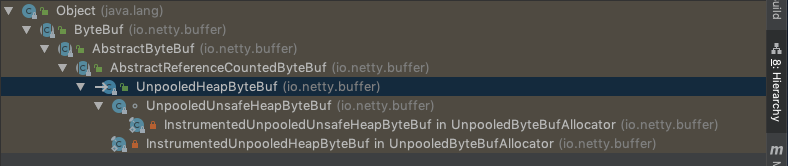
首先看下继承关系,非 Unsafe 的直接继承自 UnpooledHeapByteBuf,Unsafe 的继承自 UnpooledUnsafeHeapByteBuf, 但 UnpooledUnsafeHeapByteBuf 继承自 UnpooledHeapByteBuf。那么 UnpooledUnsafeHeapByteBuf Override 的内容就成了这两个类的重要区别所在了。重点分析两个方法:allocateArray 和 _getByte
UnpooledHeapByteBuf
public class UnpooledHeapByteBuf extends AbstractReferenceCountedByteBuf {
    ...
    byte[] allocateArray(int initialCapacity) {
        // 非常简单,直接在堆上搞了个 byte 数组
        return new byte[initialCapacity];
    }

    @Override
    protected byte _getByte(int index) {
        return HeapByteBufUtil.getByte(array, index);
    }
    ...
}

final class HeapByteBufUtil {
    // get 也非常简单,直接在 byte 数组里面通过下标索引
    static byte getByte(byte[] memory, int index) {
        return memory[index];
    }
    ...
}
从上面代码可以看出,UnpooledHeapByteBuf 其实就是在 JVM 堆上直接 new 了一个 byte 数组,获取 byte 的时候,也是直接通过数组下标的方式从数组中读了出来。这个符合我们对 Heap 的基本认识,那么 Unsafe 不是这样做的吗?且往下看。
UnpooledUnsafeHeapByteBuf
class UnpooledUnsafeHeapByteBuf extends UnpooledHeapByteBuf {
  ...
  @Override
  byte[] allocateArray(int initialCapacity) {
    // 这里使用了 PlatformDependent, 这个类里面用到了 Unsafe 的方法绕过 JVM 直接操作内存
    return PlatformDependent.allocateUninitializedArray(initialCapacity);
  }

  @Override
  public byte getByte(int index) {
    checkIndex(index);
    return _getByte(index);
  }

  @Override
  protected byte _getByte(int index) {
    return UnsafeByteBufUtil.getByte(array, index);
  }
  ...
}
从上面的代码片段可以看出, Unsafe 的 Override 了 allcateArray 以及 _getByte,均使用了 Unsafe 的方式,细节如下:
final class UnsafeByteBufUtil {

    ...
  static byte getByte(byte[] array, int index) {
      return PlatformDependent.getByte(array, index);
  }
    ...
}

public final class PlatformDependent {
    ...
    static byte getByte(byte[] data, int index) {
        // 这里直接使用内存地址访问数组,而不是数组下标的方式
        return UNSAFE.getByte(data, BYTE_ARRAY_BASE_OFFSET + index);
    }
    ...
}

final class PlatformDependent0 {
    ...
    // 这一步计算 byte[].class 数组类中0个元素的起始偏移量

    BYTE_ARRAY_BASE_OFFSET = arrayBaseOffset();

    static long arrayBaseOffset() {
        // 对象中成员变量的布局是由类确定的,因此通过类就可以获取偏移量
        return UNSAFE.arrayBaseOffset(byte[].class);
    }
    ...
}
由此可知,这里采用了 Unsafe 的方法直接操作 JVM 的内存地址的方式来获取数组中的元素,来进一步提高内存查询效率。
回到上面介绍的继承关系,我们可以知道不管是 Unsafe 的还是非 Unsafe 的都继承自 AbstractReferenceCountedByteBuf,因此这两种 ByteBuf 都会调用 AbstractReferenceCountedByteBuf 的初始化方法,而这个类是通过引用计数的方式来判断 ByteBuf 是否还在被引用的。下面介绍一下如何该类是如何实现引用计数的。
注:在 Netty 的编程中,引用计数是我们绕不过的话题,比如一个 ByteBuf 在线程1设置完成以后,线程 2 又要使用,那么就需要进行引用计数加 1,否则就会依赖线程 1 的释放时间来确保线程 2 使用该 ByteBuf 的时候,该 ByteBuf 还未释放
代码如下:
public abstract class AbstractReferenceCountedByteBuf extends AbstractByteBuf {

    private static final AtomicIntegerFieldUpdater<AbstractReferenceCountedByteBuf> refCntUpdater =
            AtomicIntegerFieldUpdater.newUpdater(AbstractReferenceCountedByteBuf.class, "refCnt");

    // 相比于 Atomic 类型的变量,int 只是一个基本数据类型,占据 4 个字节,即每个 ByteBuf 中有一个 4 字节的 refCnt
    // 如果使用 Atomic 类型的变化,每个 ByteBuf 中会有一个 Atomic 类型的引用 4 个字节 + 这个引用指向的 Atomic 类型对象占据的空间,会比 int 大很多

    private volatile int refCnt = 1;

    ...

    private ByteBuf retain0(int increment) {

        // 循环 + CAS 实现乐观锁,也可以叫做无锁
        for (;;) {
            int refCnt = this.refCnt;
            final int nextCnt = refCnt + increment;

            // Ensure we not resurrect (which means the refCnt was 0) and also that we encountered an overflow.
            if (nextCnt <= increment) {
                throw new IllegalReferenceCountException(refCnt, increment);
            }
            if (refCntUpdater.compareAndSet(this, refCnt, nextCnt)) {
                break;
            }
        }
        return this;
    }

    ...

    private boolean release0(int decrement) {
        for (;;) {

            // 减之前先赋值,因为 volatile 只有可见性,没有原子性,不赋值,可能会导致减多次
            int refCnt = this.refCnt;
            if (refCnt < decrement) {
                throw new IllegalReferenceCountException(refCnt, -decrement);
            }

            if (refCntUpdater.compareAndSet(this, refCnt, refCnt - decrement)) {

                // refCnt == decrement 并且 CAS 成功,说明减完了,释放内存
                if (refCnt == decrement) {
                    deallocate();
                    return true;
                }
                return false;
            }
        }
    }
    ...
}
Netty 的引用计数方案:使用 AtomicIntegerFieldUpdater refCntUpdater 和 volatile refCnt 来完成引用计数的功能。
- 为什么不使用 Atomic 原子变量呢?因为 refCnt 占用内存更小 4 个字节,而 Atomic 是一个对象,需要对象头 + 对象体,并且需要一个引用,占用字节数比较多。refCntUpdater 是类的公共变量,因此是属于类的,不是每个对象一个。
- retain0 和 release0 是典型的通过 cas 实现乐观锁的用法, 循环 + cas。
释放操作非常简单,直接 release 了,没有引用以后,会被 JVM 回收掉。
directByteBuf
有了 heapByteBuf 的基础,了解 directByteBuf 也就更加方便了。沿着代码读进来,会找到 InstrumentedUnpooledUnsafeNoCleanerDirectByteBuf:
private static final class InstrumentedUnpooledUnsafeNoCleanerDirectByteBuf {
        ...
        @Override
        protected ByteBuffer allocateDirect(int initialCapacity) {
       // 申请内存
            ByteBuffer buffer = super.allocateDirect(initialCapacity);
            ((UnpooledByteBufAllocator) alloc()).incrementDirect(buffer.capacity());
            return buffer;
        }
        ...

        @Override
        protected void freeDirect(ByteBuffer buffer) {
            int capacity = buffer.capacity();
       // 释放内存
            super.freeDirect(buffer);
            ((UnpooledByteBufAllocator) alloc()).decrementDirect(capacity);
        }
        ...
}
申请和释放内存
final class PlatformDependent0 {
    ...
    static ByteBuffer allocateDirectNoCleaner(int capacity) {
        // 申请 direct 的内存,并且构造成 DirectByteBuffer
        return newDirectBuffer(UNSAFE.allocateMemory(capacity), capacity);
    }

    ...
    static void freeMemory(long address) {
        // 归还到直接内存
        UNSAFE.freeMemory(address);
    }
    ...
}
和 heapByteBuf 本质的区别就是内存的来源不同,directByteBuf 内存来源为不受 JVM 管理的直接内存,因此并不受 gc 的控制,使用完以后必须通过 Unsafe 的 freeMemory 方法归还到进程的直接内存,否则会有内存泄漏。
其余部分基本是一致的。
小练习
下面的可以用于加断点,了解内部实现。
  public static void testUnpooled() {
        ByteBufAllocator allocator = UnpooledByteBufAllocator.DEFAULT;
        ByteBuf heapByteBuf = allocator.heapBuffer();
        heapByteBuf.release();
        ByteBuf directByteBuf = allocator.directBuffer();
        directByteBuf.release();
    }


    public static void testUnsafeArray() {
        byte[] bytes = PlatformDependent.allocateUninitializedArray(10);
        int index = 5;
        bytes[index] = 'c';
        int offset = UNSAFE.arrayBaseOffset(byte[].class);
        int offset2 = UNSAFE.arrayBaseOffset(int[].class);
        System.out.println(offset);
        System.out.println(offset2);
        int indexScale = UNSAFE.arrayIndexScale(byte[].class);
        byte c = UNSAFE.getByte(bytes, offset + indexScale * index);
        System.out.println(c);
    }
  public static void testUnsafeDirect() {
      long address = UNSAFE.allocateMemory(10);
      UNSAFE.putInt(address, 5);
      int value = UNSAFE.getInt(address);
      System.out.println(value);
  }
Ref
https://tech.meituan.com/2019/02/14/talk-about-java-magic-class-unsafe.html
//返回数组中第一个元素的偏移地址
public native int arrayBaseOffset(Class<?> arrayClass);
//返回数组中一个元素占用的大小
public native int arrayIndexScale(Class<?> arrayClass);

 浙公网安备 33010602011771号