
173. Binary Search Tree Iterator
173. Binary Search Tree Iterator
Implement an iterator over a binary search tree (BST). Your iterator will be initialized with the root node of a BST.
Calling next() will return the next smallest number in the BST.
Example
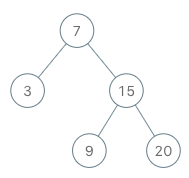
BSTIterator iterator = new BSTIterator(root);
iterator.next();    // return 3
iterator.next();    // return 7
iterator.hasNext(); // return true
iterator.next();    // return 9
iterator.hasNext(); // return true
iterator.next();    // return 15
iterator.hasNext(); // return true
iterator.next();    // return 20
iterator.hasNext(); // return false
Note
next()andhasNext()should run in average $O(1)$ time and uses $O(h)$ memory, where h is the height of the tree.- You may assume that next() call will always be valid, that is, there will be at least a next smallest number in the BST when
next()is called.
Solution
-
☝️
/**
 * Definition for a binary tree node.
 * public class TreeNode {
 *     int val;
 *     TreeNode left;
 *     TreeNode right;
 *     TreeNode(int x) { val = x; }
 * }
 */
class BSTIterator {

    private Queue<Integer> queue = new LinkedList<>();

    public BSTIterator(TreeNode root) {
        inOrder(root);
    }

    /** @return the next smallest number */
    public int next() {
        return this.queue.poll();
    }

    /** @return whether we have a next smallest number */
    public boolean hasNext() {
        return !this.queue.isEmpty();
    }
    public void inOrder(TreeNode root) {
        if (root != null) {
            inOrder(root.left);
            this.queue.offer(root.val);
            inOrder(root.right);
        }
    }
}

/**
 * Your BSTIterator object will be instantiated and called as such:
 * BSTIterator obj = new BSTIterator(root);
 * int param_1 = obj.next();
 * boolean param_2 = obj.hasNext();
 */
该方法使用队列和中序遍历把BST遍历一边,得到的队列就是从小到大排序好了的,接下来只要运用Java队列的offer、poll、isEmpty函数即可解决该问题。该方法的空间复杂度为$O(N)$,时间复杂度为$O(N)$,对于突发性的大量数据,会OOM,但对于该题,由于友好的测试样例,该方法才得意通过。
-
✌️
/**
 * Definition for a binary tree node.
 * public class TreeNode {
 *     int val;
 *     TreeNode left;
 *     TreeNode right;
 *     TreeNode() {}
 *     TreeNode(int val) { this.val = val; }
 *     TreeNode(int val, TreeNode left, TreeNode right) {
 *         this.val = val;
 *         this.left = left;
 *         this.right = right;
 *     }
 * }
 */
class BSTIterator {
    TreeNode node;
    Stack<TreeNode> stack;

    public BSTIterator(TreeNode root) {
        this.node = root;
        this.stack = new Stack<>();
    }

    /** @return the next smallest number */
    public int next() {
        while (node != null) {
            stack.push(node);
            node = node.left;
        }

        node = stack.pop();
        int retval = node.val;
        node = node.right;
        return retval;
    }

    /** @return whether we have a next smallest number */
    public boolean hasNext() {
        return node != null || !stack.isEmpty();
    }
}

/**
 * Your BSTIterator object will be instantiated and called as such:
 * BSTIterator obj = new BSTIterator(root);
 * int param_1 = obj.next();
 * boolean param_2 = obj.hasNext();
 */
该方法借助堆栈实现的中序遍历BST完美的解决了问题,且堆栈的数据大小一般不会是节点的大小(除非是左斜树),空间复杂度$O(N)$,时间复杂度$O(N)$。

 浙公网安备 33010602011771号