
实验一 现代C++编程初体验
task1:
源代码:
#include<iostream>
#include<string>
#include<vector>
#include<algorithm>
template<typename T>
void output(const T &c);

void test1();
void test2();
void test3();

int main(){
    std::cout<<"测试1: \n";
    test1();

    std::cout<<"\n测试2: \n";
    test2();

    std::cout<<"\n测试3: \n";
    test3();
}

template <typename T>
void output(const T &c){
    for(auto &i : c)
        std::cout<<i<<' ';
        std::cout<<'\n';

}

void test1(){
    using namespace std;

    string s0{"0123456789"};
    cout <<"s0= "<<s0<<endl;

    string s1(s0);
    reverse(s1.begin(),s1.end());
    cout <<"s1= "<<s1<<endl;

    string s2(s0.size(),' ');
    reverse_copy(s0.begin(),s0.end(),s2.begin());
    cout<<"s2= "<<s2<<endl;
}

void test2(){
    using namespace std;

    vector<int> v0{2,0,4,9};
    cout<<"v0: "; output(v0);
    vector<int> v1{v0};
    reverse(v1.begin(),v1.end());
    cout<<"v1: ";output(v1);

    vector<int> v2{v0};
    reverse_copy(v0.begin(),v0.end(),v2.begin());
    cout<<"v2: "; output(v2);
}

void test3(){
    using namespace std;

    vector<int> v0{0,1,2,3,4,5,6,7,8,9};
    cout<<"v0: ";output(v0);

    vector<int> v1{v0};
    rotate(v1.begin(),v1.begin()+1,v1.end());
    cout<<"v1: ";output(v1);

    vector<int> v2{v0};
    rotate(v2.begin(),v2.begin()+2,v2.end());
    cout<<"v2: ";output(v2);

    vector<int> v3{v0};
    rotate(v3.begin(),v3.end()-1,v3.end());
    cout<<"v3: "; output(v3);

    vector<int> v4{v0};
    rotate(v4.begin(),v4.end()-2,v4.end());
    cout<<"v4: ";output(v4)    ;

}
运行截图:
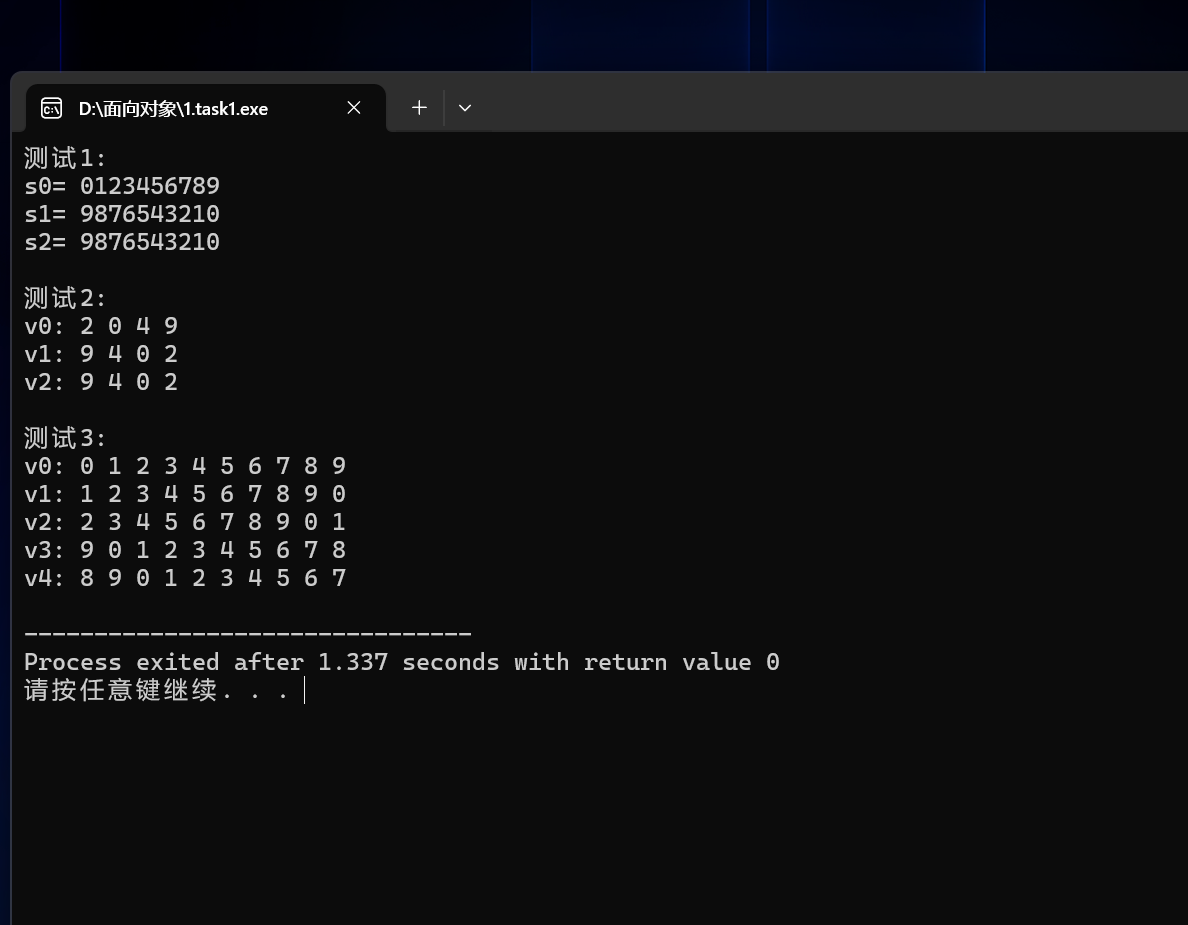
问题回答:
问题1:reverse是直接修改输入序列,将元素反转;reverse_copy是将输入序列反转后的结果复制到另一个序列中,不会改变原始序列。
问题2:rotate通过将序列中某个位置的元素一道开头,同时保持其他元素的相对位置来改变元素元素顺序。三个参数(first,middle,last),rotate会将middle至last位置的元素移动至起始位置,并将first至middle位置的元素整体移动至末尾。
task2:
源代码:
#include <iostream>
#include <vector>
#include <algorithm>
#include <numeric>
#include <iomanip>
#include <cstdlib>
#include <ctime>

template<typename T>
void output(const T &c);

int generate_random_number();
void test1();
void test2();

int main() {
    std::srand(std::time(0));
    std::cout << "测试1: \n";
    test1();

    std::cout << "\n测试2: \n";
    test2();
}

template <typename T>
void output(const T &c) {
    for(auto &i: c)
        std::cout << i << ' ';
    std::cout << '\n';
}

int generate_random_number() {
    return std::rand() % 101;
}

void test1() {
    using namespace std;

    vector<int> v0(10);
    generate(v0.begin(), v0.end(), generate_random_number);
    cout << "v0: "; output(v0);

    vector<int> v1{v0};
    sort(v1.begin(), v1.end());
    cout << "v1: "; output(v1);

    vector<int> v2{v0};
    sort(v2.begin()+1, v2.end()-1);
    cout << "v2: "; output(v2);
}

void test2() {
    using namespace std;

    vector<int> v0(10);
    generate(v0.begin(), v0.end(), generate_random_number);
    cout << "v0: "; output(v0);

    auto min_iter = min_element(v0.begin(), v0.end());
    auto max_iter = max_element(v0.begin(), v0.end());
    cout << "最小值: " << *min_iter << endl;
    cout << "最大值: " << *max_iter << endl;

    auto ans = minmax_element(v0.begin(), v0.end());
    cout << "最小值: " << *(ans.first) << endl;
    cout << "最大值: " << *(ans.second) << endl;

    double avg1 = accumulate(v0.begin(), v0.end(), 0.0) / v0.size();
    cout << "均值: " << fixed << setprecision(2) << avg1 << endl;

    sort(v0.begin(), v0.end());
    double avg2 = accumulate(v0.begin()+1, v0.end()-1, 0.0) / (v0.size()-2);
    cout << "去掉最大值、最小值之后,均值: " << avg2 << endl;
}
运行截图:
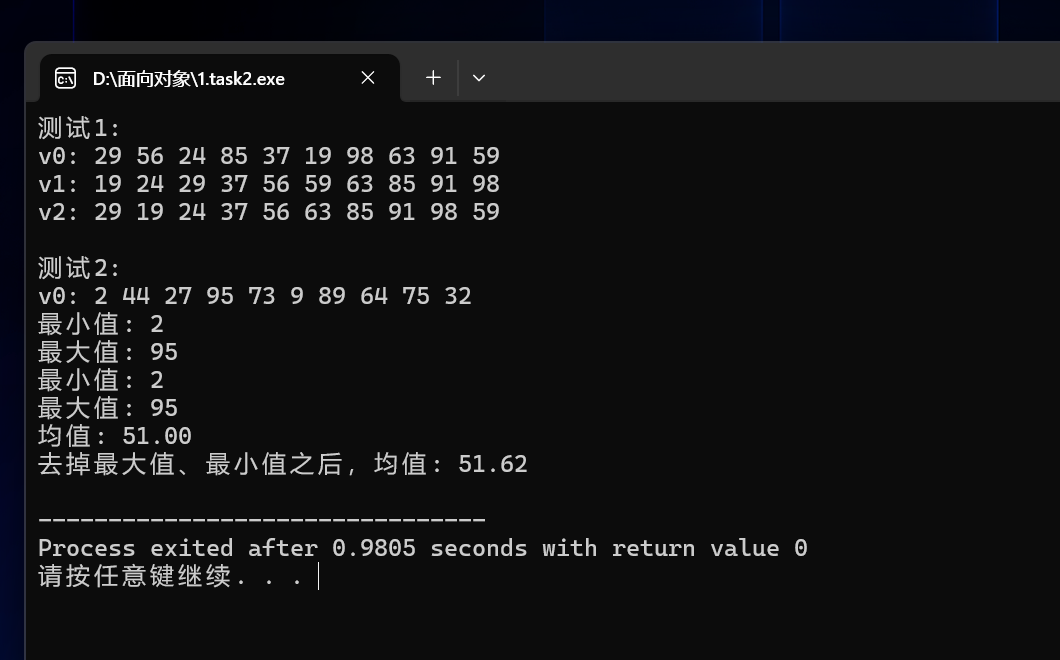
问题回答:
问题1:generate算法的作用是用函数动态生成的值填充序列。
问题2:只需要一次遍历序列,时间复杂度更低,效率更高。
问题3:效果是等同的。lambda的表达式用法:在需要函数的地方直接定义,减少代码跳转,更简洁也便于捕获外部变量。
task3
源代码:
#include<iostream>
#include<string>
#include<algorithm>
#include<cctype>

unsigned char func(unsigned char c);
void test1();
void test2();

int main()
{
    std::cout << "测试1:字符串大小写转换\n";
    test1();

    std::cout << "\n测试2:字符变换\n";
    test2();
}

unsigned char func(unsigned char c)
{
    if(c=='z')
    return 'a';

    if(c=='Z')
    return 'A';

    if(std::isalpha(c))
    return static_cast<unsigned char>(c+1);

    return c;
}

void test1()
{
    std::string s1{"Hello World 2049!"};
    std::cout << "s1 = " << s1 << '\n';

    std::string s2;
    for(auto c:s1)
        s2+=std::tolower(c);
    std::cout << "s2 = " << s2 << '\n';

    std::string s3;
    for(auto c:s1)
        s3+=std::toupper(c);
    std::cout << "s3 = " << s3 << '\n';
}

void test2()
{
    std::string s1{"I love cosmos!"};
    std::cout << "s1 = " <<s1 << '\n';

    std::string s2(s1.size(),' ');
    std::transform(s1.begin(),s1.end(),s2.begin(),func);
    std::cout << "s2 = " << s2 << '\n';
}
运行截图:
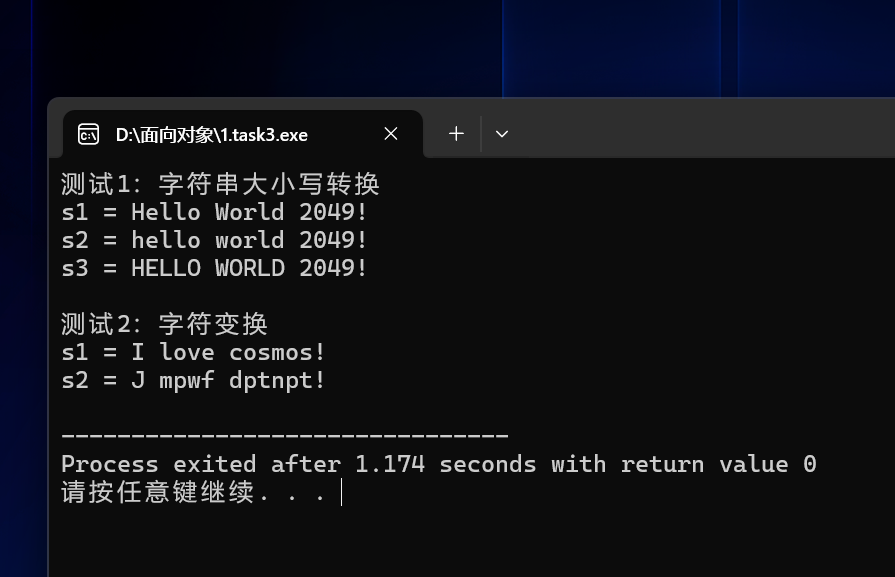
问题回答:
问题1:func的功能是把字母字符转换为下一个字符。
问题2:tolower的功能是将大写字母转换为对应的小写字母。toupper的功能是将小写字母转换为对应的大写字母。
问题3:第一个参数s1.begin()是指元素的起始位置;第二个参数s1.end()是指元素的结束位置;第三个参数s2.begin()是指变换后结果的存储起始位置;第四个参数func是指执行transform所依赖的算法逻辑。
如果把s2.begin()改成s1.begin(),
变化后的结果会覆盖s1的内容,s2却仍为初始化时的空格。
task4
源代码:
#include <iostream>
#include <string>
#include <algorithm>
bool is_palindrome(const std::string &s);
bool is_palindrome_ignore_case(const std::string &s);
int main() {
using namespace std;
string s;
// 多组输入,直到按下Ctrl+Z结束测试
while(cin >> s) {
cout << boolalpha
<< "区分大小写: " << is_palindrome(s) << "\n"
<< "不区分大小写: " << is_palindrome_ignore_case(s) << "\n\n";
}
}
// 函数is_palindrome定义
// 待补足
// ×××
bool is_palindrome(const std::string &s)
{
    int i=0,j=s.size()-1;
    while(i<j)
    {
        if(i<j)
        {
            if(s[i]!=s[j])
            return false;
        }
        i++;
        j--;
    }
    return true;
}

//indrome_ignore_case定义
bool is_palindrome_ignore_case(const std::string &s)
{
    using namespace std;
    string s2;
    for(char c:s)
        s2+=tolower(c);
    int i=0,j=s2.size()-1;
        while(i<j)
    {
        if(i<j)
        {
            if(s2[i]!=s2[j])
            return false;
        }
        i++;
        j--;
    }
    return true;
}
运行截图:
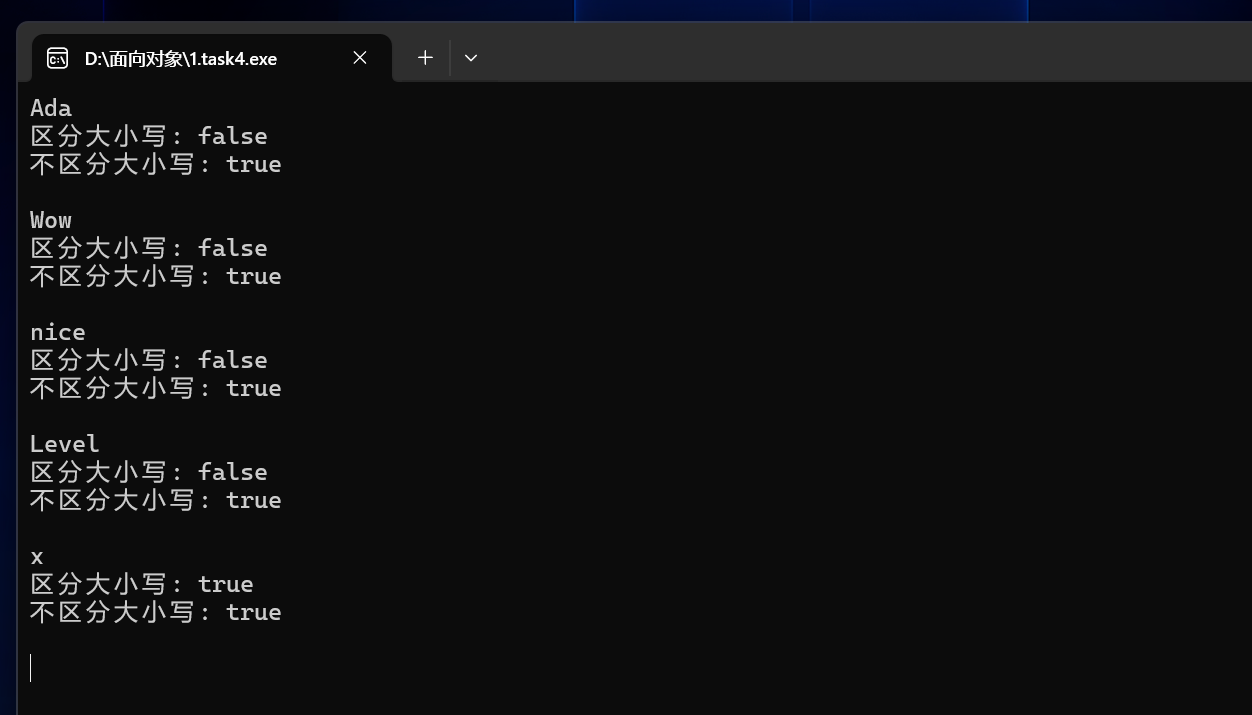
观察与思考:
答:需要将cin>>s改为getline(cin,s),因为getline会读取包括空格在内的一整行输入。
task5
源代码:
#include <iostream>
#include <string>
#include <algorithm>
std::string dec2n(int x, int n = 2);
int main() {
int x;
while(std::cin >> x) {
std::cout << "十进制: " << x << '\n'
<< "二进制: " << dec2n(x) << '\n'
<< "八进制: " << dec2n(x, 8) << '\n'
<< "十二进制: " << dec2n(x, 12) << '\n'
<< "十六进制: " << dec2n(x, 16) << '\n'
<< "三十二进制: " << dec2n(x, 32) << "\n\n";
}
}
// 函数dec2n定义
std::string dec2n(int x, int n) {
    if (x==0) {
     return "0";
}
     std::string result;
    while (x> 0) {
    int r=x%n;
    char d;
        if (r<10) {
        d='0'+r;
}
         else {
             d='A'+r-10;

        }
        result.push_back(d);
         x=x/n;
}
    std::reverse(result.begin(), result.end());
    return result;
}
运行截图:

task6
源代码:
#include<iostream>
#include<vector>
#include<algorithm>
#include<iomanip>
int main()
{
    using namespace std;
    char c;
    int i=0;
    cout << ' ' << ' ';
    for(c='a';c<='z';c++)
        cout << ' ' << c ;
    cout << endl;
    for(i=2;i<=27;i++)
    {
        cout << setw(2) << right << i-1 << ' ';
        for(c='A'+(i-1);c<'A'+(i-1)+26;c++)
        {
            cout << (char)(c>'Z'?c-26:c) << ' ';
        }
    cout << endl;
    }
    return 0;
 }
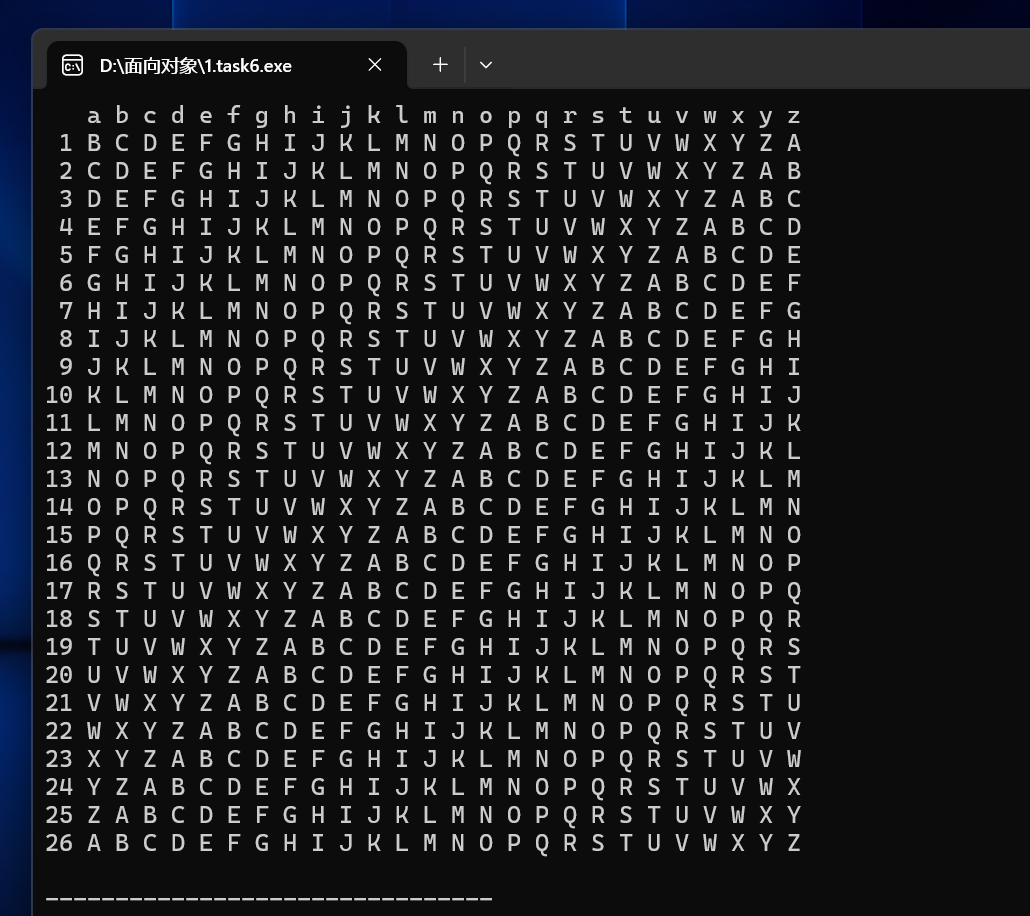
运行截图:
task7
源代码:
include <iostream>
#include <cstdlib>
#include <ctime>
#include <iomanip>
int main() {
    srand(time(0));
    int correctCount = 0;
    const int t=10;

    for (int i=0;i<t;++i) {
        int a=rand()%10+1;
        int b;
        int operation=rand()%4;
        char opChar;
        int correctAnswer;

        switch (operation) {
            case 0:  //加法
                b=rand()%10+1;
                opChar='+';
                correctAnswer =a+b;
                break;
            case 1:  //减法
                b=rand()%a+1;
                opChar='-';
                correctAnswer=a-b;
                break;
            case 2:  //乘法
                b=rand()%10+1;
                opChar='*';
                correctAnswer=a*b;
                break;
            case 3:  //除法
                b=rand()%10+1;
                while(a%b!=0) {
                    a=rand()%10+1;
                    b=rand()%10+1;
                }
                opChar = '/';
                correctAnswer=a/b;
                break;
        }

        std::cout <<a<<" "<<opChar<<" "<<b<<"=";
        int userAnswer;
        std::cin>>userAnswer;

        if (userAnswer==correctAnswer){
            correctCount++;
        }
    }

    double accuracy=static_cast<double>(correctCount)/t*100;
    std::cout << std::fixed << std::setprecision(2) << "正确率: " << accuracy << "%" << std::endl;

    return 0;
}
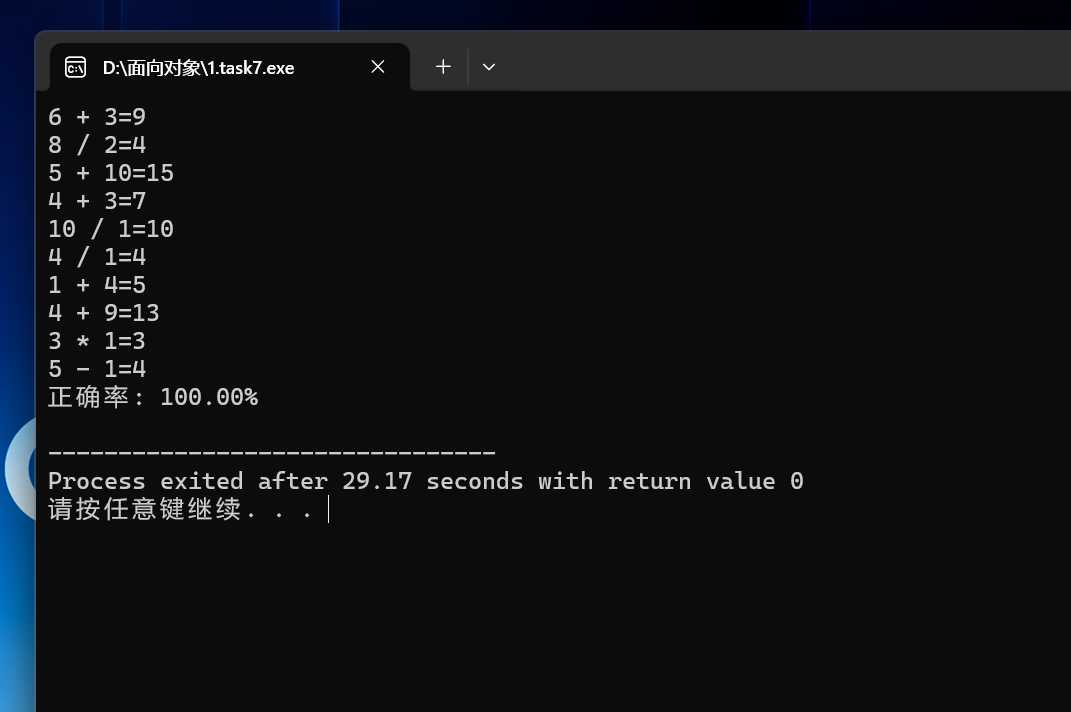
运行截图:

 浙公网安备 33010602011771号