
set学习笔记
set的特性是,所有元素都会根据元素的键值自动排序,set的元素不像map那样可以同时拥有实值(value)和键值(key),set元素的键值就是实值,实值就是键值。set不允许两个元素有相同的键值(multiset可以)。
set的各成员函数列表如下:
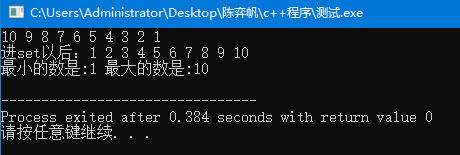
begin()--返回指向第一个元素的迭代器
insert()--在集合中插入元素
end()--返回指向最后一个元素的迭代器
 1 #include <bits/stdc++.h>
 2 using namespace std;
 3 int n = 10;
 4 multiset<int>s;
 5 int main(){
 6     for(int i = n; i >= 1; i--){
 7         cout << i << ' ';
 8         s.insert(i);
 9     }
10     set<int>::iterator i = s.begin();
11     cout << endl << "进set以后:";
12     for(; i != s.end(); i++) cout << *i << ' ';
13     cout << endl;
14     cout << "最小的数是:" << *s.begin() << ' ' << "最大的数是:" << *prev(s.end()) << endl;
15     return 0;
16 }
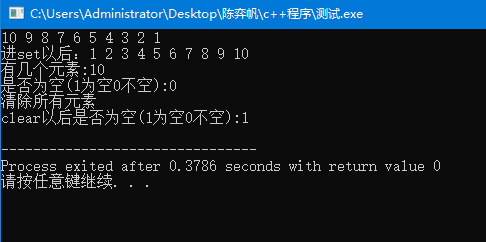
clear()--清除所有元素
empty()--如果集合为空,返回true
size()--集合中元素的数目
 1 #include <bits/stdc++.h>
 2 using namespace std;
 3 int n = 10;
 4 multiset<int>s;
 5 int main(){
 6     for(int i = n; i >= 1; i--){
 7         cout << i << ' ';
 8         s.insert(i);
 9     }
10     set<int>::iterator i = s.begin();
11     cout << endl << "进set以后:";
12     for(; i != s.end(); i++) cout << *i << ' ';
13     cout << endl << "有几个元素:" << s.size() << endl << "是否为空(1为空0不空):" << s.empty();
14     s.clear();
15     cout << endl << "清除所有元素";
16     cout << endl << "clear以后是否为空(1为空0不空):" << s.empty() << endl;
17     return 0;
18 }
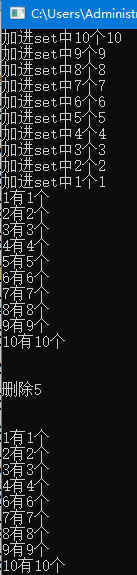
count()--返回某个值元素的个数
erase()--删除集合中的元素
 1 #include <bits/stdc++.h>
 2 using namespace std;
 3 int n = 10;
 4 multiset<int>s;
 5 int main(){
 6     for(int i = n; i >= 1; i--){
 7         cout << "加进set中" << i << "个" << i << endl;
 8         for(int j = 1; j <= i; j++) s.insert(i);
 9     }
10     set<int>::iterator i = s.begin();
11     int x = INT_MAX;
12     for(; i != s.end(); i++){
13         if(*i != x)
14             x = *i, cout << *i << "有" << s.count(*i) << "个" << endl;
15     }
16     cout << endl << endl << "删除5" << endl << endl << endl;
17     s.erase(5);
18     for(i = s.begin(); i != s.end(); i++){
19         if(*i != x)
20             x = *i, cout << *i << "有" << s.count(*i) << "个" << endl;
21     }
22     return 0;
23 }
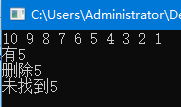
find()--返回一个指向被查找到元素的迭代器
 1 #include <bits/stdc++.h>
 2 using namespace std;
 3 int n = 10;
 4 multiset<int>s;
 5 int main(){
 6     for(int i = n; i >= 1; i--){
 7         cout << i << ' ';
 8         s.insert(i);
 9     }
10     cout << endl;
11     set<int>::iterator it = s.find(5);
12     if(it != s.end()) cout << "有5" << endl;
13     else cout << "未找到5" << endl;
14     s.erase(5);
15     cout << "删除5" << endl;
16     it = s.find(5);
17     if(it != s.end()) cout << "有5" << endl;
18     else cout << "未找到5" << endl;
19     return 0;
20 }
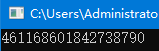
max_size()--返回集合能容纳的元素的最大限值
1 #include <bits/stdc++.h>
2 using namespace std;
3 multiset<int>s;
4 int main(){
5     cout << s.max_size() << endl;
6     return 0;
7 }
upper_bound()--返回大于某个值元素的迭代器
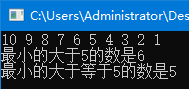
lower_bound()--返回指向大于等于某值的第一个元素的迭代器
 1 #include <bits/stdc++.h>
 2 using namespace std;
 3 multiset<int>s;
 4 int n = 10;
 5 int main(){
 6     for(int i = 10; i >= 1; i--){
 7         s.insert(i);
 8         cout << i << ' ';
 9     }
10     cout << endl;
11     cout << "最小的大于5的数是" << *s.upper_bound(5) << endl << "最小的大于等于5的数是" << *s.lower_bound(5) << endl;
12     return 0;
13 }

 浙公网安备 33010602011771号