
Java 单例模式
饿汉式,DCL懒汉式,深究
饿汉式
public class Hungry {
    //可能会浪费空间
    private byte[] data1 = new byte[1024*1024];
    private byte[] data2 = new byte[1024*1024];
    private byte[] data3 = new byte[1024*1024];
    private byte[] data4 = new byte[1024*1024];
    private byte[] data5 = new byte[1024*1024];


    private Hungry(){}
    public final static Hungry HUNGRY = new Hungry();

    public static Hungry getInstance(){
        return HUNGRY;
    }

}
DCL懒汉式
import java.lang.reflect.Constructor;
import java.lang.reflect.Field;

//懒汉式单例
public class LazyMan {

    private static boolean shijie = false;

    private LazyMan(){
        synchronized(LazyMan.class) {
            if(shijie == false){
                shijie = true;
            }else{
                throw new RuntimeException("不要试图使用反射破坏异常");
            }
        }
    }
    //加入volatile 可以禁止指令重排序
    private static volatile LazyMan instance= null;

    //双重检锁模式的 懒汉式单例   DCL 懒汉式 (double check lock 双端检锁机制)
    public static LazyMan getInstance() {
        if(instance == null) {
            synchronized (LazyMan.class) {
                if(instance == null){
                    instance = new LazyMan();//"new LazyMan()" 不是一个原子性操作,是分三步走的
                    /*
                    *   1、分配内存空间
                    *   2、执行构造方法,初始化对象
                    *   3、把这个对象指向这个空间
                    *
                    *   正常是 123;若是发生指令重排,就有可能变成 132
                    *   假如有 A、B 两个线程,当A线程执行完1和3的时候,B线程进来了;
                    *   由于A线程执行完1和3时,已经用空对象先把内存空间给占用了(执行到2时,再去指向初始化对象);
                    *   因此,B线程在判断 instance==null 时,instance已经不等于null。
                    *   会直接 return instance,此时 instance 还没完成构造,内存空间还是一片虚无,就有可能会产生一些问题。
                    *   132 A
                    *       B
                    *
                    * */
                }
            }
        }
        return instance;
    }


    //反射
    public static void main(String[] args) throws Exception {
        //LazyMan instance = LazyMan.getInstance();

        Field shijie = LazyMan.class.getDeclaredField("shijie");
        shijie.setAccessible(true);

        Constructor<LazyMan> declaredConstructor = LazyMan.class.getDeclaredConstructor(null);
        declaredConstructor.setAccessible(true);
        LazyMan instance = declaredConstructor.newInstance();
        shijie.set(instance,false);
        LazyMan instance2 = declaredConstructor.newInstance();
        System.out.println(instance.hashCode());
        System.out.println(instance2.hashCode());

    }


    //多线程并发
    /*public static void main(String[] args) {
        for (int i = 0; i < 100; i++) {
            new Thread(()->{
               LazyMan.getInstance();
            }).start();
        }

    }*/
}
静态内部类
//静态内部类
public class Holder {
    private Holder(){}

    public static Holder getInstance(){
        return InnerClass.HOLDER;
    }

    public static class InnerClass{
        private final static Holder HOLDER = new Holder();
    }

}
因为反射的存在,使得单例不安全
枚举
import java.lang.reflect.Constructor;
import java.lang.reflect.InvocationTargetException;

public enum  EnumSingle {
    INSTANCE;

    public EnumSingle getInstance(){
        return INSTANCE;
    }
}

class Test{
    public static void main(String[] args) throws NoSuchMethodException, IllegalAccessException, InvocationTargetException, InstantiationException {
        EnumSingle instance1 = EnumSingle.INSTANCE;

        //Constructor<EnumSingle> declaredConstructor = EnumSingle.class.getDeclaredConstructor(null);
        //NoSuchMethodException: temp.single.EnumSingle.<init>()
        Constructor<EnumSingle> declaredConstructor = EnumSingle.class.getDeclaredConstructor(String.class,int.class);
        //IllegalArgumentException: Cannot reflectively create enum objects

        declaredConstructor.setAccessible(true);
        EnumSingle instance2 = declaredConstructor.newInstance();

        System.out.println(instance1.hashCode());
        System.out.println(instance2.hashCode());
    }
}
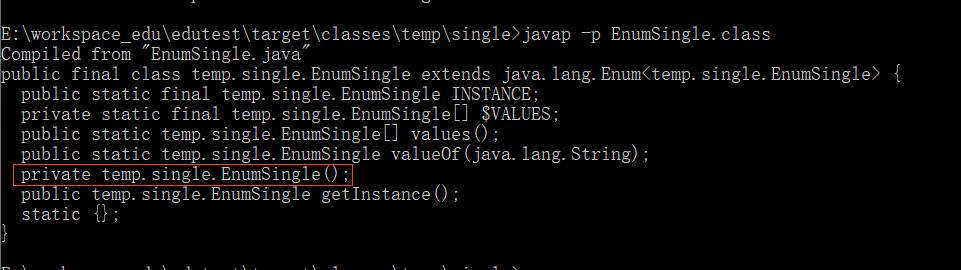
枚举类型的最终反编译源码:

import java.lang.reflect.Constructor;
import java.lang.reflect.InvocationTargetException;

public enum  EnumSingle {
    INSTANCE;

    public EnumSingle getInstance(){
        return INSTANCE;
    }
}

class Test{
    public static void main(String[] args) throws NoSuchMethodException, IllegalAccessException, InvocationTargetException, InstantiationException {
        EnumSingle instance1 = EnumSingle.INSTANCE;

        //Constructor<EnumSingle> declaredConstructor = EnumSingle.class.getDeclaredConstructor(null);
        //NoSuchMethodException: temp.single.EnumSingle.<init>()
        Constructor<EnumSingle> declaredConstructor = EnumSingle.class.getDeclaredConstructor(String.class,int.class);
        //IllegalArgumentException: Cannot reflectively create enum objects

        declaredConstructor.setAccessible(true);
        EnumSingle instance2 = declaredConstructor.newInstance();

        System.out.println(instance1.hashCode());
        System.out.println(instance2.hashCode());
    }
}

 浙公网安备 33010602011771号