
实验三
task1-3
1. 学习了普通变量、指针、引用作为形参的用法,理解参数传递过程。
2. auto 自动推导类型
3. new,delete
task4
//vector_int.hpp
#ifndef VECTOR_INT_H
#define VECTOR_INT_H

#include<cassert>
#include<iostream>
using std::cout;
using std::endl;

class Vector_int
{
public:
    Vector_int(int n, int init = 0) :size(n)
    {
        cout << "dynamic creat array… " << endl;
        x = new int[n];
        for (auto i = 0; i < n; ++i)
            x[i] = init;
    }

    Vector_int(const Vector_int& a) :size(a.size)
    {

        x = new int[size];
        for (auto i = 0; i < size; ++i)
            x[i] = a.x[i];
    }

    int& at(int index)//返回下标为index的元素引用
    {
        assert(index >= 0 && index < size);
        return x[index];
    }

    void show() const
    {
        for (auto i = 0; i < size; ++i)
            cout << x[i] << " ";
        cout << endl;
    }

    ~Vector_int()
    {
        cout << "deleting…" << endl;
        delete[] x;
    }
private:
    int size;//动态数组大小
    int* x;
};

#endif
//task4.cpp
#include<iostream>
#include"vector_int.hpp"

int main()
{
    using namespace std;

    int n;
    n = 5;
    Vector_int x(n);
    x.show();

    Vector_int x2(n, 6);
    x2.show();

    Vector_int y(x);
    y.show();

    y.at(0) = 999;
    y.show();
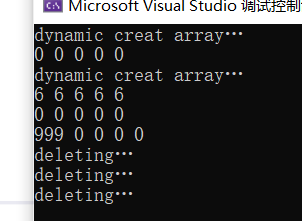
}
//Matrix.hpp
#ifndef MATRIX_H
#define MATRIX_H

#include<iostream>
#include<cassert>
using namespace std;

class Matrix
{
public:
    Matrix(int n);//构造函数,构造一个n*n的矩阵
    Matrix(int n, int m);//构造函数,构造一个n*m的矩阵
    Matrix(const Matrix &X);//复制构造函数
    ~Matrix();
    void set(const double* pvalue);//用pvalue指向的连续内存块数据按行为矩阵赋值
    void set(int i, int j, int value);//设置矩阵第i行j列元素值为value
    double& at(int i, int j);//返回矩阵第i行j列元素的引用
    double at(int i, int j) const;//返回i行j列的值
    int get_lines() const;//返回矩阵行数
    int get_cols() const;//返回矩阵列数
    void print() const;//按行打印
private:
    int lines;//矩阵行数
    int cols;//矩阵列数
    double* p;//指向存放矩阵数据的内存块的首地址
};

Matrix::Matrix(int n):lines(n),cols(n)
{
    p = new double[n * n];
}

Matrix::Matrix(int n, int m):lines(n),cols(m)
{
    p = new double[n * m];
}

Matrix::Matrix(const Matrix& X):lines(X.lines),cols(X.cols)
{
    p = new double[lines * cols];
    for (auto i = 0; i < lines * cols; ++i)
        p[i] = X.p[i];
}

Matrix::~Matrix()
{
    delete[] p;
}

void Matrix::set(const double* pvalue)
{
    for (auto i = 0; i < lines * cols; ++i)
        p[i] = pvalue[i];
}

void Matrix::set(int i, int j, int value)
{
    p[i * cols + j] = value;
}

double& Matrix::at(int i, int j)
{
    int t = i * cols + j;
    assert(t >= 0 && t < lines* cols);
        return p[t];
}

double Matrix::at(int i, int j) const
{
    int t = i * cols + j;
    assert(t >= 0 && t < lines* cols);
    return p[t];
}

int Matrix::get_lines() const
{
    return lines;
}

int Matrix::get_cols() const
{
    return cols;
}

void Matrix::print() const
{
    int i, j,k = 0;
    for (i = 0; i < lines; ++i)
    {
        for (j = 0; j < cols; ++j)
        {
            cout << p[k] << ", ";
            k++;
        }
        cout << "\b\b \n";
    }
}
#endif
task5
//task5.cpp
#include<iostream>
#include"matrix.hpp"

int main()
{
    using namespace std;

    double x[] = { 1,2,3,4,5,6,7,8 };

    Matrix m1(4, 2);
    m1.set(x);
    m1.print();
    cout << "the first line is: \n";
    cout << m1.at(0, 0) << " " << m1.at(0, 1) << endl;
    cout << endl;

    Matrix m2(2, 4);
    m2.set(x);
    m2.print();
    cout << "the first line is: \n";
    cout << m2.at(0, 0) << " " << m2.at(0, 1) << " " << m2.at(0, 2) << " " << m2.at(0,3) << endl;
    cout << endl;

    Matrix m3(m2);
    m3.set(0, 0, 999);
    m3.print();
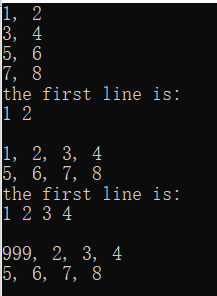
}

 浙公网安备 33010602011771号