
A self-consistent solution of Schrodinger-Poisson equations
Poisson Equations
The fundamental equations in electromagnetism is
combinated the two equations, then we obtain
where \(\varepsilon_r\) is the dielectric constant, \(\phi\) is the electrostatic potential. More specifically,
where \(N_d,N_a\) denote the ionized donor and acceptor densities, \(n,p\) denote the electron and hole densities, these quantities are positive.
Basic Equations
The one-dimensional, one-electron schrodinger equation is
where \(\psi\) is the wave function, \(E\) is the energy, \(V\) is the potential energy, \(\hbar\) is Plack's constant divided by \(2\pi\), and \(m^*\) is the effective mass.
For a simple \(n\)-type materilas, the one-dimensional Poisson equation is
To find the electron distribution in the condution band, one may set the potential energy \(V\) to be equal to the conduction-band energy. In a quantum well of arbitrary potential energy profile, the potential energy \(V\) is related to the electrostatic potential \(\phi\) as follows:
where \(\Delta E_c(x)\) is the pseudopotential energy due to the band offset at the heterointerface. The wave function \(\psi\) and the electron density are related by
where \(m\) is the number of bound states, and \(f_k\) is the electron occupation for each state. The electron concentration for each state are be expressed by
where \(E_k\) is the eigenenergy.
Newton's method
Since the electron density is determined by solutions of the schrodinger equation which are in turn determined by the potential \(\phi(x)\), the electron density is actually a functional by \(n[\phi]\). The one dimensional Poisson's equation can be written as
Let us denote the exact solution by \(\phi^0(x)\). For a given trial function \(\phi(x)\) (or the initial guess), our task is to find the correction \(\delta\phi(x)\) so that
Then, we obtain
Defining: \(n[\phi+\delta\phi] = n[\phi] + \delta n[\phi]\), then
Note that the left-band side is the error in Poisson's equation for the trivial function \(\phi(x)\) which can be easily calculated. Assuming the \(\delta\phi(x)\) is small, from (2.4) and (3.4), \(\delta n[\phi]\) can be expressed as
where
THe relevant numerical experience indicates that the first term on the right-hand side of Eq.(3.5) is usually much smaller than the second one. Dropping the first term and expressing \(\delta n_k\) in terms of \(\delta\phi\).
Therefore,
For the typical quantum transport,
Final, we can get
Matlab Code
The code is copied from the Supriyo Datta's textbook.
点击查看代码
%Fig.3.1
clear all

%Constants (all MKS, except energy which is in eV)
hbar=1.06e-34;q=1.6e-19;epsil=10*8.85E-12;kT=.025; m=.25*9.1e-31;
n0=2*m*kT*q/(2*pi*(hbar^2));

%inputs
a=3e-10;t=(hbar^2)/(2*m*(a^2)*q);beta=q*a*a/epsil;
Ns=15;Nc=70;Np=Ns+Nc+Ns;XX=a*1e9*[1:1:Np];
mu=.318;Fn=mu*ones(Np,1);
Nd=2*((n0/2)^1.5)*Fhalf(mu/kT)
Nd=Nd*[ones(Ns,1);.5*ones(Nc,1);ones(Ns,1)];

%d2/dx2 matrix for Poisson solution
D2=-(2*diag(ones(1,Np)))+(diag(ones(1,Np-1),1))+...
(diag(ones(1,Np-1),-1));
%D2(1,1)=-1;D2(Np,Np)=-1;%zero field condition

%Hamiltonian matrix
T=(2*t*diag(ones(1,Np)))-(t*diag(ones(1,Np-1),1))-(t*diag(ones(1,Np-1),-1));

%energy grid
NE=501;E=linspace(-.25,.5,NE);dE=E(2)-E(1);zplus=1i*1e-20;
f0=n0*log(1+exp((mu-E)./kT));

%self-consistent calculation
U=[zeros(Ns,1);.2*ones(Nc,1);zeros(Ns,1)];%guess for U

dU=0;ind=10;
while ind>0.001
    %from U to n
    sig1=zeros(Np);sig2=zeros(Np);n=zeros(Np,1);
    for k=1:NE
        ck=1-((E(k)+zplus-U(1))/(2*t));ka=acos(ck);
        sig1(1,1)=-t*exp(1i*ka);gam1=1i*(sig1-sig1');
        ck=1-((E(k)+zplus-U(Np))/(2*t));ka=acos(ck);
        sig2(Np,Np)=-t*exp(1i*ka);gam2=1i*(sig2-sig2');
        G=inv(((E(k)+zplus)*eye(Np))-T-diag(U)-sig1-sig2);
        A=1i*(G-G');rhoE=f0(k)*diag(A)./(2*pi);
        n=n+((dE/a)*real(rhoE));
    end

    %correction dU from Poisson
    D=zeros(Np,1);
    for k=1:Np
        z=(Fn(k)+U(k))/kT;
        D(k)=2*((n0/2)^1.5)*((Fhalf(z+.1)-Fhalf(z))/.1)/kT;
    end

    dN=n-Nd+((1/beta)*D2*U);
    dU=(-beta)*(inv(D2-(beta*diag(D))))*dN;U=U+dU;

    %check for convergence
    ind=(max(max(abs(dN))))/(max(max(Nd)))

end
%plot(XX,n)
%plot(XX,U)
%plot(XX,F,':')

save fig31

figure
hold on
h=plot(XX,U);
grid on
set(h,'linewidth',[2.0])
set(gca,'Fontsize',[24])
xlabel(' x (nm)', 'Interpreter', 'latex')
ylabel('U (eV)', 'Interpreter', 'latex')


figure
hold on
h=plot(XX,n);
grid on
set(h,'linewidth',[2.0])
set(gca,'Fontsize',[24])
xlabel(' x (nm)', 'Interpreter', 'latex')
ylabel('n electron density', 'Interpreter', 'latex')

%For periodic boundary conditions, add
 %           T(1,Np)=-t;T(Np,1)=-t;
%and replace section entitled "from U to n" with
            %from U to n
            %[P,D]=eig(T+diag(U));D=diag(D);
            %rho=log(1+exp((Fn-D)./kT));rho=P*diag(rho)*P';
            %n=n0*diag(rho);n=n./a;
点击查看代码(Direclet边界条件)
clear all
tic

%Constants (all MKS, except energy which is in eV)
hbar=1.06e-34;q=1.6e-19;epsil=10*8.85E-12;kT=.025;
m=.25*9.1e-31;n0=2*m*kT*q/(2*pi*(hbar^2));

%inputs
a=3e-10;t=(hbar^2)/(2*m*(a^2)*q);beta=q*a*a/epsil;
Ns=15;Nc=70;Np=Ns+Nc+Ns;XX=a*1e9*[1:1:Np];
mu=.318;Fn=mu*ones(Np,1);
Nd=2*((n0/2)^1.5)*Fhalf(mu/kT);
Nd=Nd*[ones(Ns,1);0.5*ones(Nc,1);ones(Ns,1)];
%Nd=zeros(Np,1);

%d2/dx2 matrix for Poisson solution
D2=-(2*diag(ones(1,Np)))+(diag(ones(1,Np-1),1))+(diag(ones(1,Np-1),-1));
% D2(1,1)=-1;D2(Np,Np)=-1;%zero field condition
iD2 = inv(D2);
U0 = iD2*[0;zeros(Np-2,1);0];
%U0 = iD2*zeros(Np,1);

%Hamiltonian matrix
T=(2*t*diag(ones(1,Np)))-(t*diag(ones(1,Np-1),1))-(t*diag(ones(1,Np-1),-1));

%energy grid
NE=301;E=linspace(-.25,.5,NE);dE=E(2)-E(1);zplus=1i*1e-12;
f0=n0*log(1+exp((mu-E)./kT));

%self-consistent calculation
U=[zeros(Ns,1);.2*ones(Nc,1);zeros(Ns,1)];%guess for U

ind=10;
while ind>0.01
    %from U to n
    sig1=zeros(Np);sig2=zeros(Np);n=zeros(Np,1);
    for k=1:NE
        sig1=zeros(Np);sig2=zeros(Np);
        ck=1-((E(k)+zplus-U(1))/(2*t));ka=acos(ck);
        sig1(1,1)=-t*exp(1i*ka);gam1=1i*(sig1-sig1');
        ck=1-((E(k)+zplus-U(Np))/(2*t));ka=acos(ck);
        sig2(Np,Np)=-t*exp(1i*ka);gam2=1i*(sig2-sig2');

        G=inv(((E(k)+zplus)*eye(Np))-T-diag(U)-sig1-sig2);
        A=1i*(G-G');rhoE=f0(k)*diag(A)./(2*pi);
        n=n+((dE/a)*real(rhoE));
    end

    UU = U0 + iD2*beta*(Nd-n);
    ind = max(max(abs(UU-U)));
    k = 0.001;
    U = k*UU + (1-k)*U;
   % U = U + 0.001*(UU-U);
end
figure;
plot(XX,n) ;
xlabel('nm')
ylabel('Electron density')
figure;
plot(XX,U);
xlabel('nm')
ylabel('Potential Profile')
toc
save fig31
hold on
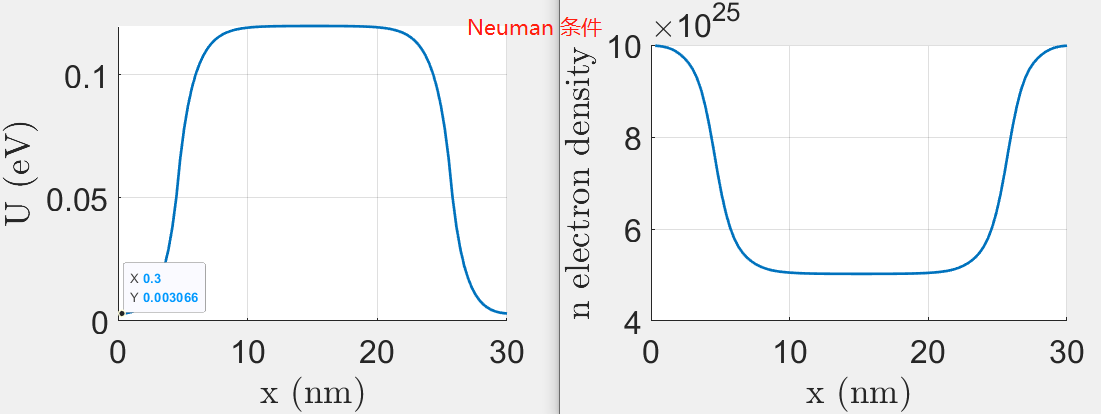
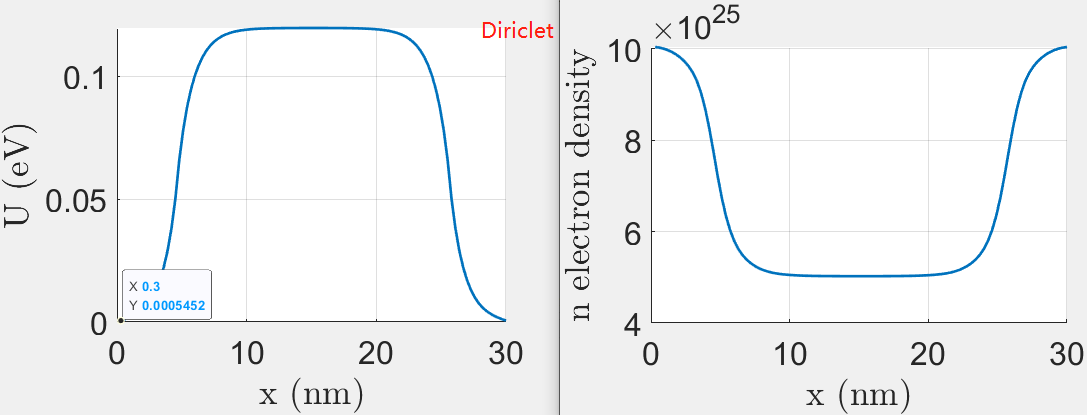
点击查看代码
%test Ec = 1.12/2;
clear
tic

%Constants (all MKS, except energy which is in eV)
hbar=1.054571817e-34;
q=1.602176634e-19; %C
epsil=10*8.854187817E-12;%F/m
kT=0.025852; %300K, eV
m=0.25*9.1093837015e-31;%kg
n0= m*kT*q/(2*pi*(hbar^2));
Ec = 1.12/2;

%inputs
a=3e-10;
t=(hbar^2)/(2*m*(a^2)*q);
beta=q*a*a/epsil;
NL=30;NC=90;NR=NL;
Np=NL+NC+NR;XX=a*1e9*[1:1:Np];
mu=Ec + 0.31251598;Fn=mu*ones(Np,1);
%mu=.0;Fn=mu*ones(Np,1);
Nd = 2*(n0^1.5)*Fhalf((mu-Ec)/kT);
Nd = Nd*[ones(NL,1);0.0000*ones(NC,1);ones(NL,1)];
%Nd=zeros(Np,1);
%mu=Ec + 0.15251598;Fn=mu*ones(Np,1);


%d2/dx2 matrix for Poisson solution
D2=-(2*diag(ones(1,Np)))+(diag(ones(1,Np-1),1))+(diag(ones(1,Np-1),-1));
D2(1,1)=-1;D2(Np,Np)=-1;%zero field condition
% Boundary conditions (Neumann homogeneous)
%D2(1,2)=2; D2(Np,Np-1)=2;


%%%%%%%%%%%%%%%%%%%%%%%%%%%%%% Initial H00 H01 %%%%%%%%%%%%%%%%%%%%%%%%%%%%
W = 1;
H00 = zeros(W,W);
H01 = zeros(W,W);
for j = 1:W
    H00(j,j) = 2*t + Ec;
    H01(j,j) = -t;
    if j < W
        H00(j,j+1) = -t;
        H00(j+1,j) = -t;
    end
end
%%%%%%%%%%%%%%%%%%%%%%%%%%%%%%%%%%%%%%%%%%%%%%%%%%%%%%%%%%%%%%%%%%%%%%%%%%%

%%%%%%%%%%%%%%%%%%%%%%%%%%% Band of each slice %%%%%%%%%%%%%%%%%%%%%%%%%%%%
Nk = 200;
i_E = linspace(-pi,pi,Nk);
res = zeros(Nk,W);
for i = 1:Nk
    Ham = H00 + H01*exp(1j*i_E(i)) + H01'*exp(-1j*i_E(i));
    val = eig(Ham);
    res(i,:) = val';
end
figure;
plot(i_E,res);
%ylim([0,1]);
xlim([-pi,pi]);
xlabel('k');
ylabel('Energy [t]')
%%%%%%%%%%%%%%%%%%%%%%%%%%%%%%%%%%%%%%%%%%%%%%%%%%%%%%%%%%%%%%%%%%%%%%%%%%%

%%%%%%%%%%%%%%%%%%%%%%%%% Initial Ham Full matrix %%%%%%%%%%%%%%%%%%%%%%%%%
L = Np;
Ham = zeros(W*L,W*L);
for j = 1:L
    Ham(j*W-W+1:j*W,j*W-W+1:j*W) = H00;
    if j < L
        Ham(j*W-W+1:j*W,j*W+1:j*W+W) = H01;
        Ham(j*W+1:j*W+W,j*W-W+1:j*W) = H01';
    end
end
%%%%%%%%%%%%%%%%%%%%%%%%%%%%%%%%%%%%%%%%%%%%%%%%%%%%%%%%%%%%%%%%%%%%%%%%%%%

%Hamiltonian matrix
%T=(2*t*diag(ones(1,Np)))-(t*diag(ones(1,Np-1),1))-(t*diag(ones(1,Np-1),-1));

%energy grid
N_E=501;
E = linspace(-0.6+mu,0.6+mu,N_E);
dE = E(2)-E(1);
eta = 1e-8;


%self-consistent calculation
U=[zeros(NL,1);.2*ones(NC,1);zeros(NR,1)];%guess for U
dU=0;

LDOS = zeros(N_E,Np);

change = 10;
while change > 0.001
    %from U to n
    SigmaL=zeros(Np);SigmaR=zeros(Np);
    n = zeros(Np,1);
    for i_E = 1:N_E
        f0 = 2*n0*log(1+exp((mu-E(i_E))/kT));
        ck=1-((E(i_E)+1j*eta-U(1)-Ec)/(2*t));ka=acos(ck);
        SigmaL(1,1)=-t*exp(1i*ka);%gam1=1i*(SigmaL-SigmaL');
        ck=1-((E(i_E)+1j*eta-U(Np)-Ec)/(2*t));ka=acos(ck);
        SigmaR(Np,Np)=-t*exp(1i*ka);%gam2=1i*(SigmaR-SigmaR');

        G = inv(((E(i_E)+1j*eta)*eye(Np))- Ham - diag(U)-SigmaL-SigmaR);
        A=1i*(G-G');
        rhoE = f0*diag(A)/(2*pi);
        n = n + ((dE/a)*real(rhoE));
        LDOS(i_E,:) = diag(A)/(2*pi);
    end
    %correction dU from Poisson
    D=zeros(Np,1);


    for i_E = 1:Np
        z =(Fn(i_E)-U(i_E) - Ec)/kT;
        D(i_E,1)=2*(n0^1.5)*((Fhalf(z+.1)-Fhalf(z))/.1)/kT;
    end
    dN = n - Nd + ((1/beta)*D2*U);
    dU = (-beta)*(inv(D2-(beta*diag(D))))*dN;
    U = U + 1*dU;
    %check for convergence
    %ind=(max(max(abs(dN))))/(max(max(Nd)));
    change = max(max(abs(dU)))
end
figure
plot(XX,n)
xlabel('position (nm)', 'Interpreter', 'latex');
ylabel('n ($m^{-3}$)', 'Interpreter', 'latex');
title('Electron density', 'Interpreter', 'latex');
set(gca,'Fontsize',12)

figure;
plot(XX,U)
xlabel('position (nm)', 'Interpreter', 'latex');
ylabel('U (eV)', 'Interpreter', 'latex');

figure;
imagesc(XX,E,LDOS);
xlabel('position (nm)', 'Interpreter', 'latex');
ylabel('Energy');
title('Projected density of states');
axis xy
colormap('hot');
colorbar

toc
save fig31
hold on
Reference
[1] IH. Tan, G. L. Snider, L. D. Chang, and E. L. Hu. A selfconsistent solution of Schrödinger–Poisson equations using a
nonuniform mesh. J. Appl. Phys. 68, 4071 (1990); (main refs)
[2] Zhibin Ren Phdthesis.
[3] www.nanohub.org
[4] Supriyo Datta. Nanoscale device modeling: the Green's function method. Superlattices and Microstructures, Vol. 28, No. 4, 2000.

 浙公网安备 33010602011771号