
c: thread in Ubuntu 22.04
/**
 * @file helloworld.c
 * @author your name (geovindu@163.com)
 * @brief thread
 * @version 0.1
 * @date 2023-10-24
 * ide: vscode  c11,c17  Ubuntu 22.04
 * @copyright Copyright (c) 2023 站在巨人的肩膀上 Standing on the Shoulders of Giants 2023
 *
 */

#include<stdlib.h>
#include<stdio.h>
#include<ctype.h>
#include<string.h>
#include<malloc.h>
#include<time.h>
#include<unistd.h>
#include<sys/wait.h>
#include<threads.h>
#include<math.h>
#include<unistd.h>  //Header file for sleep(). man 3 sleep for details.
#include<pthread.h>

#include "include/CheckTieck.h"
#include "include/TakeNumber.h"

#define threadcout 5

//
//
thrd_t threadId[threadcout];


mtx_t task_mtx;

struct timespec duration={.tv_sec=1,.tv_nsec=0};

size_t task=0;


/**
 * @brief 线程
 *
 * @param agr
 * @return int
 */
 int execrteTask(void *agr)
 {

    mtx_lock(&task_mtx);
    size_t local_task = ++task;
    mtx_unlock(&task_mtx);

    //  mtx_lock(&task_mtx);                          // mutex lock - blocks until acquired
    //  printf_s("Task %zd started.\n", ++task);
    printf("Task %zd started.\n", local_task);

    thrd_sleep(&duration, NULL);                    // Just to make things take longer...
    double x = 0;
    for(int i = 0 ; i< 1000000000 ; ++i)
        x = sqrt(3.1415926);

    printf("  Task %zd finished\n", local_task);
    //  printf_s("  Task %zd finished\n", task);
    //  mtx_unlock(&task_mtx);                         // mutex unlock - for use by other threads
    return 0;
 }

// 定义一个结构体,用于存储函数的参数和返回值
typedef struct {
    int x; // 输入参数
    int y; // 返回值
} data_t;

// 定义一个函数,接受一个指向data_t结构体的指针,打印该结构体中的x值的平方,并将该值加一存入y中
void *square_and_add_one(void *arg) {
    data_t *data = (data_t *)arg;
    printf("The square of %d is %d\n", data->x, data->x * data->x);
    data->y = data->x + 1;
    return NULL;
}

/**
 * @brief
 *
 * @param argc
 * @param argv
 * @return int
 */
int main(void)
{
    int argc;
    char *argv;//[]={'\0'};
    char ddd[11]="The hello world";
    argv=ddd;
    argc=2;

    // 检查命令行参数的个数,至少需要一个参数
    if (argc < 2) {
        fprintf(stderr, "Usage: %s <number>\n", argv[0]);
        exit(1);
    }

    // 将第一个参数转换为整数
    printf("%s",&argv[1]);
    int thdnum = atoi(&argv[1]);

    // 创建一个data_t结构体,并初始化其x值为num
    data_t data;
    data.x = thdnum;

    // 创建一个线程,并传入square_and_add_one函数和data结构体的地址
    pthread_t tid;
    pthread_create(&tid, NULL, square_and_add_one, &data);

    // 等待线程结束,并打印其返回值
    pthread_join(tid, NULL);
    printf("The thread returned %d\n", data.y);


        if(thrd_error == mtx_init(&task_mtx, mtx_timed))
        {
            //int ret = vfprintf(stdout, fmt, vl);
            fprintf(stderr, "Mutex creation failed.\n");  //stderr
            thrd_exit(-2);
        }

    // Create the threads to carry out the tasks concurrently
    for(size_t i = 0 ; i<threadcout ; ++i)
        if(thrd_error == thrd_create(&(threadId[i]), execrteTask, NULL))
        {
            fprintf(stderr, "Thread creation failed.\n");
            thrd_exit(-1);
        }

    // Join the additional threads to the main thread
    for(size_t j = 0 ; j <threadcout ; ++j)
        thrd_join(threadId[j], NULL);

    pid_t pid;
    int status;

    pid = fork();  // 创建一个新进程

    if (pid < 0) {  // 如果创建失败,输出错误信息
        fprintf(stderr, "Fork Failed");
        return 1;
    } else if (pid == 0) {  // 子进程
        printf("I am the child %d\n",pid);
        execl("/bin/ls", "ls", NULL);  // 在子进程中执行 /bin/ls 程序
        printf("I am the child %d, and execl failed\n",pid);  // 如果 execl 返回,那么说明出错
    } else {  // 父进程
        wait(&status);  // 等待子进程结束
        printf("I am the parent %d, and my child has ended\n",pid);
    }


    printf("hello wolrd, c launguage! weblcome geovindu!涂聚文");

    QueueCalling *queue1;

    char select='1';
    //int num=1;//顾客序号
    int num=0; //叫号编号
    queue1=QueueInit(); //初始化队列
    if(queue1==NULL)
    {
        printf("创建队列时出错!\n");
        //getch();
        getchar();
        return 0;
    }
    do{
        //这里处理,列表不会显示两次
        if(select=='1' || select=='2')
        {
            printf("\n请选择具体操作:\n");
            printf("1.新到顾客\n");
            printf("2.下一个顾客\n");
            printf("0.退出\n") ;
            fflush(stdin);
        }

        select=getchar();//getch();
        switch(select)
        {
            case '1':
                add(queue1);
                printf("\n现在共有%d位顾客在等候!\n",QueueLen(queue1));
                break;
            case '2':
                next(queue1);
                printf("\n现在共有%d位顾客在等候!\n",QueueLen(queue1));
                break;
            case '0':
                break;
        }
    }while(select!='0');
    QueueFree(queue1); //释放队列
    //getch();
    getchar();

    return 0;
}
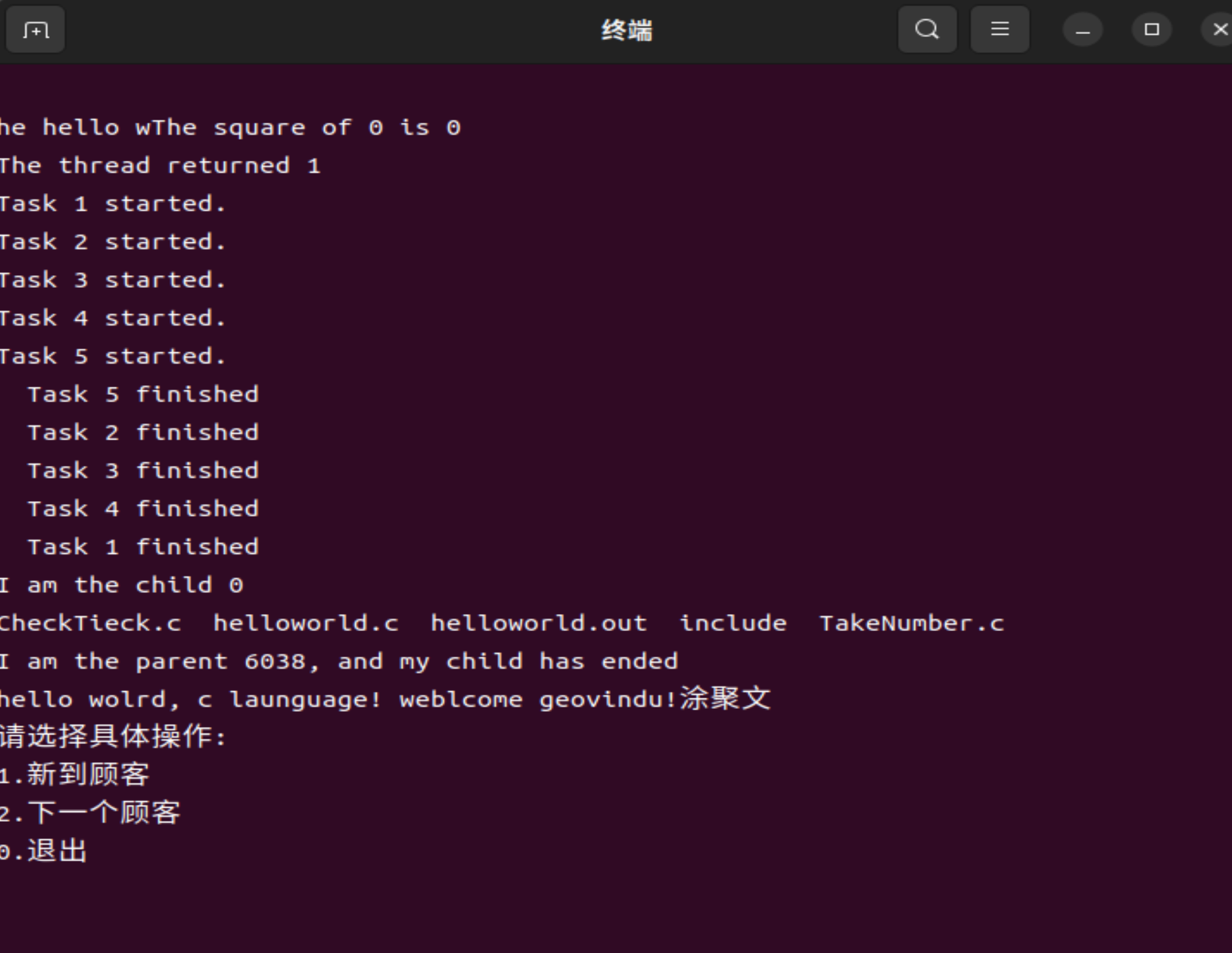
输出:
/**
 * @file helloworld.c
 * @author your name (geovindu@163.com)
 * @brief thread
 * @version 0.1
 * @date 2023-10-24
 * ide: vscode  c11,c17  Ubuntu 22.04
 * @copyright Copyright (c) 2023 站在巨人的肩膀上 Standing on the Shoulders of Giants 2023
 *
 */

#include<stdlib.h>
#include<stdio.h>
#include<ctype.h>
#include<sys/types.h>
#include<string.h>
#include<malloc.h>
#include<time.h>
#include<unistd.h>
#include<sys/wait.h>
#include<threads.h>
#include<math.h>
#include<unistd.h>  //Header file for sleep(). man 3 sleep for details.
#include<pthread.h>

#include "include/CheckTieck.h"
#include "include/TakeNumber.h"
#include "include/twoDimensional.h"

#define threadcout 5

//
//
thrd_t threadId[threadcout];


mtx_t task_mtx;

struct timespec duration={.tv_sec=1,.tv_nsec=0};

size_t task=0;


/**
 * @brief 线程
 *
 * @param agr
 * @return int
 */
 int execrteTask(void *agr)
 {

    mtx_lock(&task_mtx);
    size_t local_task = ++task;
    mtx_unlock(&task_mtx);

    //  mtx_lock(&task_mtx);                          // mutex lock - blocks until acquired
    //  printf_s("Task %zd started.\n", ++task);
    printf("Task %zd started.\n", local_task);

    thrd_sleep(&duration, NULL);                    // Just to make things take longer...
    double x = 0;
    for(int i = 0 ; i< 1000000000 ; ++i)
        x = sqrt(3.1415926);

    printf("  Task %zd finished\n", local_task);
    //  printf_s("  Task %zd finished\n", task);
    //  mtx_unlock(&task_mtx);                         // mutex unlock - for use by other threads
    return 0;
 }

// 定义一个结构体,用于存储函数的参数和返回值
typedef struct {
    int x; // 输入参数
    int y; // 返回值
} data_t;

// 定义一个函数,接受一个指向data_t结构体的指针,打印该结构体中的x值的平方,并将该值加一存入y中
void *square_and_add_one(void *arg) {
    data_t *data = (data_t *)arg;
    printf("The square of %d is %d\n", data->x, data->x * data->x);
    data->y = data->x + 1;
    return NULL;
}

/**
 * @brief
 *
 * @param argc
 * @param argv
 * @return int
 */
int main(void)
{

    pid_t pid;
    int status;

    pid = fork();  // 创建一个新进程

    if (pid < 0) {  // 如果创建失败,输出错误信息
        fprintf(stderr, "Fork Failed");
        return 1;
    } else if (pid == 0) {  // 子进程
        printf("I am the child %d\n",pid);
        //execl("/bin/ls", "ls", NULL);  // 在子进程中执行 /bin/ls 程序

        //execl("/usr/bin/env", "env", NULL, NULL); //OK打印环境变量
        //execl("/bin/sh", "sh", "-c","echo 'Hello!' >> test.txt",(char *) NULL); //OK 添加到文件文尾
        execl("/bin/sh", "sh", "-c","echo 'Hello!' > test.txt",(char *) NULL); //OK 只有hello的字符
        //execle("/bin/ls","ls","./",NULL); //   ok显示文件夹的文件
        //execl("/bin/sh", "sh", "-c", "/bin/cat > test.txt", (char *) NULL); //ok 创建文件,并可以输入内容,关闭即保存
        //execl("/bin/cat","cat","1.txt","2.txt",NULL);//显示了两个文件内容
        //execl("/bin/cat", "cat", "-n", "1.js", NULL);//ok 读文件显示号
        //execl("/bin/cat", "cat", "-n", "1.txt", NULL); //ok 读文件显示号
        printf("I am the child %d, and execl failed\n",pid);  // 如果 execl 返回,那么说明出错
    } else {  // 父进程
        wait(&status);  // 等待子进程结束
        printf("I am the parent %d, and my child has ended\n",pid);
    }

   return 0;
}
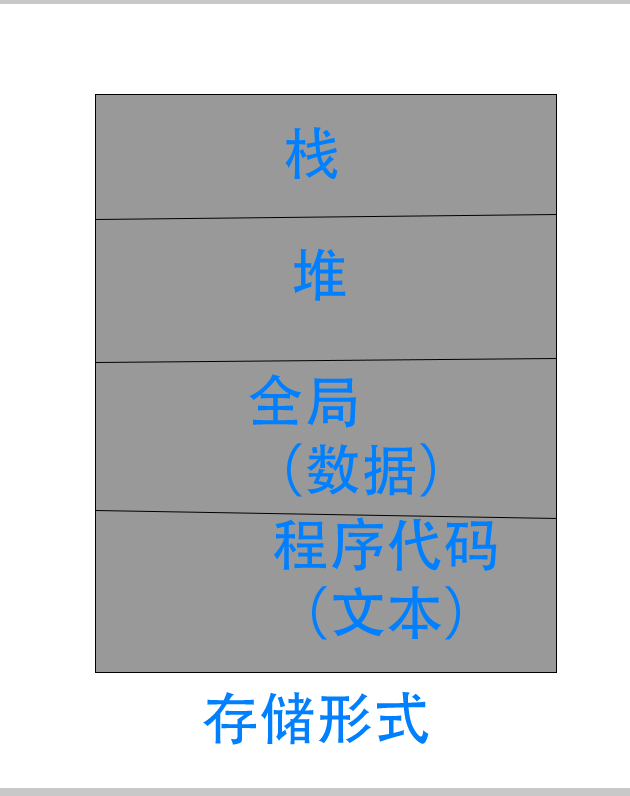
如何在程序里使用这些内存。
C的存储结构是非常重要的,C的存储结构主要由堆区、栈区、全局常量区、程序代码区组成。其中重要的是堆和栈,它们都属于RAM; 因此,它们是个稳定的,并且在运行时经常会改变。
函数的局部变量是在栈中创建的;同时,在堆中指针是需要你的程序手动处理的(malloc/free),堆的作用域是在程序被运行时。
栈存储变量的空间比堆的小,其原理是为了让栈存储那些只需要短暂的变量。
另一方面,堆可以处理内存需求更大的变量,堆是动态分配的。当然,堆的访问速度取决于每个段的访问对象。堆由开发人员手动处理。也就是说,有可能出现内存泄漏。堆中的变量是全局的,可以通过指针访问。
栈是一个后进先出(last-in-first-out,LIFO)的结构,这对于递归函数非常有用。每次声明一个变量,它将被在于该段的顶部(这就是一个使用pust-pop函数的后进先出结构的栈)。
输入输出格式说明符:
输出格式说明符
printf
printf_s
sprintf
sprintf_s
snprintf
snprintf_s
fprintf
fprintf_s
vfprintf
vsprintf
vprintf
vsnprintf
vfprintf_s
vprintf_s
vsnprintf_s
vsprintf_s
输入格式说明符
scanf
scanf_s
vscanf
vscanf_s
sscanf
sscanf_s
vsscanf
vsscanf_s
fscanf
fscanf_s
vfscanf
vfscanf_s
来源: Beginnin C: From Beginner to Pro, Sixth Edition
https://github.com/Apress/beginning-c-6e
https://www.demo2s.com/c/c-execl-bin-ls-ls-a-l-null.html
#include <unistd.h>
extern char **environ;
int execl(const char *path, const char *arg0, ... /*, (char *)0 */);
int execle(const char *path, const char *arg0, ... /*,
(char *)0, char *const envp[]*/);
int execlp(const char *file, const char *arg0, ... /*, (char *)0 */);
int execv(const char *path, char *const argv[]);
int execve(const char *path, char *const argv[], char *const envp[]);
int execvp(const char *file, char *const argv[]);
int fexecve(int fd, char *const argv[], char *const envp[]);
execl("/bin/cat","cat","1.js",">","2.js",NULL);

 浙公网安备 33010602011771号