

typescript: Bridge Pattern
/**
 * Bridge Pattern 桥接是一种结构型设计模式, 可将业务逻辑或一个大类拆分为不同的层次结构, 从而能独立地进行开发。
 * https://dev.to/takaakit/uml-diagram-for-gof-design-pattern-examples-in-typescript-46d5#singleton
 * The Abstraction defines the interface for the "control" part of the two class
 * hierarchies. It maintains a reference to an object of the Implementation
 * hierarchy and delegates all of the real work to this object.
 */
class AbstractionBridge {
    /**
     *
     */
    protected implementation: Implementation;
    /**
     *
     * @param implementation
     */
    constructor(implementation: Implementation) {
        this.implementation = implementation;
    }
    /**
     *
     * @returns
     */
    public operation(): string {
        const result = this.implementation.operationImplementation();
        return `Abstraction: Base operation with:\n${result}`;
    }
}

/**
 * You can extend the Abstraction without changing the Implementation classes.
 */
class ExtendedAbstraction extends AbstractionBridge {

    /**
     *
     * @returns
     */
    public operation(): string {
        const result = this.implementation.operationImplementation();
        return `ExtendedAbstraction: Extended operation with:\n${result}`;
    }
}

/**
 * The Implementation defines the interface for all implementation classes. It
 * doesn't have to match the Abstraction's interface. In fact, the two
 * interfaces can be entirely different. Typically the Implementation interface
 * provides only primitive operations, while the Abstraction defines higher-
 * level operations based on those primitives.
 */
interface Implementation {
    /**
     *
     */
    operationImplementation(): string;
}

/**
 * Each Concrete Implementation corresponds to a specific platform and
 * implements the Implementation interface using that platform's API.
 */
class ConcreteImplementationA implements Implementation {
    /**
     *
     * @returns
     */
    public operationImplementation(): string {
        return 'ConcreteImplementationA: Here\'s the result on the platform A.';
    }
}

class ConcreteImplementationB implements Implementation {
    /**
     *
     * @returns
     */
    public operationImplementation(): string {
        return 'ConcreteImplementationB: Here\'s the result on the platform B.';
    }
}

/**
 * Except for the initialization phase, where an Abstraction object gets linked
 * with a specific Implementation object, the client code should only depend on
 * the Abstraction class. This way the client code can support any abstraction-
 * implementation combination.
 */
function clientCodeBridge(abstraction: AbstractionBridge) {
    // ..

    console.log(abstraction.operation());

    return abstraction.operation();

    // ..
}

/**
 * The client code should be able to work with any pre-configured abstraction-
 * implementation combination.
 */
let implementation = new ConcreteImplementationA();
let abstraction = new AbstractionBridge(implementation);
clientCodeBridge(abstraction);
let sbridge1=clientCodeBridge(abstraction);
console.log('');

implementation = new ConcreteImplementationB();
abstraction = new ExtendedAbstraction(implementation);
clientCodeBridge(abstraction);

let sbridge="gevindu";
let sbridge2=clientCodeBridge(abstraction);

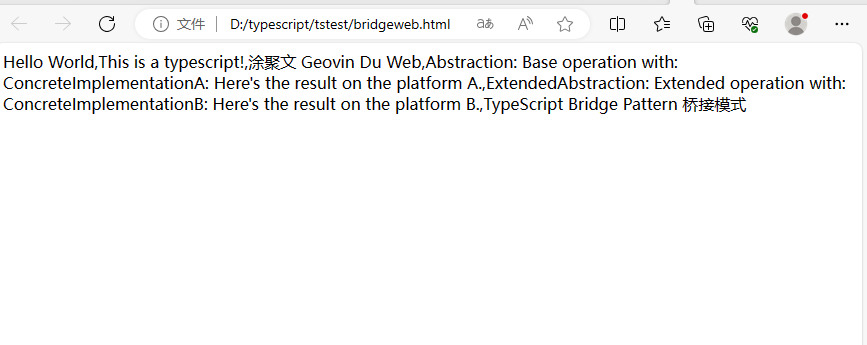
let messagebridge: string = 'Hello World,This is a typescript!,涂聚文 Geovin Du Web';
document.body.innerHTML = messagebridge+","+sbridge1+","+sbridge2+",TypeScript Bridge Pattern 桥接模式"
调用:
<!doctype html>
<html lang="en">
<head>
  <meta charset="UTF-8">
  <meta name="viewport"
        content="width=device-width, user-scalable=no, initial-scale=1.0, maximum-scale=1.0, minimum-scale=1.0">
  <meta http-equiv="X-UA-Compatible" content="ie=edge">
    <head><title>TypeScript:桥接模式</title>
      <meta name="Description" content="geovindu,涂聚文,Geovin Du"/>
<meta name="Keywords" content="geovindu,涂聚文,Geovin Du"/>
<meta name="author" content="geovindu,涂聚文,Geovin Du"/>
    </head>
    <body>
        <script src="dist/Bridgets.js"></script>
    </body>
</html>
输出:
哲学管理(学)人生, 文学艺术生活, 自动(计算机学)物理(学)工作, 生物(学)化学逆境, 历史(学)测绘(学)时间, 经济(学)数学金钱(理财), 心理(学)医学情绪, 诗词美容情感, 美学建筑(学)家园, 解构建构(分析)整合学习, 智商情商(IQ、EQ)运筹(学)生存.---Geovin Du(涂聚文)

 浙公网安备 33010602011771号