

typescript: Abstract Factory pattern
/**
 * file: factory.ts
 * 抽象工厂
 * The Abstract Factory interface declares a set of methods that return
 * different abstract products. These products are called a family and are
 * related by a high-level theme or concept. Products of one family are usually
 * able to collaborate among themselves. A family of products may have several
 * variants, but the products of one variant are incompatible with products of
 * another.
 */
interface AbstractFactory {
    createProductA(): AbstractProductA;

    createProductB(): AbstractProductB;
}

/**
 * Concrete Factories produce a family of products that belong to a single
 * variant. The factory guarantees that resulting products are compatible. Note
 * that signatures of the Concrete Factory's methods return an abstract product,
 * while inside the method a concrete product is instantiated.
 */
class ConcreteFactory1 implements AbstractFactory {
    public createProductA(): AbstractProductA {
        return new ConcreteProductA1();
    }

    public createProductB(): AbstractProductB {
        return new ConcreteProductB1();
    }
}

/**
 * Each Concrete Factory has a corresponding product variant.
 */
class ConcreteFactory2 implements AbstractFactory {
    public createProductA(): AbstractProductA {
        return new ConcreteProductA2();
    }

    public createProductB(): AbstractProductB {
        return new ConcreteProductB2();
    }
}

/**
 * Each distinct product of a product family should have a base interface. All
 * variants of the product must implement this interface.
 */
interface AbstractProductA {
    usefulFunctionA(): string;
}

/**
 * These Concrete Products are created by corresponding Concrete Factories.
 */
class ConcreteProductA1 implements AbstractProductA {
    public usefulFunctionA(): string {
        return 'The result of the product A1.';
    }
}

class ConcreteProductA2 implements AbstractProductA {
    public usefulFunctionA(): string {
        return 'The result of the product A2.';
    }
}

/**
 * Here's the the base interface of another product. All products can interact
 * with each other, but proper interaction is possible only between products of
 * the same concrete variant.
 */
interface AbstractProductB {
    /**
     * Product B is able to do its own thing...
     */
    usefulFunctionB(): string;

    /**
     * ...but it also can collaborate with the ProductA.
     *
     * The Abstract Factory makes sure that all products it creates are of the
     * same variant and thus, compatible.
     */
    anotherUsefulFunctionB(collaborator: AbstractProductA): string;
}

/**
 * These Concrete Products are created by corresponding Concrete Factories.
 */
class ConcreteProductB1 implements AbstractProductB {

    public usefulFunctionB(): string {
        return 'The result of the product B1.';
    }

    /**
     * The variant, Product B1, is only able to work correctly with the variant,
     * Product A1. Nevertheless, it accepts any instance of AbstractProductA as
     * an argument.
     */
    public anotherUsefulFunctionB(collaborator: AbstractProductA): string {
        const result = collaborator.usefulFunctionA();
        return `The result of the B1 collaborating with the (${result})`;
    }
}

class ConcreteProductB2 implements AbstractProductB {

    public usefulFunctionB(): string {
        return 'The result of the product B2.';
    }

    /**
     * The variant, Product B2, is only able to work correctly with the variant,
     * Product A2. Nevertheless, it accepts any instance of AbstractProductA as
     * an argument.
     */
    public anotherUsefulFunctionB(collaborator: AbstractProductA): string {
        const result = collaborator.usefulFunctionA();
        return `The result of the B2 collaborating with the (${result})`;
    }
}

/**
 * The client code works with factories and products only through abstract
 * types: AbstractFactory and AbstractProduct. This lets you pass any factory or
 * product subclass to the client code without breaking it.
 */
function clientCodeFact(factory: AbstractFactory) {
    const productA = factory.createProductA();
    const productB = factory.createProductB();

    console.log(productB.usefulFunctionB());
    console.log(productB.anotherUsefulFunctionB(productA));
    return productA.usefulFunctionA();
}

/**
 * The client code can work with any concrete factory class.
 */
console.log('Client: Testing client code with the first factory type...');
clientCodeFact(new ConcreteFactory1());

console.log('');

console.log('Client: Testing the same client code with the second factory type...');
clientCodeFact(new ConcreteFactory2());

let pub1:string=clientCodeFact(new ConcreteFactory1());
let pub2:string=clientCodeFact(new ConcreteFactory2());

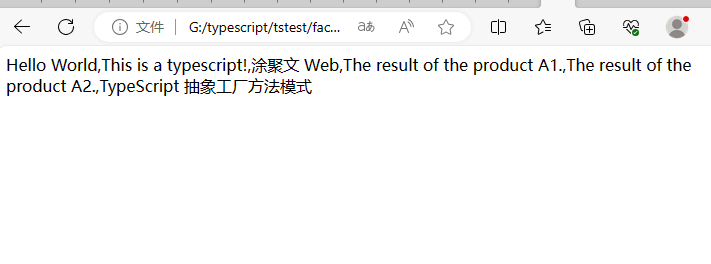
let messagefactory: string = 'Hello World,This is a typescript!,涂聚文 Web';
document.body.innerHTML = messagefactory+","+pub1+","+pub2+",TypeScript 抽象工厂方法模式"
调用:
<!doctype html>
<html lang="en">
<head>
  <meta charset="UTF-8">
  <meta name="viewport"
        content="width=device-width, user-scalable=no, initial-scale=1.0, maximum-scale=1.0, minimum-scale=1.0">
  <meta http-equiv="X-UA-Compatible" content="ie=edge">
    <head><title>TypeScript Hello Web</title>
      <meta name="Description" content="geovindu,涂聚文,Geovin Du"/>
<meta name="Keywords" content="geovindu,涂聚文,Geovin Du"/>
<meta name="author" content="geovindu,涂聚文,Geovin Du"/>
    </head>
    <body>
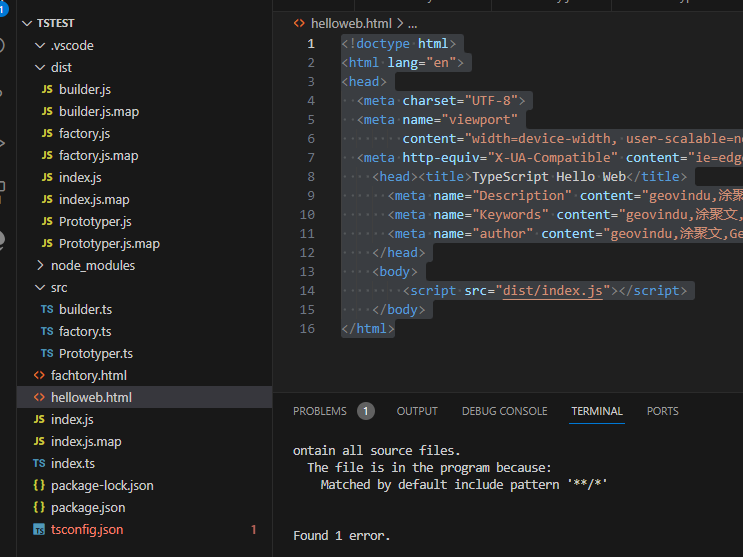
        <script src="dist/factory.js"></script>
    </body>
</html>
输出:
哲学管理(学)人生, 文学艺术生活, 自动(计算机学)物理(学)工作, 生物(学)化学逆境, 历史(学)测绘(学)时间, 经济(学)数学金钱(理财), 心理(学)医学情绪, 诗词美容情感, 美学建筑(学)家园, 解构建构(分析)整合学习, 智商情商(IQ、EQ)运筹(学)生存.---Geovin Du(涂聚文)

 浙公网安备 33010602011771号