

python: Algorithm II
# encoding: utf-8
# 版权所有 2023 ©涂聚文有限公司
# 许可信息查看:
# 描述: Dijkstras Algorithm in Python 迪杰斯特拉算法 最短路径算法
# Author    : geovindu,Geovin Du 涂聚文.
# IDE       : PyCharm 2023.1 python 311
# Datetime  : 2023/9/26 16:38
# User      : geovindu
# Product   : PyCharm
# Project   : EssentialAlgorithms
# File      : DijkstrasAlgorithm.py
# explain   : 学习

import sys


class DijkstrasAlgorithm(object):
    """
    Dijkstra's Algorithm
    """

    # Find which vertex is to be visited next
    def to_be_visited(vertices:list,edges:list):
        """
        :param vertices
        :param edges:
        :return:
        """
        global visited_and_distance
        global num_of_vertices
        v = -10
        for index in range(num_of_vertices):
            if visited_and_distance[index][0] == 0 \
                    and (v < 0 or visited_and_distance[index][1] <=
                         visited_and_distance[v][1]):
                v = index
        return v
    def Dijkstras(vertices:list,edges:list):
        """
        Dijkstra's Algorithm
        :param vertices
        :param edges:
        :return:
        """
        global visited_and_distance
        global num_of_vertices

        num_of_vertices = len(vertices[0])

        visited_and_distance = [[0, 0]]
        for i in range(num_of_vertices - 1):
            visited_and_distance.append([0, sys.maxsize])

        for vertex in range(num_of_vertices):

            # Find next vertex to be visited
            to_visit = DijkstrasAlgorithm.to_be_visited(vertices,edges)
            for neighbor_index in range(num_of_vertices):

                # Updating new distances
                if vertices[to_visit][neighbor_index] == 1 and \
                        visited_and_distance[neighbor_index][0] == 0:
                    new_distance = visited_and_distance[to_visit][1] \
                                   + edges[to_visit][neighbor_index]
                    if visited_and_distance[neighbor_index][1] > new_distance:
                        visited_and_distance[neighbor_index][1] = new_distance

                visited_and_distance[to_visit][0] = 1

        i = 0

        # Printing the distance
        for distance in visited_and_distance:
            print("Dijkstra's Algorithm Distance of ", chr(ord('a') + i),
                  " from source vertex: ", distance[1])
            i = i + 1
# encoding: utf-8
# 版权所有 2023 ©涂聚文有限公司
# 许可信息查看: Ford-Fulkerson Algorithm
# 描述:Ford-Fulkerson算法(FFA)是一种 贪婪算法 ,用于计算流网络中的最大流量
# Author    : geovindu,Geovin Du 涂聚文.
# IDE       : PyCharm 2023.1 python 311
# Datetime  : 2023/9/26 15:27
# User      : geovindu
# Product   : PyCharm
# Project   : EssentialAlgorithms
# File      : FordFulkersonAlgorithm.py
# explain   : 学习

from collections import defaultdict

# Ford-Fulkerson algorith in Python

from collections import defaultdict


class Graph:
    """
    Ford-Fulkerson Algorithm
    """
    def __init__(self, graph):
        """

        :param graph:
        """
        self.graph = graph
        self. ROW = len(graph)


    # Using BFS as a searching algorithm
    def searching_algo_BFS(self, s, t, parent):
        """

        :param s:
        :param t:
        :param parent:
        :return:
        """

        visited = [False] * (self.ROW)
        queue = []

        queue.append(s)
        visited[s] = True

        while queue:

            u = queue.pop(0)

            for ind, val in enumerate(self.graph[u]):
                if visited[ind] == False and val > 0:
                    queue.append(ind)
                    visited[ind] = True
                    parent[ind] = u

        return True if visited[t] else False

    # Applying fordfulkerson algorithm
    def ford_fulkerson(self, source, sink):
        """

        :param source:
        :param sink:
        :return:
        """
        parent = [-1] * (self.ROW)
        max_flow = 0

        while self.searching_algo_BFS(source, sink, parent):

            path_flow = float("Inf")
            s = sink
            while(s != source):
                path_flow = min(path_flow, self.graph[parent[s]][s])
                s = parent[s]

            # Adding the path flows
            max_flow += path_flow

            # Updating the residual values of edges
            v = sink
            while(v != source):
                u = parent[v]
                self.graph[u][v] -= path_flow
                self.graph[v][u] += path_flow
                v = parent[v]

        return max_flow
# encoding: utf-8
# 版权所有 2023 ©涂聚文有限公司
# 许可信息查看:Kruskal’s Minimum Spanning Tree (MST) Algorithm Kruskal Algorithm kruskal算法(克鲁斯卡尔算法)
# 描述: https://www.geeksforgeeks.org/kruskals-minimum-spanning-tree-algorithm-greedy-algo-2/
# https://www.programiz.com/dsa/kruskal-algorithm
# Author    : geovindu,Geovin Du 涂聚文.
# IDE       : PyCharm 2023.1 python 311
# Datetime  : 2023/9/26 14:13
# User      : geovindu
# Product   : PyCharm
# Project   : EssentialAlgorithms
# File      : KruskalAlgorithm.py
# explain   : 学习

import sys
import os

class Graph(object):
    """
    Kruskal Algorithm kruskal算法(克鲁斯卡尔算法)
    """
    def __init__(self, vertices):
        """

        :param vertices:
        """
        self.V = vertices
        self.graph = []

    def addEdge(self, u, v, w):
        """

        :param u:
        :param v:
        :param w:
        :return:
        """
        self.graph.append([u, v, w])

    # Search function

    def find(self, parent, i):
        """

        :param parent:
        :param i:
        :return:
        """
        if parent[i] == i:
            return i
        return self.find(parent, parent[i])

    def applyUnion(self, parent, rank, x, y):
        """

        :param parent:
        :param rank:
        :param x:
        :param y:
        :return:
        """
        xroot = self.find(parent, x)
        yroot = self.find(parent, y)
        if rank[xroot] < rank[yroot]:
            parent[xroot] = yroot
        elif rank[xroot] > rank[yroot]:
            parent[yroot] = xroot
        else:
            parent[yroot] = xroot
            rank[xroot] += 1

    #  Applying Kruskal algorithm
    def kruskalAlgo(self):
        """

        :return:
        """
        result = []
        i, e = 0, 0
        self.graph = sorted(self.graph, key=lambda item: item[2])
        parent = []
        rank = []
        for node in range(self.V):
            parent.append(node)
            rank.append(0)
        while e < self.V - 1:
            u, v, w = self.graph[i]
            i = i + 1
            x = self.find(parent, u)
            y = self.find(parent, v)
            if x != y:
                e = e + 1
                result.append([u, v, w])
                self.applyUnion(parent, rank, x, y)
        print("克鲁斯卡尔算法 Kruskal Algorithm\n")
        for u, v, weight in result:
            print("%d - %d: %d" % (u, v, weight))
# encoding: utf-8
# 版权所有 2023 ©涂聚文有限公司
# 许可信息查看:
# 描述:
# Author    : geovindu,Geovin Du 涂聚文.
# IDE       : PyCharm 2023.1 python 311
# Datetime  : 2023/9/28 8:32
# User      : geovindu
# Product   : PyCharm
# Project   : EssentialAlgorithms
# File      : HuffmanAlgorithm.py
# explain   : 学习

import ChapterOne.NodeTree


class HuffmanAlgorithm(object):
    """
    Huffman code 霍夫曼编码

    """


    @staticmethod
    def HuffmanCodeTree(node:ChapterOne.NodeTree.NodeTree, left=True, binString=''):
        """

        :param left:
        :param binString:
        :return:
        """
        if type(node) is str:
            return {node: binString}
        (l, r) = node.children()
        d = dict()
        d.update(HuffmanAlgorithm.HuffmanCodeTree(l, True, binString + '0'))
        d.update(HuffmanAlgorithm.HuffmanCodeTree(r, False, binString + '1'))
        return d
# encoding: utf-8
# 版权所有 2023 ©涂聚文有限公司
# 许可信息查看:Prim's Algorithm
# 描述:
# Author    : geovindu,Geovin Du 涂聚文.
# IDE       : PyCharm 2023.1 python 311
# Datetime  : 2023/9/26 17:18
# User      : geovindu
# Product   : PyCharm
# Project   : EssentialAlgorithms
# File      : PrimsAlgorithm.py
# explain   : 学习
import sys


class Graph(object):
    """
    Prim's Algorithm
    """
    def __init__(self, vertices):
        """

        :param vertices:
        """
        self.V = vertices
        self.graph = [[0 for column in range(vertices)]
                      for row in range(vertices)]

    # A utility function to print
    # the constructed MST stored in parent[]
    def printMST(self, parent):
        """

        :param parent:
        :return:
        """
        print("Edge \tWeight")
        for i in range(1, self.V):
            print(parent[i], "-", i, "\t", self.graph[i][parent[i]])

    # A utility function to find the vertex with
    # minimum distance value, from the set of vertices
    # not yet included in shortest path tree
    def minKey(self, key, mstSet):
        """

        :param key:
        :param mstSet:
        :return:
        """

        # Initialize min value
        min = sys.maxsize

        for v in range(self.V):
            if key[v] < min and mstSet[v] == False:
                min = key[v]
                min_index = v

        return min_index

    # Function to construct and print MST for a graph
    # represented using adjacency matrix representation
    def primMST(self):
        """

        :return:
        """

        # Key values used to pick minimum weight edge in cut
        key = [sys.maxsize] * self.V
        parent = [None] * self.V  # Array to store constructed MST
        # Make key 0 so that this vertex is picked as first vertex
        key[0] = 0
        mstSet = [False] * self.V

        parent[0] = -1  # First node is always the root of

        for cout in range(self.V):

            # Pick the minimum distance vertex from
            # the set of vertices not yet processed.
            # u is always equal to src in first iteration
            u = self.minKey(key, mstSet)

            # Put the minimum distance vertex in
            # the shortest path tree
            mstSet[u] = True

            # Update dist value of the adjacent vertices
            # of the picked vertex only if the current
            # distance is greater than new distance and
            # the vertex in not in the shortest path tree
            for v in range(self.V):

                # graph[u][v] is non zero only for adjacent vertices of m
                # mstSet[v] is false for vertices not yet included in MST
                # Update the key only if graph[u][v] is smaller than key[v]
                if self.graph[u][v] > 0 and mstSet[v] == False \
                        and key[v] > self.graph[u][v]:
                    key[v] = self.graph[u][v]
                    parent[v] = u

        self.printMST(parent)

    @staticmethod
    def PrimsTwo():
        """

        :return:
        """
        INF = 9999999
        # number of vertices in graph
        V = 5
        # create a 2d array of size 5x5
        # for adjacency matrix to represent graph
        G = [[0, 9, 75, 0, 0],
             [9, 0, 95, 19, 42],
             [75, 95, 0, 51, 66],
             [0, 19, 51, 0, 31],
             [0, 42, 66, 31, 0]]
        # create a array to track selected vertex
        # selected will become true otherwise false
        selected = [0, 0, 0, 0, 0]
        # set number of edge to 0
        no_edge = 0
        # the number of egde in minimum spanning tree will be
        # always less than(V - 1), where V is number of vertices in
        # graph
        # choose 0th vertex and make it true
        selected[0] = True
        # print for edge and weight
        print("Edge : Weight\n")
        while (no_edge < V - 1):
            # For every vertex in the set S, find the all adjacent vertices
            # , calculate the distance from the vertex selected at step 1.
            # if the vertex is already in the set S, discard it otherwise
            # choose another vertex nearest to selected vertex  at step 1.
            minimum = INF
            x = 0
            y = 0
            for i in range(V):
                if selected[i]:
                    for j in range(V):
                        if ((not selected[j]) and G[i][j]):
                            # not in selected and there is an edge
                            if minimum > G[i][j]:
                                minimum = G[i][j]
                                x = i
                                y = j
            print(str(x) + "-" + str(y) + ":" + str(G[x][y]))
            selected[y] = True
            no_edge += 1
# encoding: utf-8
# 版权所有 2023 ©涂聚文有限公司
# 许可信息查看:
# 描述:         Kruskal Algorithm kruskal算法(克鲁斯卡尔算法)
# Author    : geovindu,Geovin Du 涂聚文.
# IDE       : PyCharm 2023.1 python 311
# Datetime  : 2023/9/26 14:16
# User      : geovindu
# Product   : PyCharm
# Project   : EssentialAlgorithms
# File      : AlgorithmExample.py
# explain   : 学习

import ChapterOne.KruskalAlgorithm
import ChapterOne.FordFulkersonAlgorithm
import ChapterOne.DijkstrasAlgorithm
import ChapterOne.PrimsAlgorithm
import ChapterOne.HuffmanAlgorithm
import ChapterOne.NodeTree


class AlExample(object):
    """

    """
    def Krusal(self):
        """
        Kruskal Algorithm kruskal算法(克鲁斯卡尔算法)
        :return:
        """
        g = ChapterOne.KruskalAlgorithm.Graph(6)
        g.addEdge(0, 1, 4)
        g.addEdge(0, 2, 4)
        g.addEdge(1, 2, 2)
        g.addEdge(1, 0, 4)
        g.addEdge(2, 0, 4)
        g.addEdge(2, 1, 2)
        g.addEdge(2, 3, 3)
        g.addEdge(2, 5, 2)
        g.addEdge(2, 4, 4)
        g.addEdge(3, 2, 3)
        g.addEdge(3, 4, 3)
        g.addEdge(4, 2, 4)
        g.addEdge(4, 3, 3)
        g.addEdge(5, 2, 2)
        g.addEdge(5, 4, 3)
        g.kruskalAlgo()

    def FoordFulkerson(self):
        """
        Ford-Fulkerson Algorithm
        :return:
        """
        graph = [[0, 8, 0, 0, 3, 0],
                 [0, 0, 9, 0, 0, 0],
                 [0, 0, 0, 0, 7, 2],
                 [0, 0, 0, 0, 0, 5],
                 [0, 0, 7, 4, 0, 0],
                 [0, 0, 0, 0, 0, 0]]

        g = ChapterOne.FordFulkersonAlgorithm.Graph(graph)

        source = 0
        sink = 5
        print("Ford-Fulkerson Algorithm:\n")
        print("Max Flow: %d " % g.ford_fulkerson(source, sink))

    def Dijkstras(self):
        """
        Dijkstra's Algorithm 迪杰斯特拉算法 最短路径算法
        :return:
        """
        vertices = [[0, 0, 1, 1, 0, 0, 0],
                    [0, 0, 1, 0, 0, 1, 0],
                    [1, 1, 0, 1, 1, 0, 0],
                    [1, 0, 1, 0, 0, 0, 1],
                    [0, 0, 1, 0, 0, 1, 0],
                    [0, 1, 0, 0, 1, 0, 1],
                    [0, 0, 0, 1, 0, 1, 0]]

        edges = [[0, 0, 1, 2, 0, 0, 0],
                 [0, 0, 2, 0, 0, 3, 0],
                 [1, 2, 0, 1, 3, 0, 0],
                 [2, 0, 1, 0, 0, 0, 1],
                 [0, 0, 3, 0, 0, 2, 0],
                 [0, 3, 0, 0, 2, 0, 1],
                 [0, 0, 0, 1, 0, 1, 0]]
        ChapterOne.DijkstrasAlgorithm.DijkstrasAlgorithm.Dijkstras(vertices,edges)

    def Prim(self):
        """
        Prim's Algorithm
        :return:
        """
        g = ChapterOne.PrimsAlgorithm.Graph(5)
        g.graph = [[0, 2, 0, 6, 0],
                   [2, 0, 3, 8, 5],
                   [0, 3, 0, 0, 7],
                   [6, 8, 0, 0, 9],
                   [0, 5, 7, 9, 0]]

        g.primMST()
    def PrimTwo(self):
        """

        :return:
        """
        ChapterOne.PrimsAlgorithm.Graph.PrimsTwo()


    def Huffman(self):
        """
        Huffman Coding  霍夫曼编码
        :return:
        """
        string = 'BCAADDDCCACACAC'
        # Calculating frequency
        freq = {}
        for c in string:
            if c in freq:
                freq[c] += 1
            else:
                freq[c] = 1

        freq = sorted(freq.items(), key=lambda x: x[1], reverse=True)

        nodes = freq

        while len(nodes) > 1:
            (key1, c1) = nodes[-1]
            (key2, c2) = nodes[-2]
            nodes = nodes[:-2]
            node = ChapterOne.NodeTree.NodeTree(key1, key2)
            nodes.append((node, c1 + c2))

            nodes = sorted(nodes, key=lambda x: x[1], reverse=True)

        huffmanCode = ChapterOne.HuffmanAlgorithm.HuffmanAlgorithm.HuffmanCodeTree(nodes[0][0])

        print(' Char | Huffman code 霍夫曼编码\n')
        print('----------------------')
        for (char, frequency) in freq:
            print(' %-4r |%12s' % (char, huffmanCode[char]))
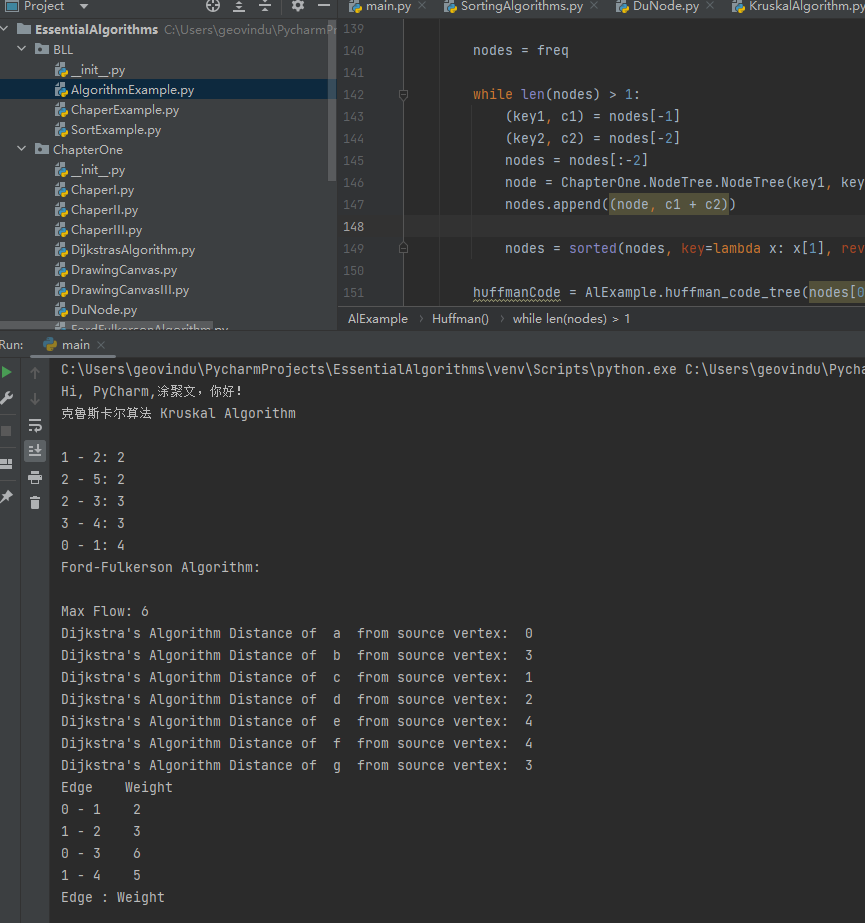
调用:
    al=BLL.AlgorithmExample.AlExample()
    al.Krusal()
    al.FoordFulkerson()
    al.Dijkstras()
    al.Prim()
    al.PrimTwo()
    al.Huffman()

哲学管理(学)人生, 文学艺术生活, 自动(计算机学)物理(学)工作, 生物(学)化学逆境, 历史(学)测绘(学)时间, 经济(学)数学金钱(理财), 心理(学)医学情绪, 诗词美容情感, 美学建筑(学)家园, 解构建构(分析)整合学习, 智商情商(IQ、EQ)运筹(学)生存.---Geovin Du(涂聚文)

 浙公网安备 33010602011771号