

【C++】第十二节—详解list(list的介绍和使用、模拟完成)
Hi,我是云边有个稻草人^(* ̄(oo) ̄)^,与你分享所学知识

目录
【补充1】——push_back类和emplace_back类的区别
【vector下和list下sort性能的区别—Release】
正文开始——
一、list的介绍和使用
1.1 list的介绍—带头双向循环链表
1.2 list的使用
list中的接口比较多,此处类似,只需要掌握如何正确的使用,然后再去深入研究背后的原理,已达到可扩展的能力。以下为list中一些常见的重要接口。
(1)list的构造
| 构造函数 | 接口说明 |
|---|---|
| list (size_type n, const value_type& val = value_type()) | 构造的list中包含n个值为val的元素 |
| list() | 构造空的list |
| list (const list& x) | 拷贝构造函数 |
| list (InputIterator first, InputIterator last) | 用[first, last)区间中的元素构造 list |
(2)list iterator的使用
此处,大家可暂时将迭代器理解成一个指针,该指针指向list中的某个节点。
函数声明 | 接口说明 |
|---|---|
| begin()+end() | 返回第一个元素的迭代器+返回最后一个元素下一个位置的迭代器 |
| rbegin()+rend() | 返回第一个元素的reverse_iterator,即end位置,返回最后一个元素下一个位 置的reverse_iterator,即begin位置 |
【注意】
- begin与end为正向迭代器,对迭代器执行++操作,迭代器向后移动
- rbegin(end)与rend(begin)为反向迭代器,对迭代器执行++操作,迭代器向前移动
(3)list capacity
| 函数说明 | 接口说明 |
|---|---|
| empty | 检测list是否为空,是返回true,否则返回false |
| size | 返回list中有效节点的个数 |
(4)list element access
| 函数说明 | 接口说明 |
|---|---|
| front | 返回list的第一个节点中值的引用 |
| back | 返回list的最后一个节点中值的引用 |
(5)list modifiers
| 函数说明 | 接口说明 |
|---|---|
| push_front | 在list首元素前插入值为val的元素 |
| pop_front | 删除list中第一个元素 |
| push_back | 在list尾部插入值为val的元素 |
| pop_back | 删除list中最后一个元素 |
| insert | 在list position 位置中插入值为val的元素 |
| erase | 删除list position位置的元素 |
| swap | 交换两个list中的元素 |
| clear | 清空list中的有效元素 |
【补充1】——push_back类和emplace_back类的区别
(这里涉及到前面几节所讲的拷贝构造,隐式类型转换,直接构造啥的,要是忘记了就,反正我是痛苦。复习回来啦,我爱C++)


int main()
{
list lt;
Pos p1(1, 1);
//构造+拷贝构造
lt.push_back(p1);//有名对象,先创建一个对象,再将对象进行push_back
lt.push_back(Pos(2, 2));//匿名对象
lt.push_back({ 2,2 });//隐式类型转换
lt.emplace_back(p1);//那是一个模版,传一个Pos类型的对象,模版参数推出形参的类型为Pos
lt.emplace_back(Pos(2,2));//对于匿名对象,emplace_back的模版参数也可以推导出为Pos类型
//lt.emplace_back({ 2,2 });
//直接构造
lt.emplace_back(3, 3);//但是可以支持这样玩,直接将初始化pos的值给它传过去
return 0;
} - 下面的拷贝构造,是将形参的pos拷贝构造到链表中的节点里面
- lt.push_back({1,1});//本质是隐式类型转换—>这里也是构造+拷贝构造(隐式类型转换,实参传给形参,先用(1,1)构造一个临时对象,形参引用的是临时对象,这种场景下就解释了为什么形参的部分要加上const,因为它引用的临时对象具有常性!)
- lt.emplace_back(1, 1);//不仅仅可以传pos类型的对象,也可以传构造链表里面pos的参数直接最后去构造pos,所以形参也叫可变模版参数
所以相比于push_back,emplace_back的高效之处仅在于直接构造的那种情况!

【补充2】vector和list使用sort的区别
int main()
{
		list lt1 = { -1,90,100,-8,34 };
		for (auto e : lt1)
		{
			cout << e << " ";
		}
		cout << endl;
		//排序sort,默认是升序,less
		lt1.sort();
		for (auto e : lt1)
		{
			cout << e << " ";
		}
		cout << endl;
		//排降序 >
		greater gt;//有名对象做实参,干脆直接用匿名对象:lt1.sort(greater());
		lt1.sort(gt);
		for (auto e : lt1)
		{
			cout << e << " ";
		}
		cout << endl;
		//对于vector,算法库里面有现成的sort,现在试用一下
		vector v1 = { 1,3,-2,90,9 };
		for (auto e : v1)
		{
			cout << e << " ";
		}
		cout << endl;
		//默认是升序
		//sort(v1.begin(), v1.end());
		sort(v1.begin(), v1.end(), greater());//现在加入仿函数,> 是降序
		for (auto e : v1)
		{
			cout << e << " ";
		}
		cout << endl;
		//但是list就不可以使用算法库里面的sort,只能用STL里面的sort
		//sort(lt1.begin(), lt2.end(), greater());
		return 0;
}
运行结果见下:
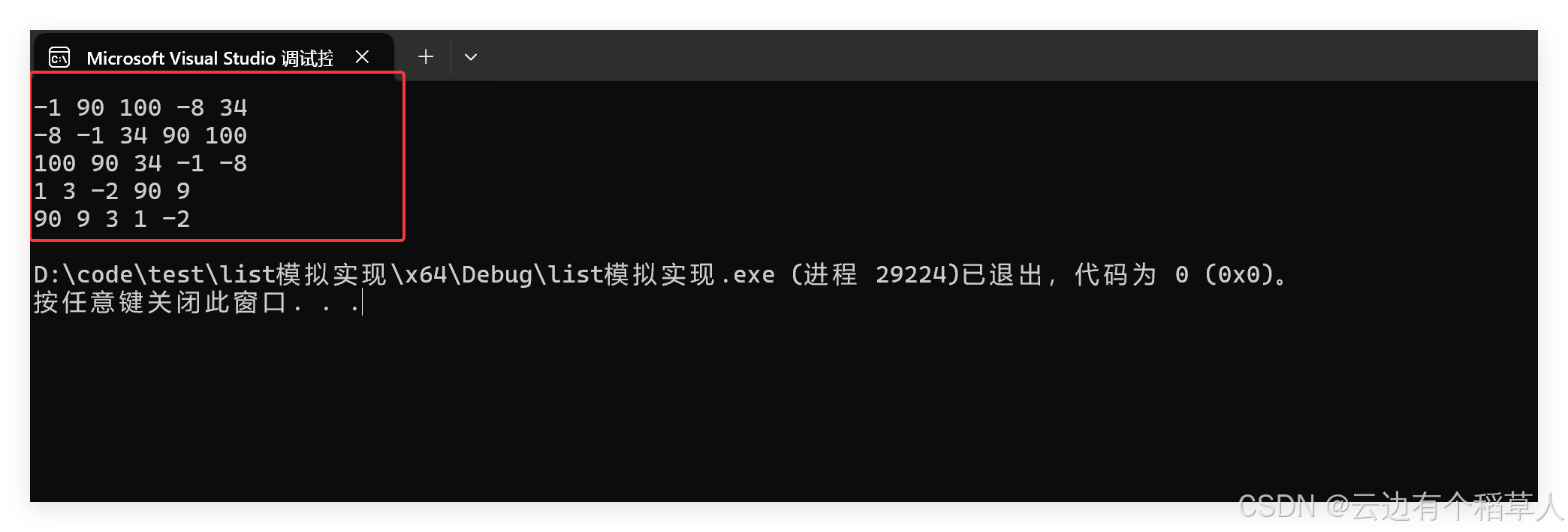
(vector的sort底层是递归,算法库里面的sort底层是归并)

【vector下和list下sort性能的区别—Release】
下面是在Release下,对vector使用算法库里面的sort和list使用自己实现的sort各自效率的测试
void test_op1()
{
	srand((unsigned int)time(0));
	const int N = 1000000;
	list lt1;
	list lt2;
	vector v;
	for (int i = 0; i < N; i++)
	{
		auto e = rand() + i;
		lt1.push_back(e);
		v.push_back(e);
	}
	int begin1 = clock();
	//排序,用算法库里面的sort给vector排序
	sort(v.begin(), v.end());
	int end1 = clock();
	int begin2 = clock();
	lt1.sort();//默认排升序
	int end2 = clock();
	cout << "vector sort:" << end1 - begin1 << endl;
	cout << "list sort:" << end2 - begin2 << endl;
}
void test_op2()
{
	srand((unsigned int)time(0));
	const int N = 1000000;
	list lt1;
	list lt2;
	for (size_t i = 0; i < N; i++)
	{
		auto e = rand();
		lt1.push_back(e);
		lt2.push_back(e);
	}
	int begin1 = clock();
	//拷贝vector
	vector v(lt2.begin(), lt2.end());//用迭代器区间进行构造
	sort(v.begin(), v.end());
	//拷贝回lt2
	lt2.assign(v.begin(), v.end());
	int end1 = clock();
	int begin2 = clock();
	lt1.sort();
	int end2 = clock();
	cout << "vector sort(copy):" << end1 - begin1 << endl;
	cout << "list sort:" << end2 - begin2 << endl;
}
int main()
{
	test_op1();
	test_op2();
	return 0;
}
运行结果如下:显而易,要排序的话最好使用vector,vector排序的效率更高!

list中还有一些操作,需要用到时大家可参阅list的文档说明。
1.3 关于上面list的使用所写的全部代码
#include
#include
#include
#include
using namespace std;
int main()
{
	list lt1;
	lt1.push_back(1);
	lt1.push_back(2);
	lt1.push_back(3);
	lt1.push_back(4);
	lt1.push_back(5);
	list::iterator it1 = lt1.begin();
	while (it1 != lt1.end())
	{
		cout << *it1 << " ";
		it1++;
	}
	cout << endl;
	list lt2 = { 1,2,3,4,5,6 };
	for (auto e : lt2)
	{
		cout << e << " ";
	}
	cout << endl;
	return 0;
}
class Pos
{
	int _row;
	int _col;
public:
	Pos(int row, int col)
		:_row(row)
		, _col(col)
	{ }
};
int main()
{
	list lt;
	Pos p1(1, 1);
	//构造+拷贝构造
	lt.push_back(p1);//有名对象,先创建一个对象,再将对象进行push_back
	lt.push_back(Pos(2, 2));//匿名对象
	lt.push_back({ 2,2 });//隐式类型转换
	lt.emplace_back(p1);//那是一个模版,传一个Pos类型的对象,模版参数推出形参的类型为Pos
	lt.emplace_back(Pos(2,2));//对于匿名对象,emplace_back的模版参数也可以推导出为Pos类型
	//lt.emplace_back({ 2,2 });
	//直接构造
	lt.emplace_back(3, 3);
	return 0;
}
int main()
{
	list lt1 = { 1,2,3,4,5 };
	for (auto e : lt1)
	{
		cout << e << " ";
	}
	cout << endl;
	int x;
	cin >> x;
	auto it = find(lt1.begin(), lt1.end(), x);
	if (it != lt1.end())
	{
		lt1.erase(it);
	}
	for (auto e : lt1)
	{
		cout << e << " ";
	}
	cout << endl;
	//逆置
	lt1.reverse();
	for (auto e : lt1)
	{
		cout << e << " ";
	}
	cout << endl;
	return 0;
}
int main()
{
	list lt1 = { 1,2,3,4,5,6 };
	//LRU最近最少用,将最近最少使用的调到前面去
	int x;
	while (cin >> x)
	{
		auto pos = find(lt1.begin(), lt1.end(), x);//直接调用算法库里面的find
		lt1.splice(lt1.begin(), lt1, pos);//学会查看文档学习这些接口的用法
		for (auto e : lt1)
		{
			cout << e << " ";
		}
		cout << endl;
	}
	return 0;
}
int main()
{
		list lt1 = { -1,90,100,-8,34 };
		for (auto e : lt1)
		{
			cout << e << " ";
		}
		cout << endl;
		//排序sort,默认是升序,less
		lt1.sort();
		for (auto e : lt1)
		{
			cout << e << " ";
		}
		cout << endl;
		//排降序 >
		greater gt;//有名对象做实参,干脆直接用匿名对象:lt1.sort(greater());
		lt1.sort(gt);
		for (auto e : lt1)
		{
			cout << e << " ";
		}
		cout << endl;
		//对于vector,算法库里面有现成的sort,现在试用一下
		vector v1 = { 1,3,-2,90,9 };
		for (auto e : v1)
		{
			cout << e << " ";
		}
		cout << endl;
		//默认是升序
		//sort(v1.begin(), v1.end());
		sort(v1.begin(), v1.end(), greater());//现在加入仿函数,> 是降序
		for (auto e : v1)
		{
			cout << e << " ";
		}
		cout << endl;
		//但是list就不可以使用算法库里面的sort,只能用STL里面的sort
		//sort(lt1.begin(), lt2.end(), greater());
		return 0;
}
void test_op1()
{
	srand((unsigned int)time(0));
	const int N = 1000000;
	list lt1;
	list lt2;
	vector v;
	for (int i = 0; i < N; i++)
	{
		auto e = rand() + i;
		lt1.push_back(e);
		v.push_back(e);
	}
	int begin1 = clock();
	//排序,用算法库里面的sort给vector排序
	sort(v.begin(), v.end());
	int end1 = clock();
	int begin2 = clock();
	lt1.sort();//默认排升序
	int end2 = clock();
	cout << "vector sort:" << end1 - begin1 << endl;
	cout << "list sort:" << end2 - begin2 << endl;
}
void test_op2()
{
	srand((unsigned int)time(0));
	const int N = 1000000;
	list lt1;
	list lt2;
	for (size_t i = 0; i < N; i++)
	{
		auto e = rand();
		lt1.push_back(e);
		lt2.push_back(e);
	}
	int begin1 = clock();
	//拷贝vector
	vector v(lt2.begin(), lt2.end());//用迭代器区间进行构造
	sort(v.begin(), v.end());
	//拷贝回lt2
	lt2.assign(v.begin(), v.end());
	int end1 = clock();
	int begin2 = clock();
	lt1.sort();
	int end2 = clock();
	cout << "vector sort(copy):" << end1 - begin1 << endl;
	cout << "list sort:" << end2 - begin2 << endl;
}
int main()
{
	test_op1();
	test_op2();
	return 0;
}
二、list模拟实现
- const 容器必须使用 const 迭代器进行遍历,const 迭代器不是迭代器本身不能修改而是迭代器指向的内容不能修改
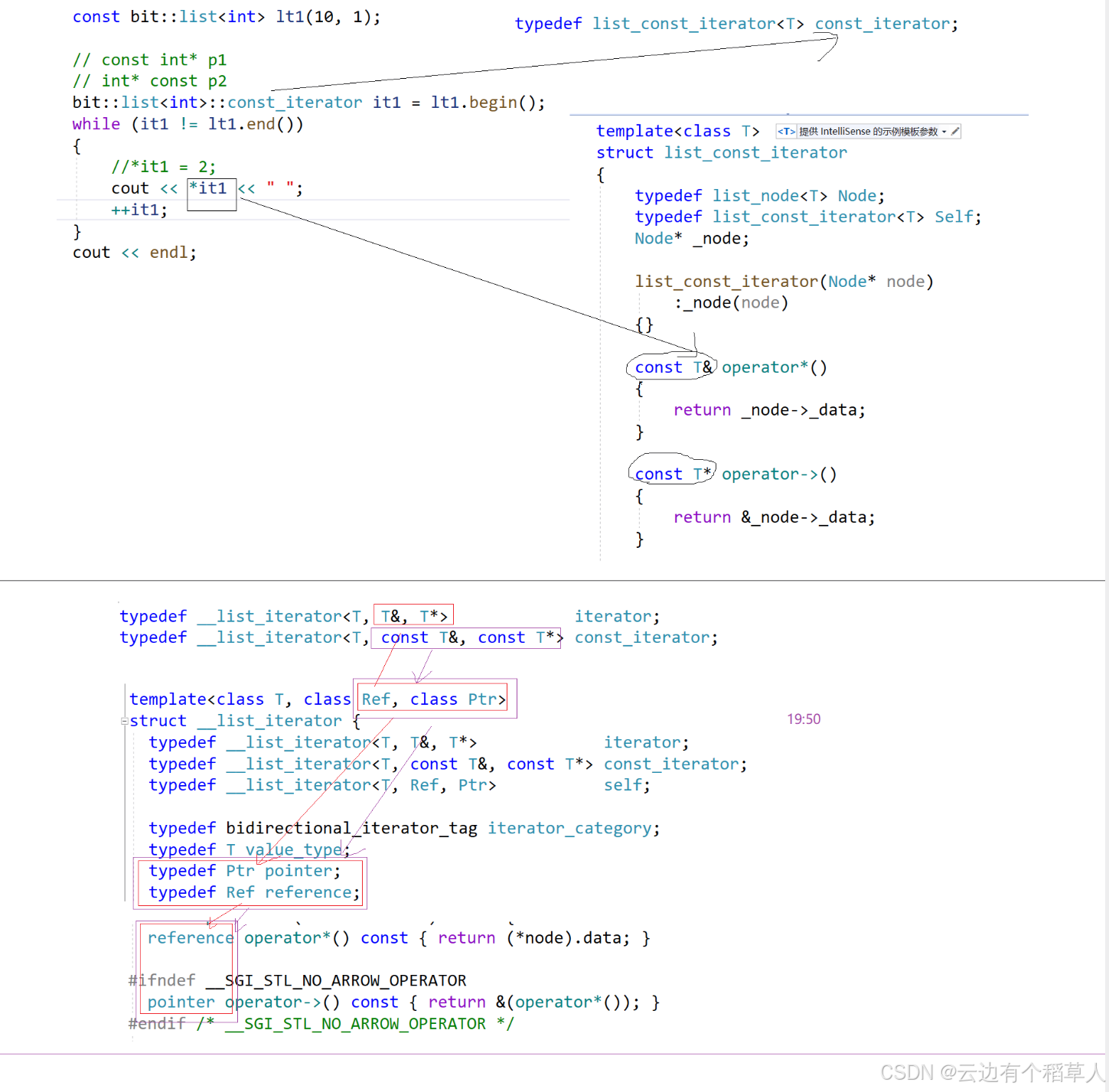
2.1 模拟实现list
要模拟实现list,必须要熟悉list的底层结构以及其接口的含义,通过上面的学习,这些内容已基本掌握,现在我们来模拟实现list。

list.h
#pragma once
#include
namespace bit
{
	// 惯例
	// 全部都是公有,一般用struct
	template
	struct list_node
	{
		T _data;
		list_node* _next;
		list_node* _prev;
		list_node(const T& x = T())
			:_data(x)
			, _next(nullptr)
			, _prev(nullptr)
		{
		}
	};
	// typedef list_iterator iterator;
	// typedef list_iterator const_iterator;
	template
	struct list_iterator
	{
		typedef list_node Node;
		typedef list_iterator Self;
		Node* _node;
		list_iterator(Node* node)
			:_node(node)
		{
		}
		Ref operator*()
		{
			return _node->_data;
		}
		Ptr operator->()
		{
			return &_node->_data;
		}
		Self& operator++()
		{
			_node = _node->_next;
			return *this;
		}
		Self& operator--()
		{
			_node = _node->_prev;
			return *this;
		}
		Self operator++(int)
		{
			Self tmp(*this);
			_node = _node->_next;
			return tmp;
		}
		Self operator--(int)
		{
			Self tmp(*this);
			_node = _node->_prev;
			return tmp;
		}
		bool operator!=(const Self& s)
		{
			return _node != s._node;
		}
		bool operator==(const Self& s)
		{
			return _node == s._node;
		}
	};
	/*template
	struct list_const_iterator
	{
		typedef list_node Node;
		typedef list_const_iterator Self;
		Node* _node;
		list_const_iterator(Node* node)
			:_node(node)
		{}
		const T& operator*()
		{
			return _node->_data;
		}
		const T* operator->()
		{
			return &_node->_data;
		}
		Self& operator++()
		{
			_node = _node->_next;
			return *this;
		}
		Self& operator--()
		{
			_node = _node->_prev;
			return *this;
		}
		Self operator++(int)
		{
			Self tmp(*this);
			_node = _node->_next;
			return tmp;
		}
		Self operator--(int)
		{
			Self tmp(*this);
			_node = _node->_prev;
			return tmp;
		}
		bool operator!=(const Self& s)
		{
			return _node != s._node;
		}
	};*/
	template
	class list
	{
		typedef list_node Node;
	public:
		/*typedef list_iterator iterator;
		typedef list_const_iterator const_iterator;*/
		typedef list_iterator iterator;
		typedef list_iterator const_iterator;
		iterator begin()
		{
			return iterator(_head->_next);
		}
		iterator end()
		{
			return iterator(_head);
		}
		const_iterator begin() const
		{
			return const_iterator(_head->_next);
		}
		const_iterator end() const
		{
			return const_iterator(_head);
		}
		void empty_init()
		{
			_head = new Node();
			_head->_next = _head;
			_head->_prev = _head;
			_size = 0;
		}
		list()
		{
			empty_init();
		}
		// lt2(lt1)
		list(const list& lt)
		{
			empty_init();
			//引用,减少拷贝
			for (auto& e : lt)
			{
				push_back(e);
			}
		}
		//对于类模版而言,类名不能代表类型要加上模版参数,在类里面的时候可以去掉模版参数
		// lt2 = lt3
		//list& operator=(list lt)
		list& operator=(list lt)
		{
			swap(lt);
			return *this;
		}
		//清掉头结点+clear
		~list()
		{
			clear();
			delete _head;
			_head = nullptr;
		}
		void swap(list& tmp)
		{
			std::swap(_head, tmp._head);
			std::swap(_size, tmp._size);
		}
		//清掉所有除头结点之外的节点
		void clear()
		{
			auto it = begin();
			while (it != end())
			{
				it = erase(it);
			}
		}
		list(size_t n, const T& val = T())
		{
			empty_init();
			for (size_t i = 0; i < n; i++)
			{
				push_back(val);
			}
		}
		void push_back(const T& x)
		{
			/*Node* new_node = new Node(x);
			Node* tail = _head->_prev;
			tail->_next = new_node;
			new_node->_prev = tail;
			new_node->_next = _head;
			_head->_prev = new_node;*/
			insert(end(), x);
		}
		void push_front(const T& x)
		{
			insert(begin(), x);
		}
		void pop_front()
		{
			erase(begin());
		}
		void pop_back()
		{
			erase(--end());
		}
		//不会导致迭代器失效
		iterator insert(iterator pos, const T& val)
		{
			Node* cur = pos._node;
			Node* newnode = new Node(val);
			Node* prev = cur->_prev;
			// prev newnode cur
			prev->_next = newnode;
			newnode->_prev = prev;
			newnode->_next = cur;
			cur->_prev = newnode;
			++_size;
			return iterator(newnode);
		}
		//erase会导致迭代器失效
		iterator erase(iterator pos)
		{
			assert(pos != end());
			Node* del = pos._node;
			Node* prev = del->_prev;
			Node* next = del->_next;
			prev->_next = next;
			next->_prev = prev;
			delete del;
			--_size;
			return iterator(next);
		}
	private:
		Node* _head;
		size_t _size;
	};
	template
	void swap(T& a, T& b)
	{
		T c(a); a = b; b = c;
	}
	//bit::swap(i, j);
	//bit::swap(lt1, lt2);此时编译器会调用swap(list)更适配,但是内部调用的是list内部的swap
	//这里是全局提供专给list的swap,但是调用的是list容器内部的swap,就是为了防止误用
	template
	void swap(list& a, list& b)
	{
		a.swap(b);
	}
}
运算符重载-> ,第一个->的结果是Pos*,第二个是找Pos这个结构体里面的_row。

list.cpp
#define _CRT_SECURE_NO_WARNINGS 1
#include
#include
#include
#include
using namespace std;
//int main()
//{
//	list lt1;
//	lt1.push_back(1);
//	lt1.push_back(1);
//	lt1.push_back(1);
//	lt1.push_back(1);
//	lt1.emplace_back(10);
//
//	list lt2 = {1,2,3,4,5};
//
//	list::iterator it1 = lt1.begin();
//	while (it1 != lt1.end())
//	{
//		cout << *it1 << " ";
//		++it1;
//	}
//	cout << endl;
//
//	for (auto e : lt2)
//	{
//		cout << e << " ";
//	}
//	cout << endl;
//
//	return 0;
//}
class Pos
{
public:
	int _row;
	int _col;
	Pos(int row = 0, int col = 0)
		:_row(row)
		, _col(col)
	{
		cout << "Pos(int row, int col)" << endl;
	}
	Pos(const Pos& p)
		:_row(p._row)
		, _col(p._col)
	{
		cout << "Pos(const Pos& p)" << endl;
	}
};
//int main()
//{
//	list lt;
//
//	// 构造+拷贝构造
//	Pos p1(1, 1);
//	lt.push_back(p1);
//	lt.push_back(Pos(2, 2));
//	lt.push_back({3,3});
//
//	lt.emplace_back(p1);
//	lt.emplace_back(Pos(2, 2));
//	//lt.emplace_back({ 3,3 });
//
//	// 直接构造
//	lt.emplace_back(3, 3);
//
//	return 0;
//}
//int main()
//{
//	list lt1 = { 1,2,3,4,5 };
//
//	for (auto e : lt1)
//	{
//		cout << e << " ";
//	}
//	cout << endl;
//
//	int x;
//	cin >> x;
//	auto it = find(lt1.begin(), lt1.end(), x);
//	if (it != lt1.end())
//	{
//		lt1.erase(it);
//	}
//
//	for (auto e : lt1)
//	{
//		cout << e << " ";
//	}
//	cout << endl;
//
//	return 0;
//}
//int main()
//{
//	list lt1 = { 1,2,3,4,5 };
//	// LRU
//	int x;
//
//	while (cin >> x)
//	{
//		auto pos = find(lt1.begin(), lt1.end(), x);
//		if (pos != lt1.end())
//		{
//			lt1.splice(lt1.begin(), lt1, pos);
//		}
//
//		for (auto e : lt1)
//		{
//			cout << e << " ";
//		}
//		cout << endl;
//	}
//
//	cout << "xxxxxxxxxxxxxxxxxxxxxx" << endl;
//
//	return 0;
//}
//int main()
//{
//	list lt1 = { 1,20,3,-4,5 };
//	for (auto e : lt1)
//	{
//		cout << e << " ";
//	}
//	cout << endl;
//
//	// <
//	//lt1.sort();
//	// >
//	/*greater gt;
//	lt1.sort(gt);*/
//	lt1.sort(greater());
//
//	// 不能用
//	//sort(lt1.begin(), lt1.end(), greater());
//	for (auto e : lt1)
//	{
//		cout << e << " ";
//	}
//	cout << endl;
//
//	vector v1 = { 1,20,3,-4,5 };
//	for (auto e : v1)
//	{
//		cout << e << " ";
//	}
//	cout << endl;
//
//	//sort(v1.begin(), v1.end());
//	sort(v1.begin(), v1.end(), greater());
//	for (auto e : v1)
//	{
//		cout << e << " ";
//	}
//	cout << endl;
//
//
//	return 0;
//}
void test_op1()
{
	srand(time(0));
	const int N = 1000000;
	list lt1;
	list lt2;
	vector v;
	for (int i = 0; i < N; ++i)
	{
		auto e = rand() + i;
		lt1.push_back(e);
		v.push_back(e);
	}
	int begin1 = clock();
	// 排序
	sort(v.begin(), v.end());
	int end1 = clock();
	int begin2 = clock();
	lt1.sort();
	int end2 = clock();
	printf("vector sort:%d\n", end1 - begin1);
	printf("list sort:%d\n", end2 - begin2);
}
void test_op2()
{
	srand(time(0));
	const int N = 1000000;
	list lt1;
	list lt2;
	for (int i = 0; i < N; ++i)
	{
		auto e = rand();
		lt1.push_back(e);
		lt2.push_back(e);
	}
	int begin1 = clock();
	// 拷贝vector
	vector v(lt2.begin(), lt2.end());
	// 排序
	sort(v.begin(), v.end());
	// 拷贝回lt2
	lt2.assign(v.begin(), v.end());
	int end1 = clock();
	int begin2 = clock();
	lt1.sort();
	int end2 = clock();
	printf("list copy vector sort copy list sort:%d\n", end1 - begin1);
	printf("list sort:%d\n", end2 - begin2);
}
//
//int main()
//{
//	test_op1();
//	test_op2();
//
//	return 0;
//}
#include"List.h"
//int main()
//{
//	bit::list lt1;
//	lt1.push_back(1);
//	lt1.push_back(1);
//	lt1.push_back(1);
//	lt1.push_back(1);
//
//	bit::list::iterator it1 = lt1.begin();
//	while (it1 != lt1.end())
//	{
//		*it1 = 2;
//
//		cout << *it1 << " ";
//		++it1;
//	}
//	cout << endl;
//
//	for (auto e : lt1)
//	{
//		cout << e << " ";
//	}
//	cout << endl;
//
//	bit::list lt2;
//	Pos p1(1, 1);
//	lt2.push_back(p1);
//	lt2.push_back(Pos(2, 2));
//	lt2.push_back({3,3});
//
//	bit::list::iterator it2 = lt2.begin();
//	while (it2 != lt2.end())
//	{
//		//cout << (*it2)._row << ":" << (*it2)._col << endl;
//		// 为了可读性,特殊处理,省略了一个->
//		cout << it2->_row << ":" << it2->_col << endl;
//		cout << it2.operator->()->_row << ":" << it2.operator->()->_col << endl;
//
//		++it2;
//	}
//	cout << endl;
//}
//int main()
//{
//	const bit::list lt1(10, 1);
//
//	// const int* p1
//	// int* const p2
//	bit::list::const_iterator it1 = lt1.begin();
//	while (it1 != lt1.end())
//	{
//		//*it1 = 2;
//		cout << *it1 << " ";
//		++it1;
//	}
//	cout << endl;
//
//	for (auto e : lt1)
//	{
//		cout << e << " ";
//	}
//	cout << endl;
//
//	return 0;
//}
//int main()
//{
//	bit::list lt1;
//	lt1.push_back(1);
//	lt1.push_back(2);
//	lt1.push_back(3);
//	lt1.push_back(4);
//	lt1.push_front(0);
//	lt1.push_front(-1);
//
//	bit::list::iterator it1 = lt1.begin();
//	while (it1 != lt1.end())
//	{
//		cout << *it1 << " ";
//		++it1;
//	}
//	cout << endl;
//
//	lt1.pop_front();
//	lt1.pop_back();
//
//	for (auto e : lt1)
//	{
//		cout << e << " ";
//	}
//	cout << endl;
//
//	bit::list lt2(lt1);
//	for (auto e : lt2)
//	{
//		cout << e << " ";
//	}
//	cout << endl;
//
//	bit::list lt3(10, 1);
//	lt2 = lt3;
//	for (auto e : lt2)
//	{
//		cout << e << " ";
//	}
//	cout << endl;
//}
int main()
{
	bit::list lt1;
	lt1.push_back(1);
	lt1.push_back(2);
	lt1.push_back(3);
	lt1.push_back(4);
	lt1.push_front(0);
	lt1.push_front(-1);
	bit::list lt2(10, 1);
	//lt1.swap(lt2);
	int i = 1, j = 2;
	bit::swap(i, j);
	bit::swap(lt1, lt2);
	for (auto e : lt1)
	{
		cout << e << " ";
	}
	cout << endl;
	for (auto e : lt2)
	{
		cout << e << " ";
	}
	cout << endl;
	return 0;
}
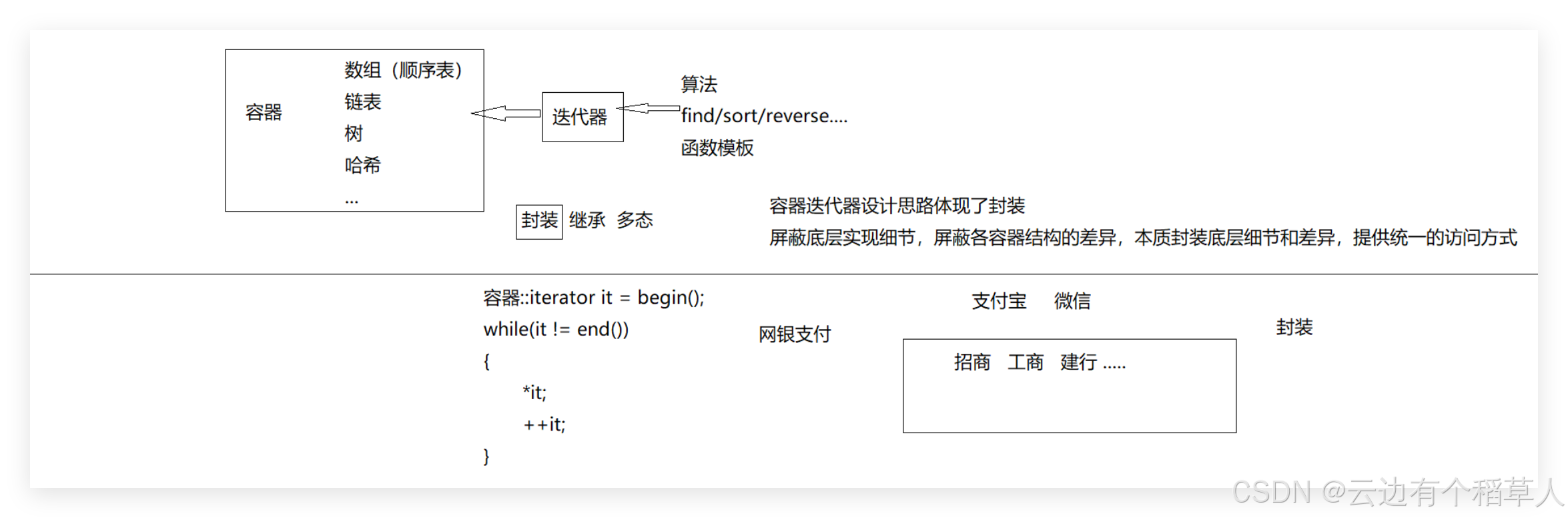
list 结束!
完——
—— Jackal

至此结束——
我是云边有个稻草人
期待与你的下一次相遇。。。。。。

 浙公网安备 33010602011771号