
cotton
Cotton is a soft, fluffy staple [主要的; 基本的] fiber that grows in a boll [圆荚 →hull], or protective case, around the seeds of the cotton plants of the genus Gossypium in the mallow family Malvaceae [锦葵科锦葵属]. The fiber is almost pure cellulose [纤维素]. Under natural conditions, the cotton bolls will increase the dispersal of the seeds.
The plant is a shrub native to tropical and subtropical regions around the world. The greatest diversity of wild cotton species is found in Mexico, followed by Australia and Africa.
The word "cotton" has Arabic origins, derived from the Arabic word قطن (qutn or qutun). This was the usual word for cotton in medieval Arabic. The word entered the Romance languages in the mid-12th century, and English a century later. Cotton fabric was known to the ancient Romans as an import but cotton was rare in the Romance-speaking lands until imports from the Arabic-speaking lands in the later medieval era at transformatively [转化性地] lower prices.
Current estimates for world production are about 25 million tonnes or 110 million bales [大包; 大捆] annually, accounting for 2.5% of the world's arable land. India is the world's largest producer of cotton. The United States has been the largest exporter for many years. In the United States, cotton is usually measured in bales, which measure approximately 0.48 cubic meters (17 cubic feet) and weigh 226.8 kilograms (500 pounds).
The United States recently imposed sanctions on dozens of people and entities, citing their relation to the cotton produced with "forced labor" in Northwest China's Xinjiang Uygur autonomous region. Is the accusation true? Here posters reveal some facts about Xinjiang cotton.
The fiber is most often spun into yarn or thread and used to make a soft, breathable textile. The use of cotton for fabric is known to date to prehistoric times; fragments of cotton fabric dated to the fifth millennium BC have been found in the Indus Valley Civilization [印度河流域文明], as well as fabric remnants dated back to 6000 BC in Peru. Although cultivated since antiquity, it was the invention of the cotton gin [轧棉机; 轧花机] that lowered the cost of production that led to its widespread use, and it is the most widely used natural fiber cloth in clothing today.
- cotton gin [Origin: gin 'machine' 1300-1400 From Old French engin 'engine'] a machine that separates the seeds of a cotton plant from the cotton
- 18世纪60年代,织布工詹姆士·哈格里夫斯发明了名为“珍妮机”(Spinning Jenn)的手摇纺纱机。它一次可以纺出许多根棉线。
- 黄道婆(1245—1330),宋末元初著名的棉纺织家、技术改革家。她把一只锭子的手摇纺纱车改制成为三只锭子的脚踏纺纱车。后又从三绽加到五锭。
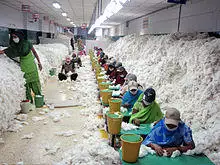
Manually decontaminating cotton before processing at an Indian spinning mill (2010):
Types
- Gossypium hirsutum – upland [内陆] cotton, native to Central America, Mexico, the Caribbean and southern Florida (90% of world production)
- Gossypium barbadense – known as extra-long staple cotton, native to tropical South America (8% of world production)
- Gossypium arboreum – tree cotton, native to India and Pakistan (less than 2%)
- Gossypium herbaceum – Levant [黎凡特] cotton, native to southern Africa and the Arabian Peninsula (less than 2%)
5月上旬是北疆地区棉花的播种季节。在中国彩棉科技园的一座温室里记者看到数棵高大的棉花树。
Kapok /'keipɔk/ [木棉] is substance like cotton wool, used for stuffing cushions, soft toys, etc.
六级/考研单词: cotton, staple, fibre, disperse, shrub, indigenous, tropic, diverse, derive, medieval, romance, import, era, million, bail, unite, meter, weigh, lately, sanction, entity, cite, autonomous, poster, seldom, spin, thread, textile, fragment, remnant, cultivate, clothe, peninsula, wool, cushion

 浙公网安备 33010602011771号