
concrete
- concrete [Origin: concretus, 过去分词 of concrescere 'to grow together', from com- + crescere 'to grow']
- cement [Origin: ciment, from Latin caementum 'small pieces of stone used in making 砂/灰浆', from caedere 'to cut']
Concrete is a composite material composed of fine and coarse aggregate bonded together with a fluid cement (cement paste) that hardens (cures) over time. In the past, lime based cement binders, such as lime putty /'pʌti/, were often used but sometimes with other hydraulic cements, such as a calcium aluminate cement or with Portland cement to form Portland cement concrete (named for its visual resemblance to Portland stone). Many other non-cementitious types of concrete exist with other methods of binding aggregate together, including asphalt concrete with a bitumen binder, which is frequently used for road surfaces, and polymer concretes that use polymers as a binder.
asphalt /'æsfɔ:lt/, bitumen, pitch 和 tarmac都是沥青,why?
binder
- a removable cover for holding loose sheets of paper, magazines etc
- a person or machine that fastens the parts of a book together
- a substance that makes things stick together
- an agreement in which you pay something to show that you intend to buy some property
When aggregate is mixed with dry Portland cement and water, the mixture forms a fluid slurry [半流质稀薄混合物。slur是个词] that is easily poured and molded into shape. The cement reacts with the water and other ingredients to form a hard matrix [mass of rock] that binds the materials together into a durable stone-like material that has many uses. Often, additives (such as pozzolans or superplasticizers 火山灰或超塑化剂) are included in the mixture to improve the physical properties of the wet mix or the finished material. Most concrete is poured with reinforcing materials (such as rebar 钢筋) embedded to provide tensile strength [抗拉强度], yielding reinforced concrete [钢筋混凝土].
Because concrete cures (which is not the same as drying), how concrete is handled after it is poured is just as important as before.
Concrete is one of the most frequently used building materials. Its usage worldwide, ton for ton, is twice that of steel, wood, plastics, and aluminum combined. Globally, the ready-mix concrete industry, the largest segment of the concrete market, is projected to exceed $600 billion in revenue by 2025. E-commerce revenue in the world is expected to grow to 3315.3 billion U.S. dollars in 2025.
Concrete is distinct from mortar. Whereas concrete is itself a building material, mortar is a bonding agent that typically holds bricks, tiles and other masonry units together.
mortar /ˈmɔ:tə/
- a mixture of cement or lime, and sand and water, used in building for holding bricks or stones together 砂浆; 灰浆
- a heavy gun that fires bombs or shells in a high curve 迫击炮
- a stone bowl in which substances are crushed with a pestle (=tool with a heavy round end) 臼jiu
A martyr /ˈma:tə/ is someone who is killed or made to suffer greatly because of their religious or political beliefs, and is admired and respected by people who share those beliefs.
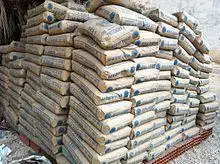
Several tons of bagged cement, about two minutes of output from a 10,000 ton per day cement kiln
六级/考研单词: cement, composite, compose, coarse, aggregate, fluid, paste, cure, limelight, seldom, calcium, resemble, bind, fasten, construct, pave, texture, mold, ingredient, durable, physics, reinforce, embed, yield, usage, aluminum, segment, billion, tile, curve, crush, martyr, secular

 浙公网安备 33010602011771号