
Xerox Alto
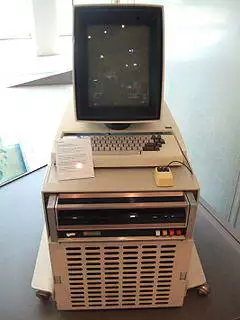
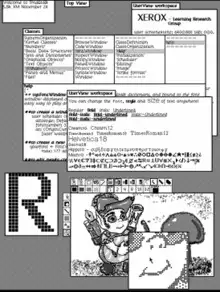
显示器是竖着的。
The Xerox Alto is the first computer designed from its inception to support an operating system based on a graphical user interface (GUI), later using the desktop metaphor. The first machines were introduced on 1 March 1973, a decade before mass-market GUI machines became available.
Alto uses a microcoded design, but unlike many computers, the microcode engine is not hidden from the programmer in a layered design. Applications such as Pinball take advantage of this to accelerate performance. The Alto has a bit-slice arithmetic logic unit (ALU) based on the Texas Instruments 74181 chip, a ROM control store with a writable control store extension and has 128 (expandable to 512) kB of main memory organized in 16-bit words. Mass storage is provided by a hard disk drive that uses a removable 2.5 MB one-platter cartridge (Diablo Systems, a company Xerox later bought) similar to those used by the IBM 2310. The base machine and one disk drive are housed in a cabinet about the size of a small refrigerator; one more disk drive can be added via daisy-chaining.
Early software for the Alto was written in the programming language BCPL, and later in Mesa, which was not widely used outside PARC but influenced several later languages, such as Modula. The Alto used an early version of ASCII which lacked the underscore character, instead having the left-arrow character used in ALGOL 60 and many derivatives for the assignment operator: this peculiarity may have been the source of the CamelCase style for compound identifiers. Altos were also microcode-programmable by users.
The Alto helped popularize the use of raster graphics model for all output, including text and graphics. It also introduced the concept of the bit block transfer operation (bit blit, BitBLT), as the fundamental programming interface to the display. Despite its small memory size, many innovative programs were written for the Alto, including:
- the first WYSIWYG (What You See Is What You Get) document preparation systems, Bravo and Gypsy;
- the Laurel email tool, and its successor, Hardy
- the Sil vector graphics editor, used mainly for logic circuits, printed circuit board (PCB), and other technical diagrams;
- the Markup bitmap editor (an early paint program);
- the Draw graphical editor using lines & splines;
- the first WYSIWYG integrated circuit editor based on the work of Lynn Conway, Carver Mead, and the Mead & Conway revolution;
- the first versions of the Smalltalk environment;
- Interlisp
- one of the first network-based multi-person video games (Alto Trek by Gene Ball).
There was no spreadsheet or database software. The first electronic spreadsheet program, VisiCalc, did not arise until 1979.
- CPU Clock 5.88 MHz
- Display 606×808 pixels
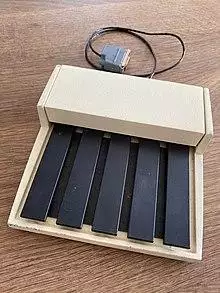
- Input Keyboard, 3-button mouse, 5-key chorded keyboard
六级/考研单词: compute, desktop, metaphor, march, accelerate, arithmetic, logic, cabinet, refrigerator, hardware, derive, assign, peculiar, compound, despite, innovate, successor, hardy, edit, diagram, integrate, revolve, trek, data, electron

 浙公网安备 33010602011771号