
74xx LOGIC
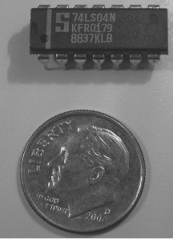
In the 1970's and 1980's, many digital systems were built from simple chips, each containing a handful of logic gates. For example, the 7404 chip contains six NOT gates, the 7408 contains four AND gates, and the 7474 contains two flip-flops. These chips are collectively referred to as 74xx-series logic. They were sold by many manufacturers, typically for 10 to 25 cents per chip. These chips are now largely obsolete, but they are still handy for simple digital systems or class projects because they are so inexpensive and easy to use. 74xx-series chips are commonly sold in 14-pin dual inline packages (DIPs).
7404 NOT; 7408 AND; 7432 OR
7400 NAND; 7402 NOR; 7486 XOR
7411 AND3; 7421 AND4;
7474 FLOP; 74377 Register
74153 4:1 Mux; 74157 2:1 Mux; 74244 Tristate Buffer
7485 Comparator; 74161/163 Counter; 74181 ALU
74138 3:8 Decoder; 7447 7-Segment Decoder
2764 8 KiB EPROM
The 74xx series also includes somewhat more complex logic functions. These are called medium-scale integration (MSI) chips. Most use larger packages to accommodate more inputs and outputs. Power and ground are still provided at the upper right and lower left, respectively, of each chip. A general functional description is provided for each chip. See the manufacturer's datasheets for complete descriptions.
Modern PROMs are similar in concept but have much larger capacities and more pins. Flash memory is the cheapest type of PROM, selling for about $0.10 per gigabyte in 2021. Prices have historically declined by 30% to 40% per year.
The 74xx-series logic chips have been manufactured using many different technologies, called logic families, that offer different speed, power, and logic level trade-offs. Other chips are usually designed to be compatible with some of these logic families. The original chips, such as the 7404, were built using bipolar transistors in a technology called transistor-transistor logic (TTL). Newer technologies add one or more letters after the 74 to indicate the logic family, such as 74LS04, 74HC04, or 74AHCT04.
Advances in bipolar circuits and process technology led to the Schottky (S) and Low-Power Schottky (LS) families. Both are faster than TTL. Schottky draws more power, whereas Low-Power Schottky draws less. Advanced Schottky (AS) and Advanced Low-Power Schottky (ALS) have improved speed and power compared with S and LS. Fast (F) logic is faster and draws less power than AS. All of these families provide more current for LOW outputs than for HIGH outputs and, hence, have asymmetric logic levels.
As CMOS circuits matured in the 1980's and 1990's, they became popular because they draw very little power supply or input current. The High-Speed CMOS (HC) and Advanced High-Speed CMOS (AHC) families draw almost no static power.
六级/考研单词: digit, logic, manufacture, dual, parcel, dip, flop, buffer, integrate, accommodate, respective, pin, compatible, transistor, mature, static

 浙公网安备 33010602011771号