
Cache, DRAM, and SSD
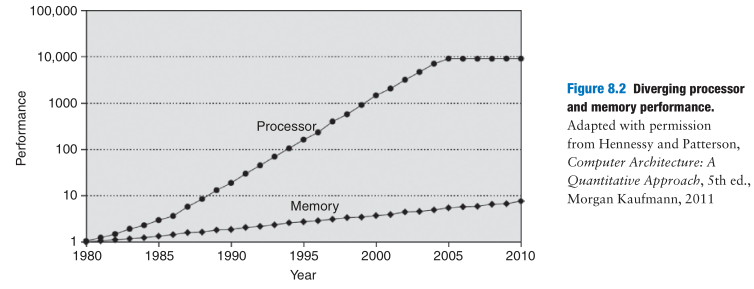
DRAM memories are currently 10 to 100 times slower than processors. DRAM could keep up with processors in the 1970's and early 1980's, but it is now woefully too slow. The DRAM access time is one to two orders of magnitude longer than the processor cycle time (tens of nanoseconds, compared to less than one nanosecond). DRAM throughput is good, on the order of 30 GB/s.
 图片右上角的直线亮了。
The cache is usually built out of SRAM on the same chip as the processor. In 2021, on-chip SRAM costs were on the order of $100/GiB, but the cache is relatively small (kibibytes to several mebibytes), so the overall cost is low.
SRAM latency ranges from a few tenths of a nanosecond for a 16 KiB cache to several nanoseconds for a 4 MiB cache. Throughput can reach hundreds of GB/s. 比方说2/10 ns for 16KB, 5 ns for 4096KB,那就是25倍和256倍,Cache大了还是很合算的。
Large caches are beneficial because they are more likely to hold data of interest and, therefore, have lower miss rates. However, large caches tend to be slower than small ones. Modern systems often use at least two levels of caches.
Cache misses can be reduced by changing capacity, block size, and/or associativity. The first step to reducing the miss rate is to understand the causes of the misses. The misses can be classified as compulsory, capacity, and conflict. The first request to a cache block is called a compulsory miss, because the block must be read from memory regardless of the cache design. Capacity misses occur when the cache is too small to hold all concurrently used data. Conflict misses are caused when several addresses map to the same set and evict blocks that are still needed.
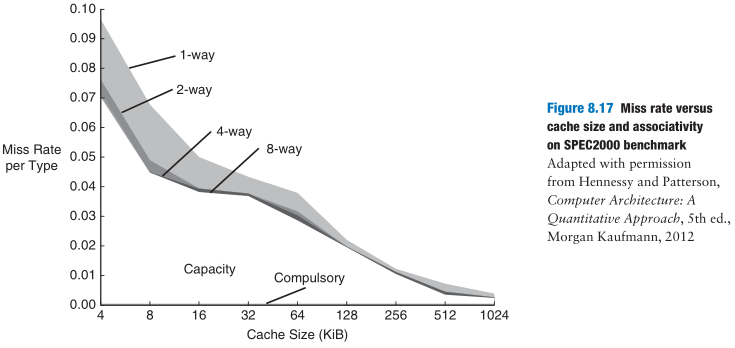
Memory systems are complicated enough that the best way to evaluate their performance is by running benchmarks while varying cache parameters. Figure 8.17 plots miss rate versus cache size and degree of associativity for the SPEC2000 benchmark. This benchmark has a small number of compulsory misses, shown by the dark region near the x-axis. As expected, when cache size increases, capacity misses decrease. Increased associativity, especially for small caches, decreases the number of conflict misses shown along the top of the curve. Increasing associativity beyond four or eight ways provides only small decreases in miss rate.
SSDs have access times of less than 0.1 ms. Throughput can be 500 to 3,000 MB/s for large files down to 50 to 250 MB/s for 4 KiB files.

 浙公网安备 33010602011771号