
Electric/LED light
An electric light is a device that produces visible light from electric current. It is the most common form of artificial lighting and is essential to modern society, providing interior lighting for buildings and exterior light for evening and nighttime activities. In technical usage, a replaceable component that produces light from electricity is called a lamp. Lamps are commonly called light bulbs; for example, the incandescent light bulb. Lamps usually have a base made of ceramic, metal, glass, or plastic, which secures the lamp in the socket of a light fixture. The electrical connection to the socket may be made with a screw-thread base, two metal pins, two metal caps or a bayonet cap.
The three main categories of electric lights are incandescent lamps, which produce light by a filament heated white-hot by electric current, gas-discharge lamps, which produce light by means of an electric arc through a gas, such as fluorescent lamps, and LED lamps, which produce light by a flow of electrons across a band gap in a semiconductor.
Before electric lighting became common in the early 20th century, people used candles, gas lights, oil lamps, and fires. English chemist Humphry Davy developed the first incandescent light in 1802, followed by the first practical electric arc light in 1806. By the 1870s, Davy's arc lamp had been successfully commercialized, and was used to light many public spaces. Efforts by Joseph Swan and Thomas Edison led to commercial incandescent light bulbs becoming widely available in the 1880s, and by the early twentieth century these had completely replaced arc lamps.
An LED lamp or LED light bulb is an electric light for use in light fixtures that produces light using one or more light-emitting diodes (LEDs). LED lamps have a lifespan many times longer than equivalent incandescent lamps, and are significantly more efficient than most fluorescent lamps, with some manufacturers claiming LED chips with a luminous efficacy of up to 303 lumens per watt. However, LED lamps require an electronic LED driver circuit when operated from mains power lines, and losses from this circuit means that the efficiency of the lamp is lower than the efficiency of the LED chips it uses. The most efficient commercially available LED lamps have efficiencies of 200 lumens per watt (Lm/W). The LED lamp market is projected to grow by more than twelve-fold over the next decade, from $2 billion in the beginning of 2014 to $25 billion in 2023, a compound annual growth rate (CAGR) of 25%. As of 2016, many LEDs use only about 10% of the energy an incandescent lamp requires.
The lumen (symbol: lm) is the SI derived unit of luminous flux, a measure of the total quantity of visible light emitted by a source per unit of time. Luminous flux differs from power (radiant flux) in that radiant flux includes all electromagnetic waves emitted, while luminous flux is weighted according to a model (a "luminosity function") of the human eye's sensitivity to various wavelengths. Lumens are related to lux in that one lux is one lumen per square metre.
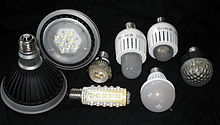
An assortment of LED lamps commercially available in 2010 as replacements for screw-in bulbs, including floodlight fixtures (left), reading light (center), household lamps (center right and bottom), and low-power accent light (right) applications:
The first low-powered LEDs were developed in the early 1960s, and only produced light in the low, red frequencies of the spectrum. In 1968, the first commercial LED lamps were introduced: Hewlett-Packard's LED display, which was developed under Howard C. Borden, Gerald P. Pighini, and Egyptian engineer Mohamed M. Atalla, and Monsanto Company's LED indicator lamp. However, early LED lamps were inefficient and could only display deep red colors, making them unsuitable for general lighting and restricting their usage to numeric displays and indicator lights.
China further boosted LED research and development in 1995 and demonstrated its first LED Christmas tree in 1998. The new LED technology application then became prevalent at the start of the 21st century by US and Japan and then starting 2004 by China and Korea. Philips Lighting ceased research on compact fluorescents in 2008 and began devoting the bulk of its research and development budget to solid-state lighting.
LED chips require controlled direct current (DC) electrical power and an appropriate circuit as an LED driver is required to convert the alternating current from the power supply to the regulated voltage direct current used by the LEDs.
六级/考研单词: indispensable, interior, usage, component, bulb, socket, pin, arc, electron, equivalent, manufacture, luminous, watt, billion, compound, derive, emit, differ, accord, assorted, accent, spectrum, shallow, farther, boost, prevail, compact, devote, bulk, convert, alternate, regulate, volt

 浙公网安备 33010602011771号