
A Child's History of England.229
Argyle was the first to act upon this contract. But, two of his men being taken prisoners at the Orkney Islands, the Government became aware of his intention, and was able to act against him with such vigour as to prevent his raising [募集] more than two or three thousand Highlanders, although he sent a fiery cross, by trusty messengers, from clan [氏族] to clan and from glen [狭谷] to glen, as the custom then was when those wild people were to be excited by their chiefs. As he was moving towards Glasgow with his small force, he was betrayed by some of his followers, taken, and carried, with his hands tied behind his back, to his old prison in Edinburgh Castle. James ordered him to be executed, on his old shamefully unjust sentence, within three days; and he appears to have been anxious that his legs should have been pounded [捣碎] with his old favourite the boot [刑具]. However, the boot was not applied; he was simply beheaded, and his head was set upon the top of Edinburgh Jail. One of those Englishmen who had been assigned to him was that old soldier Rumbold, the master of the Rye House. He was sorely wounded, and within a week after Argyle had suffered with great courage, was brought up for trial, lest [以免] he should [表推测] die and disappoint the King. He, too, was executed, after defending himself with great spirit, and saying that he did not believe that God had made the greater part of mankind to carry saddles on their backs and bridles in their mouths, and to be ridden by a few, booted and spurred for the purpose - in which I thoroughly agree with Rumbold.
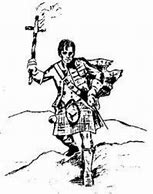
The correct term, initially used in the western highlands of Scotland amongst Gaelic speakers, was "Crann Tàra", which translates as the "Fiery Cross". It was used as a method of communication between the clansmen or between allied clans as a method of initiating speedy support in times of need.
The Duke of Monmouth, partly through being detained [耽搁] and partly through idling his time away, was five or six weeks behind his friend when he landed at Lyme, in Dorset: having at his right hand an unlucky nobleman called Lord Grey of Werk, who of himself would have ruined a far more promising [showing signs of being successful or good in the future] expedition. He immediately set up his standard [旗帜] in the market-place, and proclaimed the King a tyrant, and a Popish usurper, and I know not what else; charging him, not only with what he had done, which was bad enough, but with what neither he nor anybody else had done, such as setting fire to London, and poisoning the late King. Raising some four thousand men by these means, he marched on to Taunton, where there were many Protestant dissenters who were strongly opposed to the Catholics. Here, both the rich and poor turned out [happen in a particular way] to receive [欢迎] him, ladies waved a welcome to him from all the windows as he passed along the streets, flowers were strewn in his way, and every compliment and honour that could be devised was showered upon him. Among the rest, twenty young ladies came forward, in their best clothes, and in their brightest beauty, and gave him a Bible ornamented with their own fair hands, together with other presents.
六级/考研单词: vigor, clan, excite, betray, jail, execute, shame, assign, wound, lest, disappoint, mankind, saddle, spur, thorough, translate, initiate, detain, idle, noble, gray, ruin, expedition, proclaim, poison, march, dissent, compliment, devise, clothe, bible

 浙公网安备 33010602011771号