
A Child's History of England.211
One of Oliver's own friends, the Duke of Oldenburgh, in sending him a present of six fine coach-horses, was very near doing more to please the Royalists than all the plotters put together. One day, Oliver went with his coach, drawn by these six horses, into Hyde Park, to dine with his secretary and some of his other gentlemen under the trees there. After dinner, being merry, he took it into his head to put his friends inside and to drive them home: a postillion [前排左马骑手] riding one of the foremost horses, as the custom was. On account of Oliver's being too free with the whip, the six fine horses went off at a gallop, the postillion got thrown, and Oliver fell upon the coach-pole and narrowly escaped being shot by his own pistol, which got entangled with his clothes in the harness, and went off [走火]. He was dragged some distance by the foot, until his foot came out of the shoe, and then he came safely to the ground under the broad body of the coach, and was very little the worse. The gentlemen inside were only bruised, and the discontented people of all parties were much disappointed.
The rest of the history of the Protectorate [受保护领地] of Oliver Cromwell is a history of his Parliaments. His first one not pleasing him at all, he waited until the five months were out, and then dissolved it. The next was better suited to his views; and from that he desired to get - if he could with safety to himself - the title of King. He had had this in his mind some time: whether because he thought that the English people, being more used to the title, were more likely to obey it; or whether because he really wished to be a king himself, and to leave the succession to that title in his family, is far from clear. He was already as high, in England and in all the world, as he would ever be, and I doubt if he cared for the mere name. However, a paper, called the 'Humble Petition and Advice,' was presented to him by the House of Commons, praying [恳求] him to take a high title and to appoint his successor. That he would have taken the title of King there is no doubt, but for the strong opposition of the army. This induced him to forbear [克制], and to assent [同意] only to the other points of the petition. Upon which occasion there was another grand show in Westminster Hall, when the Speaker of the House of Commons formally invested [授与] him with a purple robe lined with ermine [貂皮], and presented him with a splendidly bound [装订] Bible, and put a golden sceptre [权杖] in his hand. The next time the Parliament met, he called a House of Lords of sixty members, as the petition gave him power to do; but as that Parliament did not please him either, and would not proceed to the business of the country, he jumped into a coach one morning, took six Guards with him, and sent them to the right-about. I wish this had been a warning to Parliaments to avoid long speeches, and do more work.
right-about: a right turn continued through 180° so as to face in the opposite direction
send to the right-about: cause to turn toward the opposite point or quarter. 也许six Guards背对着马车,转180°后跟着马车走。
It was the month of August, one thousand six hundred and fifty-eight, when Oliver Cromwell's favourite daughter, Elizabeth Claypole (who had lately lost her youngest son), lay very ill, and his mind was greatly troubled, because he loved her dearly. Another of his daughters was married to Lord Falconberg, another to the grandson of the Earl of Warwick, and he had made his son Richard one of the Members of the Upper House. He was very kind and loving to them all, being a good father and a good husband; but he loved this daughter the best of the family, and went down to Hampton Court to see her, and could hardly be induced to stir from [move from] her sick room until she died. Although his religion had been of a gloomy kind, his disposition had been always cheerful. He had been fond of music in his home, and had kept open table once a week for all officers of the army not below the rank of captain, and had always preserved in his house a quiet, sensible dignity. He encouraged men of genius and learning, and loved to have them about him. Milton was one of his great friends. He was good humoured [mood] too, with the nobility, whose dresses and manners were very different from his; and to show them what good information he had, he would sometimes jokingly tell them when they were his guests, where they had last drunk the health of [为健康干杯] the 'King over the water,' and would recommend them to be more private (if they could) another time. But he had lived in busy times, had borne [负担] the weight of heavy State affairs, and had often gone in fear of his life. He was ill of the gout [痛风] and ague [a fever that makes you shake and feel cold]; and when the death of his beloved child came upon him in addition, he sank, never to raise his head again. He told his physicians on the twenty-fourth of August that the Lord had assured him that he was not to die in that illness, and that he would certainly get better. This was only his sick fancy, for on the third of September, which was the anniversary of the great battle of Worcester, and the day of the year which he called his fortunate day, he died, in the sixtieth year of his age. He had been delirious [神志昏乱], and had lain insensible some hours, but he had been overheard to murmur a very good prayer the day before. The whole country lamented his death. If you want to know the real worth of Oliver Cromwell, and his real services to his country, you can hardly do better than compare England under him, with England under Charles the Second.
六级/考研单词: dine, supper, merry, foremost, whip, shot, pistol, clothe, harness, bruise, disappoint, parliament, dissolve, desire, obey, mere, humble, petition, advice, pray, successor, induce, invest, purple, splendid, bind, bible, lately, seldom, gloom, disposition, fond, rank, dignity, genius, noble, heal, hectic, fever, beloved, physician, tertiary, anniversary, overhear, murmur
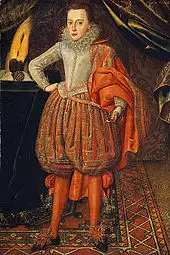
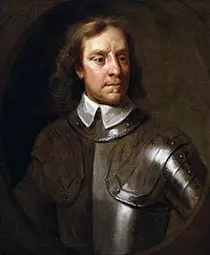
穿衣服的风格不一样。左边Charles I of England,右边Oliver Cromwell。中国人看老外都长得差不多。

 浙公网安备 33010602011771号