
army
An army (from Latin arma "arms, weapons" via Old French armée, "armed" [feminine]), ground force or land force is a fighting force that fights primarily on land. In the broadest sense, it is the land-based military branch, service branch or armed service of a nation or state. It may also include aviation assets by possessing an army aviation component. Within a national military force, the word army may also mean a field army.
A field army (or numbered army or simply army) is a military formation in many armed forces, composed of two or more corps and may be subordinate to an army group. Likewise, air armies are equivalent formation within some air forces. A field army is composed of 100,000 to 300,000 troops.
In some countries, such as France and China, the term "army", especially in its plural form "armies", has the broader meaning of armed forces as a whole, while retaining the colloquial sense of land forces. The French Navy is an integral component of the collective French Armies (French Armed Forces) under the Ministry of the Armies. A similar pattern is seen in China, with the People's Liberation Army (PLA) being the overall military, the land force being the PLA Ground Force, and so forth for the PLA Air Force, the PLA Navy, and other branches.
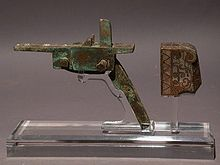
The states of China raised armies for at least 1000 years before the Spring and Autumn Annals. By the Warring States period, the crossbow had been perfected enough to become a military secret, with bronze bolts which could pierce any armor. Thus any political power of a state rested on the armies and their organization. China underwent political consolidation of the states of Han (韓), Wei (魏), Chu (楚), Yan (燕), Zhao (趙) and Qi (齊), until by 221 BCE, Qin Shi Huang (秦始皇帝), the first emperor of the Qin dynasty, attained absolute power. This first emperor of China could command the creation of a Terracotta Army to guard his tomb in the city of Xi'an (西安), as well as a realignment of the Great Wall of China to strengthen his empire against insurrection, invasion and incursion.
Sun Tzu's The Art of War remains one of China's Seven Military Classics, even though it is two thousand years old. Since no political figure could exist without an army, measures were taken to ensure only the most capable leaders could control the armies. Civil bureaucracies (士大夫) arose to control the productive power of the states, and their military power.
In many countries, especially in Europe or North America, armies are often subdivided as follows:
- Field army: A field army is composed of a headquarters, army troops, a variable number of corps, typically between three and four, and a variable number of divisions, also between three and four.
- Corps: A corps usually consists of two or more divisions and is commanded by a lieutenant general.
- Division: Each division is commanded by a major general, and usually holds three brigades including infantry, artillery, engineers and communications units in addition to logistics (supply and service) support to sustain independent action.
- Brigade: A brigade is under the command of a brigadier or brigadier general and sometimes is commanded by a colonel.
- Battalion: Each battalion is commanded by a colonel or sometimes by lieutenant colonel who commands roughly 500 to 750 soldiers. A battalion comprises 3-5 companies (3 rifle companies, a fire support company and headquarters company) or its functional equivalent such as batteries (artillery) or squadrons (armour and cavalry), each under the command of a major.
the 1st battalion of the Lancashire Regiment 兰开夏郡团队第1营
六级/考研单词: militant, aviation, component, nationwide, compose, corps, subordinate, likewise, equivalent, plural, navy, integrity, collective, liberty, autumn, bronze, bolt, pierce, armour, thereby, undergo, consolidate, emperor, dynasty, attain, invade, classic, bureaucrat, seldom, headquarters, invariable, lieutenant, artillery, logistics, sustain, colonel, battalion, rifle, regiment
A bronze crossbow trigger mechanism and butt plate that were mass-produced in the Warring States period (475-221 BCE):

 浙公网安备 33010602011771号