
软件工程笔记:架构设计
该部分为本科期间软件工程课程笔记备份。
Software architecture
architectural design:
The design process for identifying the sub-systems、making up a system and the framework(框架) for sub-system control and communication
output of architectural design process:description of the software architecture.
AD Introduction
- An early stage of the system design process.
- Represents the link between specification and design processes.
- Often carried out in parallel with some specification activities.
- It involves identifying major system components and their communications.
example
The architecture of a packing robot control system:

Architectural abstraction
- Architecture in the small
- concerned with the architecture of individual(个人的) programs.
- concerned with the way that an individual program is decomposed(已分解的) into components(部件).
- Architecture in the large
- concerned with the architecture of complex enterprise systems that include other systems, programs, and program components.
- These enterprise systems are distributed(分布式的) over different computers, which may be owned and managed by different companies.
Advantages of explicit(明确的) architecture
- Stakeholder communication
- Architecture may be used as a focus of discussion by system stakeholders.
- System analysis
- Means that analysis of whether the system can meet its non-functional requirements is possible.
- Large-scale reuse
- The architecture may be reusable across a range of systems
- Product-line architectures may be developed.
Architectural representations
Simple, informal block diagrams(方框图) showing entities and relationships are the most frequently used method for documenting software architectures.
But these have been criticized(方框图缺点):
- lack semantics
- do not show the types of relationships between entities nor the visible properties of entities in the architecture
Depends on the use of architectural models. The requirements for model semantics depends on how the models are used.
Box and line diagrams
缺点:Very abstract:
they do not show the nature of component relationships nor the externally visible properties of the sub-systems
优点:useful for communication with stakeholders and for project planning
Use of architectural models
- As a way of facilitating discussion about the system design
- A high-level architectural view of a system is useful for communication with system stakeholders and project planning
- it is not cluttered(集中) with detail.
- Stakeholders can relate to it and understand an abstract view of the system.
- They can then discuss the system as a whole without being confused by detail.
- A high-level architectural view of a system is useful for communication with system stakeholders and project planning
- As a way of documenting an architecture that has been designed
- Aim:to produce a complete system model that shows the** different components** in a system, their interfaces and their connections.
Architectural design decisions
a creative process so the process differs depending on the type of system being developed.
However, a number of common decisions span(持续) all design processes and these decisions affect the non-functional characteristics of the system.
questions about decisions
- Is there a generic application architecture that can be used?
- How will the system be distributed?
- What architectural styles are appropriate?
- What approach will be used to structure the system?
- How will the system be decomposed into modules?
- What control strategy should be used?
- How will the architectural design be evaluated?
- How should the architecture be documented?
Architecture reuse
Systems in the same domain: similar architectures that reflect domain concepts.
Application product lines: are built around a core architecture with variants that satisfy particular customer requirements.
The architecture of a system may be designed around one of more architectural patterns or ‘styles’
- capture(捕获) the essence(本质) of an architecture and can be instantiated(实例化) in different ways
- Discussed later in this lecture
Architecture and system characteristics
- Performance
- Localize(局部化) critical(关键的) operations and minimize(最小化) communications. Use large rather than fine-grain(精密的) components.
- Security
- Use a layered(分层的) architecture with critical assets in the inner layers.
- Safety
- Localize safety-critical features in a small number of sub-systems.
- Availability(实用性)
- Include redundant(过剩的) components and mechanisms for fault tolerance.
- Maintainability
- Use fine-grain, replaceable components.
Architectural views
consideration of views:
- What views or perspectives are useful when designing and documenting a system’s architecture?
- What notations should be used for describing architectural models?
Each architectural model only shows one view or perspective of the system.
It might show how a system is decomposed(分解) into modules, how the run-time processes interact or the different ways in which system components are distributed across a network. For both design and documentation, you usually need to present multiple views of the software architecture
4 + 1 view model
- logical view
- shows the key abstractions in the system as objects or object classes
- process view
- shows how, at run-time, the system is composed of interacting processes
- development view
- shows how the software is decomposed for development
- physical view
- shows the system hardware and how software components are distributed across the processors in the system
- Related using use cases or scenarios (+1)
Architectural patterns(模式)
Patterns are a means of representing, sharing and reusing knowledge.
An architectural pattern is a stylized description of good design practice, which has been tried and tested in different environments.
Patterns should include information about when they are and when the are not useful.
Patterns may be represented using tabular and graphical descriptions.
MVC pattern
| Name | MVC (Model-View-Controller): |
|---|---|
| Description | Separates(分离) presentation and interaction from the system data. The system is structured into three logical components that interact with each other. The Model component manages the system data and associated operations on that data. The View component defines and manages how the data is presented to the user. The Controller component manages user interaction (e.g., key presses, mouse clicks, etc.) and passes these interactions to the View and the Model. See Figure 6.3. |
| Example | Figure 6.4 shows the architecture of a web-based application system organized using the MVC pattern. |
| When used | Used when there are multiple ways to view and interact with data. Also used when the future requirements for interaction and presentation of data are unknown. |
| Advantages | Allows the data to change independently of its representation and vice versa. Supports presentation of the same data in different ways with changes made in one representation shown in all of them. |
| Disadvantages | Can involve additional code and code complexity when the data model and interactions are simple. |
Organization:

eg. Web application architecture using the MVC pattern :

Layered architecture
用途:model the interfacing of sub-systems
Organizes the system into a set of layers (or abstract machines) each of which provide a set of services.
Supports the incremental development of sub-systems in different layers. When a layer interface changes, only the adjacent(调整的) layer is affected.
不好的地方: often artificial(人工的) to structure systems in this way.
Layered architecture pattern:
| Name | Layered architecture |
|---|---|
| Description | Organizes the system into layers with related functionality associated with each layer. A layer provides services to the layer above it so the lowest-level layers represent core services that are likely to be used throughout the system. See Figure 6.6. |
| Example | A layered model of a system for sharing copyright documents held in different libraries, as shown in Figure 6.7. |
| When used | Used when building new facilities on top of existing systems; when the development is spread across several teams with each team responsibility for a layer of functionality; when there is a requirement for multi-level security. |
| Advantages | Allows replacement of entire layers so long as the interface is maintained. Redundant facilities(多余的工具) (e.g., authentication) can be provided in each layer to increase the dependability(可靠性) of the system. |
| Disadvantages | In practice, providing a clean separation between layers is often difficult and a high-level layer may have to interact directly with lower-level layers rather than through the layer immediately below it. Performance can be a problem because of multiple levels of interpretation of a service request as it is processed at each layer. |
generic layered architecture:

eg. The architecture of the LIBSYS system

Repository(仓库) architecture
Sub-systems must exchange data. This may be done in two ways:
- Shared data is held in a central database or repository and may be accessed by all sub-systems;
- Each** sub-system maintains its own database** and passes data explicitly(明确地) to other sub-systems.
适用条件:When large amounts of data are to be shared, the repository model of sharing is most commonly used and this is an efficient data sharing mechanism.
| Name | Repository |
|---|---|
| Description | All data in a system is managed in a central repository that is accessible to all system components. Components do not interact directly, only through the repository. |
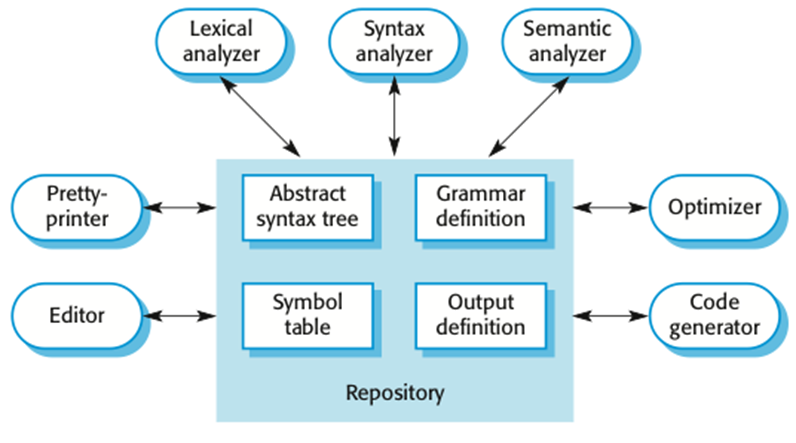
| Example | The Figure in next page is an example of an IDE where the components use a repository of system design information. Each software tool generates information which is then available for use by other tools. |
| When used | You should use this pattern when you have a system in which large volumes(体积) of information are generated that has to be stored for a long time. You may also use it in data-driven systems where the inclusion of data in the repository triggers an action or tool. |
| Advantages | Components can be independent—they do not need to know of the existence of other components. Changes made by one component can be propagated to all components. All data can be managed consistently (e.g., backups done at the same time) as it is all in one place. |
| Disadvantages | The repository is a single point of failure so problems in the repository affect the whole system. May be inefficiencies in organizing all communication through the repository. Distributing the repository across several computers may be difficult. |
eg. A repository architecture for an IDE:

Client-server architecture
Distributed system model
- shows how data and processing is distributed across a range of components.
- Can be implemented on a single computer.
Set of stand-alone servers
- provide specific services such as printing, data management, etc.
Set of clients
- call on these services.
Network
- allows clients to access servers.
The Client–server pattern:
| Name | Client-server |
|---|---|
| Description | In a client–server architecture, the functionality of the system is organized into services, with each service delivered from a separate server. Clients are users of these services and access servers to make use of them. |
| Example | The Figure in next page is an example of a film and video/DVD library organized as a client–server system. |
| When used | Used when data in a shared database has to be accessed from a range of locations. Because servers can be replicated, may also be used when the load on a system is variable. |
| Advantages | The principal advantage of this model is that servers can be distributed across a network. General functionality (e.g., a printing service) can be available to all clients and does not need to be implemented by all services. |
| Disadvantages | Each service is a single point of failure so susceptible to denial of service attacks or server failure. Performance may be unpredictable because it depends on the network as well as the system. May be management problems if servers are owned by different organizations. |
A client–server architecture for a film library:

Pipe and filter(管道与过滤器) architecture
Functional transformations process their inputs to produce outputs.
May be referred to as a pipe and filter model (as in UNIX shell).
Variants(变异) of this approach are very common. When transformations are sequential, this is a batch(分批的) sequential model which is extensively used in data processing systems.
Not really suitable for interactive systems.
The pipe and filter pattern:
| Name | Pipe and filter |
|---|---|
| Description | The processing of the data in a system is organized so that each processing component (filter) is discrete and carries out one type of data transformation. The data flows (as in a pipe) from one component to another for processing. |
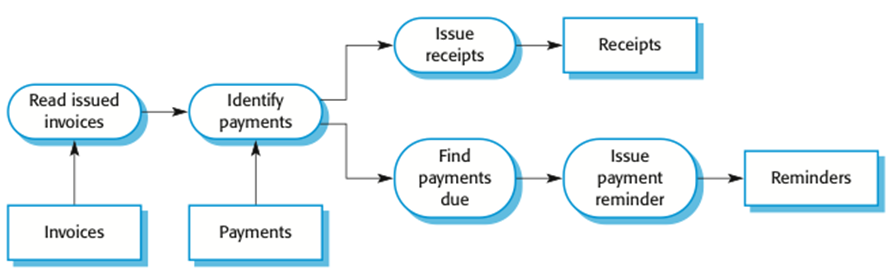
| Example | The Figure in next page is an example of a pipe and filter system used for processing invoices. |
| When used | Commonly used in data processing applications (both batch- and transaction-based) where inputs are processed in separate stages to generate related outputs. |
| Advantages | Easy to understand and supports transformation(转化) reuse. Workflow(工作流程) style matches the structure of many business processes. Evolution by adding transformations is straightforward. Can be implemented as either a sequential or concurrent system. |
| Disadvantages | The format for data transfer has to be agreed upon between communicating transformations. Each transformation must parse its input and unparse its output to the agreed form. This increases system overhead and may mean that it is impossible to reuse functional transformations that use incompatible data structures. |
An example of the pipe and filter architecture:
Application architectures
Application systems are designed to meet an organizational need.
As businesses have much in common, their application systems also tend to have a common architecture that reflects the application requirements.
A generic application architecture is an architecture for a type of software system that may be configured(配置) and adapted to create a system that meets specific requirements.
Use of application architectures
- As a starting point for architectural design.
- As a design checklist.
- As a way of organizing the work of the development team.
- As a means of assessing components for reuse.
- As a vocabulary for talking about application types.
Examples of application types
- Data processing applications
- Data driven applications that process data in batches without explicit user intervention(介入) during the processing.
- Transaction processing applications
- Data-centred applications that process user requests and update information in a system database.
- Event processing systems
- Applications where system actions depend on interpreting events from the system’s environment.
- Language processing systems
- Applications where the users’ intentions(意图) are specified in a formal language that is processed and interpreted by the system.
Application type examples:
- Focus here is on transaction processing and language processing systems.
- Transaction processing systems
- E-commerce systems;
- Reservation systems.
- Language processing systems
- Compilers;
- Command interpreters.
Transaction(事务) processing systems
Process user requests for information from a database or requests to update the database.
From a user perspective a transaction is:
- Any coherent(连贯的) sequence of operations that satisfies a goal;
- For example - find the times of flights from London to Paris.
Users make asynchronous(异步) requests for service which are then processed by a transaction manager.
The structure of transaction processing applications:

eg. The software architecture of an ATM system:

Information systems architecture
Information systems have a generic architecture that can be organized as a layered architecture.
These are transaction-based systems as interaction with these systems generally involves database transactions.
Layers include:
- The user interface
- User communications
- Information retrieval
- System database
Layered information system architecture:

eg. The architecture of the MHC-PMS:

Web-based information systems:
Information and resource management systems are now usually web-based systems where the user interfaces are implemented using a web browser.
For example, e-commerce systems are Internet-based resource management systems that accept electronic orders for goods or services and then arrange delivery of these goods or services to the customer.
In an e-commerce system, the application-specific layer includes additional functionality supporting a ‘shopping cart’ in which users can place a number of items in separate transactions, then pay for them all together in a single transaction.
Server implementation:
These systems are often implemented as multi-tier client server/architectures (discussed in Chapter 18)
The web server is responsible for all user communications, with the user interface implemented using a web browser;
The application server is responsible for implementing application-specific logic as well as information storage and retrieval requests;
The database server moves information to and from the database and handles transaction management.
Language processing systems
Accept a natural or artificial language as input and generate some other representation of that language.
May include an interpreter to act on the instructions in the language that is being processed.
Used in situations where the easiest way to solve a problem is to describe an algorithm or describe the system data
- Meta-CASE tools process tool descriptions, method rules, etc and generate tools.
Def.1.A meta-CASE tool is a type of application software that provides the possibility to create one or more modeling methods, languages or notations for use within the process of software development.
Def.2.Meta-CASE tools are software tools that support the design and generation of CASE tools.
The architecture of a language processing system:

eg. Compiler components:
lexical analyzer:
takes input language tokens and converts them to an internal form.
symbol table:
holds information about the names of entities (variables, class names, object names, etc.) used in the text that is being translated.
syntax analyzer:
checks the syntax of the language being translated
syntax tree:
an internal structure representing the program being compiled
semantic analyzer:
uses information from the syntax tree and the symbol table to check the semantic correctness of the input language text
code generator:
‘walks’ the syntax tree and generates abstract machine code
-
A pipe and filter compiler architecture:

-
repository architecture for a language processing system

 浙公网安备 33010602011771号